Inside a former bicycle factory in Berlin’s Charlottenburg district, Paul Tinnappel and Benjamin Metz, of TINNAPPELMETZ, crafted a loft for an abstract painter who wanted a space where he could live and entertain among his canvases.
The designers converted the original three-bedroom layout into an open cooking, dining and living area, with a single, expansive sleeping suite. What was once the smallest bedroom now functions as both a gallery and a boxing gym. “We wanted to create a very warm and muted, no-fuzz environment,” says Tinnappel.
In the living room, a vintage LC4 chaise longue by Le Corbusier, Pierre Jeanneret and Charlotte Perriand reclines opposite a D4 folding chair by Marcel Breuer for Tecta, together presenting a study in early-modernist steel and leather.
A tray table and bench from TINNAPPELMETZ’s own line join the conversation, under a painting by the late Michael Rauthenberg Fischer.
“As we used many of our own designs, we wanted to add something that nods to modernism, which inspires us,” Tinnappel says of the configuration. “We thought that using the LC4 would be cool, since it was kind of lost in the last decade or more, after it had been overused before. It’s a great piece by great designers. Very comfortable and chic.”

This colorful dining nook in a townhouse in New York City’s West Village, designed by Ingrao Inc., may look laid-back, but its components are anything but casual.
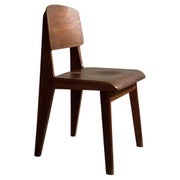
Six mint-green Jean Prouvé Standard chairs gather around a contemporary slab table, while above, a 1950s Model A5011 pendant by Gaetano Sciolari for Stilnovo dangles from the bespoke wood-paneled ceiling. Yayoi Kusama’s vibrant and primal canvas Brilliance of Life (2013) presides over it all.
The effortlessness of the scene reflects Tony Ingrao’s broader approach to design.
“My secret of success is to not take it all too seriously,” says Ingrao, who leads the large firm with his partner, Randy Kemper. Taking on projects that often encompass both architecture and interior design, the studio treats each as an opportunity to blur categories.
“Our design vocabulary is very expansive and isn’t limited to one look,” Ingrao notes. “We come up with custom interiors for custom people — and have fun along the way.”

In a six-story house on Manhattan’s Upper East Side, Carlos Garciavelez and David Lawrence, of the firm CARLOS DAVID, assembled a living room from objects spanning continents and centuries, placed shoulder to shoulder.
This tightly composed corner features a 1950s Marco Zanuso Lady armchair, upholstered in a Pierre Frey wool bouclé and Holland & Sherry leather, sourced from Karl Kemp Antiques. This is paired with an early-17th-century Flemish cabinet made of ebonized oak inlaid with bone and tortoiseshell, which is crowned with a duo of 18th-century Chinese blue-and-white porcelain vases, both from Newel. The Baccarat crystal ball on a 2014 bronze-and-African-granite M’Benga side table by Franck Evennou, from Maison Gerard, adds a moment of mystique.
The mix, Lawrence explains, was intended “to create an elevated room that felt vibrant and fresh, not old and stuffy.” He points to the endurance of modernist classics as part of their appeal.
“Zanuso, like many of the other mid-century modern design masters, created pieces with iconic shapes that have stood the test of time,” he says. “The quality of these pieces is also excellent. This chair is easily 50-plus years old and still feels like new. Many ‘new’ furniture pieces can’t say the same.”

Tina Ramchandani gave a minimalist, all-white update to a kitchen in rural Stone Ridge, New York. Paneled appliances and retractable doors that conceal a coffee station and microwave keep everything clean-lined and open. New shelving beneath the stairs puts the homeowners’ cookbook collection on display and within reach.
In the nearby dining area, the designer opted for a homier approach, surrounding the contemporary farm table with two mid-century modern classics: Eero Saarinen’s 1957 Tulip armchairs — updated with charcoal upholstery on the seat cushions — and Harry Bertoia’s 1952 wire side chairs, whose open grid frames allow air and light to pass through.
The goal, Ramchandani explains on her website, was to “seamlessly integrate custom storage solutions and meticulous details while infusing the space with a bright, fresh aesthetic.”

In a downtown Austin home, MK Workshop transformed the stair landing into a comfortable lounge. Custom oak and powder-coated-steel shelving and a curved window seat were designed specifically for the nook.
“This was a fairly small and awkward ‘flex space’ on a large stair landing that features a huge panorama window with an amazing view of Downtown Austin. It was just calling for a window seat,” says Petra McKenzie, cofounder of MK Workshop. “We reimagined this area as a cool space to retreat and read a book or to sit and chat while enjoying the view before going to bed.”
The designers introduced a mix of vintage and contemporary furnishings to complete the scene. Providing curvy counterpoints to the boxy shelves are a Hans J. Wegner for Carl Hansen & Søn Shell chair and a Blueprint Lighting Tulle sconce, seconded by an Arteriors Serafina side table sporting psychedelic swirls, a black-and-white wool shag rug from the studio’s own collection and art by Jen Du.
“We were looking for a lounge chair that could stand alone as a centerpiece,” McKenzie says of her choice of the Shell seat, “a sculptural statement piece that would feel light, to avoid overwhelming the small space, and be comfortable and not too dainty at the same time.”

When Billy Cotton first stepped into his client’s Brooklyn townhome, he could almost hear his voice echo off the walls. The owner was living there with her husband and children, but “there was no furniture,” the designer recalls. “She said, ‘I love the house empty, and I’m petrified to put anything in it.’ Which I can understand.”
Rather than rush to fill the interiors, Cotton introduced a few custom pieces, beginning with a Pick-Up Stick chandelier in the kitchen, followed by a rectilinear dining table from his Joinery Collection, the brass connectors that fasten the top to the legs introducing a subtle flair.
Next came a few select vintage pieces. A pair of Jacques Dumond modern sconces play well with a black mobile sculpture hanging over the table, which is encircled by Gio Ponti’s Leggera chairs for Cassina, their famously lean silhouettes preserving the airiness the client craves.
“My goal,” Cotton says, “was to make sure that the spirit of the empty house remained after we put in furniture.”

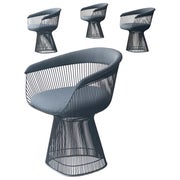
In the kitchen of a mid-century house in Los Angeles’s famed Trousdale Estates, Andrew Torrey arranged a Warren Platner wire dining table and armchairs, found on 1stDibs, directly in front of a window overlooking the downtown skyline.
The house belongs to a European couple with an eye for statement pieces. “They love pops of bold color and strong lines in the furniture and wanted a contemporary version of a true Trousdale-style home,” the designer explains.
For Torrey, whose work spans continents, sourcing rare furniture from 1stDibs is integral to his process. The website, he says, “makes it very easy to be an international designer. I can shop the galleries in Paris, Italy and Berlin. It enables me to pull in the best antiques and vintage pieces without actually getting on a plane.”

Portuguese designers Jacques Bec and Artur Miranda, of Oitoemponto, devised both the architecture and the interiors of a sprawling family villa set in the countryside outside Porto.
The living room is organized around an oversize chimney clad in copper tiles that look like ceramic from a distance. “They’re deceptive,” Miranda says. “It’s only when you get up close that you realize what they are.”
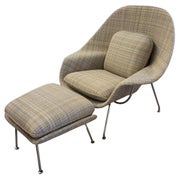
Across the room, a bolder version of the fireplace’s burnished tone appears in the upholstery of three Eero Saarinen Womb chairs and ottomans. These sit comfortably among other mid-century standouts, including a set of four Axel Larsson armchairs around an Aldo Tura games table, not to mention a de Sede DS-600 sofa and a Finn Juhl for Baker Furniture cocktail table.
Adjacent to the fireplace is a more recent creation, Shinique Smith’s expressive canvas And The World Don’t Stop, 2009. The ensemble is grounded by a custom hand-tufted rug embossed with a Tibetan-inspired pattern, conceived, as Bec puts it, as “a large, stylized cloud, which helps to bring calm and snugness to the space.”
Deploying well-known furniture designs keeps the medley in check, Miranda explains: “It’s good to have items that are more familiar. They prevent things from becoming too eclectic.”

In a Lower Manhattan apartment designed by Jessica Schuster for an art-obsessed single father and his daughter, the living room serves as a flexible gathering space.
Much of the home’s artwork was curated by Vito Schnabel, a friend of both the homeowner and Schuster. The designer responded with a diverse layering of new, custom and vintage furnishings.
In one corner of the room, a folding steel-and-lacquer dining table is paired with a set of LC7 armchairs by Charlotte Perriand for Cassina, their tubular frames lending mid-century rigor to the freewheeling interior. “I really like to mix things up. I just don’t think there are any rules in design, and I try to live by that,” Schuster says. “I think you could have a mid-century modern chair next to an Art Deco table, if it was the right combination of the two.”