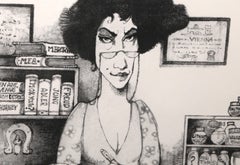
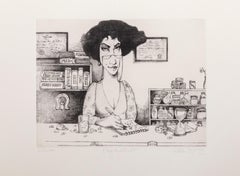
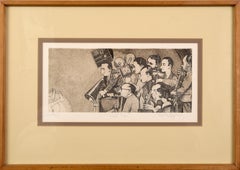
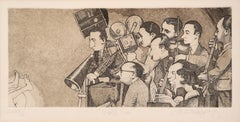
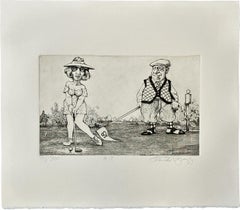
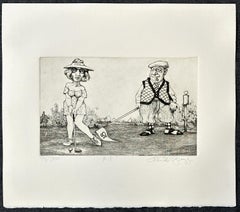
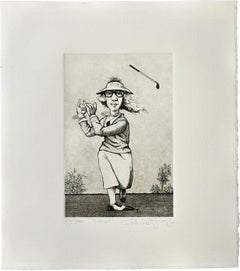
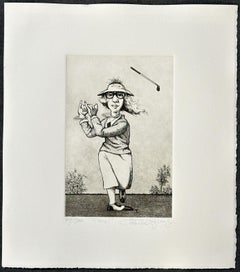
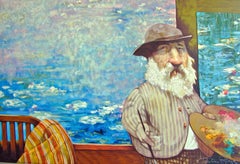
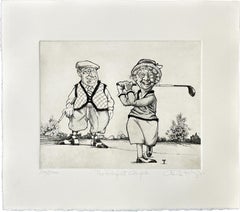
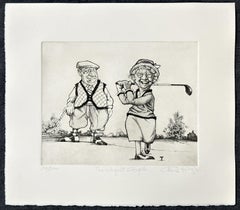
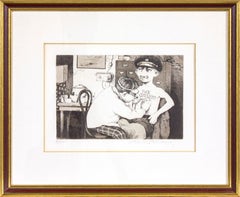
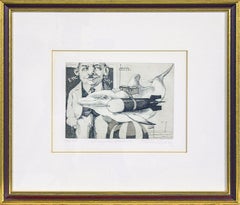
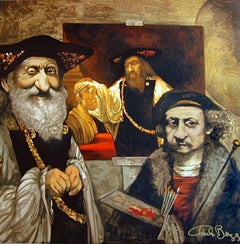
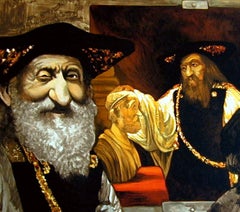
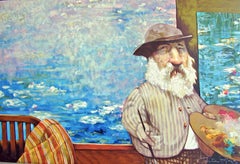
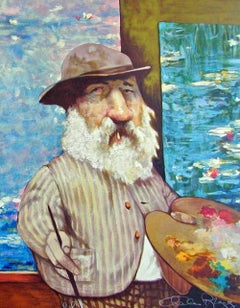
Charles Bragg Signed Prints For Sale on 1stDibs
There is a broad range of charles bragg signed prints for sale on 1stDibs. Finding the perfect
contemporary,
Expressionist or
Impressionist examples of these works for your space is difficult — today, we have a vast range of variations and more on offer. If you’re looking to add charles bragg signed prints that pop against an otherwise neutral space in your home, the works available on 1stDibs include that feature elements of
gray,
black,
beige,
white and more. The range of these distinct pieces — often created in
etching,
paper and
lithograph — can elevate any room of your home. Large charles bragg signed prints can be an attractive addition to some spaces, while the smaller iterations available — each spanning 10 inches in width — may make for a better choice for a more modest living area.
How Much are Charles Bragg Signed Prints?
Prices for art of this kind can differ depending upon size, time period and other attributes — charles bragg signed prints in our inventory begin at $100 and can go as high as $1,000, while the average can fetch as much as $280.
Charles Bragg for sale on 1stDibs
Charles Bragg, born in 1931 in St. Louis, Missouri, was an American artist, author and one of the art world’s best-known satirists. His works often featured celebrities or ordinary people depicted in a humorous—and sometimes macabre fashion—across his sculptures, stories, prints, and paintings. “You observe the human race and the world, and, if you don't get a kick out of it. I think you're missing something,” Bragg once mused. Bragg attended the High School of Music and Art in Harlem before moving to California. His early visual art stemmed from commissioned portraits, and, over time, he began to inject his own political views in sharp satires of society at large, which brought him acclaim and critical success. He was the recipient of numerous honors, notably including the Gold Medal from the National Society of Illustrators as well as the Award of Merit from the Art Directors Guild of New York. Today, his works can be found in the collections of the Pushkin Museum in Moscow; the Albrecht Museum of Art in St. Joseph, Missouri; the Loch Haven Art Center in Orlando, and the Stedelijk Museum in Amsterdam, among others. Bragg died on January 9, 2017 at the age of 85.
Finding the Right Figurative-prints-works-on-paper for You
Bring energy and an array of welcome colors and textures into your space by decorating with figurative fine-art prints and works on paper.
Figurative art stands in contrast to abstract art, which is more expressive than representational. The oldest-known work of figurative art is a figurative painting — specifically, a rock painting of an animal made over 40,000 years ago in Borneo. This remnant of a remote past has long faded, but its depiction of a cattle-like creature in elegant ocher markings endures.
Since then, figurative art has evolved significantly as it continues to represent the world, including a breadth of works on paper, including printmaking. This includes woodcuts, which are a type of relief print with perennial popularity among collectors. The artist carves into a block and applies ink to the raised surface, which is then pressed onto paper. There are also planographic prints, which use metal plates, stones or other flat surfaces as their base. The artist will often draw on the surface with grease crayon and then apply ink to those markings. Lithographs are a common version of planographic prints.
Figurative art printmaking was especially popular during the height of the Pop art movement, and this kind of work can be seen in artist Andy Warhol’s extensive use of photographic silkscreen printing. Everyday objects, logos and scenes were given a unique twist, whether in the style of a comic strip or in the use of neon colors.
Explore an impressive collection of figurative art prints for sale on 1stDibs and read about how to arrange your wall art.