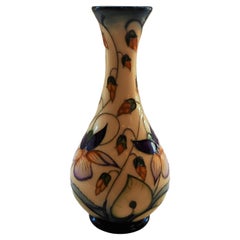
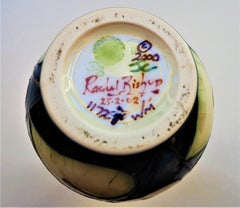
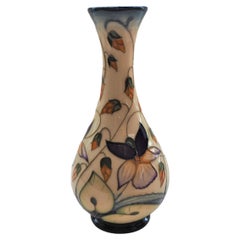
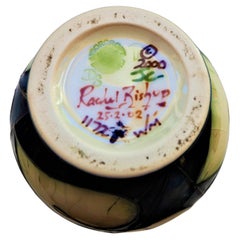
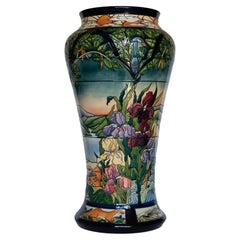
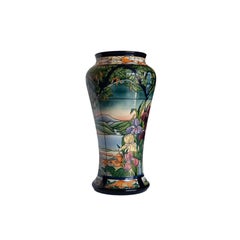
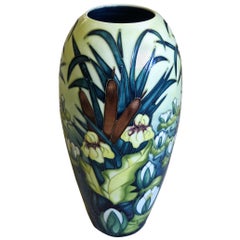
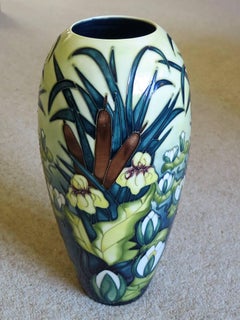
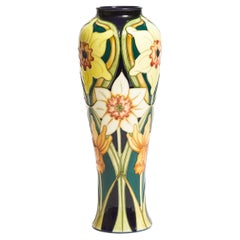
Find many varieties of an authentic piece of moorcroft rachel bishop pottery available at 1stDibs. An item from our selection of moorcroft rachel bishop pottery — often made from
ceramic and
pottery — can elevate any home. There are many kinds of the choice in our collection of moorcroft rachel bishop pottery you’re looking for, from those produced as long ago as the 20th Century to those made as recently as the 21st Century. Each object in our assortment of moorcroft rachel bishop pottery bearing
Art Nouveau,
Arts and Crafts or
Art Deco hallmarks is very popular. Many designers have produced at least one well-made option in this array of moorcroft rachel bishop pottery over the years, but those crafted by
Moorcroft Pottery and
William Moorcroft are often thought to be among the most beautiful.
William Moorcroft (1872–1945), the founder of the celebrated British art-pottery company that shares his last name, was both an aesthete and a technical innovator. Along with William de Morgan, he is regarded as one of the greatest ceramists of the Arts and Crafts movement, yet Moorcroft’s singular style is heavily inflected with the lush naturalism of the Art Nouveau school of art and design.
The son of a decorative pottery painter, Moorcroft was born in Staffordshire, the center of English ceramics-making, studied at the Wedgwood Institute and in 1897 joined the local pottery manufacturer James Macintyre & Co. as a designer. After a year, he was put in charge of the company’s art-pottery studio, and there he developed a new style of wares named “Florian,” made with a technique called tube-lining, or slip-trailing. In this method, decorative motifs are outlined with a thin, raised border produced by piping a thread of clay onto the body of a vessel — much like squeezing toothpaste from a tube.
Moorcroft, who took the unusual step of signing his ceramics, would go on to win numerous international awards. In 1913, backed by the London department store Liberty & Co., he left Macintyre to open his own workshop. Queen Mary, wife of King George V, gave Moorcroft her Royal Warrant in 1928. Shortly before he died in 1945, his son, Walter Moorcroft (1917–2002), took over as head of the firm. The pottery company is still in business in Staffordshire, with a design department headed by Rachel Bishop.
William Moorcroft’s ceramics are noted for their colorful, ebullient (and often slightly surreal) decorations depicting stylized natural forms — flowers, toadstools, fruit (pomegranate is a favorite among collectors), insects and landscapes. Most Moorcroft wares are finished with a glossy overglaze. Blue-and-white and pastel shades were generally used as underglazes on early Moorcroft pieces, and he later developed a rich, ruddy background glaze he called “flambé.”
Moorcroft art pottery has a rich, warm and inviting look — a comforting aesthetic that explains their enduring appeal.
Find antique and vintage Moorcroft pottery, vases, serveware and more on 1stDibs.
Whether it’s a Chinese Han dynasty glazed ceramic wine vessel, a work of Murano glass or a hand-painted Scandinavian modern stoneware piece, a fine vase brings a piece of history into your space as much as it adds a sophisticated dynamic.
Like sculptures or paintings, antique and vintage vases are considered works of fine art. Once offered as tributes to ancient rulers, vases continue to be gifted to heads of state today. Over time, decorative porcelain vases have become family heirlooms to be displayed prominently in our homes — loved pieces treasured from generation to generation.
The functional value of vases is well known. They were traditionally utilized as vessels for carrying dry goods or liquids, so some have handles and feature an opening at the top (where they flare back out). While artists have explored wildly sculptural alternatives over time, the most conventional vase shape is characterized by a bulbous base and a body with shoulders where the form curves inward.
Owing to their intrinsic functionality, vases are quite possibly versatile in ways few other art forms can match. They’re typically taller than they are wide. Some have a neck that offers height and is ideal for the stems of cut flowers. To pair with your mid-century modern decor, the right vase will be an elegant receptacle for leafy snake plants on your teak dining table, or, in the case of welcoming guests on your doorstep, a large ceramic floor vase for long tree branches or sticks — perhaps one crafted in the Art Nouveau style — works wonders.
Interior designers include vases of every type, size and style in their projects — be the canvas indoors or outdoors — often introducing a splash of color and a range of textures to an entryway or merely calling attention to nature’s asymmetries by bringing more organically shaped decorative objects into a home.
On 1stDibs, you can browse our collection of vases by material, including ceramic, glass, porcelain and more. Sizes range from tiny bud vases to massive statement pieces and every size in between.