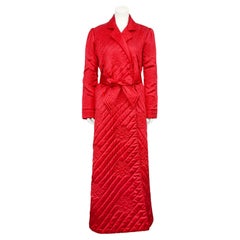
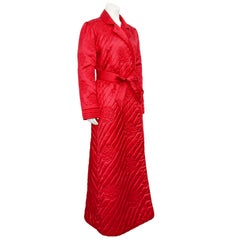
1980s Christian Dior Red Quilted Lounge Robe
By Christian Dior
Located in Toronto, Ontario
Fabulous Christian Dior red lounge robe from the 1980s. Diagonally quilted with large quilted lotus
Category
1980s Christian Dior Red Quilted Lounge Robe
By Christian Dior
Located in Toronto, Ontario
Fabulous Christian Dior red lounge robe from the 1980s. Diagonally quilted with large quilted lotus
When Christian Dior launched his couture house, in 1946, he wanted nothing less than to make “an elegant woman more beautiful and a beautiful woman more elegant.” He succeeded, and in doing so the visionary designer altered the landscape of 20th century fashion. Vintage Dior bags, shoes, evening dresses, shirts and other garments and accessories are known today for their feminine and sophisticated sensibility.
Dior was born in Granville, on the Normandy coast, in 1905. His prosperous haute bourgeois parents wanted him to become a diplomat despite his interest in art and architecture. However, they agreed to bankroll an art gallery, which Dior opened in 1928 in Paris with a friend.
This was the start of Dior’s rise in the city’s creative milieu, where he befriended Pablo Picasso and Jean Cocteau. After seven years as an art dealer, Dior retrained as a fashion illustrator, eventually landing a job as a fashion designer for Robert Piguet, and in 1941, following a year of military service, he joined the house of Lucien Lelong. Just five years later, with the backing of industrialist Marcel Boussac, the ascendant Dior established his own fashion house, at 30 avenue Montaigne in Paris.
Just two years after the end of World War II, the fashion crowd and the moribund haute couture industry were yearning, comme tout Paris, for security and prosperity, desperate to discard the drab, sexless, utilitarian garb imposed by wartime deprivation. They needed to dream anew.
And Dior delivered: He designed a collection for a bright, optimistic future. “It’s quite a revolution, dear Christian!” exclaimed Carmel Snow, the prescient American editor-in-chief of Harper’s Bazaar, famously proclaiming, “Your dresses have such a new look.” The press ran with the description, christening Dior’s debut Spring/Summer haute couture collection the New Look. “God help those who bought before they saw Dior,” said Snow. “This changes everything.”
Dior’s collection definitively declared that opulence, luxury and femininity were in. His skirts could have 40-meter-circumference hems, and outfits could weigh up to 60 pounds. They were cut and shaped like architecture, on strong foundations that molded women and “freed them from nature,” Dior said. Rather than rationing, his ladies wanted reams of fabric and 19-inch waists enforced by wire corsets, and the fashion world concurred. The debut got a standing ovation.
In the subsequent decade, Paris ruled as the undisputed fashion capital of the world, and Christian Dior reigned as its king. With the luxuriously full skirts of his New Look, suits and his drop-dead gorgeous couture dresses and ball gowns worthy of any princess, Dior gave women the gift of glamour they’d lost in the miserable years of war.
On 1stDibs, find an exquisite range of vintage Christian Dior clothing, jewelry, handbags and other items.
As the most intimate layer of clothing, lingerie has evolved over time from an object of modesty to one of sensuality. Some vintage and designer lingerie includes garments and accessories that are hard, such as corsets and structured bras, while other items are soft to the touch, including nightgowns and slips.
In the 18th century, European women commonly wore whalebone corsets to create the look of an hourglass figure. Corsets were a standard part of women’s fashion into the 19th century. In 1914, Caresse Crosby filed a patent for the first modern bra, made by sewing two handkerchiefs together with ribbon ties. By the 1920s, the corset fell out of fashion in North America and Europe, and loose silhouettes and silky slips became mainstream.
As fashion returned to feminine forms in the 1930s, so did lingerie, with girdles and minimal bras. During World War II, bras were adapted to the rationing of materials like nylon and metal. In the postwar era, women had more lingerie choices than ever before, with inventions including the strapless bra.
In the 1950s, lingerie became more glamorous, matching the trends led by legendary French couturier Christian Dior and his “New Look,” a collection that introduced a new feminine silhouette of extravagant elegance upon its postwar debut. Just as the evolution of women’s swimwear over time reflected changing aesthetic taste as well as social upheaval, shifts in the design of lingerie owed to changing perspectives toward sex and style trends. Mid-century pinup models like Bettie Page transformed the undergarments market forever with a new desire for sexy lingerie. It would lead to the founding of Victoria’s Secret by Roy and Gaye Raymond in 1977.
In the late 1980s, performers like Madonna and Selena wore bustiers as outerwear, a trend that continued through the 1990s and early 2000s. With the broadcasting of the Victoria's Secret fashion show beginning in 1995, everyday style also changed. Lingerie was no longer expected to be hidden away.
On 1stDibs, find a range of alluring vintage and designer lingerie, including black bodysuits, black bralettes, corsets and more by designers such as Vivienne Westwood, Azzedine Alaïa and Versace.