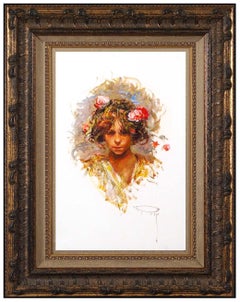
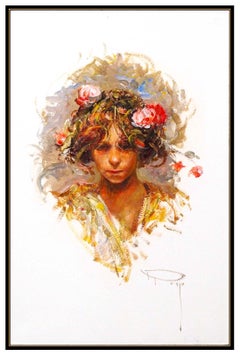
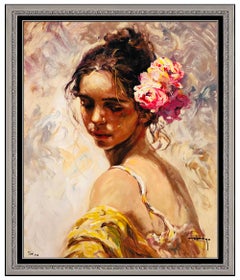
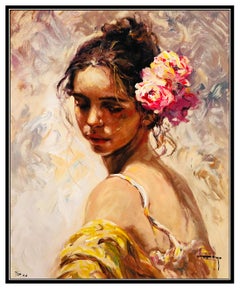
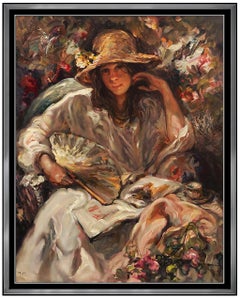
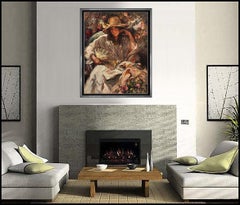
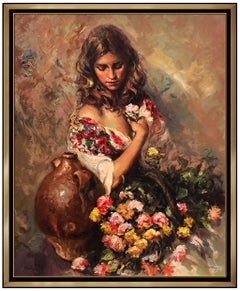
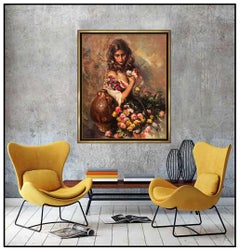
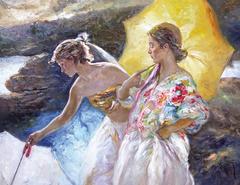
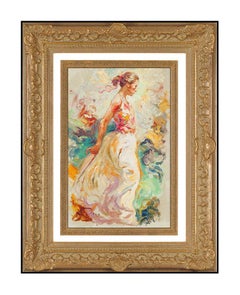
José Royo for sale on 1stDibs
Born in 1941 in Valencia, Spain, Jose Royo began demonstrating his artistic talent early. When he was the age of 9, his father, a prominent physician and avid art enthusiast, employed private tutors to instruct Royo in drawing, painting, and sculpture. When Royo turned 14, he entered the San Carlos Royal Academy of Fine Arts in Valencia. Upon turning 18 Royo continued his artistic studies privately with Aldolfo Ferrer Amblat, Chairman of Art Studies at the San Carlos Academy. He also visited the major museums in Europe at this time to study the famous masters-Velasquez, Goya, Renoir, Monet, and Sorolla among others.
During the mid-60's-early 70's Royo added more dimensions to his skills creating theatre sets and doing graphic illustration and restoration work. He also participated in competitions, gaining major distinctions. In 1968 he began to exhibit in Spain, specifically Lisbon, Madrid and Barcelona. With positive reception of his works in Madrid, Royo received commissions to paint the royal portraits of King Juan Carlos and Queen Sofia. He received subsequent commissions to paint the Judges of the High Magistrature and the Court of Justice, as well as prominent political and society figures.
At the age of 25 Royo began feeling a growing desire to paint the land of his birth; to convey the light, the color and the intensity of Valencia and the Mediterranean. This meant a new focus and change of style in his work; he needed to perfect new ways to capture the light, the shadow and to work on classical composition styles. Through the 1980's Royo perfected his style of painting the Mediterranean and exhibited abroad, notably in London, Brussels, Copenhagen and Paris. He also participated in the International Geneva Art Fair.
Beginning in 1989 and continuing until today, we see the development of Royo's "matured" style. His dramatic usage of color and "texturing" capture his subject matter with unique flair. Parallels can be drawn to the work of the European masters; for example, with Royo's "homage to the female form," we see the distinct influence of Renoir. It is the similar, almost portrait-like treatment of the female model, caught in a serene, contemplative moment, with the surrounding "bursts" of color from the floral landscapes where we see the "Renoir" in Royo's work. In fact, critics have concluded, "If the artwork of Renoir were blended with that of the 'Valencian painters' you would arrive at the canvasses approaching the uniqueness of the impressive work of Royo."
Impressive parallels can also be drawn between Royo's work and that of the Spanish master, Joaquin Sorolla. Both were born in Valencia, both were classically trained, both "matured" into styles of painting capturing the dramatic visual essence of their homeland-Valencia and the Mediterranean Sea. They have both been described as "painters of the Light"; some have said, "of the Light of the South," that is, the southern coast of Spain.
A Close Look at Post-impressionist Art
In the revolutionary wake of Impressionism, artists like Vincent van Gogh, Georges Seurat, Paul Cézanne and Paul Gauguin advanced the style further while firmly rejecting its limitations. Although the artists now associated with Postimpressionist art did not work as part of a group, they collectively employed an approach to expressing moments in time that was even more abstract than that of the Impressionists, and they shared an interest in moving away from naturalistic depictions to more subjective uses of vivid colors and light in their paintings.
The eighth and final Impressionist exhibition was held in Paris in 1886, and Postimpressionism — also spelled Post-Impressionism — is usually dated between then and 1905. The term “Postimpressionism” was coined by British curator and art critic Roger Fry in 1910 at the “Manet and the Postimpressionists” exhibition in London that connected their practices to the pioneering modernist art of Édouard Manet. Many Postimpressionist artists — most of whom lived in France — utilized thickly applied, vibrant pigments that emphasized the brushstrokes on the canvas.
The Postimpressionist movement’s iconic works of art include van Gogh’s The Starry Night (1889) and Seurat’s A Sunday on La Grande Jatte (1884). Seurat’s approach reflected the experimental spirit of Postimpressionism, as he used Pointillist dots of color that were mixed by the eye of the viewer rather than the hand of the artist. Van Gogh, meanwhile, often based his paintings on observation, yet instilled them with an emotional and personal perspective in which colors and forms did not mirror reality. Alongside Mary Cassatt, Cézanne, Henri Matisse and Gauguin, the Dutch painter was a pupil of Camille Pissarro, the groundbreaking Impressionist artist who boldly organized the first independent painting exhibitions in late-19th-century Paris.
The boundary-expanding work of the Postimpressionist painters, which focused on real-life subject matter and featured a prioritization of geometric forms, would inspire the Nabis, German Expressionism, Cubism and other modern art movements to continue to explore abstraction and challenge expectations for art.
Find a collection of original Postimpressionist paintings, mixed media, prints and other art on 1stDibs.