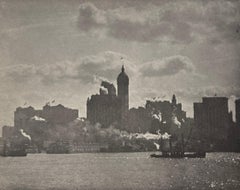
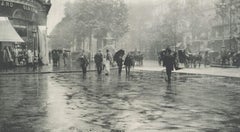
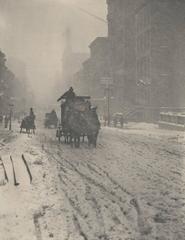
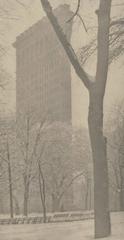
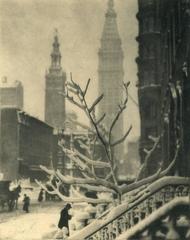
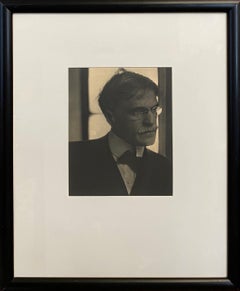
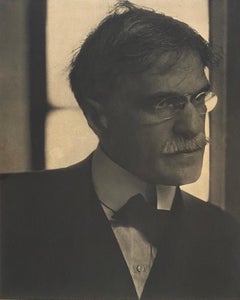
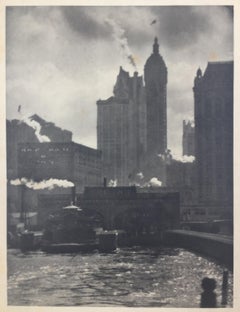
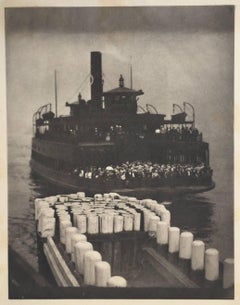
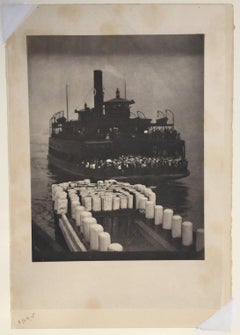
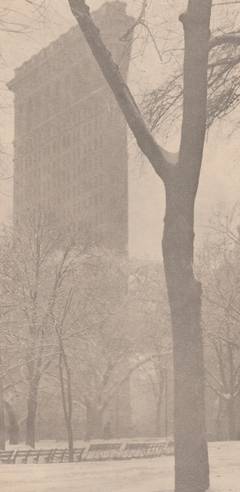
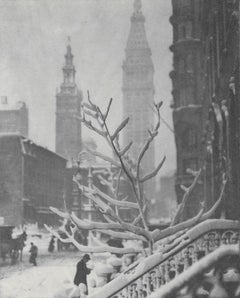
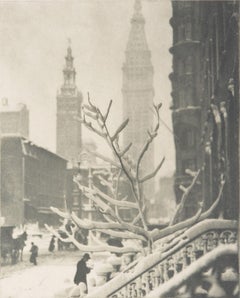
You are likely to find exactly the stieglitz photogravure you’re looking for on 1stDibs, as there is a broad range for sale. There are many
Modern and
Photorealist versions of these works for sale. If you’re looking for a stieglitz photogravure from a specific time period, our collection is diverse and broad-ranging, and you’ll find at least one that dates back to the 19th Century while another version may have been produced as recently as the 20th Century. Adding a stieglitz photogravure to a room that is mostly decorated in warm neutral tones can yield a welcome change — find a piece on 1stDibs that incorporates elements of
gray,
brown,
black and more. These artworks were handmade with extraordinary care, with artists most often working in
intaglio,
photogravure and
paper. A large stieglitz photogravure can be an attractive addition to some spaces, while smaller examples are available — approximately spanning 7 high and 3.5 wide — and may be better suited to a more modest living area.
A stieglitz photogravure can differ in price owing to various characteristics — the average selling price for items in our inventory is $2,800, while the lowest priced sells for $475 and the highest can go for as much as $30,000.
Few individuals have exerted as strong an influence on 20th-century American art and culture as the photographer and art dealer Alfred Stieglitz.
Born in Hoboken, New Jersey, in 1864 during the Civil War, Stieglitz lived until 1946. He began to take photographs while a student in Berlin in the 1880s and studied with the renowned photochemist Hermann Wilhelm Vogel. On his return to the United States in 1890, he began to advocate that photography should be treated as an art. He wrote many articles arguing his cause, edited the periodicals Camera Notes (1897–1902) and Camera Work (1903–1917), and in 1902 formed the Photo-Secession, an organization of photographers committed to establishing the artistic merit of photography.
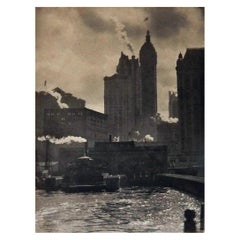
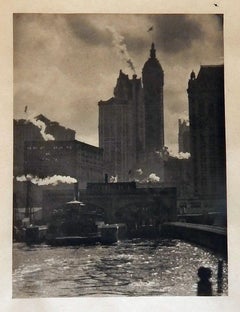
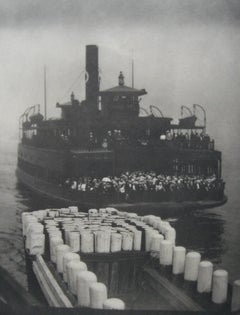
Stieglitz photographed New York for more than 25 years, portraying its streets, parks, and newly emerging skyscrapers; its horse-drawn carriages, trolleys, trains, and ferry boats; as well as some of its people. In the late 1910s and early 1920s, he also focused his camera on the landscape around his summer home in Lake George, New York.
In 1918 Stieglitz became consumed with photographing his future wife, the artist Georgia O’Keeffe. For many years he had wanted to make an extended photographic portrait — he called it a composite portrait — in which he would study one person over a long period. Over the next 19 years, he made more than 330 finished portraits of her. Beginning in 1922 and continuing throughout the 1920s, he also became preoccupied with another subject, clouds, making more than 300 finished studies of them.
Photography was always of central importance to Stieglitz: not only was it the medium he employed to express himself, but, more fundamentally, it was the touchstone he used to evaluate all art. Just as it is apparent today that computers and digital technology will dominate not only our lives but also our thinking in this century, so too did Stieglitz realize, long before many of his contemporaries, that photography would be a major cultural force in the 20th century. Fascinated with what he called “the idea of photography,” Stieglitz foresaw that it would revolutionize all aspects of the way we learn and communicate and that it would profoundly alter all of the arts.
Stieglitz’s own photographs were central to his understanding of the medium: they were the instruments he used to plumb both its expressive potential and its relationship to the other arts. When he began to photograph in the early 1880s, the medium was barely 40 years old. Complicated and cumbersome and employed primarily by professionals, photography was seen by most as an objective tool and utilized for its descriptive and recording capabilities.
By the time ill health forced Stieglitz to stop photographing in 1937, photography and the public’s perception of it had changed dramatically, thanks in large part to his efforts. Through the publications he edited, including Camera Notes, Camera Work, and 291; through the exhibitions he organized; and through his own lucid and insightful photographs, Stieglitz had conclusively demonstrated the expressive power of the medium.
Find original Alfred Stieglitz photography on 1stDibs.
(Biography provided by PDNB Gallery)
There’s a lot to love about black and white photography.
The unique and timeless quality of a black and white photograph accentuates any room. Some might argue that we’re naturally drawn to color photography because it’s the world we know best. This is a shared belief, particularly in the era of camera-phone photography, editing apps and the frenetic immediacy of sharing photos on social media. But when we look at black and white photography, we experience deep, rich shadows and tonal properties in a way that transfixes us. Composition and textures are crisp and engaging. We’re immediately drawn to the subjects of vintage street photography and continue to feel the emotional impact of decades-old photojournalism. The silhouettes of mountains in black and white landscape photography are particularly pronounced, while portrait photography and the skylines of urban cityscapes come to life in monochrome prints.
When decorating with fine photography, keep in mind that some color photographs may not be suitable for every space. However, you can be more daring with black and white photos. The gray tones are classic, sophisticated and generally introduce elegance to any corner of your home, which renders black and white prints amazingly versatile.
Black and white photography adapts to its surroundings like a chameleon might. A single large-scale black and white photograph above the sofa in your living room is going to work with any furniture style, and as some homeowners and designers today are working to introduce more muted tones and neutral palettes to dining rooms and bedrooms, the integration of black and white photography — a hallmark of minimalist decor — is a particularly natural choice for such a setting.
Another advantage to bringing black and white photography into your home is that you can style walls and add depth and character without worrying about disrupting an existing color scheme. Black and white photographs actually harmonize well with accent colors such as yellow, red and green. Your provocative Memphis Group lighting and bold Pierre Paulin seating will pair nicely with the black and white fine nude photography you’ve curated over the years.
Black and white photography also complements a variety of other art. Black and white photos pair well with drawings and etchings in monochromatic hues. They can also form part of specific color schemes. For example, you can place black and white prints in colored picture frames for a pop of color. And while there are no hard and fast rules, it’s best to keep black and white prints separate from color photographs. Color prints stand out in a room more than black and white prints do. Pairing them may detract attention from your black and white photography. Instead, dedicate separate walls or spaces to each.
Once you’ve selected the photography that best fits your space, you’ll need to decide how to hang the images. If you want to hang multiple photos, it’s essential to know how to arrange wall art. A proper arrangement can significantly enhance a living space.
On 1stDibs, explore a vast collection of compelling black and white photography by artists such as Mark Shaw, Jack Mitchell (a photographer you should know), Berenice Abbott and David Yarrow.