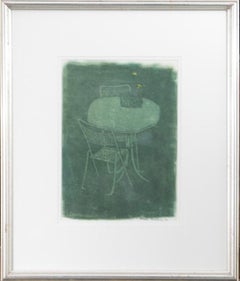
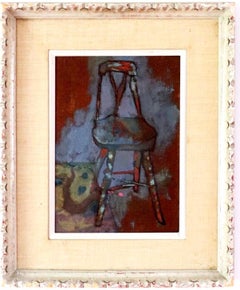
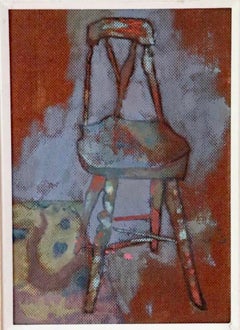
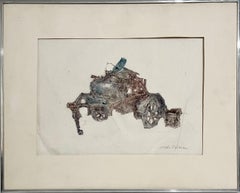
Wpa Chairs For Sale on 1stDibs
On 1stDibs, there are several options of wpa chairs available for sale. Today, if you’re looking for
Impressionist editions of these works and are unable to find the perfect match for your home, our selection also includes
abstract. These items have been made for many years, with versions that date back to the 20th Century alongside those produced as recently as the 21st Century. If you’re looking to add wpa chairs that pop against an otherwise neutral space in your home, the works available on 1stDibs include that feature elements of
brown,
black,
gray,
orange and more.
Benton Murdoch Spruance,
Mervin Jules,
Arthur Rothstein,
John Deforest Stull and
Anton Refregier took a thoughtful approach to this subject that are worth considering. Each of these unique pieces was handmade with extraordinary care, with artists most often working in
paint,
paper and
watercolor.
How Much are Wpa Chairs?
Prices for art of this kind can differ depending upon size, time period and other attributes — wpa chairs in our inventory begin at $275 and can go as high as $75,000, while the average can fetch as much as $2,600.
Joseph Solman for sale on 1stDibs
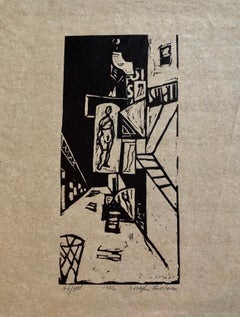
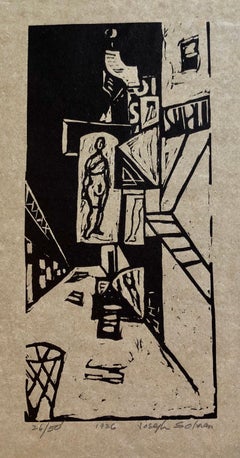
Brought to America from Russia as a child in 1912, Joseph Solman was a prodigious draftsman and knew, in his earliest teens, that he would be an artist. He went straight from high school to the National Academy of Design, though he says he learned more by sketching in the subway on the way back from school late at night: people “pose perfectly when they’re asleep.” In 1929, Solman saw the inaugural show at the Museum of Modern Art featuring Seurat, Gauguin, Van Gogh, and Cezanne. It changed his life – and his art. Joseph Solman was, with Mark Rothko, the unofficial co-leader of The Ten, a group of expressionist painters who exhibited as the “Whitney Dissenters” at the Mercury Galleries in New York in 1938. A champion of modernism, Solman was elected an editor of Art Front Magazine when its other editors, art historian Meyer Shapiro and critic Harold Rosenberg, were still partial to Social Realism In 1964, The Times, discussing his well-known subway gouaches (done while commuting to his some-time job as a racetrack pari-mutuel clerk), called him a “Pari-Mutuel Picasso.” In 1985, on the occasion of a 50-year retrospective, The Washington Post wrote: “It appears to have dawned, at last, on many collectors that this is art that has already stood the acid test of time.” We had the pleasure of the meeting the artist a few times at his home which was over the original Second Avenue Deli in the East Village.
A Close Look at Modern Art
The first decades of the 20th century were a period of artistic upheaval, with modern art movements including Cubism, Surrealism, Futurism and Dadaism questioning centuries of traditional views of what art should be. Using abstraction, experimental forms and interdisciplinary techniques, painters, sculptors, photographers, printmakers and performance artists all pushed the boundaries of creative expression.
Major exhibitions, like the 1913 Armory Show in New York City — also known as the “International Exhibition of Modern Art,” in which works like the radically angular Nude Descending a Staircase by Marcel Duchamp caused a sensation — challenged the perspective of viewers and critics and heralded the arrival of modern art in the United States. But the movement’s revolutionary spirit took shape in the 19th century.
The Industrial Revolution, which ushered in new technology and cultural conditions across the world, transformed art from something mostly commissioned by the wealthy or the church to work that responded to personal experiences. The Impressionist style emerged in 1860s France with artists like Claude Monet, Paul Cézanne and Edgar Degas quickly painting works that captured moments of light and urban life. Around the same time in England, the Pre-Raphaelites, like Edward Burne-Jones and Dante Gabriel Rossetti, borrowed from late medieval and early Renaissance art to imbue their art with symbolism and modern ideas of beauty.
Emerging from this disruption of the artistic status quo, modern art went further in rejecting conventions and embracing innovation. The bold legacy of leading modern artists Georges Braque, Pablo Picasso, Frida Kahlo, Salvador Dalí, Henri Matisse, Joan Miró, Marc Chagall, Piet Mondrian and many others continues to inform visual culture today.
Find a collection of modern paintings, sculptures, prints and other fine art on 1stDibs.