Arnold Friberg Art

to
3
3
Overall Width
to
Overall Height
to
6
5
4
3
2
2
1
1
1
1
1
1
1
1
1
1
1
1
1
1
1
6

Use search to find more

6
11,946
2,896
2,541
1,647

Use search to find more

Artist: Arnold Friberg
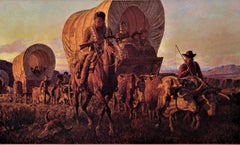
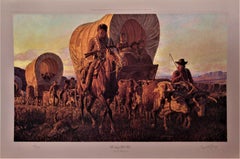
The Long Trail West
The Long Trail West

The Long Trail West

By Arnold Friberg 1

Located in San Francisco, CA

This artwork titled "TheLong Trail West" c.1980 is a color offset lithograph by renown western artist Arnold Friberg, 1913-2010. It is hand signed and n...

Category

Late 20th Century American Realist Arnold Friberg Art

Materials

Lithograph

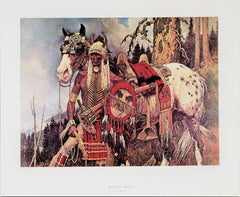
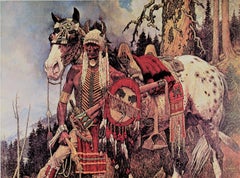
When the Land was His

When the Land was His

By Arnold Friberg 1

Located in San Francisco, CA

This artwork titled "When the Land was His" 1985, is a color offset lithograph by renown western artist Arnold Friberg, 1913-2010. It is hand signed and...

Category

Late 20th Century American Realist Arnold Friberg Art

Materials

Lithograph

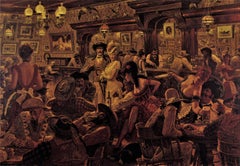
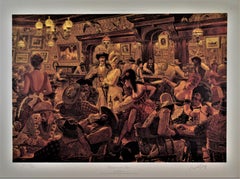
Winners and Loosers
Winners and Loosers

Winners and Loosers

By Arnold Friberg 1

Located in San Francisco, CA

This artwork titled "Winners Loosers" is a color offset lithograph by renown western artist Arnold Friberg, 1913-2010. It is hand signed and inscribed/n...

Category

Late 20th Century American Realist Arnold Friberg Art

Materials

Lithograph

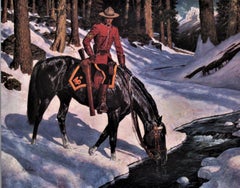
Springtime in the North

Springtime in the North

By Arnold Friberg 1

Located in San Francisco, CA

This artwork titled "Springtime in the North" c.1980, published 1996, is a color offset lithograph by renown western artist Arnold Friberg, 1913-2010. I...

Category

Late 20th Century American Realist Arnold Friberg Art

Materials

Lithograph

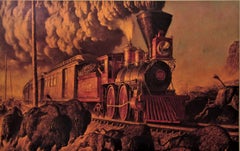
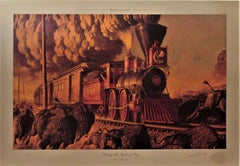
Yelding the Right of Way

Yelding the Right of Way

By Arnold Friberg 1

Located in San Francisco, CA

This artwork titled "Yelding the Right of Way" c.1975 is a color offset lithograph by renown western artist Arnold Friberg, 1913-2010. It is hand signed...

Category

Late 20th Century American Realist Arnold Friberg Art

Materials

Lithograph

The Trail Ends at the Sea

The Trail Ends at the Sea

By Arnold Friberg 1

Located in San Francisco, CA

This artwork titled "The Trail Ends at the Sea" c.1980 is a color offset lithograph by renown western artist Arnold Friberg, 1913-2010. It is hand signe...

Category

Late 20th Century American Realist Arnold Friberg Art

Materials

Lithograph

Related Items
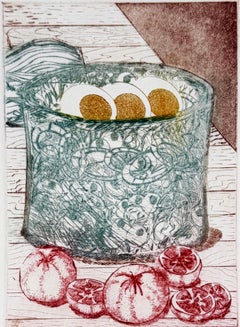
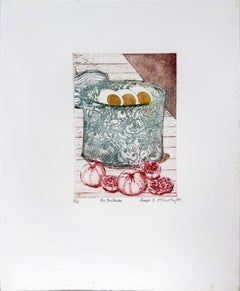
"En Salada" Salad Fixings Intaglio on Paper by Joseph C. MaCarthy

"En Salada" Salad Fixings Intaglio on Paper by Joseph C. MaCarthy

Located in Soquel, CA

"En Salada" Salad Fixings Etching on Paper by Joseph C. MaCarthy This Intaglio print, titled "En Salada," by San Francisco Bay area artist Joseph C. McCarthy (American, 20th C), cre...

Category

1980s American Realist Arnold Friberg Art

Materials

Watercolor, Laid Paper, Intaglio

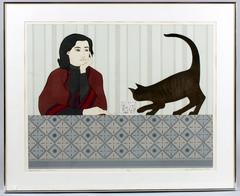
Meditation and Minou

Meditation and Minou

By Will Barnet

Located in Buffalo, NY

Artist: Will Barnet, American (1911 - 2012) Title: Meditation and Minou Year: 1980 Medium: Lithograph and Serigraph on BFK Rives, signed and numbered in pencil Edition: 40/150

Category

1970s American Realist Arnold Friberg Art

Materials

Archival Paper, Lithograph
COMING ROUND THE MOUNTAIN - Extremely Rare Early Benton & Music Subject

COMING ROUND THE MOUNTAIN - Extremely Rare Early Benton & Music Subject

By Thomas Hart Benton

Located in Santa Monica, CA

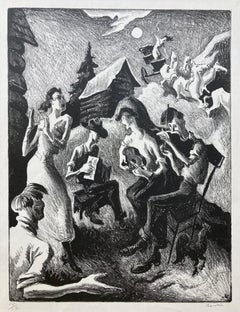
THOMAS HART BENTON (1889-1975) COMING ROUND THE MOUNTAIN (MISSOURI MUSICIANS) 1931 (Fath 4) Lithograph, signed in pencil. Although Fath indicates an edition of 75, it is numbered ...

Category

1930s American Realist Arnold Friberg Art

Materials

Lithograph

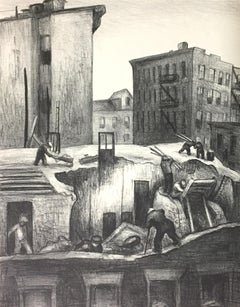
Ann Nooney, (Demolition with Windows, NYC)

Ann Nooney, (Demolition with Windows, NYC)

By Ann Nooney

Located in New York, NY

The dimensions are for the image; there are large margins. This lithograph is signed in pencil. A native New Yorker, Ann Nooney (1900-1970) recorded the urban scene while on the Wo...

Category

1930s American Realist Arnold Friberg Art

Materials

Lithograph

Jonas Wood, Interiors and Landscapes (Lt. Ed Hand signed and inscribed poster)

Jonas Wood, Interiors and Landscapes (Lt. Ed Hand signed and inscribed poster)

By Jonas Wood

Located in New York, NY

JONAS WOOD Interiors and Landscapes Offset lithograph poster (hand signed and inscribed) 24 × 18 inches Hand signed, dated by Jonas Wood with the artist's distinctive basketball leg...

Category

2010s Contemporary Arnold Friberg Art

Materials

Permanent Marker, Lithograph, Offset

Original "Me Travel?  not this summer  Vacation At Home vintage poster  1945

Original "Me Travel? not this summer Vacation At Home vintage poster 1945

By Albert Dorne 1

Located in Spokane, WA

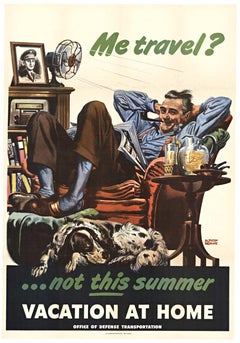
Original World War Two, U. S. Military poster: ME TRAVEL? … NOT THIS SUMMER, VACATION AT HOME. Artist Albert Dorne. This is the large format printing (26" x 37") of this poster...

Category

1940s American Realist Arnold Friberg Art

Materials

Offset

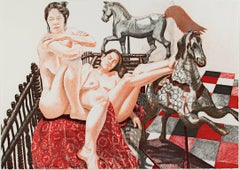
Contemporary color lithograph nude female figures horses red black signed

Contemporary color lithograph nude female figures horses red black signed

By Philip Pearlstein

Located in Milwaukee, WI

"Models & Horses" is an original color lithograph by Philip Pearlstein. The artist signed the piece lower left and it is edition 15/140. This piece features two nude female model...

Category

1990s American Realist Arnold Friberg Art

Materials

Lithograph

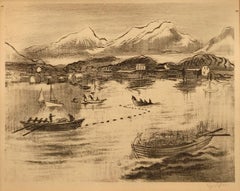
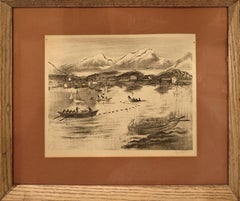
"Fishing Village" Joe Jones, Mid-Century, American Life, Small Town Scene

"Fishing Village" Joe Jones, Mid-Century, American Life, Small Town Scene

By Joe Jones

Located in New York, NY

Joe Jones Fishing Village, 1949 Signed in pencil lower right margin Lithograph on wove paper Image 9 5/16 x 12 9/16 inches Sheet 12 x 15 15/16 inches From the edition of 250 The initial details of Jones' career are sparse, and this is intentional. The young artist was engaged in a process of self-reinvention, crafting a persona. When he submitted a work to the Sixteen Cities Exhibition at New York City's Museum of Modern Art in 1933, he briefly characterized himself: "Born St. Louis, 1909, self-taught. " Jones intentionally portrayed himself to the art community as an authentic working-class figure, backed by a compelling history. He was the youngest of five children in a family led by a one-armed house painter from St. Louis, a Welsh immigrant, and his German American spouse. At the age of ten, Jones found himself in a Missouri reformatory due to authorities' concerns over his graffiti activities. After completing elementary school, he traveled by freight car to California and back, even being arrested for vagrancy in Pueblo, Colorado. Returning to St. Louis, he attempted to settle down by working alongside his father. Yet, Jones felt a profound restlessness and was drawn toward a more elevated artistic pursuit in his late teenage years. He discovered a local collective of budding artists that formed St. Louis’s "Little Bohemia," sharing a studio and providing mutual support until he managed to secure his own modest workspace in a vacant garage. Jones’s initial creations comprised still lifes, landscapes, and poignant portraits of those close to him. These subjects were not only accessible but also budget-friendly, as hiring models was beyond his means. He depicted himself, his father, mother, and eventually, his wife. In December 1930, at the age of 21, Jones wed Freda Sies, a modern dancer and political activist who was four years older than him. By 1933, Jones had started gaining noteworthy local recognition through a solo exhibition at the Artists’ Guild of Saint Louis. Of the twenty-five paintings on display, one, titled River Front (private collection, previously with Hirschl and Adler Galleries), was selected to illustrate a feature article about his show in The Art Digest (February 15, 1933, p. 9). Shortly before this exhibition, a young surgeon named Dr. Robert Elman took an interest in Jones’s art, purchasing several pieces and forming a group of potential patrons committed to providing the emerging artist with a monthly stipend in exchange for art. This group was officially known as the "Co-operative Art Society," but it was informally dubbed the "Joe Jones Club. " Jones became an active participant in the St. Louis artistic scene, particularly within its bohemian segments. He embraced modernism and was a founding member of the "New Hat" movement in 1931, a playful rebellion against the conservative and traditional mainstream art establishment. The summer of 1933 marked a significant shift in Jones’s journey. Sponsored by a dedicated ally, Mrs. Elizabeth Green, Jones, along with Freda and Green, embarked on an eastward road trip. In Washington, D. C., they explored the Corcoran Gallery of Art, the Freer Gallery (part of the Smithsonian Institution), the Library of Congress, and Mount Vernon. Following this whirlwind of art and American culture, they made their way to New York, where they visited various museums and galleries, including a stop at The New School for Social Research, which featured notable contemporary murals by fellow Missourian Thomas Hart Benton and the politically active Mexican artist, José Clemente Orozco. From June through August, Jones and Freda resided in the artist colony of Provincetown, Massachusetts, later returning home via Detroit to see Diego Rivera’s Detroit Industry mural housed at the Detroit Institute of Fine Arts. While Elizabeth Green allegedly hoped that Jones would refine his artistic skills under the guidance of Charles Hawthorne or Richard Miller in Provincetown, Jones followed a different path. Rather than pursuing conservative mentors, he connected with an engaging network of leftist intellectuals, writers, and artists who dedicated their time to reading Marx and applying his theories to the American landscape. Jones's reaction to the traditional culture of New England was captured in his statement to a reporter from the St. Louis Post Dispatch: “Class consciousness . . . that’s what I got of my trip to New England. Those people [New Englanders] are like the Chinese—ancestor worshipers. They made me realize where I belong” (September 21, 1933). The stark social divisions he witnessed there prompted him to embrace his working-class identity even more fervently. Upon returning to St. Louis, he prominently identified himself as a Communist. This newfound political stance created friction with some of his local supporters. Many of his middle-class advocates withdrew their backing, likely influenced not only by Jones’s politics but also by his flamboyant and confrontational demeanor. In December 1933, Jones initiated a complimentary art class for unemployed individuals in the Old Courthouse of St. Louis, the same location where the Dred Scott case was deliberated and where slave auctions formerly took place. Concurrently, the St. Louis Art League was offering paid courses. Emphasizing the theme of social activism, with a studio adorned with Soviet artwork, Jones’s institution operated for just over a year before being removed from the courthouse by local officials. The school’s political focus and unconventional teaching practices, along with its inclusion of a significant number of African American students during a period marked by rigid racial segregation, certainly contributed to its challenges. Under Jones’s guidance, the class created a large chalk pastel mural on board, measuring 16 by 37 feet, titled Social Unrest in St. Louis. Mural painting posed no challenge for the former housepainter, who was adept at handling large wall surfaces. His first significant commission in St. Louis in late 1931 was a mural that celebrated the city’s industrial and commercial fortitude for the local radio station, KMOX. This mural, aimed at conveying optimism amid severe economic hardship, showcased St. Louis's strengths in a modernist approach. When Jones resumed mural work in late 1933, his worldview had evolved considerably. The mural produced for the school in the courthouse, conceived by Jones, featured scenes of modern St. Louis selected to highlight political messages. Jones had observed the technique of utilizing self-contained scenes to craft visual narratives in the murals he encountered in the East. More locally, this compositional strategy was commonly employed by the renowned Missouri artist...

Category

1940s American Realist Arnold Friberg Art

Materials

Paper, Lithograph
Norman Rockwell, 'Jim got down on his knees', 1972, Litho, a.p., Signed, Framed

Norman Rockwell, 'Jim got down on his knees', 1972, Litho, a.p., Signed, Framed

By Norman Rockwell

Located in Columbia, MO

Norman Rockwell (American, 1894–1978) Signed recto Norman Rockwell remains one of the most celebrated illustrators of the twentieth century, renowned for his ability to translate na...

Category

Mid-20th Century American Realist Arnold Friberg Art

Materials

Lithograph
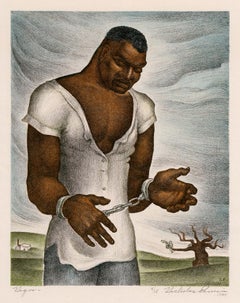
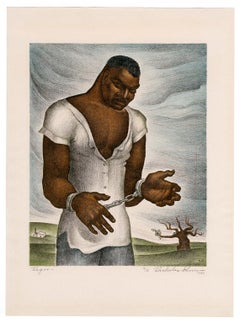
'Negro' — California WPA Social Realism–Slavery, Signed Color Lithograph
'Negro' — California WPA Social Realism–Slavery, Signed Color Lithograph
Located in Myrtle Beach, SC

Nicholas Panesis, 'Negro', 1934, color lithograph, edition 18. Signed, dated, titled, and numbered 8/28 in pencil. Initialed in the stone, lower right. A fine impression, with fresh colors, on buff wove paper, with margins (1 1/8 to 2 3/8 inches). Minor glue staining at the extreme sheet edges verso, where previously taped (not visible recto), otherwise in excellent condition. Matted to museum standards, unframed. Very scarce. Image size 10 5/8 x 8 1/2 inches; (270 x 216 mm); sheet size 14 13/16 x 10 15/16 inches (376 x 278 mm). Created for the California Works Progress Administration, Federal Art Project (WPA). Impressions of this work are held in the public collections of La Salle University Art Museum (Philadelphia), U.S. General Services Administration, and the Weisman Art Museum (University of Minnesota). ABOUT THE ARTIST Nicholas Panesis (1913–1967) was an American painter, printmaker, ceramicist, and illustrator whose lithographs of the 1930s rank among the most compelling examples of California WPA printmaking. Working within the traditions of Social Realism and the American Scene movement, he combined expressive draftsmanship with a modernist sense of design to create images of remarkable graphic power that address themes of labor, race, industry, and everyday American life. Born in Massachusetts in 1913, Panesis studied art at Syracuse University before joining the faculty of Alfred University, where he taught ceramics. In the early 1930s he relocated to California, first settling in San Francisco before moving to Los Angeles. There he worked for several animation studios...

Category

1930s American Realist Arnold Friberg Art

Materials

Lithograph

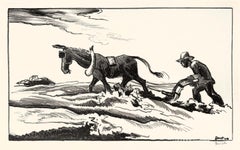
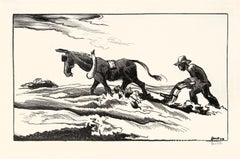
'Plowing It Under' — WPA Era American Regionalism, Signed Lithograph
'Plowing It Under' — WPA Era American Regionalism, Signed Lithograph
By Thomas Hart Benton

Located in Myrtle Beach, SC

Thomas Hart Benton, 'Goin' Home', lithograph, 1937, edition 250, Fath 14. Signed in pencil. Signed in the stone, lower right. A fine, richly-inked impression, on off-white, wove pape...

Category

1930s American Realist Arnold Friberg Art

Materials

Lithograph
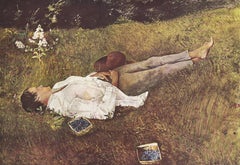
Andrew Wyeth, The Berry Picker, from The Four Seasons, 1962 (after)

Andrew Wyeth, The Berry Picker, from The Four Seasons, 1962 (after)

By Andrew Wyeth

Located in Fairfield, CT

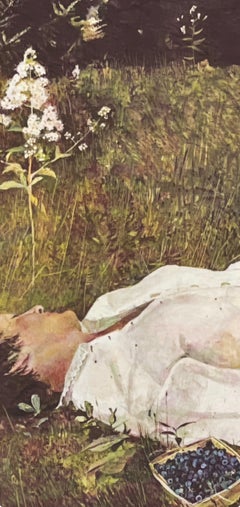
Artist: Andrew Wyeth (1917–2009) (after) Title: The Berry Picker Year: 1962 Medium: Lithograph on velin paper Paper Size: 13 x 17 inches (33 x 43.2 cm) Condition: Well preserved, con...
Category

1960s American Realist Arnold Friberg Art

Materials

Lithograph
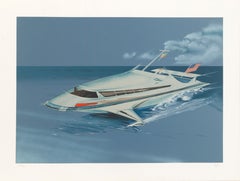
Hydrofoil, Photorealist Lithograph by Raymond Loewy

Hydrofoil, Photorealist Lithograph by Raymond Loewy

By Raymond Loewy

Located in Long Island City, NY

Artist: Raymond Loewy, American (1893 - 1986) Title: Hydrofoil Year: 1978 Medium: Lithograph, signed and numbered in pencil Edition: 300 Image Size: 17 x 24 inches Size: 21 in. x 28 ...

Category

1970s American Realist Arnold Friberg Art

Materials

Lithograph

Previously Available Items
At the End of the Day

Arnold Friberg 1At the End of the Day, c.1980

Sold

H 22.5 in W 29 in D 0.01 in

At the End of the Day

By Arnold Friberg 1

Located in San Francisco, CA

This artwork titled "At the End of the Day" c.1980, published 1995 is a color offset lithograph by renown western artist Arnold Friberg, 1913-2010. It i...

Category

Late 20th Century American Realist Arnold Friberg Art

Materials

Lithograph

Arnold Friberg art for sale on 1stDibs.

Find a wide variety of authentic Arnold Friberg art available for sale on 1stDibs. You can also browse by medium to find art by Arnold Friberg in lithograph and more. Not every interior allows for large Arnold Friberg art, so small editions measuring 27 inches across are available. Customers who are interested in this artist might also find the work of Popo and Ruby Lee, Reynold Weidenaar, and Louis Conrad Rosenberg. Arnold Friberg art prices can differ depending upon medium, time period and other attributes. On 1stDibs, the price for these items starts at $723 and tops out at $1,000, while the average work can sell for $808.

Artists Similar to Arnold Friberg