Carl Friedrich Deiker Art

to
1
1
1
Overall Width
to
Overall Height
to
3
2
1
3
1
1
1
1
1
1
1
1
1
1
2
2
1
1
1
3
11,246
2,855
2,494
1,441
2
3
Artist: Carl Friedrich Deiker
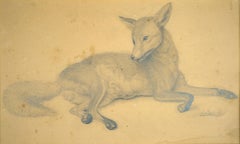
Vigilant Fox - The psyche of the fox -

Vigilant Fox - The psyche of the fox -

By Carl Friedrich Deiker

Located in Berlin, DE

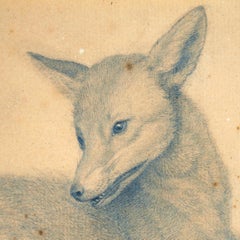
Carl Friedrich Deiker (1838 Wetzlar - 1892 Düsseldorf). Vigilant fox. Pencil drawing on brown paper, 18 × 29.5 cm (inside measurement), 31.5 x 43.5 cm (mount), signed and dated "Deiker [18]54" at lower right. - a little bit stained, with a light water stain at lower right About the artwork Carl Friedrich Deiker's consummate ability to depict animals is already evident in this early work. He brought a whole new psychological dimension to animal painting, so that one could literally speak of animal portraits. The naturalistic appearance of the fox alone makes it seem alive. Every strand of muscle, even every hair, is captured, which requires an intensive artistic study of animal anatomy and physiology. But the fox's real liveliness comes not from its natural appearance, but from its internal movement: Stretched out, it has been brought out of rest. It turns around and, with its ears pricked up, looks intently in the direction from which it has seen something. His mouth is slightly open and his pointed teeth are bared, as if he were growling. Tension gradually takes hold of his whole body. While the hind legs were still in a relaxed position, closely observed by Deiker, one front leg was already raised, ready to begin a rising movement. The fox seems so alarmed with all its senses that one gets the impression that, at any moment, its tail will move jerkily and the animal will jump up. While wild animals have traditionally been portrayed as beasts or anthropomorphised, often for caricatural purposes, Deiker explores their inherent nature by attempting to capture their psychic impulses. The wild animal is neither bestial nor human, but a creature in its own right, valued by Deiker for its own sake. In this way, he brought the dignity of the animal into representation and raised animal painting to a whole new artistic level. About the artist Carl Friedrich Deiker was the son of the drawing teacher Christian Friedrich Deiker and the younger brother of the animal painter Johannes Deiker. In addition to the family art lessons, Christian Friedrich shared a studio with his brother Johannes at Braunfels Castle, Deiker attended the drawing academy in Hanau, and from 1858 he was a student at the Karlsruhe Art Academy, where he studied under the landscape painter Johann Wilhelm Schirmer. Carl Friedrich Deiker was already in demand as an artist during his first year: Grand Duke Frederick I of Baden, Margrave Max of Baden and Grand Duke Michael of Russia bought hunting scenes by him. In 1859 he went on a study trip to the Reinhardswald. Just as the Barbizon School had rediscovered the landscape, Deiker opened up the forest for animal painting. From 1861-64 Deiker had his own studio in Karlsruhe, then moved to Düsseldorf, where his brother Johannes followed four years later. Deiker married a daughter of the landscape painter Karl Hilger and remained in Düsseldorf until his death. In 1868 he finally achieved international fame with his painting 'Pursued Noble Deer' and was regarded as a virtuoso new founder of animal painting. "Deiker brought for the first time a truly great artistic quality to animal painting [...]". - Hans Vollmer From 1870 he participated in the academic art exhibitions in Berlin, Dresden, Munich and Hanover. He was also very busy as an illustrator. He drew for the Gartenlaube, the Salon, the Universum, and produced many of the finely illustrated hunting and animal books of the period. He also worked as a printmaker, while his oil paintings circulated as reprints by Franz Dinger. From 1865 to 1892 Deiker was a member of the artists' association Malkasten. Carl Friedrich Deiker's life's work was honoured with a large posthumous memorial exhibition at the Düsseldorf Kunsthalle in 1892. His son Carl Deiker, born in 1879, also became a painter. Selection of art museums that own works by Carl Friedrich Deiker: Hamburger Kunsthalle / Kunsthalle Karlsruhe / Kunstmuseum Düsseldorf / Wallraff Richartz Cologne. Selected Bibliography H. Schmidt: Johannes and...

Category

1850s Naturalistic Carl Friedrich Deiker Art

Materials

Pencil

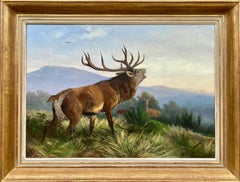
Roaring Deer Stag, Carl Friedrich Deiker, Wetzlar 1836 – 1892 Düsseldorf, Signed

Roaring Deer Stag, Carl Friedrich Deiker, Wetzlar 1836 – 1892 Düsseldorf, Signed

By Carl Friedrich Deiker

Located in Knokke, BE

Roaring Deer Stag Deiker Carl Friedrich Wetzlar, Germany 1836 – 1892 Dusseldorf, Germany German Painter Signature: Signed bottom right Medium: Oil on canvas Dimensions: Image size 58 x 81 cm, frame size 73 x 96 cm Biography: Deiker Carl Friedrich was born on April 3, 1836 in Wetzlar. He was a Prussian animal painter. Deiker was specialised in animal genres related to hunting and wildlife. He also illustrated magazines and books on hunting. Carl Friedrich Deiker was the son of Friedrich Deiker, a painter and drawing teacher at the high school. His older brother, Johannes Deiker, with whom he learned to draw after their father’s death in 1843, was a painter specialising in hunting scenes. Deiker attended the Hanau drawing Academy, where he was a pupil of the director Theodor Pélissier (1794-1863), and then studied at Johann Wilhelm Schirmer’s studio in Carlsruhe. In 1859, in the Reinhardswald forest, he collected studies for his large hunting paintings...

Category

19th Century Baroque Carl Friedrich Deiker Art

Materials

Oil, Canvas

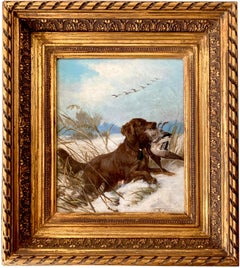
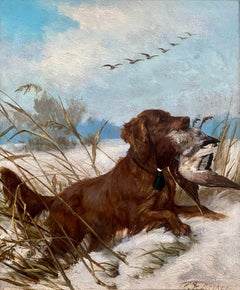
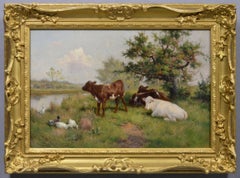
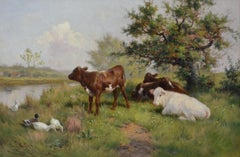
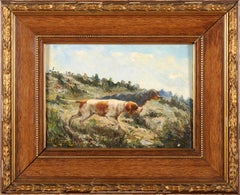
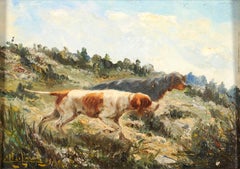
'The Hunting Dog' by Carl Friedrich Deiker (Wetzlar 1836 – 1892 Dusseldorf)

'The Hunting Dog' by Carl Friedrich Deiker (Wetzlar 1836 – 1892 Dusseldorf)

By Carl Friedrich Deiker

Located in Knokke, BE

Carl Friedrich Deiker Wetzlar 1836 – 1892 Dusseldorf German Painter 'The Hunting Dog' Signature: signed lower right 'C.F. Deiker' Medium: oil on panel Dimensions: image size 29 x 2...

Category

19th Century Realist Carl Friedrich Deiker Art

Materials

Oil, Wood Panel

Related Items
Henry Robinson Hall (British painter) - 19th century sheep Highland loch

Henry Robinson Hall (British painter) - 19th century sheep Highland loch

Located in Varmo, IT

Henry Robinson Hall (York 1859 - Barrow-in-Furness 1927) - Sheep Family in the Highlands. 67 x 36 cm. Oil on canvas, unframed. Signed lower left: "H. Hall." Autograph inscription ...

Category

Late 19th Century Realist Carl Friedrich Deiker Art

Materials

Canvas, Oil

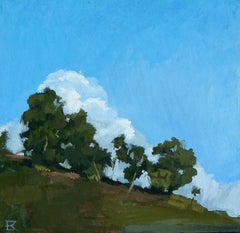
"Hindsight" - Original Still-Life and Landscape, Oil Painting on Panel

"Hindsight" - Original Still-Life and Landscape, Oil Painting on Panel

By Emma Kalff

Located in Denver, CO

"This painting was made based off of a photo I took from a bus window in Mexico, near Puerto Vallarta. The image stuck with me as the idea of an idyllic hillside. It felt to me like ...

Category

21st Century and Contemporary Realist Carl Friedrich Deiker Art

Materials

Oil, Panel

Flemish 17th, Orpheus and Animals, Large Decorative Wall Old Master Painting

Flemish 17th, Orpheus and Animals, Large Decorative Wall Old Master Painting

Located in Greven, DE

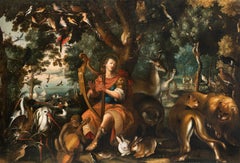
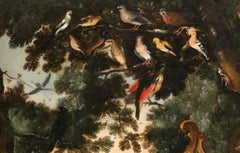
Flemish school, 17th century Orpheus and the animals Oil on canvas, 146,5 x 217 cm Provenance: South German private collection. On an impressive, room-filling format, this painting depicts "Orpheus and the Animals." The harp-playing Orpheus sits centrally in front of a tree whose trunk bifurcates above his head. This central tree frames with its crown the scenery towards the horizon and at the same time offers through branches the possibility for many birds to find space. The left half of the picture is characterized by a seascape, at the edge of which the ruins of a castle can be seen deep in the background. This seascape, framed by mountains on the horizon, is the only area where sky can be seen. On this side, waterfowl such as storks, swans and ducks can be seen. In the right half, the viewer looks into a deep European forest. On this right side, more land animals can be found, such as deer, rabbits and lions, among others. Orpheus wears opulent red and gold trimmed clothing, under his blue breastplate we see a white shirt. His feet are adorned by elaborate sandals. His head is surrounded by a radiant laurel wreath ("poeta laureatus"). The young man is clearly identifiable as the singer and poet of Greek mythology, Orpheus, by his harp, the laurel wreath and the animals surrounding him. Orpheus was one of the Argonauts who, under Jason, was searching for the Golden Fleece. He sang so beautifully that he even conquered the angry sea and enemies by the magic of his lyre. During the journey, Orpheus is said to have drowned out even the sirens with his singing. It is said that he was the greatest of all poets and charmed people, animals, stones and trees with his singing. In total, 51 birds and 37 different species are depicted in the painting. The animals are mostly depicted in great detail and, except for a few, can be identified. Mainly European species of animals are shown. Exceptions are the ostrich-like nandu peeking out from behind the deer, as well as the large parrot on the upper left, and the two lions. Similar is the case for the large animal directly behind Orpheus on the right. The shape of the head suggests an arctic fox from the polar regions, even though the body is much too large. The arctic fox was first described in 1555 by Olaus Magnus. However, it could also be a depiction of a brown or black bear. An unusual detail is the animal, which is relatively isolated in the right background and looks to the left. It is not clearly identifiable, but it shows certain similarities with the Australian kangaroo. This was first described by Vespucci in 1500 and further by Francisco Pelsaert in 1629. If it is indeed a kangaroo, this would be one of the earliest surviving pictorial representations. In this painting, Orpheus is accompanied by a small monkey playing a viola da gamba. This is an iconographic peculiarity. In general, this painting has some peculiarities compared to other paintings with "Orpheus and the animals". The central positioning of Orpheus is quite common, but he usually holds a lyre and is dressed in an antique style, but not as opulently. The choice of animals is also remarkable: European animals in particular are seen, hardly any exotic features, such as camels or elephants. The two lions in the right foreground are a quotation from Peter Paul Rubens and his depiction of "Daniel in the Lion's Den", which was realized in an engraving. The present painting can be classified as belonging to the Flemish School of the 17th century on the basis of its painterly and compositional conception. From the circle of Jan Brueghel the Younger are numerous representations of this Orpheus - theme, which take it as an opportunity to show as many exotic animals. There are also echoes of Spanish painters such as Juan de Arellano...

Category

17th Century Baroque Carl Friedrich Deiker Art

Materials

Canvas, Oil

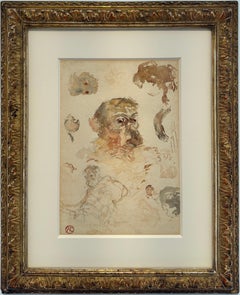
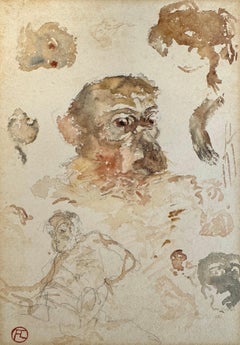
"Singes (Monkeys)" 1881 by Henri de Toulouse-Lautrec Watercolor & Graphite Study

"Singes (Monkeys)" 1881 by Henri de Toulouse-Lautrec Watercolor & Graphite Study

By Henri de Toulouse-Lautrec

Located in Yardley, PA

About this work: Before he became the celebrated chronicler of Montmartre’s nightlife, Lautrec was surrounded by a different kind of spectacle. At his family’s estates, the young art...

Category

1880s Naturalistic Carl Friedrich Deiker Art

Materials

Paper, Watercolor, Graphite

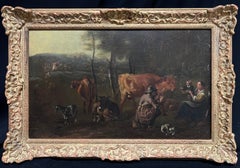
17th-Century Dutch Pastoral Scene Figures Cattle Goats in a Bucolic Landscape

17th-Century Dutch Pastoral Scene Figures Cattle Goats in a Bucolic Landscape

Located in Cirencester, Gloucestershire

Pastoral Scene with Figures Dutch Old Master, 17th century oil on canvas, framed Framed: 16.5 x 24 inches Canvas : 13 x 21 inches Provenance: private collection, UK Condition: very g...

Category

17th Century Baroque Carl Friedrich Deiker Art

Materials

Oil

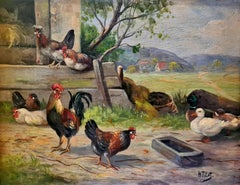
French Oil On Panel Rural Landscape, Chickens and Ducks in a Farmyard.

French Oil On Panel Rural Landscape, Chickens and Ducks in a Farmyard.

Located in Cotignac, FR

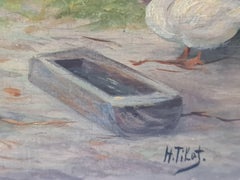
French oil on wood panel view of a sunny farmyard with chickens and ducks by H Tikat. The painting is signed bottom right. A very charming rural view of a hen house in a farmyard wi...

Category

Early 20th Century Romantic Carl Friedrich Deiker Art

Materials

Oil, Wood Panel

Highlands Sheep; A finished study from the Highlands Series

Highlands Sheep; A finished study from the Highlands Series

By Rosa Bonheur

Located in Middletown, NY

A finished primary study for Bonheur's major oil paintings of the late 1850s, capturing the quiet, unadorned dignity of animals in their native environment. Circa 1855. Graphite and...

Category

Mid-19th Century French School Carl Friedrich Deiker Art

Materials

Handmade Paper, Graphite, Crayon

19th Century Scottish landscape oil painting of Highland Cattle at a stream

19th Century Scottish landscape oil painting of Highland Cattle at a stream

By Robert Watson

Located in Nr Broadway, Worcestershire

Robert Watson British, (1855-1920) Highland Cattle by a Stream Oil on canvas, signed & dated 1920 Image size: 19.25 inches x 29.25 inches Size including frame: 27 inches x 37 in...

Category

19th Century Victorian Carl Friedrich Deiker Art

Materials

Canvas, Oil

Summer Pastoral Contemporary Regionalism Rural Modern American Scene Art Realism

Summer Pastoral Contemporary Regionalism Rural Modern American Scene Art Realism

By Roger Medearis

Located in New York, NY

Summer Pastoral Contemporary Regionalism Rural Modern American Scene Art Realism Roger Medearis (1920 – 2001) Summer Pastoral (1984) Acrylic on canvas stretched over board 27 × 40 i...

Category

1980s American Modern Carl Friedrich Deiker Art

Materials

Canvas, Oil

Hunting Dog with Game

Hunting Dog with Game

By Giacomo Nani

Located in Atlanta, GA

Famous for his paintings of animals, landscapes and still lifes, Giacomo (sometimes spelled Jacopo) Nani was an Italian painter of the Baroque period. Presumably born in Naples, Nani studied under Gasparo López and Andrea Belvedere whose style Nani often imitated. Nani became famous while working in the court of Charles of Bourbon, future Charles III of Spain (1716 – 1788). His work is featured in the collections of museums worldwide, especially his hometown museum in Naples. An excellent example of his work, this painting is signed in the lower left corner "Giacomo Nani." This painting depicts a hunting dog...

Category

18th Century and Earlier Baroque Carl Friedrich Deiker Art

Materials

Canvas, Oil

Carl Friedrich Deiker art for sale on 1stDibs.

Find a wide variety of authentic Carl Friedrich Deiker art available for sale on 1stDibs. You can also browse by medium to find art by Carl Friedrich Deiker in oil paint, paint, canvas and more. Not every interior allows for large Carl Friedrich Deiker art, so small editions measuring 12 inches across are available. Carl Friedrich Deiker art prices can differ depending upon medium, time period and other attributes. On 1stDibs, the price for these items starts at $1,221 and tops out at $8,943, while the average work can sell for $4,875.