Good Housekeeping Magazine Cover
By Cushman Parker
Located in Fort Washington, PA
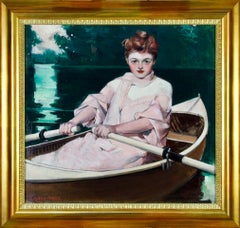
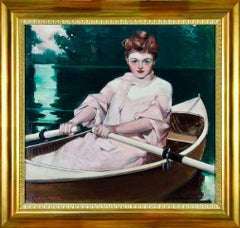
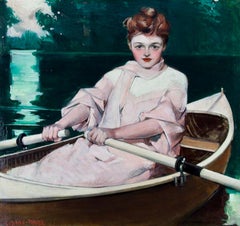
Original cover for Good Housekeeping, published August 1906 A young woman in pink sitting in a rowboat
Early 1900s Cushman Parker Art
Oil
Good Housekeeping Magazine Cover
By Cushman Parker
Located in Fort Washington, PA
Original cover for Good Housekeeping, published August 1906 A young woman in pink sitting in a rowboat
Oil
$22,500
Woman in a Rowboat - Original cover for Illustration for Good Housekeeping
By Cushman Parker
Located in Fort Washington, PA
Original magazine cover illustration for Good Housekeeping, published August 1906. The illustration features a young woman in pink sitting in a rowboat Artwork Dimensions: 22.5" x 2...
Canvas, Oil
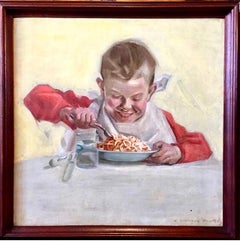
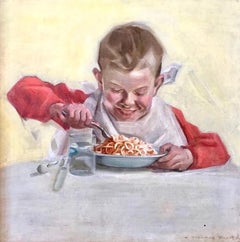
Beech-Nut Spaghetti Advertisement
By Cushman Parker
Located in Fort Washington, PA
Medium: Oil on Canvas Signature: Signed Lower Right
Canvas, Oil
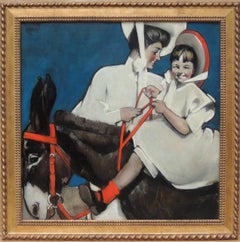
Good Housekeeping Magazine Cover, August 1905
By Cushman Parker
Located in Fort Washington, PA
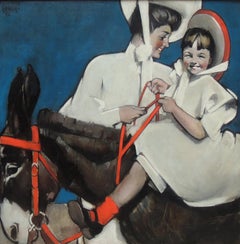
A mother watches as her daughter rides a donkey Medium: Oil on Canvas Signature: Signed Upper Left Good Housekeeping Magazine Cover, August 1905
Canvas, Oil
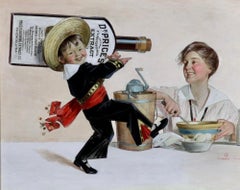
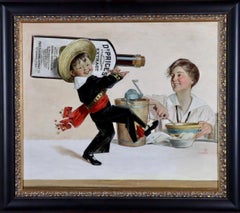
Dr. Price Flavoring
By Cushman Parker
Located in Fort Washington, PA
Medium: Oil on Canvas Signature: Signed Lower Right
Canvas, Oil
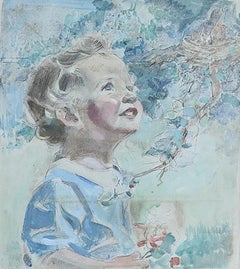
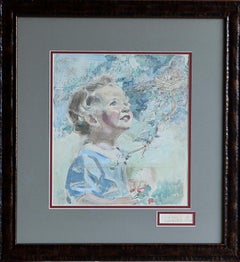
Little Boy Looking at Birds Nest
By Cushman Parker
Located in Fort Washington, PA
Medium: Watercolor on Board Signature: Unsigned Contact for exact dimensions. Likely used as an early magazine cover.
Watercolor, Board
$38,069
H 31.34 in W 26.38 in D 1.97 in
Male and female portrait, both in silk kimono, possibly textile dealers
By Christoffel Lubieniecki
Located in Amsterdam, NL
CHRISTOFFEL LUBIENIECKI (1659-1729) Pair of portraits of a gentleman and a lady, both in silk kimono, before a country house (circa 1680) Indistinctly signed “C.......” on a box under the man’s left hand Oil on canvas, 79.5 x 67 cm each Both sitters are portrayed wearing a silk “Japanese” coat. During the second half of the seventeenth the Japanese silk coat, an adapted Japanese kimono, became a real vogue in the Dutch elite. The exclusive Dutch trade contacts with Japan can explain the popularity of the kimono-style silk coats in the Netherlands. Everybody who could afford one, dressed in such a fashionable and comfortable coat and, like the present sitters, some proud owners had themselves portrayed in a “Japanese” coat often together with an oriental carpet to underline their standing and international connections. These portraits are the work of the Polish-born portraitist Christoffel Lubieniecki (also known as Lubienitski, Lubinitski or Lubiniecki) Lubieniecki was first trained in Hamburg under Julian Stuhr and after 1675 in Amsterdam under Adriaen Backer and Gerard de Lairesse. He specialized in landscapes, generally of an Italianate character, and in portraits. The loving execution of these contented burghers, enjoying the garden vistas of their country house, places him alongside Amsterdam portraitists such as Constantijn Netscher and Michiel van Musscher...
Canvas, Oil
$2,500
H 16 in W 18 in
1940's Americana WPA Modernist Watercolor Painting Catskill Mountains Bungalow
By Samuel Grunvald
Located in Surfside, FL
Bungalow (fauvist painting of New York scene) 1940's. image is 10X 11.5 inches. Hand signed lower right Watercolor painting on paper board Country Scene Samuel Grunvald was a Hunga...
Watercolor, Paper, Board
Seductive Women of the Bible Original Artwork
By Edmund Dulac
Located in Miami, FL
Keep thee from evil women, an original design for the planned, but unpublished series of American Weekly covers, 'The Book of Proverbs', watercolor and gouache, signed lower right, ...
Watercolor, Gouache, Illustration Board
$10,000
H 10 in W 7.5 in D 1 in
Art Nouveau Illustration Women and Children in the Woods
Located in Miami, FL
Complex Art Nouveau patterns intertwined with gracefull figures define this work by American Artist and illustrator, teacher and lecturer Mildred Bailey Carpenter. Signed in cartouc...
Gouache, Paper, Board
$3,212
H 18.12 in W 21.66 in D 1.97 in
Change of paradigm #1 - Hélène Duclos, Contemporary figurative painting
By Hélène Duclos
Located in Paris, FR
Oil on canvas Signed Unique work 1 / Hélène DUCLOS, 2016 – Artist Statement “Questioning the human condition and the position of being alive – What is i...
Canvas, Oil
$3,806
H 28.75 in W 36.23 in D 1.97 in
Incoherence of compulsory ways #1 - Hélène Duclos, Contemporary figurative paint
By Hélène Duclos
Located in Paris, FR
Oil on canvas Signed lower right Unique work 1 / Hélène DUCLOS, 2016 – Artist Statement “Questioning the human condition and the position of being alive – What is it to be a living being? Who / what can we believe? Who / what can we trust? How real is our view of the world? And how is that perspective angled, and ultimately limited? These are the issues at the heart of my work as an artist. Painting, drawing, engraving and embroidery give me the freedom to approach my subjects from an ambivalent and flexible standpoint. I am building up a dynamic body of work, like pieces that you can put together in one way or another to shape different structures, pierced with numerous openings. And the title that I give each piece acts as a possible clue as to how to enter inside that system. I can portray both softness and monstrosities. I focus on the links and barriers lying between living beings and their surroundings, and evoke how permeable these connections are. My aim is not to create a visual documentary reporting fact, but rather immerse myself in observing everyday life, and in a host of images depicting real events (pictures, photos and videos). Instilled with these images, I can give a more personalized, unique and allegorical vision of the world around me. I am also interested in the key transition periods of human existence, those turning points that forge our identity within a family, a group, and society as a whole at the heart of a specific environment. I centre on what makes up and creates cohesion (rituals, myths and tales….), and indeed the opposite - what leads to life becoming shattered, hindered and frustrated (moving populations, exile and migration…) Amidst a landscape roaming with wild beasts and hybrid creatures, between love and separation, metaphors for our own desires and fears lie in hiding, or reveal themselves in the painted or embroidered spaces. Sometimes they are etched with lines, symbols and tiny architectural designs. These works might depict our inner landscapes, as if harking back to a primordial and cosmic point of origin. My most recent collections recreate the images of bodies or landscapes using abstract zones and figurative details that have no direct link with either anatomy or geography. Intimacy and the unspeakable are themes that run throughout my work, and I make sure to incorporate areas of both visual tension and relief, so as to give the viewer the space to project him or herself into the work. And here, such paradoxes can only be reached through the interplay between abstraction and figuration.” 2 / Thierry Delcourt Psychiatrist, psychoanalyst and author of works on the process of artistic creation, and the conditions of existential and social creativity : "Entering into the world of Hélène Duclos in her drawings, paintings, embroidery and words means letting yourself be carried away by a torrent towards strange shores of creation where only a few artists have ever dared to venture. As if perched on a watchtower on the threshold of different worlds, Hélène Duclos throws us out of our depth, plunging us into spaces filled with destitute mankind, and guiding us through her stem-like maze of a scheme, bristling with roots and clues. But the mystery here, like a poetic, human rebus that never ends, only compels us to take a closer look.” 3 / Hélène Duclos ‘s biography : After graduating from the Duperré School of Applied Arts in Paris with a degree in textile design, I set off on a six-month sea voyage from Vannes in Brittany, to Dakar. On returning to France, I set up my atelier...
Canvas, Oil
$12,500
H 16.38 in W 12.5 in
Cuban Artist - Caricature of Adolphe Menjou Debonair Devil
Located in Miami, FL
Framed Cuban Artist/Caricaturist Conrado Walter Massaguer presents Hollywood star Adolphe Menjou in a satirical dual portrait. In the foreground, the subject is seen in a dapper top hat, tux, fashionable cigarette and boutonnière, and is shown as being the epitome of being stylishly debonair. To make a larger point about this subject, Massaguer paints a cast shadow of Menjou as a burning red devil who studies his alter ego from above. Keeping with the artist's sarcasm, we see the good and bad in one image. Works by Massaguer are rare and this work is in keeping with his signature style. This work was most likely done on assignment for Life Magazine, Cosmopolitan, The New Yorker or Vanity Fair. Signed upper right. Inscribe lower right. Titled on verso. Unframed, Slight bend to board; toning to board; scattered faint foxing; pin point abrasions to margins, not affecting image. 19-1/2 x 15-1/8 inches board size. Conrado Walter Massaguer y Diaz was a Cuban artist, political satirist, and magazine publisher. He is considered a student of the Art Nouveau. He was the first caricaturist in the world to broadcast his art on television.He was first caricaturist to exhibit on Fifth Avenue. He was the first caricaturist in the world to exhibit his caricatures on wood. He, and his brother Oscar, were the first magazine publishers in the world to use photolithographic printing. Self portrait of Conrado Walter Massaguer, depicted on a carrousel ride, with the devil over his left shoulder and an angel over his right. (1945) He created the magazine Social with his brother Oscar to showcase Cuban artistic talent. The duo later created the magazine Carteles, which became for a period the most popular magazine in Cuba, which was purchased by Miguel Ángel Quevedo in 1953. In his life, he met and drew caricatures of Franklin D. Roosevelt, Walt Disney, Albert Einstein, the King of Spain, and many others.[ In sum total, he was the author of more than 28 thousand caricatures and drawings.Ernest Hemingway once had to refrain himself from punching Massaguer in the face after the artist drew an unflattering caricature of him. The dictator Gerardo Machado, however, did not punch Massaguer for his own unflattering caricature - he had the artist deported. He was one of the most internationally renowned Cuban artists of his day, and his art is still regularly featured in galleries across the Western Hemisphere and Europe. Early life Massaguer was born on October 18, 1889, in Cárdenas, Cuba.[In 1892, his family moved to Havana. When the Cuban War of Independence broke out, Massaguer's family escaped the country. From 1896 to 1908, he lived in Mérida, Mexico. However, during this time, his parents enrolled him in the New York Military Academy, where he stayed during school years. In 1905, after graduating the military academy, he briefly attended the San Fernando school in Havana, where he was tutored by Ricardo de la Torriente and Leopoldo Romañach. In 1906, less than a year later, he returned to the family home in Mexico. Career as artist Early career While living in Yucatán, Mexico, Massaguer published his first caricatures in local newspapers and magazines. These included La Campana, La Arcadia, and the Diario Yucateco. In 1908, he moved back to Havana. After returning to the island in 1908, Massaguer began mingling with Havana's aristocratic circles, forming close friendships with some of the city's most powerful and influential men, as well as winning the favor of many women who were quickly charmed by him. Massaguer, largely self-taught, honed his style using the avant-garde techniques he studied from the European and American magazines that were widely available in Cuba at the time. Cover of the immensely popular Cuban magazine El Figaro, drawn by Massaguer in 1909. This cover depicts two bumbling, incompetent American tourists to the island. He started drawing for El Fígaro, and was featured prominently on the cover in 1909. After two years of refining his craft, Havana announced a poster contest aimed at attracting North American tourists to stay in the city during the winter months. Notable figures like Leopoldo Romañach, Armando Menocal, Rodríguez Morey, Jaime Valls, and others also entered the competition. The jury was particularly impressed by the modern execution and creative solution of one piece, signed by Massaguer, who was relatively unknown at the time. The jury deliberations caused a great controversy.[5] The prize was ultimately awarded to the Galician painter Mariano Miguel, who had recently married the daughter of Nicolás Rivero, the wealthy owner of the conservative newspaper Diario de la Marina. Although Massaguer received only an honorable mention, the fraud scandal caused such an uproar that his name quickly entered the public spotlight, and he became an overnight sensation. In 1910, he became co-owner of the advertising agency Mercurio, with Laureano Rodríguez Castells. At Mercurio, he led the Susini cigar campaign, and earned substantial wealth. Massaguer has been described as a restless man, in both mind and body.After earning enough money from his art to begin traveling, he was almost always doing so. He constantly traveled between New York City and Havana, Mexico and France, Europe and the Americas. In 1911, his reputation among the Havana socialites solidified when he organized his own first public caricature exhibit, and also the first Caricature Salon ever held in the Americas, hosted at Athenaeum of Havana (the Ateneo), and the Círculo de La Habana. Other exhibitors here included Maribona, Riverón, Portell Vilá, Valer, Botet, Barsó, García Cabrera, Carlos Fernández, Rafael Blanco, and Hamilton de Grau. "Messaguer Visits Broadway." Caricatures of theatrical and literary figures. Elsie Janis, Raymond Hitchcock, S. Jay Kaufman (columnist), Ibanez, author of The Four Horsemen, and Frances White In 1912, in the New York American Journal, he published his first Broadway drawings. From 1913 to 1918, he was an editor for Gráfico. Social Main article: Social (magazine) Cover of the magazine Social, July 7, 1923 In 1916, he created the magazine Social with his brother, Oscar H. Massaguer. Social's contributors included Guillén Carpentier, Chacón y Calvo, Enrique José Varona and others.Social has been described as Massaguer's great love in the magazine industry, and was the property that historians say he cared the most about. Social was an innovative magazine, being the first magazine in the world to use a modern printing process called photolithographic printing. Social set cultural trends, not only in the fashion of Cuba, but in art, politics, and Cuban identity.[11] Social catered to a certain aesthetic in Cuba - that of the sophisticated elite socialite - but Massaguer would also use this magazine to ridicule and jibe against that same class of society when he found their personalities worthy of his contempt. In Social, readers could find a variety of content, including short stories, avant-garde poetry, art reviews, philosophical essays, and serialized novels, as well as articles on interior design, haute couture, and fashion. Occasionally, the magazine also featured reports on sports such as motor racing, rowing, tennis, and horse riding.The cultural promotion efforts of both Massaguer and Emilio Roig de Leuchsenring are evident in the magazine. Notably, this period overlaps with their involvement in the Minorista Group, which was then at the forefront of the country's intellectual life.[5] Many contributors were devoted members of the group, leading some experts to consider Social as the cultural voice of the Minoristas. One of the features of Social magazine was its section called "Massa Girls," which was a play on his own name, and pronounced with a glottal 'g' in a similar fashion to the letter in Massaguer.[12] Massaguer drew women as independent and free-thinking, and never drew the woman celebrity as a caricature of herself, but as a free agent surrounded by caricatures.[11] However, Massaguer himself has been described as a womanizer in his personal life, and hesitant to fully embrace every facet of women's liberation. In 1916, he also established la Unión de Artes Gráficas and the advertising agency Kesevén Anuncios.[9] The art critic Bernardo González Barroa wrote: “Massaguer has solved the problem of working hard, living comfortably off what his art produces and not missing any artistic, sporting or social event. His broad, childish laugh, of a carefree individual who carries his luck hidden in a pocket, appears everywhere for the moment, disguising the pranks of pupils that lurk, mock and, finally, flash with satisfaction at finding the characteristic point after having analyzed a soul... Massaguer's personality is beginning to solidify now. He has been the best-known and most popular caricaturist for a long time, but his technique had not reached the security, the mastery of values that he presents in his latest works, which is very natural and explainable”[5] Carteles Main article: Carteles Cover of the magazine Carteles, November 29, 1931 In 1919, Massaguer and his brother created the magazine Carteles.[9] Carteles gained the widest circulation of any magazine in Latin America, and the most popular magazine in Cuba for a time, until that title was claimed by Revista Bohemia. Carteles remained in print until July 1960.This magazine showcased Cuban commerce, art, sports, and social life before the revolution. In 1924, Carteles took a more political turn, with articles criticizing Gerardo Machado's government. it became a prime example of the humor and graphic design employed by artists like Horacio Rodríguez Suria and Andrés García...
Ink, Watercolor, Illustration Board
$6,000
H 13 in W 21 in
Art Deco Coulple Magazine Story Illustration, RedBook The Saturday Evening Post
By Seymour Alling Ball
Located in Miami, FL
Signed lower left: Seymour Ball Inscribed upper left: To Morris E Weiss with best wishes Seymour Ball" Matted not framed
India Ink, Watercolor, Illustration Board
$1,000
H 3.75 in W 5.5 in
Light Envelope with Tape, realist watercolor and pencil still life, 2016
By Margot Glass
Located in New York, NY
Margot Glass explores the fragility of communication, and people’s natural drive to find narrative in even the most ordinary of objects. In her Envelopes series, Glass works in water...
Watercolor, Illustration Board
$7,019
H 35.04 in W 57.09 in D 1.97 in
Alien invasion Stéphane Fauchille Contemporary art painting colour humour
By Stéphane Fauchille
Located in Paris, FR
Oil paint on canvas Unique work Hand-signed by the artist Stéphane Fauchille, dream anthropologist “Would you, for a moment, like to become the Claude Lévi-Strauss of the aborigin...
Canvas, Oil
$4,163
H 28.75 in W 36.23 in D 1.97 in
Selective memory #3 - Hélène Duclos, 21st Century, Contemporary painting
By Hélène Duclos
Located in Paris, FR
Oil on canvas Signed Unique work 1 / Hélène DUCLOS, 2016 – Artist Statement “Questioning the human condition and the position of being alive – What is it to be a living being? Who /...
Canvas, Oil
$11,301
H 76.78 in W 51.19 in D 1.97 in
The republican picnic Stéphane Fauchille Contemporary art painting colour humour
By Stéphane Fauchille
Located in Paris, FR
Oil paint on canvas Unique work Hand-signed by the artist Stéphane Fauchille, dream anthropologist “Would you, for a moment, like to become the Claude Lévi-Strauss of the aborigin...
Canvas, Oil