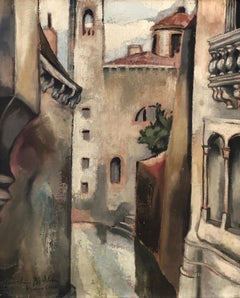
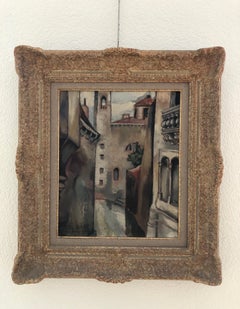
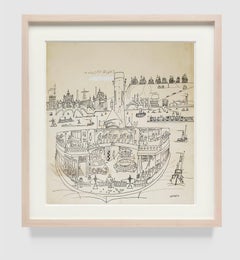
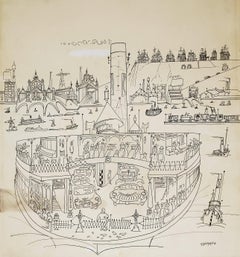
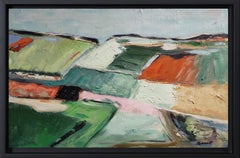
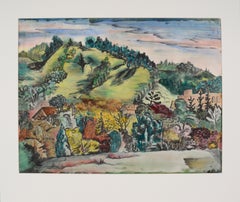
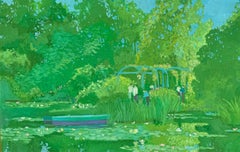
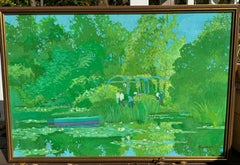
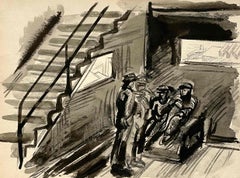
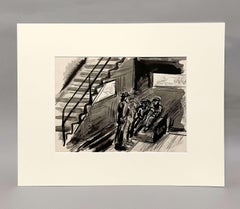
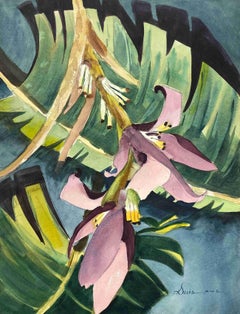
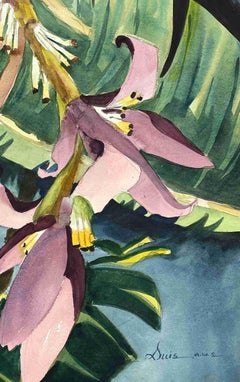
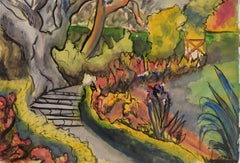
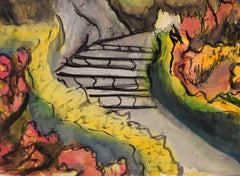
Doris Lee Landscape Paintings

1905-1983

Doris Lee, born in Aledo, Illinois, was one of the most successful artists of the depression era. Lee studied at the Kansas City Art Institute with the noted American impressionist Ernest Lawson. She also studied in Paris with the influential cubist painter Andre Lhote and at the California School of Fine Arts, San Francisco, with Arnold Blanch, whom she later married. In 1931, Lee moved permanently to Woodstock, New York and established herself as a leader in an important artist colony. The town’s proximity to New York City guaranteed a regular flow of artists between the colony and the metropolis, keeping in touch with current development in the arts. The Art Students League of New York helped to create that flow when it established a summer school in Woodstock in 1906 that brought hundreds of art students into the town each summer. The 1930s marked the beginning of a long and productive career for Doris Lee. Her work included easel paintings, murals, prints and illustrations, as well as costume, textile and ceramic design. Lee’s work from this period was concerned with life in rural America, and in a stylistic and ideological sense, had much in common with regionalism. Lee portrayed the simple joys of American life in touching, nostalgic and sometimes fanciful ways. Lee’s work was exhibited in the first Whitney Biennial exhibition in 1931. Her earliest major career achievement came in 1935 when she was awarded the Logan Prize for her painting Thanksgiving from the Art Institute of Chicago. Shortly after the Logan Prize, Lee was awarded two commissions by the U.S. Department of the Treasury for murals of the Washington, D.C. Post Office Building. An additional boost to the artist’s fame and prestige came in 1937 with the purchase of her painting ‘Catastrophe’ by the Metropolitan Museum of Art. From 1936–39, Lee was invited to be a summer guest artist at the Colorado Springs Fine Art Center. The 1930s finished with a flourish when Lee was invited to exhibit in the 1939 New York World’s Fair. This early support given to Lee by the museums and the art establishment was an impressive accomplishment for a young woman struggling for acceptance in the male-dominated art world of the time.

Starting in the late 1930s, Lee and her husband, Arnold Blanch, began to spend their winters in Key West, Florida. During the winters of the 1940s through the 1960s, Lee painted her unique Florida subjects: fishermen, bathers, beaches, mangrove swamps and Florida’s plant and wildlife. Lee combined the sophistication of her knowledge of pure abstraction with her love of American folk art to create her unique style. In the 1940s, Lee’s work became more stylized, more concerned with pure form and color. Her simple, flat paintings portrayed gardens, seasonal landscapes and women and children, as well as birds and other beasts. In 1943 and 1944, Lee was the guest artist at Michigan State College in Lansing, Michigan. She received many painting assignments from Life magazine during these years. She was awarded the prestigious Carnegie Prize in 1944 and was included in the 15 of the annual juried exhibition at Pennsylvania Academy of the Fine Arts.

Lee worked in Hollywood, California and Hawaii during the winter months of 1945. She toured Central America in 1946 and went to North Africa in 1951. During the 1950s until the end of the 1960s, Lee’s dealers have Associated American Artists Gallery and World House Galleries in New York City and the Rudolf Gallery in Woodstock. She participated in both one-man and group exhibitions with these dealers. Her paintings from this period are characterized by a bold move to pure abstraction. They are richly colored and geometric in design, with realistic references still discernible. Lee produced a significant body of abstract work during the 1960s. In these paintings, she combined her knowledge of international style, her interest in American folk art and her early training with Andre Lhote in abstract painting. The works celebrate Lee’s private experience of the world and synthesize her personal and emotional response to her subject matter. To engage the viewer’s entire field of vision, Lee used broad expanses of color, often geometrically organized. During this period, Lee experimented with black and white, biomorphic shapes and calligraphic brushwork. The late work is painterly yet contains the subtle, wry humor of her earlier work. Doris Lee retired from painting at the end of the 1960s. She died in Clearwater, Florida, in 1983.
to
1
1
Overall Width
to
Overall Height
to
2
1
2
2
1
2
1
1
1
4
639
629
458
321
1
1
2
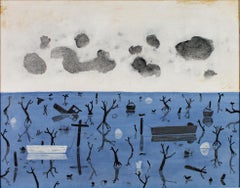
Artist: Doris Lee
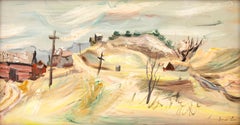
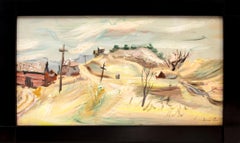
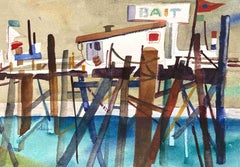
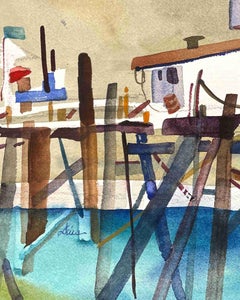
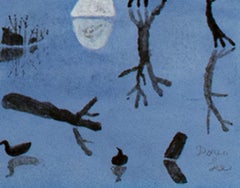
"Boats Amongst the Mangroves, " Watercolor & Gouache on Paper signed by Doris Lee

"Boats Amongst the Mangroves, " Watercolor & Gouache on Paper signed by Doris Lee

By Doris Lee

Located in Milwaukee, WI

"Boats Amongst the Mangroves" is an original watercolor and gouache painting on paper by Doris Lee. The artist signed the piece lower right. It depicts boats and other objects on a f...

Category

1930s American Modern Doris Lee Landscape Paintings

Materials

Watercolor, Gouache

Related Items
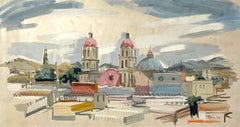
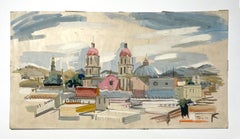
A Charming 1940s Modern Watercolor of a City in Mexico w/ Cathedral and Rooftops

A Charming 1940s Modern Watercolor of a City in Mexico w/ Cathedral and Rooftops

Located in Chicago, IL

A Charming 1940s Watercolor of a City in Mexico with Cathedral and Rooftops by Noted Chicago Artist, Rudolph T. Pen. A well executed early work by Pen, completed during the artist's...

Category

1940s American Modern Doris Lee Landscape Paintings

Materials

Watercolor, Gouache, Paper

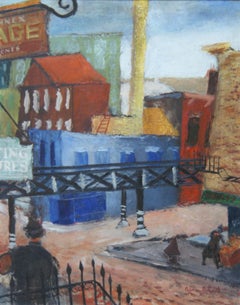
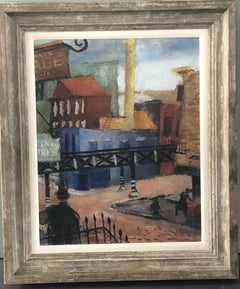
NYC Cityscape American Scene WPA Modern Realism Mid 20th Century Architectural

NYC Cityscape American Scene WPA Modern Realism Mid 20th Century Architectural

By Ernest Fiene

Located in New York, NY

NYC Cityscape American Scene WPA Modern Realism Mid 20th Century Architectural Ernest Fiene (1894-1965) Cityscape 36 x 30 inches Oil on canvas Signed and dated 1930. lower right Provenance Estate of the artist. ACA Galleries, New York Exhibited New York, Frank Rehn Gallery, Changing Old New York, 1931. New York, ACA Galleries, Ernest Fiene: Art of the City, 1925-1955, May 2-23, 1981, n.p., no. 5. BIO Ernest Fiene was born in Elberfeld, Germany in 1894. As a teenager, Fiene immigrated to the United States in 1912. He studied art at the National Academy of Design in New York City from 1914 to 1918, taking day classes with Thomas Maynard and evening classes with Leon Kroll. Fiene continued his studies at the Beaux-Arts Institute of Design in New York from 1916 to 1918, adding classes in printmaking at the Art Students League in 1923. Fiene began his career as an artist in 1919 with his first exhibition of watercolors at the MacDowell Club arranged by his mentor Robert Henri. In 1923 the Whitney Studio Club mounted a large exhibition of his works. The following year he had an exhibition at the New Gallery in New York, which completely sold out all fifty-two works, including paintings, watercolors, drawings, and etchings. With the proceeds of sales from the New Gallery exhibition, Ernest Fiene and his younger brother Paul, a sculptor, built studios in Woodstock, New York in 1925. In the early Twenties Ernest Fiene painted mostly landscapes of Woodstock and both the Ramapo and Hudson River Valleys. The first monograph from the Younger Artists Series was published on Fiene in 1922. Published in Woodstock, the series went on to include Alexander Brook, Peggy Bacon, and Yasuo Kuniyoshi. The book reproduced 1 illustration in color and another 27 reproductions in black and white. Around 1925 Fiene became fascinated with the intensity, excitement, and opportunities for color harmonies New York City offered as a subject. His paintings shifted to urban and industrial themes with architecture, industry, and transportation becoming his subjects. By 1926 Fiene had attracted the dealer Frank K.M. Rehn, who gave him a one-man exhibition that year, which travelled to the Boston Arts Club. C.W. Kraushaar Galleries gave Fiene a one-man exhibition of urban, landscape, portrait, and still life paintings in 1927. Julianna Force, the director of the Whitney Studio Club and first director of the Whitney Museum of American Art, included two of Fiene’s paintings in a fall exhibition in 1928. The Whitney Studio Club showed Fiene’s paintings in a two-man exhibition with Glenn O. Coleman that year and acquired three of Fiene’s paintings. Also in 1928 Fiene became affiliated with Edith Halpert’s Downtown Gallery where he had an exhibition of 20 lithographs in the spring. Fiene sold his house in Woodstock in 1928 to spend more of his time in New York City. With so many successful exhibitions, Fiene returned to Paris in 1928-29 where he rented Jules Pascin's studio and studied at the Académie de la Grande Chaumière. In France, Fiene painted both landscape and urban subjects developed from ideas influenced by Cubist geometry and the use of flat areas of broad color. Upon returning to New York in 1930, Fiene used this new approach to continue to paint New York skyscraper and waterfront subjects, as well as to begin a series of paintings on changing old New York based on the excavations for Radio City Music Hall and the construction of the Empire State Building. Frank K.M. Rehn Galleries exhibited this series, titled “Changing Old New York,” in 1931. Fiene also has solo exhibitions at Rehn Galleries in 1930 and 1932. Fiene’s oil paintings are exhibited at the Chicago Arts Club in 1930 as well. Fiene was included in the Museum of Modern Art’s exhibition Painting and Sculpture by Living Americans in December of 1931. Visiting New York, Henri Matisse saw the exhibition and called Fiene’s Razing Buildings, West 49th Street the finest painting he had seen in New York. Fiene had two mural studies from his Mechanical Progress series exhibited at the Museum of Modern Art’s exhibition Murals by American Painters and Photographers in 1932. Fiene sent View from my Window which depicts Fiene working on a lithograph stone while looking out his window to the newly completed Empire State Building to the Carnegie International in 1931. In 1932 Fiene participated in the first Biennial of American Painting at the Whitney Museum and his prints were included in exhibitions at the Downtown Gallery and the Wehye Gallery. In the same year, Fiene was awarded a Guggenheim fellowship to further study mural painting in Florence, Italy. On his return from Italy in 1933 Fiene re-engaged himself in New York City life and won several public and private mural projects. Fiene resumed his active exhibition schedule, participating in two group exhibitions at the Whitney Museum and a one-man exhibition of recent paintings at the Downtown Gallery in January 1934. In 1933 he purchased a farm in Southbury, Connecticut, which added Connecticut scenes to his landscape subjects. This was also the year Fiene began to spend summers on Monhegan Island, Maine, where he painted seascapes, harbor scenes, and still lifes. Fiene’s landscape paintings attracted numerous commissions as part of the American Scene movement. Through the fall and winter of 1935-36, Fiene took an extended sketching trip through the urban, industrial, and farming areas of Pennsylvania and West Virginia. Most of the twenty-four Pennsylvania urban and rural paintings...

Category

1930s American Modern Doris Lee Landscape Paintings

Materials

Canvas, Oil

"Winter" American Modernism WPA Regionalism Landscape  Mid-Century Magic Realism

"Winter" American Modernism WPA Regionalism Landscape Mid-Century Magic Realism

By Dale Nichols

Located in New York, NY

"Winter" American Modernism WPA Regionalism Landscape Mid-Century Magic Realism. 30 x 40 inches. Oil on canvas, c. 1960s, Signed lower right. As we list the painting now, the work is currently being cleaned, restored and a hand carved frame is being built. Additional photos will be uploaded as soon as possible. Our gallery, Helicline Fine Art, just launched our new digital exhibition: American Art: The WPA and Beyond. Three dozen paintings, works on paper and sculptures which are available here on 1stDibs. In person viewings can be arranged by appointment at our midtown Manhattan gallery. Provenance: "Winter" was originally purchased by Stanley Byer. Mr. Byer owned homes in Key West, New York City, and Washington, D.C. He purchased the painting from Dunning Auction in 1984 in Elgin, Illinois. Mr. Byer was related to Abraham Weiss from Florida. Saul Babbin, now deceased was a cousin of Mr. Weiss. I purchased the painting from Joy Babbin, Mr. Babbin's wife, now living in from New Mexico. Dale Nichols (1905 – 1995) Artist, printmaker, illustrator, watercolorist, designer, writer and lecturer, Nichols did paintings that reflected his rural background of Nebraska where he was born in David City, a small town. Although he did much sketching outdoors, most of his paintings were completed in his studio and often included "numerology, magic squares...

Category

1960s American Modern Doris Lee Landscape Paintings

Materials

Canvas, Oil

Till the Clouds Roll By 1945 Frank Sinatra Mid Century Modern Hollywood Film WPA

Till the Clouds Roll By 1945 Frank Sinatra Mid Century Modern Hollywood Film WPA

By Richard Whorf

Located in New York, NY

Till the Clouds Roll By 1945 Frank Sinatra Mid Century Modern Hollywood Film WPA TILL THE COULDS ROLL BY (Film Set), oil on canvas, 20 x 24 inches signed “Richard Whorf” lower right and signed and dated on the verso “R. Whorf/ Dec. 21, 1945. Frame by Hendenryk. ABOUT THE PAINTING This painting is from the collection of Barbara and Frank Sinatra, dated December 21, 1945 (just nine days after Frank Sinatra’s 30th birthday), and depicts the Metro-Goldwyn-Mayer Culver City backlot during the filming of Till the Clouds Roll By, the direction of the film having been taking over by Richard Whorf in December 1945. It is not presently clear if Whorf gave the Sinatras this painting as a gift, as the presence of the Dalzell Hatfield Galleries label on the verso indicates the painting may have been sourced there. Frank and Nancy Sinatra acquired a number of works from Dalzell Hatfield Galleries during the 1940’s, or perhaps they framed it for the couple. Sinatra performed “Old Man River’ in the film. Sinatra and June Allyson are depicted in the center of the painting. PROVENANCE From the Estate of Mrs. Nancy Sinatra; Dalzell Hatfield Galleries, Ambassador Hotel, Los Angeles. An image of the Dalzell Hatfield label and the back of the original frame (which we replaced with a stunning Heydenrk frame) are attached. Nancy Sinatra was Fran's first wife. Nancy Rose Barbato was 17 years old when she met Frank Sinatra, an 18-year-old singer from Hoboken, on the Jersey Shore in the summer of 1934. They married in 1939 at Our Lady of Sorrows Church in Jersey City where Frank gave Nancy a recording of a song dedicated to her titled "Our Love" as a wedding present. The young newlyweds lived and worked in New Jersey, where Frank worked as an unknown singing waiter and master of ceremonies at the Rustic Cabin while Nancy worked as a secretary at the American Type Founders. His musical career took off after singing with big band leaders Harry James and Tommy Dorsey...

Category

1940s American Modern Doris Lee Landscape Paintings

Materials

Canvas, Oil

A brooding American modernist landscape painting with a house or outbuilding

A brooding American modernist landscape painting with a house or outbuilding

Located in Colfax, CA

A nice American modernist landscape painting, dating from the 1940s. This work is on the manner of E. Oscar Thalinger, but does not appear to be signed. The work is unframed, as it...

Category

1940s American Modern Doris Lee Landscape Paintings

Materials

Oil

Houses in Zoar, Ohio Landscape, Early 20th Century Cleveland School

Houses in Zoar, Ohio Landscape, Early 20th Century Cleveland School

By August F. Biehle

Located in Beachwood, OH

August Frederick Biehle (1885-1979) Houses in Zoar, c. 1921 Gouache, litho crayon, colored pencil and graphite on paper Signed lower right 14 x 19 inches 20.25 x 25.25 inches, framed...

Category

1920s American Modern Doris Lee Landscape Paintings

Materials

Crayon, Gouache, Color Pencil, Graphite

Farm Landscape, Zoar, Ohio, American Modern, Gouache on Paper, Signed, C. 1923

Farm Landscape, Zoar, Ohio, American Modern, Gouache on Paper, Signed, C. 1923

By August F. Biehle

Located in Beachwood, OH

August Frederick Biehle (1885-1979) Farm Landscape, Zoar, c. 1923 Gouache, litho crayon and graphite on paper Signed lower right 14 x 19 inches 17 x 23 inches, framed A versatile pa...

Category

1920s American Modern Doris Lee Landscape Paintings

Materials

Crayon, Gouache, Graphite

Stylish Hawaiian Luau Oil Painting by Listed artist Mario Larrinaga (1895-1979)

Stylish Hawaiian Luau Oil Painting by Listed artist Mario Larrinaga (1895-1979)

Located in Baltimore, MD

Mario Larrinaga was born in Baja California in 1895 and moved with his brother to Los Angeles in 1909. He had no formal training in art, but had natural talent that was noticed by local movie studios. He was hired by Universal Studios as a designer, art director and creator of background scenes. He produced some of the background effects for King Kong in 1933. After a career in set design and illustration he focused on painting for pleasure in California, Mexico and Hawaii. He belonged to local art clubs and exhibited his works often. This stylized modernist work was likely created around 1960. It is oil on wood panel and of a horizontal format, 18” x 36”. It portrays a procession of seemingly Hawaiian natives...

Category

Mid-20th Century American Modern Doris Lee Landscape Paintings

Materials

Oil

Vintage Rockwell Kent Copy of "Vermont Winter 1921" Oil on Canvas Painting, 1960

Vintage Rockwell Kent Copy of "Vermont Winter 1921" Oil on Canvas Painting, 1960

By Rockwell Kent

Located in Baltimore, MD

This large painting is a ca. 1960 copy of a famous Rockwell Kent painting that was executed in Vermont in 1921. The work is oil on canvas and well represents the original image, tho...

Category

1960s American Modern Doris Lee Landscape Paintings

Materials

Oil

FLIGHT American Futurism Modernism Scene WPA Mid-Century Oil Painting Realism

FLIGHT American Futurism Modernism Scene WPA Mid-Century Oil Painting Realism

By Daniel Ralph Celentano

Located in New York, NY

FLIGHT American Futurism Modernism Scene WPA Mid-Century Oil Painting Realism Daniel Celentano (1902-1980) "Flight," 26 x 26 inches. Oil on canvas, c. 1940s. Signed lower right. Ori...

Category

1940s American Modern Doris Lee Landscape Paintings

Materials

Canvas, Oil

"Concert" Early 20th Century WPA Modernism American City Landscape Scene Ashcan

"Concert" Early 20th Century WPA Modernism American City Landscape Scene Ashcan

By Michael Loew

Located in New York, NY

"Concert" Early 20th Century WPA Modernism American City Landscape Scene Ashcan The size of the canvas 28 3/4 x 43 1/4 inches. The painting comes directly from the artist's estate. It is signed lower right as well as signed, titled and dated verso. We have available more than two dozen paintings and works on paper from the 1930s - 80s that come directly from the Loew estate. BIO Michael Loew (1907 – 1985) was the son of a New York City baker. After high school, he was an apprentice to a stained-glass maker, and from 1926-1929, he studied at the Art Students League. In 1929, he traveled to Paris, North Africa, Germany, and Italy with a group of artists. When he returned to New York City in 1931, the Great Depression hit Loew unexpectedly, and for the next two years he paid his apartment rent with his paintings. In 1935, he found work with the WPA where he painted murals and partnered up with longtime friend Willem de Kooning in 1939 on a mural for the Hall of Pharmacy at the New York World’s Fair. Their friendship lasted for the rest of their lives. In the mid-30’s he painted in Mexico and the Yucatán documenting the construction of a U.S. Naval airbase on Tinian Island. It was from this airbase that the Enola...

Category

1920s American Modern Doris Lee Landscape Paintings

Materials

Canvas, Oil

WPA Era, Industrial Scene Steel Mill by Chicago Modern Artist, Harold Haydon

WPA Era, Industrial Scene Steel Mill by Chicago Modern Artist, Harold Haydon

By Harold Haydon

Located in Chicago, IL

A dynamic 1930s, WPA era industrial scene watercolor of a steel mill and factory workers by notable Chicago Modern artist, Harold Haydon. A wonderful example of early Twentieth Cent...

Category

1930s American Modern Doris Lee Landscape Paintings

Materials

Watercolor, Paper

Doris Lee landscape paintings for sale on 1stDibs.

Find a wide variety of authentic Doris Lee landscape paintings available for sale on 1stDibs. If you’re browsing the collection of landscape paintings to introduce a pop of color in a neutral corner of your living room or bedroom, you can find work that includes elements of blue and other colors. You can also browse by medium to find art by Doris Lee in paint, gouache, oil paint and more. Much of the original work by this artist or collective was created during the 20th century and is mostly associated with the modern style. Not every interior allows for large Doris Lee landscape paintings, so small editions measuring 26 inches across are available. Customers who are interested in this artist might also find the work of Leon Dolice, Frank Wilcox, and Eric Sloane. Doris Lee landscape paintings prices can differ depending upon medium, time period and other attributes. On 1stDibs, the price for these items starts at $12,000 and tops out at $47,000, while the average work can sell for $29,500.