Hendrik Glintenkamp Art

American, 1887-1946
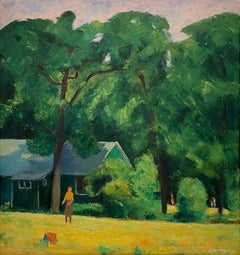
The painter and illustrator Henry Glintenkamp (1887-1946) is known mainly for his anti-war illustrations that appeared in The Masses and other publications in the early twentieth century. As a painter, he was additionally successful, particularly in his landscape and urban scenes. Born in Augusta, New Jersey, the son of Hendrik and Sophie Dietz Glintenkamp, Henry received his elementary art training at the National Academy of Design (1903-06) before his study with Robert Henri the two years following. Henri consequently attracted artists like Glintenkamp interested in returning to a sense of human qualities. Setting up his studio in the Lincoln Arcade Building with Stuart Davis and Glenn O. Coleman, Glintenkamp did work that reflects a preoccupation with urban scenes and landscapes. In May of 1910 Glintenkamp exhibited his works as a student at the Henri School and at the Exhibition of Independent Artists of 1910. Two years later, he accepted the position of instructor at the Hoboken Arts Club in New Jersey and in 1913, he took up with others in the organization of The Masses, designed as a publication devoted to humanitarian causes. This publication stood in stark opposition to war, as its articles and cartoons reflected pacifism. At the Armory Show (1913), Glintenkamp exhibited The Village Cemetery. In 1917, Glintenkamp moved to Mexico to avoid the draft, and remained there until 1924, supporting "the socialist agenda of Mexico's new leadership." The period following 1917 marks a new phase in the artist's development. Brighter in color and compositionally more involved, his later works are more discordant than the artist's earlier work. The artist sacrificed the atmospheric quality of the limited palette for the increased influence of modernist movements. After extensive travels in Europe, Glintenkamp returned to New York in 1934, and became a teacher at the New York School of Fine and Industrial Art and the John Reed Club School of Art. As chairman for the committee responsible for the organization of an Exhibition in Defense of World Democracy, in 1937, Glintenkamp continued his humanitarian purpose, though never really took up with the socialist rebels, many of whom followed similar groups and publications. Indeed, Glintenkamp was instrumental in founding the American Artists' Congress; he continued serving its needs as both the organization's president and secretary. A peripheral member of the impressionist-tonalist group in his early career, Glintenkamp had progressed through many American movements by the time of his death in 1946.
to
1
2
2
1
1
1
1
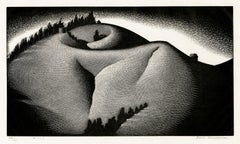
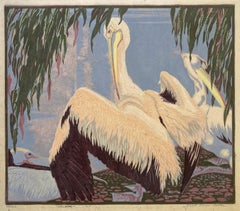
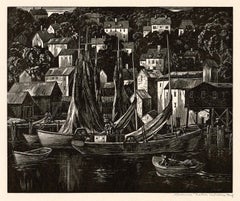
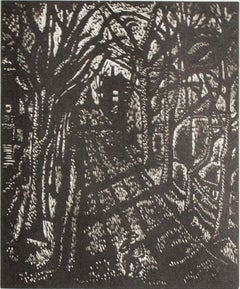
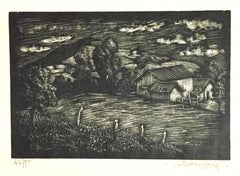
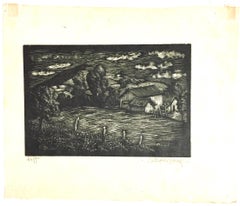
Hendrik Glintenkamp, (Farmyard)

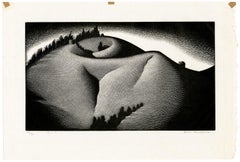
Hendrik Glintenkamp, (Farmyard)

By Hendrik Glintenkamp

Located in New York, NY

More a wood engraving rather than a woodcut, Glintenkamp's Farmyard scene was given all the care and detail of the artist's more complex images. It is signed and numbered in pencil. ...

Category

1920s American Modern Hendrik Glintenkamp Art

Materials

Woodcut

Related Items
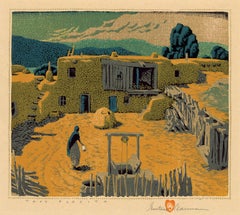
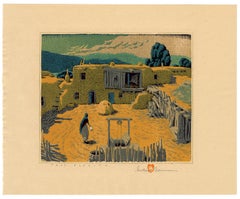
'Taos Placita' — American Southwest Regionalist Masterwork

'Taos Placita' — American Southwest Regionalist Masterwork

By Gustave Baumann

Located in Myrtle Beach, SC

Gustave Baumann, 'Taos Placita', color woodcut, 1947, edition 125. Baumann 132. Signed, titled, and numbered '20-125' in pencil; with the artist’s Hand-in-Heart chop. A superb, richly-inked impression, with fresh colors, on fibrous oatmeal wove paper; the full sheet with margins (2 to 3 1/8 inches); slight rippling at the left sheet edge, in excellent condition. Matted to museum standards, unframed. Image size 9 5/8 x 11 1/4 inches (244 x 286 mm); sheet size 13 1/4 x 17 inches (337 x 432 mm). Collections: Harwood Museum of Art, New Mexico Museum of Art, Phoenix Art Museum, Scottsdale Art Museum, Wichita Art Museum. ABOUT THE ARTIST Gustave Baumann (1881-1971) was a renowned printmaker and a leading figure of the American color woodcut revival whose exquisite craftsmanship and vibrant imagery captured the essence of the Southwest. "A brilliant printmaker, Baumann brought to the medium a full mastery of the craft of woodworking that he acquired from his father, a German cabinetmaker. This craftsmanship was coupled with a strong artistic training that resulted in the handsome objects we see in the exhibition today. After discovering New Mexico in 1918, Baumann began to explore in his woodblock prints of this period the light. color, and architectural forms of that landscape. His prints of this period are among the most beautiful and poetic images of the American West." —Lewis I. Sharp, Director, Denver Art Museum Baumann, the son of a craftsman, immigrated to the United States from Germany with his family when he was ten, settling in Chicago. From 1897 to 1904, he studied in the evenings at the Art Institute of Chicago, working in a commercial printmaking shop during the day. In 1905, he returned to Germany to attend the Kunstwerbe Schule in Munich, where he decided on a career in printmaking. He returned to Chicago in 1906 and worked for a few years as a graphic designer of labels. Baumann made his first prints in 1909 and exhibited them at the Art Institute of Chicago the following year. In 1910, he moved to the artists’ colony in Nashville, Indiana, where he explored the creative and commercial possibilities of a career as a printmaker. In 1915, he exhibited his color woodcuts at the Panama-Pacific International Exposition in San Francisco, winning the gold medal. Among Baumann’s ongoing commercial activities was his work for the Packard Motor Car Company from 1914 to 1920 where he produced designs, illustrations, and color woodcuts until 1923. In 1919, Baumann’s printmaking work dominated the important exhibition of American color woodcuts at the Detroit Institute of Arts. Twenty-six of his prints were included, far more than the works of any other artist. A set of his blocks, a preparatory drawing, and seven progressive proofs complemented the exhibition. That same year, Baumann worked in New York and, over the summer, in Provincetown, Massachusetts. His airy images of Cape Cod employed soft, pastel colors and occasionally showed the influence of the white-line woodcut technique. Many of his Chicago artist friends had traveled to the southwest, and Baumann became intrigued by their paintings, souvenirs, and stories of an exotic place named Taos, New Mexico. In the summer of 1918, he spent the summer in Taos sketching and painting before visiting Santa Fe. Paul Walter, the director of the Museum of New Mexico, offered him a studio in the museum's basement. Inspired by the rugged beauty of the Southwest—the vibrant colors and dramatic landscapes of the region became a central theme in his work, influencing his artistic style and subject matter for the remainder of his career. Later in the decade, he traveled to the West Coast and made prints of California landscape. Baumann's prints became synonymous with the Southwest, capturing the spirit of its place in America's identity with a unique sense of authenticity and reverence. His iconic images of desert vistas, pueblo villages, and indigenous cultures served as visual tributes to the region's rich cultural heritage, earning him a dedicated following among collectors and curators alike. A true craftsman and artist, Baumann completed every step of the printmaking process himself, cutting each block, mixing the inks, and printing every impression on the handmade paper he selected. His dedication to true craftsmanship and his commitment to preserving the integrity of his artistic vision earned him widespread acclaim and recognition within the art world. About the vibrant colors he produced, Baumann stated, “A knowledge of color needs to be acquired since they don’t all behave the same way when ground or mixed...careful chemistry goes into the making of colors, with meticulous testing for permanence. While complicated formulae evolve new colors, those derived from Earth and metal bases are still the most reliable.” In the 1930s, Baumann became interested in puppet theater. He designed and carved his own marionettes and established a little traveling company. From 1943 to 1945, the artist carved an altarpiece for the Episcopal Church of the Holy Faith in Santa Fe. In 1952, a retrospective exhibition of his prints was mounted at the New Mexico Museum of Fine Arts. Throughout his prolific career, Baumann executed nearly four hundred color woodcuts. Baumann’s woodcuts...

Category

1940s American Modern Hendrik Glintenkamp Art
Materials

Woodcut

A Bustling, 1950s Mid-Century Modern Summer Harbor Scene of Martha's Vineyard

A Bustling, 1950s Mid-Century Modern Summer Harbor Scene of Martha's Vineyard

By Francis Chapin

Located in Chicago, IL

A Bustling 1950s Mid-Century Modern Harbor Scene of Martha's Vineyard by Famed Chicago Artist, Francis Chapin (Am. 1899-1965). A busy harbor scene of sandy shoreline, docks and boat...

Category

Mid-20th Century American Modern Hendrik Glintenkamp Art
Materials

Canvas, Oil

A Compelling 1940s American Scene, Social Realism Oil Painting, "Tenement Ruins"

A Compelling 1940s American Scene, Social Realism Oil Painting, "Tenement Ruins"

Located in Chicago, IL

A Brooding, Compelling 1940s American Scene, Social Realist Oil Painting, "Tenement Ruins" by Notable Canadian / American artist Emil Weddige (1907-2001). Oil on canvas, dating from...

Category

1940s American Modern Hendrik Glintenkamp Art
Materials

Canvas, Oil

“Middleton Place II, 1974” Wolf Kahn, West Brattleboro, Vermont Barn Oil Canvas

“Middleton Place II, 1974” Wolf Kahn, West Brattleboro, Vermont Barn Oil Canvas

By Wolf Kahn

Located in Yardley, PA

A fantastic early painting from Kahn’s iconic barn series depicting Dr. Middleton’s property in West Brattleboro, VT. Here, Kahn turns a familiar rural motif into something hovering ...

Category

1970s American Modern Hendrik Glintenkamp Art
Materials

Canvas, Oil

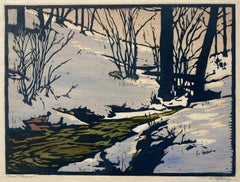
THE THAW
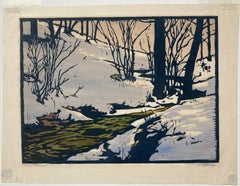
THE THAW

THE THAW

By William Seltzer Rice

Located in Santa Monica, CA

WILLIAM SELTZER RICE (1873 - 1963) THE THAW c 1915-20 Color woodcut, signed and titled in pencil. Image 8 7/8 x 12 inches, sheet 10 3/4 x 14 3/8 inches. On textured fibrous paper. V...

Category

1910s American Modern Hendrik Glintenkamp Art
Materials

Color, Woodcut

John Edward Thompson Early Spring (Artist Studio) 1933 Colorado Modernist

John Edward Thompson Early Spring (Artist Studio) 1933 Colorado Modernist

By John Edward Thompson

Located in Denver, CO

A luminous 1933 modernist landscape by John Edward Thompson titled Early Spring (Thompson’s Studio), depicting the exterior of the artist’s Denver studio surrounded by the quiet emer...

Category

1930s American Modern Hendrik Glintenkamp Art
Materials

Canvas, Oil

A Serene 1940s, Modern Western Landscape Painting with Horses by Francis Chapin

A Serene 1940s, Modern Western Landscape Painting with Horses by Francis Chapin

By Francis Chapin

Located in Chicago, IL

A serene, 1940s Modern Western landscape painting with horses by famed Chicago artist, Francis Chapin. Accompanied with a handsome walnut brown stained wooden frame. Canvas size: 22 x 28 inches. Framed size: 25 x 31 inches. Estate stamped on reverse. Provenance: Estate of the artist. Francis Chapin, affectionately called the “Dean of Chicago Painters” by his colleagues, was one of the city’s most popular and celebrated painters in his day. Born at the dawn of the 20th Century in Bristolville, Ohio, Chapin graduated from Washington and Jefferson College near Pittsburgh, Pennsylvania before enrolling at the Art Institute of Chicago in 1922. He would set down deep roots at the Art Institute of Chicago, exhibiting there over 31 times between 1926 and 1951. In 1927 Chapin won the prestigious Bryan Lathrop Fellowship from the Art Institute – a prize that funded the artist’s yearlong study trip to Europe. Upon his return to the United States, Chapin decided to remain in Chicago, noting the freedom Chicago artists have in developing independently of the pressure to conform to pre-existing molds (as was experienced by artists in New York, for example). Chapin became a popular instructor at the Art Institute, teaching there from 1929 to 1947 and at the Art Institute’s summer art school in Saugatuck, Michigan (now called Oxbow) between 1934 – 1938 (he was the director of the school from 1941-1945). Chapin’s contemporaries among Chicago’s artists included such luminaries as Ivan Le Lorraine Albright...

Category

1940s American Modern Hendrik Glintenkamp Art
Materials

Canvas, Oil

View Of Wellfleet, Massachusetts

View Of Wellfleet, Massachusetts

Located in Bryn Mawr, PA

Edwin Dickinson (1891-1978) View Of Wellfleet, Massachusetts, 1942 Oil on canvas, 10 x 12 inches (25.4 x 30.5 cm) Framed dimensions: 15 1/4 x 17 1/4 in Signed in the wet, vertically ...

Category

1940s American Modern Hendrik Glintenkamp Art
Materials

Canvas, Oil

"Squall, " Sailboat Maritime Scene Wood Engraving by Lowell Merritt Lee

"Squall, " Sailboat Maritime Scene Wood Engraving by Lowell Merritt Lee

By Lowell Merritt Lee

Located in Milwaukee, WI

"Squall is an original wood engraving by Lowell Merritt Lee. It features a rendition of a squall, a sudden violent gust of wind that often brings in rain, snow, or sleet. Image: 6.1...

Category

1930s American Modern Hendrik Glintenkamp Art
Materials

Woodcut

Jane Peterson, Signed Still Life Floral Oil Painting

Jane Peterson, Signed Still Life Floral Oil Painting

By Jane Peterson

Located in Rockport, MA

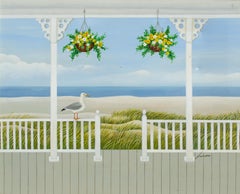
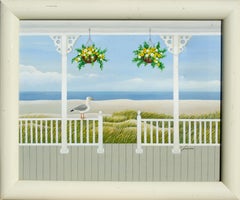
Dimensions: 24"x24" with frame 32"x32" Signed Lower Left A vibrant and expressive still life by Jane Peterson, "Flowers in a Yellow Vase" exemplifies the artist’s mastery of color, ...

Category

Mid-20th Century American Modern Hendrik Glintenkamp Art
Materials

Canvas, Oil

Previously Available Items
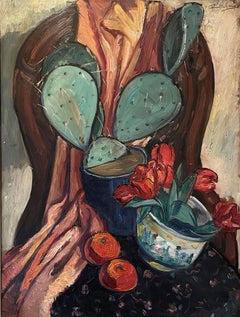
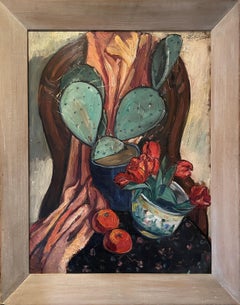
"Cactus, Tulips, and Tangerines Still Life, " Hendrik Glintenkamp, Mexico Modern

"Cactus, Tulips, and Tangerines Still Life, " Hendrik Glintenkamp, Mexico Modern

By Hendrik Glintenkamp

Located in New York, NY

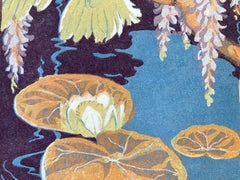
Hendrik (Henry) J Glintenkamp (1887 - 1946) Cactus, Tulips, and Tangerines Still Life, 1928 Oil on board 26 x 20 inches Signed upper right; signed, dated and titled on the reverse T...

Category

1920s Hendrik Glintenkamp Art
Materials

Oil, Board

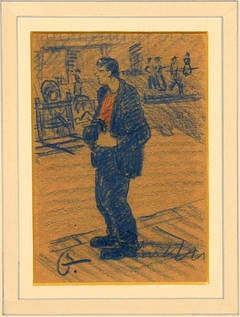
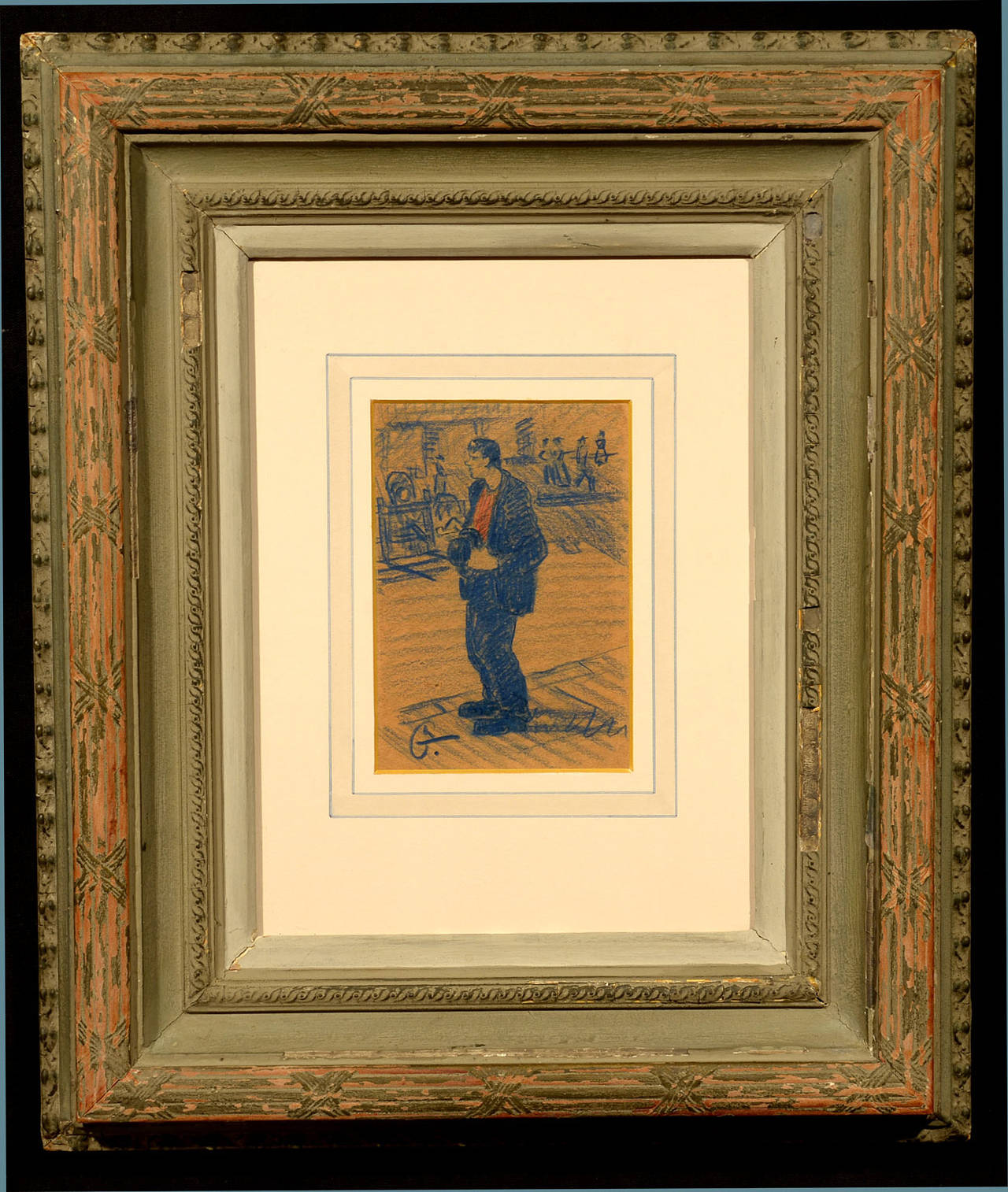
Streets of New York
Streets of New York

Streets of New York

By Hendrik Glintenkamp

Located in Wiscasset, ME

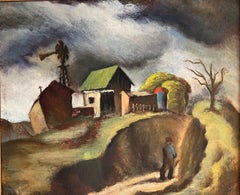
Born in 1887 in Augusta, New Jersey, painter, printmaker, illustrator and sculptor Hendrik Glintenkamp studied at the National Academy of Design and with Robert Henri and John Sloan ...

Category

1910s Ashcan School Hendrik Glintenkamp Art
Materials

Crayon

Hendrik Glintenkamp art for sale on 1stDibs.

Find a wide variety of authentic Hendrik Glintenkamp art available for sale on 1stDibs. You can also browse by medium to find art by Hendrik Glintenkamp in oil paint, paint, board and more. Much of the original work by this artist or collective was created during the 20th century and is mostly associated with the modern style. Not every interior allows for large Hendrik Glintenkamp art, so small editions measuring 6 inches across are available. Customers who are interested in this artist might also find the work of August Mosca, Luigi Lucioni, and Frank Weston Benson. Hendrik Glintenkamp art prices can differ depending upon medium, time period and other attributes. On 1stDibs, the price for these items starts at $400 and tops out at $9,750, while the average work can sell for $6,500.

Artists Similar to Hendrik Glintenkamp