By Mary Spain
Located in Valladolid, ES
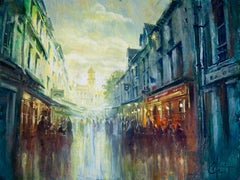
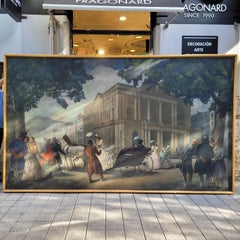
“The walk”, Lluís Muntané Muns, Catalan School, pp. 20th century - Spain
Technique on support: oil on canvas
Title of the work: “The Walk”
Author: Lluís Muntané Muns (1899 - 1987)
Style/School: Catalan School
Period: first half of the 20th century
Country of origin: Catalonia, Spain
Origin: Banco Santander
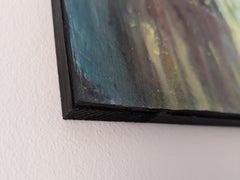
Some damage visible in the photographs and that could be restored
Dimensions: 204 x 343 cm.
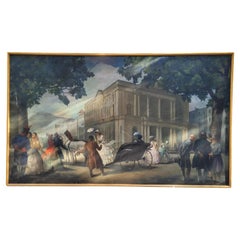
One of a kind and Large oil on canvas signed by Lluís Muntané Muns depicting a pleasant everyday scene, aristocrats and bourgeois taking a walk along a wide avenue. The ladies with their elegant dresses and parasols and the men with long coats.
This work is unique, not only for its pictorial quality in such a large, almost muralist size, but for its traceability, it was commissioned at the beginning of the 20th century and includes a bank building from the end and beginning of the 20th century in Latin America.
The composition is divided into a horizontal strip in the lower half in which the different characters are arranged, conversing with each other, flanked by the trees that appear at the ends. Behind them, in the center of the composition rises a large neoclassical-style building that escapes towards the landscape that can be seen in the background.
Lluís Muntané Muns opted for a realistic academicism, of high quality but with sober and static expression, which is also reminiscent of some of the characteristics of Catalan noucentisme. Although most of his career was dedicated to portraits, he also cultivated muralism. A lover of chiaroscuro, he managed to provide warmth to his plastic environments with an equally elegant and contained palette. His compositions are always well constructed and have the elegance that seems a dominant note in all aspects of his work.
Noucentisme or Novencentism designates a cultural movement that began in 1906 in Catalonia (propounded by Eugenio d'Ors), claiming the need for a classicism with a sense of modernity, but that was at the same time linked to tradition, given its nationalist mood. . Catalan identity linked to the classic substratum of Catalonia and its connection with the Mediterranean. He wanted to break with the cosmopolitan character of Modernism and the transience of Impressionism. He set out to achieve a more objective, constant and, ultimately, eternal art. For this, the idea of the “classical” (but never an explicit copy of said period) and the “Mediterranean” was used and the way to capture it in painting was through static, balanced, and simple compositions. It must be pointed out that it cannot be understood as a style, but as a series of ideas that each artist understands in his own way.
In this case, the memory of noucentisme is appreciated above all in the composition: a feeling of serenity, proportion, the figures do not present very exaggerated or grandiose movements... It attempts to represent the eternal through compositional balance. The colors seem muted because this effect was sought, since they understood classicism as something serene and balanced.
Lluís Muntané Muns (Mataró, Barcelona, 1899 – Barcelona, 1987)
A disciple of Vicente Borrás and José...
Category
1920s Spanish Romantic Vintage Mary Spain Art
MaterialsCanvas, Paint, Wood