Werner Drewes Prints and Multiples

American, 1899-1985

Werner Drewes was a painter, printmaker, and teacher, who was born in Canig, Germany, in 1899. His father, a Lutheran Minister, hoped he would become an architect, but Werner chose the life of an artist. After he served on the front line in France during the war, Werner was admitted to the Bauhaus in 1921, where he studied under Klee, Itten, and Muche. Later, he traveled through Europe to study such old masters as Tintoretto, Velasquez and El Greco. After marrying Margaret Schrobsdorff, they traveled throughout South America, North America and Asia. In 1930, Werner immigrated to New York City with his family. In New York City, despite the Depression, Werner joined other Bauhaus artists such as Piet Mondrian and Lyonel Feininger to make a living as an artist. This group became the core of the American Abstract Artists group. Werner taught at Columbia University, worked on the design of the 1939 World's Fair building, and had shows at the Museum of Modern Art, Kleeman Gallery, and elsewhere. In 1946, he accepted a tenured position at the Washington University in St. Louis. In his later years, he moved to Virginia and continued to show at galleries in Germany, Turkey, and in the United States. The Smithsonian held a show attributing his 65 years as a printmaker at the Museum for American Artists.

to
12
6
Overall Width
to
Overall Height
to
4
3
1
24
1,257
970
908
867
1
17
1
6
1
3
1
14
4
5
4
3
2
1
1
1
1
1
1
1
1
1
1
10
6
3
3
1
1
18
Artist: Werner Drewes
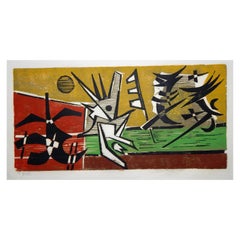
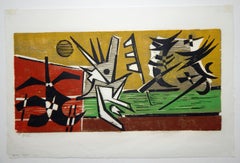
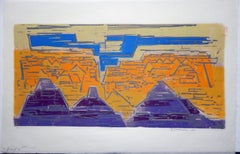
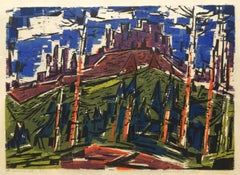
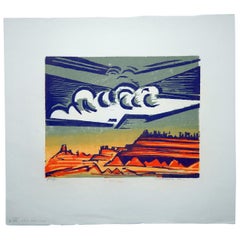
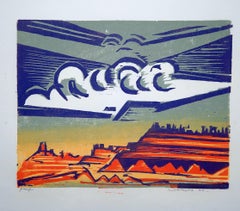
Huge  - CASTLE ROCK WYOMING (Jackson Hole),

Huge - CASTLE ROCK WYOMING (Jackson Hole),

By Werner Drewes

Located in Santa Monica, CA

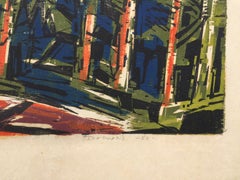
WERNER DREWES (1899 - 1985) CASTLE ROCK WYOMING (Jackson Hole), (Rose RIII 194) Color woodcut Total edition XXX, Signed, annotated AP and dated '58 in...

Category

1950s Abstract Expressionist Werner Drewes Prints and Multiples

Materials

Woodcut

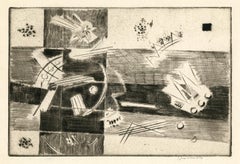
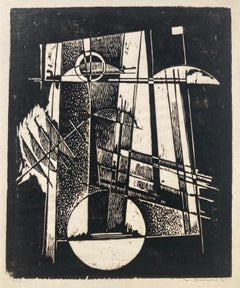
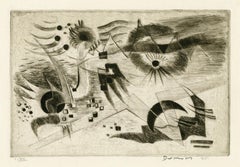
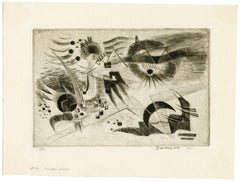
Pointed Shapes and Black Half Moon

Pointed Shapes and Black Half Moon

By Werner Drewes

Located in Myrtle Beach, SC

Werner Drewes, 'Pointed Shapes and Black Half Moon', etching, 1935, edition 20, Rose l.198. Signed, dated, and numbered 'I-XX' in pencil. A fine, rich impression, in warm black ink...

Category

1930s Bauhaus Werner Drewes Prints and Multiples

Materials

Etching

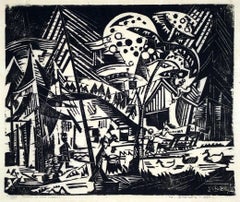
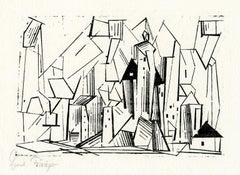
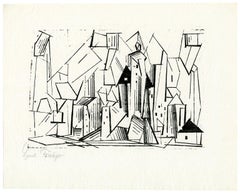
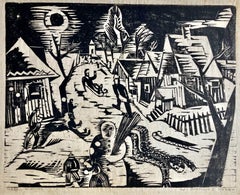
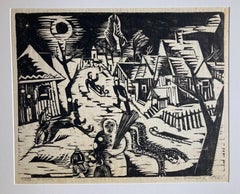
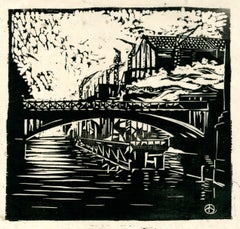
Werner Drewes, Winter, 1933, modernist woodcut

Werner Drewes, Winter, 1933, modernist woodcut

By Werner Drewes

Located in New York, NY

A modernist fantasy winter scene created by Werner Drewes, this print brings key aspects of the period together. His cubist-inspired woodcut technique is utilized here to bring the s...

Category

1930s American Modern Werner Drewes Prints and Multiples

Materials

Woodcut

1969 Woodcut, Titled "Andalusian Sky" by Bauhaus Master Werner Drewes

1969 Woodcut, Titled "Andalusian Sky" by Bauhaus Master Werner Drewes

By Werner Drewes

Located in Chicago, IL

A 1969 woodcut, titled "Andalusian Sky" by Bauhaus Master Werner Drewes. Signed and numbered in pencil. Edition: 21/XXX. An impression of this print is in the collection of the Sm...

Category

1960s Bauhaus Werner Drewes Prints and Multiples

Materials

Paper, Woodcut

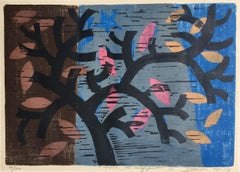
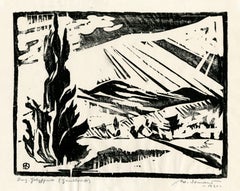
Tree at Night
Tree at Night

Tree at Night

By Werner Drewes

Located in Santa Monica, CA

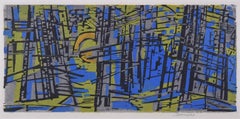
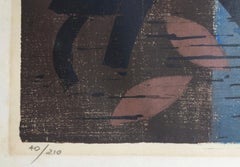
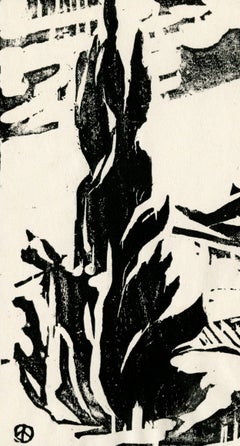
WERNER DREWES (German-American 1899-1985) TREE AT NIGHT, 1964 (Rose 241) Color woodcut Signed titled, dated and numbered 40 /210 all in pencil below image. Image 11 1/8 x 15 7/8 inc...

Category

1960s Abstract Expressionist Werner Drewes Prints and Multiples

Materials

Woodcut

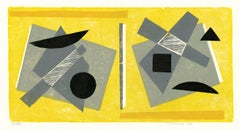
Twin Formation in Gray

Twin Formation in Gray

By Werner Drewes

Located in Myrtle Beach, SC

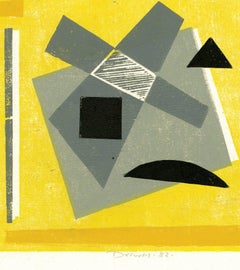
Twin Formation in Gray, color woodcut, 1982, edition 30, Rose III.400. Signed, dated and numbered I7/XXX in pencil, annotated 415 and titled in the bottom left sheet edge. A fine impression with fresh, rich colors, on heavy off-white Japan paper; the full sheet with wide margins (1 3/4 to 3 1/4 inches), in good condition. Printed in black, dark gray, medium gray, yellow/orange, and lemon yellow. Matted to museum standards, unframed. An impression of this work is included in the permanent collection of the Smithsonian American Art Museum. ABOUT THE ARTIST Painter, printmaker, and art teacher, Werner Drewes (1899–1985) was among the founding fathers of American abstraction. A student at the famed Bauhaus in the 1920s, he studied under Lyonel Feininger, Paul Klee, Laszlo Moholy-Nagy and Wassily Kandinsky. Following his emigration to the United States in 1930, he was instrumental in introducing modernist Bauhaus concepts and esthetics to America. Drewes’ boldly dynamic and emotionally expressive work, which encompassed both non-objective and figurative genres, brought him critical acclaim and numerous gallery and institutional exhibitions throughout his artistic career. Drewes' graphic work can be found in most major American art museums including, the Ackland Art Museum, The Art Institute of Chicago, Bauhaus Archive...

Category

Late 20th Century Bauhaus Werner Drewes Prints and Multiples

Materials

Woodcut

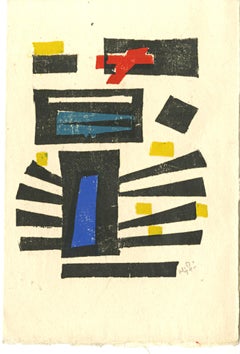
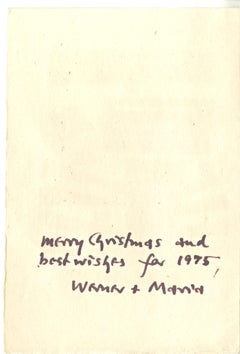
Untitled Mid Century Modern Abstract Woodcut

Untitled Mid Century Modern Abstract Woodcut

By Werner Drewes

Located in New York, NY

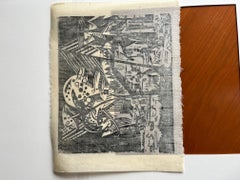
Werner Drewes Untitled Mid Century Modern Abstract Woodcut, 1974 Woodcut fold-out card on Rives BFK paper with deckled edges 9 1/5 × 6 1/4 inches Unframed Rarely seen, this twice sig...

Category

Mid-20th Century Abstract Werner Drewes Prints and Multiples

Materials

Woodcut

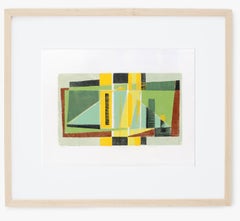
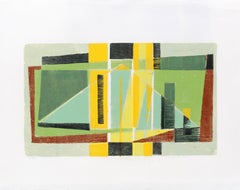
Werner Drewes Woodblock Print Cubist Colorful Rare Framed Green Black Red 1982

Werner Drewes Woodblock Print Cubist Colorful Rare Framed Green Black Red 1982

By Werner Drewes

Located in Buffalo, NY

An original woodblock print by American artist Werner Drews. This composition comes in an archival frame presentation which measures 26 x 30 on the wall. Werner Drewes (1899-1985) Werner Drewes, painter, printmaker, and teacher was born in Canig, Germany in 1899. His father, a Lutheran Minister, hoped he would become and architect but Werner chose the life of an artist. After he served on the front line in France during the war, Werner was admitted to the Bauhaus in 1921 where he studied under Klee, Itten, and Muche. Later, he traveled through Europe to study such old masters as Tintoretto, Velasque, and El Greco. After marrying Margaret Schrobsdorff, they traveled throughout South America, North America, and Asia. In 1930, Werner immigrated to New York City with his family. In New York City, despite the Depression, Werner joined other Bauhaus artists such as Mondrian and Feininger to make a living as an artist. This group became the core of the American Abstract Artists group. Werner taught at Columbia University, worked on the design of the 1939 Worlds Fair building...

Category

1980s Cubist Werner Drewes Prints and Multiples

Materials

Paper, Woodcut

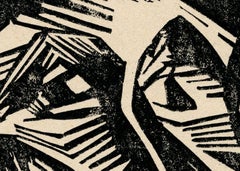
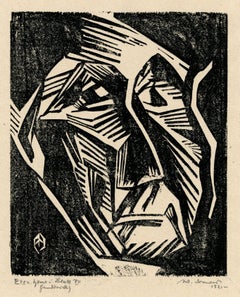
Ecce Homo VII
Ecce Homo VII

Ecce Homo VII

By Werner Drewes

Located in Fairlawn, OH

Ecce Homo VII Woodcut, 1921 Signed, titled, and dated in pencil by the artist One of only three known impressions Created while the artist was studying at the Bauhaus in Weimar, Germany. Extreme rarity-One of three know impressions Note: In 1921 Drewes went to the Bauhaus in Weimar, where, after completing the compulsory preliminary course with Johannes Itten, he continued to study with Paul Klee, Oskar Schlemmer and Georg Muche and initially went to the wall painting workshop. He then traveled extensively through Europe, North America and Asia. After returning to Germany in 1927, he went back to the Bauhaus, this time to his new location in Dessau, where he studied in the classes of László Moholy-Nagy and Wassily Kandinsky. He was one of the first artists to introduce the groundbreaking concepts of the Bauhaus School in the United States through his painting, printmaking, and teaching. Condition: Excellent Missing small voids in the upper margin from removal of the original hinges. Image size: 9 7/8 x 8 3/16 inches Reference: Rose 30 Provenance: From the estate of Drewes's teacher at the Bauhaus. During the pasot WW2 the professor lived in East Germany. WERNER DREWES 1899-1985 Werner Drewes initially studied architecture before enrolling, in 1921-22, at the Bauhaus in Weimar under Klee, Kandinsky, Itten and Feininger. For four years - 1923 to 1927 - he travelled the world with his bride, before completing his Bauhaus training in Dessau in 1929. He immigrated to the United States in 1930, documenting that move to New York through series of woodcuts. In 1936/37 he was an active founder of the American Abstract Artists and participated in the Federal Arts Project in New York before moving on to a teaching career at Washington University in St. Louis. As an artist for over sixty five years, he employed various media from drawing and watercolor, through woodcut and etching, to painting and collage. Translating an early interest in subjective cubistic forms, his work evolved into nonobjective abstraction. He was creative until the day of his death. Courtesy: Toby C. Moss Werner Drewes (1899–1985) was a painter, printmaker, and art teacher. Considered to be one of the founding fathers of American abstraction, he was one of the first artists to introduce concepts of the Bauhaus school within the United States. His mature style encompassed both nonobjective and figurative work and the emotional content of this work was consistently more expressive than formal. Drewes was as highly regarded for his printmaking as for his painting. In his role as teacher as well as artist he was largely responsible for bringing the Bauhaus aesthetic to America. Early life and education Drewes was born in 1899 to Georg Drewes, a Lutheran pastor, and Martha Schaefer Drewes. The family lived in the village of Canig within Lower Lusatia, Germany. From age eight to eighteen he attended the Saldria Gymnasium, a boarding school in Brandenburg an der Havel. There, he showed talent both for painting and woodblock printing. Graduating from Saldria in 1917, he was drafted by the German army and served in France from then until the close of the war. About this period of his life he is reported to have said that the horrors of life at the front were only made tolerable by his sketchbook, a copy of Goethe's Faust and a volume of Nietzsche. For a decade following the close of the war he studied, made paintings and prints, and traveled widely. His friend, Herwarth Walden, helped shape his appreciation for expressionist literature and art. Walden produced the quarterly magazine, Der Sturm and ran a gallery of contemporary art, Galerie Der Sturm, from which, in 1919, Drewes purchased an expressionist painting by William Wauer titled Blutrausch (Bloodlust). In the same year he made the acquaintance of Heinrich Vogeler and participated in Vogeler's socialist utopian artists' commune, Barkenhoff, at Worpswede, Lower Saxony. In 1919 Drewes also enrolled at the Königlich Technischen Hochschule Charlottenburg to study architecture and the following year he studied the same subject at the Technischen Hochschule Stuttgart. Preferring art over architecture, he then enrolled in Stuttgart's school of applied arts (Kunstgewerbeschule) where he studied life drawing and learned to work with colored glass. At this time he joined a group of artists and architects associated with the newly formed Merz Akademie, a college of design, art, and media in Stuttgart. In 1921 his friendship with a French artist, Sébastien Laurent, led him to begin studies in Weimar at Bauhaus, then a new school which taught an integrated approach to the fine and applied arts. His instructors were Johannes Itten and Lyonel Feininger, whose paintings were expressionist and abstract, and Paul Klee, who taught bookbinding, stained glass, and murals. While at Bauhaus Drewes produced a portfolio of ten woodblock prints entitled "Ecce Homo." In 1923 and 1924 he studied art during travels throughout Italy, Spain, the United States, and Central America and in 1926 he traveled to San Francisco, Japan, and Korea, thence taking the Trans-Siberian railway to Manchuria, Moscow, and Warsaw. He later said the El Grecos he saw proved to be most influential in his work. While traveling, he exhibited: (1) etchings in Madrid (1923) and Montevideo (1924), oils and etchings in Buenos Aires and St. Louis (1925), and (3) etchings in San Francisco (1926). He paid his way by the sales these exhibits produced and by taking commissions to paint portraits. While in San Francisco he set up a shop from which he sold prints he had made in Spain and South America. After his return to Germany in 1927 he resumed study at Bauhaus, which had been forced to relocate in Dessau, Saxony-Anhalt. His instructors at that time were László Moholy-Nagy (metal work), Wassily Kandinsky, and (painting), and Lyonel Feininger (prints). At this time he also worked and exhibited in Frankfurt. With the rise of Nazism abstract artists found it increasingly difficult to sell their work and, in 1930, Drewes, finding the political pressure unbearable, emigrated to the United States. There, despite the world economic crisis, Drewes was able to earn a living as a professional artist. Mature style After Drewes moved to New York, Kandinsky, who was both friend and mentor, continued to exert a strong influence over his style. Later in life he said he had a hard time getting away from Kandinsky's influence as he developed his own style. In time he was able to bring a more emotional approach to his work and to base it, more than Kandinsky did, on natural forms. In 1930 Drewes had a solo exhibition at the 135th Street Branch of the New York Public Library and a two-person show at the S.P.R. Penthouse Gallery...

Category

1920s Expressionist Werner Drewes Prints and Multiples
Materials

Woodcut

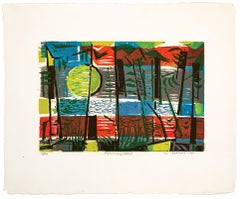
'Shimmering Waters' — Mid-Century Modernist Abstraction

'Shimmering Waters' — Mid-Century Modernist Abstraction

By Werner Drewes

Located in Myrtle Beach, SC

Werner Drewes, 'Shimmering Waters', color woodcut, 1960, edition 16 in 1960, and 210 in 1962, Rose III.209. Signed, dated, and numbered I2/210 in pencil. Annotated 415 (the artist's ...

Category

1960s American Modern Werner Drewes Prints and Multiples

Materials

Woodcut

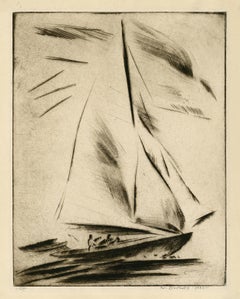
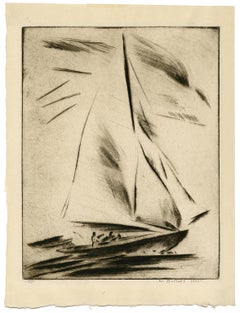
New Rochelle - Before the Wind

New Rochelle - Before the Wind

By Werner Drewes

Located in Myrtle Beach, SC

'New Rochelle - Before the Wind', drypoint, 1931, edition 30 (only a few impressions printed), Rose l.163. Signed, dated '1932' and numbered '1 – XXX' in ...

Category

1930s Modern Werner Drewes Prints and Multiples

Materials

Drypoint

Werner Drewes Bauhaus Artist Color Woodblock, 1977, White Storm Cloud

Werner Drewes Bauhaus Artist Color Woodblock, 1977, White Storm Cloud

By Werner Drewes

Located in Phoenix, AZ

Original color woodblock print by Werner Drewes. In excellent condition. Unframed. Image measures 11 1/4 x 14 1/4 inches. Pencil Signed and Dated: Proof (15) R-364. Werner Drewes (1899-1985) Werner Drewes, painter, printmaker, and teacher was born in Canig, Germany in 1899. His father, a Lutheran Minister, hoped he would become and architect but Werner chose the life of an artist. After he served on the front line in France during the war, Werner was admitted to the Bauhaus in 1921 where he studied under Klee, Itten, and Muche. Later, he traveled through Europe to study such old masters as Tintoretto, Velasque, and El Greco. After marrying Margaret Schrobsdorff, they traveled throughout South America, North America, and Asia. In 1930, Werner immigrated to New York City with his family. In New York City, despite the Depression, Werner joined other Bauhaus artists such as Mondrian and Feininger to make a living as an artist. This group became the core of the American Abstract Artists group. Werner taught at Columbia University, worked on the design of the 1939 Worlds Fair building...

Category

Late 20th Century Werner Drewes Prints and Multiples

Materials

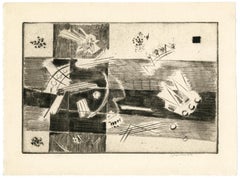
Paper

Small Forms On Crossing Bands

Small Forms On Crossing Bands

By Werner Drewes

Located in Myrtle Beach, SC

Werner Drewes, 'Small Forms on Crossing Bands', drypoint and roulette, 1935, edition 20, Rose 1.197. Signed in pencil. A fine, rich impression, in warm black ink, on cream wove paper...

Category

1930s Bauhaus Werner Drewes Prints and Multiples

Materials

Drypoint

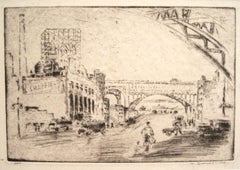
Werner Drewes, 125th Street at Broadway, NYC

Werner Drewes, 125th Street at Broadway, NYC

By Werner Drewes

Located in New York, NY

Werner Drewes brought his modernist vision to this subject but created, in my opinion, a great work of the Etching Revival. The reference is Rose 183. It...

Category

1930s American Modern Werner Drewes Prints and Multiples

Materials

Drypoint

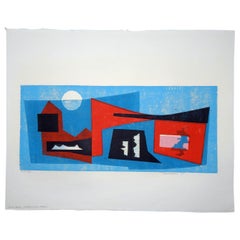
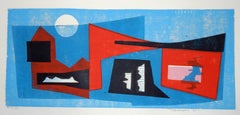
Werner Drewes Bauhaus Artist Color Woodblock, 1975, Enterlocked Forms

Werner Drewes Bauhaus Artist Color Woodblock, 1975, Enterlocked Forms

By Werner Drewes

Located in Phoenix, AZ

Original color woodblock print by Werner Drewes. In excellent condition. Unframed. Image measures 9 1/8 x 21 inches. Pencil signed and dated lower right. Edition size in pencil lower left: #3 of 30. (13) R-341 Werner Drewes (1899-1985) Werner Drewes, painter, printmaker, and teacher was born in Canig, Germany in 1899. His father, a Lutheran Minister, hoped he would become and architect but Werner chose the life of an artist. After he served on the front line in France during the war, Werner was admitted to the Bauhaus in 1921 where he studied under Klee, Itten, and Muche. Later, he traveled through Europe to study such old masters as Tintoretto, Velasque, and El Greco. After marrying Margaret Schrobsdorff, they traveled throughout South America, North America, and Asia. In 1930, Werner immigrated to New York City with his family. In New York City, despite the Depression, Werner joined other Bauhaus artists such as Mondrian and Feininger to make a living as an artist. This group became the core of the American Abstract Artists group. Werner taught at Columbia University, worked on the design of the 1939 Worlds Fair building...

Category

Late 20th Century Werner Drewes Prints and Multiples

Materials

Paper

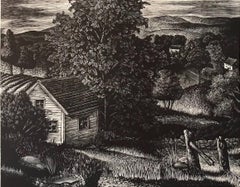
Farm in the Woods
Farm in the Woods

Farm in the Woods

By Werner Drewes

Located in New York, NY

Werner Drewes (1899-1983), Farm in the Woods, woodcut, 1933, signed and dated in pencil lower right (also numbered 1-xxx and titled lower left). Reference: Rose 83. In very good cond...

Category

1930s American Realist Werner Drewes Prints and Multiples
Materials

Woodcut

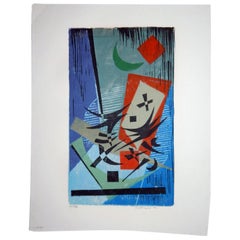
Werner Drewes Bauhaus Artist Color Woodblock, 1973, The Green Moon

Werner Drewes Bauhaus Artist Color Woodblock, 1973, The Green Moon

By Werner Drewes

Located in Phoenix, AZ

Original color woodblock print by Werner Drewes. In excellent condition. Unframed. Image measures 18 7/8 x 11 1/4 inches. Pencil signed and dated lower right. Edition size in pencil lower left: #24 of 30. (11) R-308. Werner Drewes (1899-1985) Werner Drewes, painter, printmaker, and teacher was born in Canig, Germany in 1899. His father, a Lutheran Minister, hoped he would become and architect but Werner chose the life of an artist. After he served on the front line in France during the war, Werner was admitted to the Bauhaus in 1921 where he studied under Klee, Itten, and Muche. Later, he traveled through Europe to study such old masters as Tintoretto, Velasque, and El Greco. After marrying Margaret Schrobsdorff, they traveled throughout South America, North America, and Asia. In 1930, Werner immigrated to New York City with his family. In New York City, despite the Depression, Werner joined other Bauhaus artists such as Mondrian and Feininger to make a living as an artist. This group became the core of the American Abstract Artists group. Werner taught at Columbia University, worked on the design of the 1939 Worlds Fair building...

Category

Late 19th Century Werner Drewes Prints and Multiples

Materials

Paper

Werner Drewes Bauhaus Artist Color Woodblock, 1973, At Play No. 3 'Fight'

Werner Drewes Bauhaus Artist Color Woodblock, 1973, At Play No. 3 'Fight'

By Werner Drewes

Located in Phoenix, AZ

Original color woodblock print by Werner Drewes. In excellent condition. Unframed. Image measures 11 x 22 3/4 inches. Pencil signed and dated lower right. Numbered in pencil lower left: 16 of the edition of 30. R-307. Werner Drewes (1899-1985) Werner Drewes, painter, printmaker, and teacher was born in Canig, Germany in 1899. His father, a Lutheran Minister, hoped he would become and architect but Werner chose the life of an artist. After he served on the front line in France during the war, Werner was admitted to the Bauhaus in 1921 where he studied under Klee, Itten, and Muche. Later, he traveled through Europe to study such old masters as Tintoretto, Velasque, and El Greco. After marrying Margaret Schrobsdorff, they traveled throughout South America, North America, and Asia. In 1930, Werner immigrated to New York City with his family. In New York City, despite the Depression, Werner joined other Bauhaus artists such as Mondrian and Feininger to make a living as an artist. This group became the core of the American Abstract Artists group. Werner taught at Columbia University, worked on the design of the 1939 Worlds Fair building...

Category

Late 20th Century Werner Drewes Prints and Multiples

Materials

Paper

Related Items
Room with a red arch - XXI Century, Contemporary Linocut Woodcut Print, Colorful

Room with a red arch - XXI Century, Contemporary Linocut Woodcut Print, Colorful

By Maria Stelmaszczyk

Located in Warsaw, PL

Maria Stelmaszczyk is a Polish artist born in 1983. PROVENANCE Exhibited at Katarzyna Napiorkowska Gallery. The Gallery is a primary representative for this artist. The Gallery o...

Category

Early 2000s Contemporary Werner Drewes Prints and Multiples

Materials

Paper, Woodcut, Linocut

Werner Drewes Woodblock Print Cubist Colorful Rare Framed Green Black Red 1982

Werner Drewes Woodblock Print Cubist Colorful Rare Framed Green Black Red 1982

By Werner Drewes

Located in Buffalo, NY

An original woodblock print by American artist Werner Drews. This composition comes in an archival frame presentation which measures 26 x 30 on the wall. Werner Drewes (1899-1985) Werner Drewes, painter, printmaker, and teacher was born in Canig, Germany in 1899. His father, a Lutheran Minister, hoped he would become and architect but Werner chose the life of an artist. After he served on the front line in France during the war, Werner was admitted to the Bauhaus in 1921 where he studied under Klee, Itten, and Muche. Later, he traveled through Europe to study such old masters as Tintoretto, Velasque, and El Greco. After marrying Margaret Schrobsdorff, they traveled throughout South America, North America, and Asia. In 1930, Werner immigrated to New York City with his family. In New York City, despite the Depression, Werner joined other Bauhaus artists such as Mondrian and Feininger to make a living as an artist. This group became the core of the American Abstract Artists group. Werner taught at Columbia University, worked on the design of the 1939 Worlds Fair building...

Category

1980s Cubist Werner Drewes Prints and Multiples
Materials

Paper, Woodcut

Approuvé Par L'Artiste: Mid-20th Century Abstract Lithograph

Approuvé Par L'Artiste: Mid-20th Century Abstract Lithograph

By Roger Bezombes

Located in Belgrade, MT

This lithograph is part of my private collection. It is limited in edition artist pencil signed lower right and is in very good condition. Roger Bezombes a print maker born in Paris ...

Category

Mid-20th Century Abstract Expressionist Werner Drewes Prints and Multiples
Materials

Lithograph

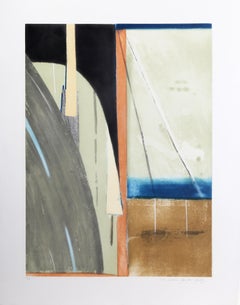
"Portal I", Abstract Patterns, Geometric Abstraction, Woodcut Monoprint on Panel

"Portal I", Abstract Patterns, Geometric Abstraction, Woodcut Monoprint on Panel

Located in Philadelphia, PA

This piece titled "Portal I" is an original piece by Alexis Nutini and is made from a woodcut monoprint mounted on panel. This piece measures 14.5"h x 9.5"w. Born in Mexico City, A...

Category

21st Century and Contemporary Contemporary Werner Drewes Prints and Multiples
Materials

Panel, Monoprint, Woodcut, Paper

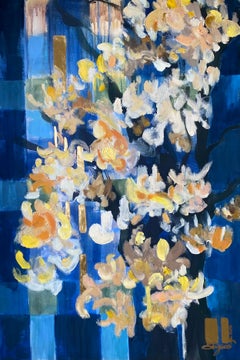
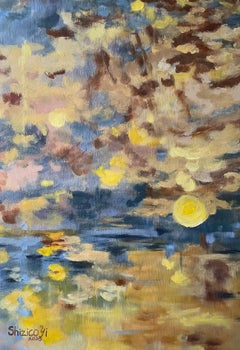
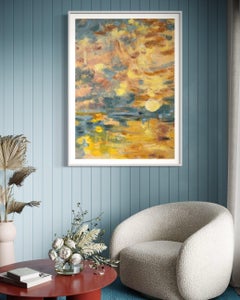
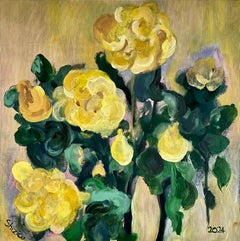
Hand-painted Aluminium Limited Edition#3-Summer Night-British Awarded Artist

Hand-painted Aluminium Limited Edition#3-Summer Night-British Awarded Artist

Located in London, GB

This is a rare hand-painted Limited Edition by contemporary artist Shizico Yi, created on a deluxe matte-finish giclée aluminium panel. Each edition is 90% hand-painted with Shizico’...

Category

2010s Abstract Expressionist Werner Drewes Prints and Multiples
Materials

Giclée, Archival Pigment, Digital Pigment

Hand painted Proof-Gladiolus Common Blue-British Awarded Artist-English Cottage

Hand painted Proof-Gladiolus Common Blue-British Awarded Artist-English Cottage

Located in London, GB

"Gladiolus Common Blue" marks the latest project by Shizico Yi, a continuation of her renowned "Sunlit Series." Initiated in late spring 2023 and extending throughout the years where...

Category

2010s Abstract Expressionist Werner Drewes Prints and Multiples
Materials

Gesso, Oil, Acrylic, Archival Paper

Frankenthaler, Mary Mary 1991, New York City, Lincoln Center

Frankenthaler, Mary Mary 1991, New York City, Lincoln Center

By Helen Frankenthaler

Located in Fairfield, CT

Artist: After Helen Frankenthaler (1928-2011) Title: Mary Mary (Lincoln Center Honorary) Year: 1991 Medium: Offset lithograph poster on extra thick Somerset paper Edition: 2000 Size...

Category

1990s Abstract Expressionist Werner Drewes Prints and Multiples
Materials

Lithograph, Offset

Winter on Cruise
Winter on Cruise

Jim DineWinter on Cruise, 2005

$8,500

H 30 in W 44 in

Winter on Cruise

By Jim Dine

Located in New York, NY

A very good impression of this color woodcut and lithograph diptych. Signed and dated in pencil by Dine. From a limited edition of 12.

Category

Early 2000s Modern Werner Drewes Prints and Multiples
Materials

Color, Lithograph, Woodcut

Harold Altman limited edition etching entitled "Park Path: Seated Bench Figures"

Harold Altman limited edition etching entitled "Park Path: Seated Bench Figures"

By Harold Altman

Located in Chesterfield, MI

Central Park, New York City is the locale for this subtle etching by Harold Altman. It is yellowing a bit around the corners due to natural aging process, however the coloring of th...

Category

Mid-20th Century Abstract Expressionist Werner Drewes Prints and Multiples
Materials

Etching

Numbers in Color, 1981, Johns

Jasper JohnsNumbers in Color, 1981, Johns, 1981

$476Sale Price|20% Off

H 39.5 in W 27 in

Numbers in Color, 1981, Johns

By Jasper Johns

Located in Fairfield, CT

Title: Numbers in Color Year: 1981 Medium: Offset Lithograph exhibition poster on archival paper Edition: 5,000 Size: 39.5 x 27 inches Condition: Excellent Notes: Published by the Al...

Category

1980s Abstract Expressionist Werner Drewes Prints and Multiples
Materials

Lithograph

Frankenthaler, Solar Imp 2001, Lincoln Center New York City Ballet

Frankenthaler, Solar Imp 2001, Lincoln Center New York City Ballet

By Helen Frankenthaler

Located in Fairfield, CT

Artist: After Helen Frankenthaler (1928-2011) Title: Solar Imp (Lincoln Center Salute’s the New York City Ballet) Year: 2001 Medium: Silkscreen poster on extra thick Somerset paper E...

Category

Early 2000s Abstract Expressionist Werner Drewes Prints and Multiples
Materials

Screen

Wedding Party
Wedding Party

Wedding Party, c. 1960

$400Sale Price|38% Off

H 16 in W 17 in

Wedding Party

Located in Buffalo, NY

An original mid century modern woodblock print. This work is hand signed illegibly and titled "Wedding Party".

Category

1960s Modern Werner Drewes Prints and Multiples
Materials

Paper, Woodcut

Previously Available Items
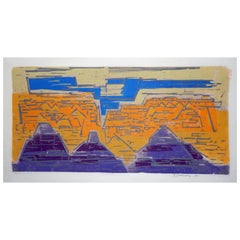
Werner Drewes Bauhaus Artist Color Woodblock, 1964, Grand Canyon

Werner Drewes Bauhaus Artist Color Woodblock, 1964, Grand Canyon

By Werner Drewes

Located in Phoenix, AZ

Original color woodblock print by Werner Drewes. In excellent condition. Unframed. Image measures: 11 1/8 x 22 7/8 inches. Pencil signed and dated lower right. Numbered in pencil lower left: Proof 3 R-232. Werner Drewes (1899-1985) Werner Drewes, painter, printmaker, and teacher was born in Canig, Germany in 1899. His father, a Lutheran Minister, hoped he would become and architect but Werner chose the life of an artist. After he served on the front line in France during the war, Werner was admitted to the Bauhaus in 1921 where he studied under Klee, Itten, and Muche. Later, he traveled through Europe to study such old masters as Tintoretto, Velasque, and El Greco. After marrying Margaret Schrobsdorff, they traveled throughout South America, North America, and Asia. In 1930, Werner immigrated to New York City with his family. In New York City, despite the Depression, Werner joined other Bauhaus artists such as Mondrian and Feininger to make a living as an artist. This group became the core of the American Abstract Artists group. Werner taught at Columbia University, worked on the design of the 1939 Worlds Fair building...

Category

Late 20th Century Werner Drewes Prints and Multiples
Materials

Paper

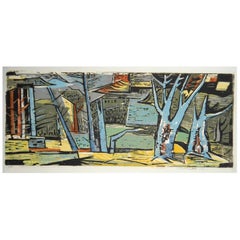
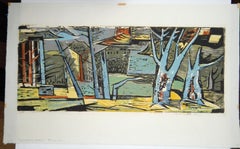
Werner Drewes Bauhaus Artist Color Woodblock, 1956, Mysterious Forest

Werner Drewes Bauhaus Artist Color Woodblock, 1956, Mysterious Forest

By Werner Drewes

Located in Phoenix, AZ

Original color woodblock print by Werner Drewes. In excellent condition. Unframed. Image measures: 9 3/4 x 23 3/4 inches. Pencil signed and dated. Numbered 2/X St. IV full color. Rose catalog #176 Werner Drewes (1899-1985) Werner Drewes, painter, printmaker, and teacher was born in Canig, Germany in 1899. His father, a Lutheran Minister, hoped he would become and architect but Werner chose the life of an artist. After he served on the front line in France during the war, Werner was admitted to the Bauhaus in 1921 where he studied under Klee, Itten, and Muche. Later, he travelled through Europe to study such old masters as Tintoretto, Velasque, and El Greco. After marrying Margaret Schrobsdorff, they travelled throughout South America, North America, and Asia. In 1930, Werner immigrated to New York City with his family. In New York City, despite the Depression, Werner joined other Bauhaus artists such as Mondrian and Feininger to make a living as an artist. This group became the core of the American Abstract Artists group. Werner taught at Columbia University, worked on the design of the 1939 World’s Fair...

Category

Mid-20th Century Werner Drewes Prints and Multiples
Materials

Paper

Ecce Homo Plate X
Ecce Homo Plate X

Ecce Homo Plate X

By Werner Drewes

Located in Fairlawn, OH

Ecce Homo Plate X Woodcut, 1921 Signed, titled, and dated in pencil by the artist (see photos) Edition: One of two known impressions This image wwas unknown to the catloger Ingrid Rose in 1984 when she published the catalog raisonne of Drewes prints. Done while Drewes was studying at the Bauhaus. Reference: Ingrid Rose, Werner Drewes: A Catalogue Raisonne of His Prints (Munich: Verlag Kunstgalerie Esslingen, 1984), 33, one of two known impressions. Provenance: Gift of the artist to one of his Bauhaus professors. Held in East Germany until the opening of the wall Jorg Maas Kunsthandel, Berlin Other image from the suite of Ecce Homo images are available. Extremely early, rare Bauhaus works. n 1921 Drewes went to the Bauhaus in Weimar, where, after completing the compulsory preliminary course with Johannes Itten, he continued to study with Paul Klee, Oskar Schlemmer and Georg Muche and initially went to the wall painting workshop. He then traveled extensively through Europe, North America and Asia. After returning to Germany in 1927, he went back to the Bauhaus, this time to his new location in Dessau, where he studied in the classes of László Moholy-Nagy and Wassily Kandinsky. He was one of the first artists to introduce the groundbreaking concepts of the Bauhaus School in the United States through his painting, printmaking, and teaching. Werner Drewes (1899–1985) was a painter, printmaker, and art teacher. Considered to be one of the founding fathers of American abstraction, he was one of the first artists to introduce concepts of the Bauhaus school within the United States. His mature style encompassed both nonobjective and figurative work and the emotional content of this work was consistently more expressive than formal. Drewes was as highly regarded for his printmaking as for his painting. In his role as teacher as well as artist he was largely responsible for bringing the Bauhaus aesthetic to America. Early life and education Drewes was born in 1899 to Georg Drewes, a Lutheran pastor, and Martha Schaefer Drewes. The family lived in the village of Canig within Lower Lusatia, Germany. From age eight to eighteen he attended the Saldria Gymnasium, a boarding school in Brandenburg an der Havel. There, he showed talent both for painting and woodblock printing. Graduating from Saldria in 1917, he was drafted by the German army and served in France from then until the close of the war. About this period of his life he is reported to have said that the horrors of life at the front were only made tolerable by his sketchbook, a copy of Goethe's Faust and a volume of Nietzsche. For a decade following the close of the war he studied, made paintings and prints, and traveled widely. His friend, Herwarth Walden, helped shape his appreciation for expressionist literature and art. Walden produced the quarterly magazine, Der Sturm and ran a gallery of contemporary art, Galerie Der Sturm, from which, in 1919, Drewes purchased an expressionist painting by William Wauer titled Blutrausch (Bloodlust). In the same year he made the acquaintance of Heinrich Vogeler and participated in Vogeler's socialist utopian artists' commune, Barkenhoff, at Worpswede, Lower Saxony. In 1919 Drewes also enrolled at the Königlich Technischen Hochschule Charlottenburg to study architecture and the following year he studied the same subject at the Technischen Hochschule Stuttgart. Preferring art over architecture, he then enrolled in Stuttgart's school of applied arts (Kunstgewerbeschule) where he studied life drawing and learned to work with colored glass. At this time he joined a group of artists and architects associated with the newly formed Merz Akademie, a college of design, art, and media in Stuttgart. In 1921 his friendship with a French artist, Sébastien Laurent, led him to begin studies in Weimar at Bauhaus, then a new school which taught an integrated approach to the fine and applied arts. His instructors were Johannes Itten and Lyonel Feininger, whose paintings were expressionist and abstract, and Paul Klee, who taught bookbinding, stained glass, and murals. While at Bauhaus Drewes produced a portfolio of ten woodblock prints entitled "Ecce Homo." In 1923 and 1924 he studied art during travels throughout Italy, Spain, the United States, and Central America and in 1926 he traveled to San Francisco, Japan, and Korea, thence taking the Trans-Siberian railway to Manchuria, Moscow, and Warsaw. He later said the El Grecos he saw proved to be most influential in his work. While traveling, he exhibited: (1) etchings in Madrid (1923) and Montevideo (1924), oils and etchings in Buenos Aires and St. Louis (1925), and (3) etchings in San Francisco (1926). He paid his way by the sales these exhibits produced and by taking commissions to paint portraits. While in San Francisco he set up a shop from which he sold prints he had made in Spain and South America. After his return to Germany in 1927 he resumed study at Bauhaus, which had been forced to relocate in Dessau, Saxony-Anhalt. His instructors at that time were László Moholy-Nagy (metal work), Wassily Kandinsky, and (painting), and Lyonel Feininger (prints). At this time he also worked and exhibited in Frankfurt. With the rise of Nazism abstract artists found it increasingly difficult to sell their work and, in 1930, Drewes, finding the political pressure unbearable, emigrated to the United States. There, despite the world economic crisis, Drewes was able to earn a living as a professional artist. Mature style After Drewes moved to New York, Kandinsky, who was both friend and mentor, continued to exert a strong influence over his style. Later in life he said he had a hard time getting away from Kandinsky's influence as he developed his own style. In time he was able to bring a more emotional approach to his work and to base it, more than Kandinsky did, on natural forms. In 1930 Drewes had a solo exhibition at the 135th Street Branch of the New York Public Library and a two-person show at the S.P.R. Penthouse Gallery...

Category

1920s Bauhaus Werner Drewes Prints and Multiples
Materials

Woodcut

Forest or Blue Forest

Forest or Blue Forest

By Werner Drewes

Located in Fairlawn, OH

Forest or Blue Forest Color woodcut, 1958 Signed in pencil lower right Edition: 260 The Print Club of Cleveland Publication No. 39 for 1961 (see photo of their label) Note: The Cleveland Museum of Art retains the original sketches, color separations and cancelled plate(s) in their collection under accession numbers 1961.59-1961.75 Printed by the Artist Condition: Very good Image size: 11-1/4 x 24-1/2" Werner Drewes (1899–1985) was a painter, printmaker, and art teacher. Considered to be one of the founding fathers of American abstraction, he was one of the first artists to introduce concepts of the Bauhaus school within the United States. His mature style encompassed both nonobjective and figurative work and the emotional content of this work was consistently more expressive than formal. Drewes was as highly regarded for his printmaking as for his painting. In his role as teacher as well as artist he was largely responsible for bringing the Bauhaus aesthetic to America. Early life and education Drewes was born in 1899 to Georg Drewes, a Lutheran pastor, and Martha Schaefer Drewes. The family lived in the village of Canig within Lower Lusatia, Germany. From age eight to eighteen he attended the Saldria Gymnasium, a boarding school in Brandenburg an der Havel. There, he showed talent both for painting and woodblock printing. Graduating from Saldria in 1917, he was drafted by the German army and served in France from then until the close of the war. About this period of his life he is reported to have said that the horrors of life at the front were only made tolerable by his sketchbook, a copy of Goethe's Faust and a volume of Nietzsche. For a decade following the close of the war he studied, made paintings and prints, and traveled widely. His friend, Herwarth Walden, helped shape his appreciation for expressionist literature and art. Walden produced the quarterly magazine, Der Sturm and ran a gallery of contemporary art, Galerie Der Sturm, from which, in 1919, Drewes purchased an expressionist painting by William Wauer titled Blutrausch (Bloodlust). In the same year he made the acquaintance of Heinrich Vogeler and participated in Vogeler's socialist utopian artists' commune, Barkenhoff, at Worpswede, Lower Saxony. In 1919 Drewes also enrolled at the Königlich Technischen Hochschule Charlottenburg to study architecture and the following year he studied the same subject at the Technischen Hochschule Stuttgart. Preferring art over architecture, he then enrolled in Stuttgart's school of applied arts (Kunstgewerbeschule) where he studied life drawing and learned to work with colored glass. At this time he joined a group of artists and architects associated with the newly formed Merz Akademie, a college of design, art, and media in Stuttgart. In 1921 his friendship with a French artist, Sébastien Laurent, led him to begin studies in Weimar at Bauhaus, then a new school which taught an integrated approach to the fine and applied arts. His instructors were Johannes Itten and Lyonel Feininger, whose paintings were expressionist and abstract, and Paul Klee, who taught bookbinding, stained glass, and murals. While at Bauhaus Drewes produced a portfolio of ten woodblock prints entitled "Ecce Homo." In 1923 and 1924 he studied art during travels throughout Italy, Spain, the United States, and Central America and in 1926 he traveled to San Francisco, Japan, and Korea, thence taking the Trans-Siberian railway to Manchuria, Moscow, and Warsaw. He later said the El Grecos he saw proved to be most influential in his work. While traveling, he exhibited: (1) etchings in Madrid (1923) and Montevideo (1924), oils and etchings in Buenos Aires and St. Louis (1925), and (3) etchings in San Francisco (1926). He paid his way by the sales these exhibits produced and by taking commissions to paint portraits. While in San Francisco he set up a shop from which he sold prints he had made in Spain and South America. After his return to Germany in 1927 he resumed study at Bauhaus, which had been forced to relocate in Dessau, Saxony-Anhalt. His instructors at that time were László Moholy-Nagy (metal work), Wassily Kandinsky, and (painting), and Lyonel Feininger (prints). At this time he also worked and exhibited in Frankfurt. With the rise of Nazism abstract artists found it increasingly difficult to sell their work and, in 1930, Drewes, finding the political pressure unbearable, emigrated to the United States. There, despite the world economic crisis, Drewes was able to earn a living as a professional artist. Mature style After Drewes moved to New York, Kandinsky, who was both friend and mentor, continued to exert a strong influence over his style. Later in life he said he had a hard time getting away from Kandinsky's influence as he developed his own style. In time he was able to bring a more emotional approach to his work and to base it, more than Kandinsky did, on natural forms. In 1930 Drewes had a solo exhibition at the 135th Street Branch of the New York Public Library and a two-person show at the S.P.R. Penthouse Gallery...

Category

1950s American Modern Werner Drewes Prints and Multiples
Materials

Woodcut

UNTITLED
UNTITLED

Werner DrewesUNTITLED, 1934

Sold

H 13.375 in W 11.125 in

UNTITLED

By Werner Drewes

Located in Santa Monica, CA

WERNE DREWES (1899-1985) UNTITLED, 1934 Woodcut on paper, Signed, numbered, and dated in pencil Ed. 15/20. Image 13 3/8 x 11 1/8 inches. Full sheet, 17 x 12 1/8 inches deckle edge o...

Category

1930s Abstract Werner Drewes Prints and Multiples
Materials

Woodcut

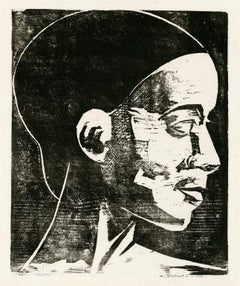
Harlem Beauty (Negress, Negro Girl, Black Girl)

Harlem Beauty (Negress, Negro Girl, Black Girl)

By Werner Drewes

Located in Myrtle Beach, SC

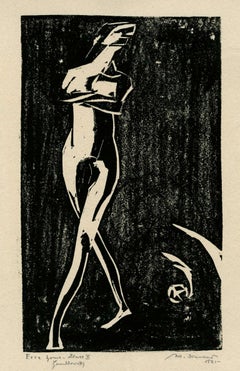
'Harlem Beauty' ('Negress', 'Negro Girl', 'Black Girl'), woodcut, 1930, edition 30, Rose lll.42. Signed, dated, numbered '1 - XXX', and titled 'Negress' in ...

Category

1930s Expressionist Werner Drewes Prints and Multiples
Materials

Woodcut

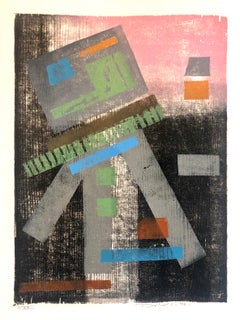
Bauhaus Abstract Color Woodcut Mechanical Ballet Woodblock Print

Bauhaus Abstract Color Woodcut Mechanical Ballet Woodblock Print

By Werner Drewes

Located in Surfside, FL

Mechanical Ballet Signed and dated Medium: Relief Print - Color Woodcut Substrate: Japanese Paper Size: Sheet 24 X 19. image 15 X 11 inches Subject: Abstract Year: 1978 Werner Drewes (1899–1985) was a painter, printmaker, and art teacher. Considered to be one of the founding fathers of American abstraction, he was one of the first artists to introduce concepts of the Bauhaus school within the United States. His mature style encompassed both nonobjective and figurative work and the emotional content of this work was consistently more expressive than formal. Drewes was as highly regarded for his printmaking as for his painting. His friend, Herwarth Walden, helped shape his appreciation for expressionist literature and art. Walden produced the quarterly magazine, Der Sturm and ran a gallery of contemporary art, Galerie Der Sturm, from which, in 1919, Drewes purchased an expressionist painting by William Wauer titled Blutrausch (Bloodlust). In the same year he made the acquaintance of Heinrich Vogeler and participated in Vogeler's socialist utopian artists' commune, Barkenhoff, at Worpswede, Lower Saxony. In 1919 Drewes also enrolled at the Königlich Technischen Hochschule Charlottenburg to study architecture and the following year he studied the same subject at the Technischen Hochschule Stuttgart. Preferring art over architecture, he then enrolled in Stuttgart's school of applied arts (Kunstgewerbeschule) where he studied life drawing and learned to work with colored stained glass. At this time he joined a group of artists and architects associated with the newly formed Merz Akademie, a college of design, art, and media in Stuttgart. In 1921 his friendship with a French artist, Sébastien Laurent, led him to begin studies in Weimar at Bauhaus, His instructors were Johannes Itten and Lyonel Feininger, whose paintings were expressionist and abstract, and Paul Klee, who taught bookbinding, stained glass, and murals. While at Bauhaus Drewes produced a portfolio of ten woodblock prints entitled "Ecce Homo." After his return to Germany in 1927 he resumed study at Bauhaus, which had been forced to relocate in Dessau, Saxony-Anhalt. His instructors at that time were László Moholy-Nagy (metal work), Wassily Kandinsky, and (painting), and Lyonel Feininger (prints). At this time he also worked and exhibited in Frankfurt. With the rise of Nazism abstract artists found it increasingly difficult to sell their work and, in 1930, Drewes, finding the political pressure unbearable, emigrated to the United States. In 1930 Drewes had a solo exhibition at the 135th Street Branch of the New York Public Library and a two-person show at the S.P.R. Penthouse Gallery (with Carl Sprinchorn...

Category

1970s Bauhaus Werner Drewes Prints and Multiples
Materials

Color, Woodcut

Ozark Flowers

Werner DrewesOzark Flowers

Sold

H 16 in W 20 in

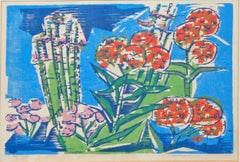
Ozark Flowers

By Werner Drewes

Located in Missouri, MO

Woodblock Image Size: approx 12 x 16 inches Framed Size: approx 16 x 20 inches Signed and Numbered Ed. 20 WERNER DREWES 1899 Germany--1985 USA The son of a Lutheran minister who ...

Category

1970s Abstract Expressionist Werner Drewes Prints and Multiples
Materials

Woodcut

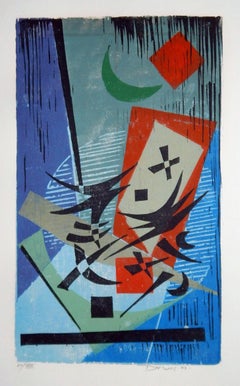
Werner Drewes prints and multiples for sale on 1stDibs.
Find a wide variety of authentic Werner Drewes prints and multiples available for sale on 1stDibs. If you’re browsing the collection of prints and multiples to introduce a pop of color in a neutral corner of your living room or bedroom, you can find work that includes elements of yellow and other colors. You can also browse by medium to find art by Werner Drewes in woodcut print, drypoint, engraving and more. Much of the original work by this artist or collective was created during the 20th century and is mostly associated with the abstract style. Not every interior allows for large Werner Drewes prints and multiples, so small editions measuring 7 inches across are available. Customers who are interested in this artist might also find the work of Lyonel Feininger, and Guy Georget. Werner Drewes prints and multiples prices can differ depending upon medium, time period and other attributes. On 1stDibs, the price for these items starts at $1,000 and tops out at $3,400, while the average work can sell for $2,500.