Timeless Intaglio
to
2
287
242
217
177
90
56
48
39
38
35
35
30
21
20
15
15
14
12
9
9
9
7
7
7
7
6
5
5
4
4
4
4
3
3
2
2
2
1
1
1
1
1
1
1
1
85
40
35
34
30
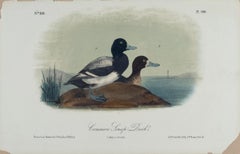
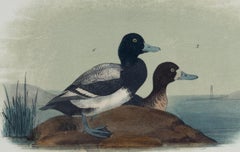
Common Scaup Duck: An Original 19th C. Audubon Hand-colored Bird Lithograph
By John James Audubon
Located in Alamo, CA
This is an original 19th century John James Audubon hand-colored lithograph entitled "Common Scaup Duck, 1. Male, 2. Female", No. 100, Plate 498 from Audubon's "Birds of America, lithographed, printed and colored by J. T. Bowen and published in Philadelphia in 1856. It depicts male and female Scaup ducks sitting on a mound, looking to the right at water. A lighthouse is seen on a point of land in the background on the right.
This original hand-colored Common Scaup Duck lithograph...
Category
Mid-19th Century Naturalistic Animal Prints
Materials
Lithograph
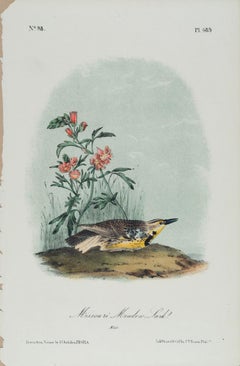
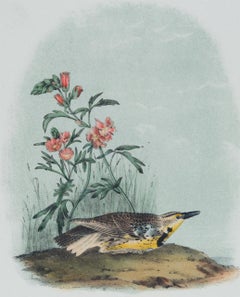
Missouri Meadow Lark: An Original 19th C. Audubon Hand-colored Bird Lithograph
By John James Audubon
Located in Alamo, CA
This is an original 19th century John James Audubon hand-colored lithograph entitled "Missouri Meadow Lark, Male", No. 98, Plate 489 from Audubon's "Birds of America, lithographed, p...
Category
Mid-19th Century Naturalistic Animal Prints
Materials
Lithograph
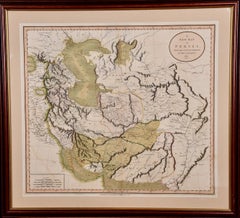
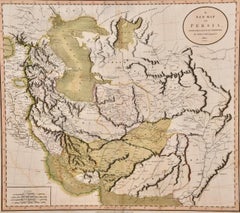
Persia & Afghanistan: A Framed Hand-colored 17th Century Map by John Cary
By John Cary
Located in Alamo, CA
This colorful and detailed early 18th century copperplate map by John Cary entitled "A New Map of Persia from the Latest Authorities" was published in London in 1801. It depicts Persia, the region of modern day Afghanistan, the Caspian Sea, the Sea of Aral, the Persian Gulf...
Category
Early 19th Century Old Masters More Prints
Materials
Engraving
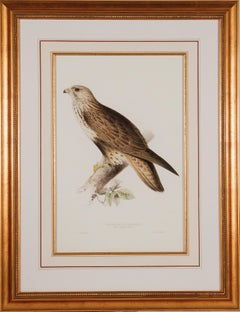
Rough-legged Buzzard: 19th C. Hand-colored Lithograph by J. Gould & Edward Lear
By Edward Lear
Located in Alamo, CA
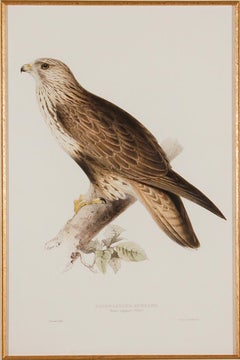
This is an original 19th century hand-colored folio-sized lithograph entitled "Archibuteo Lagopus" (Rough-Legged Buzzard) by John Gould and Edward Lear, from Gould's "Birds of Great Britain", published in London between 1862 and 1873. The print depicts an adult Rough-Legged Buzzard perched on a branch of a tree looking to the left.
This beautiful framed Gould hand-colored lithograph is presented in a gold-colored wood frame and cream-colored French mat, embellished by a gold-colored fillet. The frame measures 33" high, 25.5" wide and 1.25" thick. It is in excellent condition
There are several other unframed Gould bird lithographs available on our 1stdibs and InCollect storefronts. Two or more of these striking lithographs would make an attractive display grouping. A discount is available for purchase of a set depending on the number. These additional Gould hummingbirds may be viewed by typing Timeless Intaglio in the 1stdibs or InCollect search field to be taken to our storefront.
John Gould (1804-1881]) was an English ornithologist and artist. He, like his American contemporary John James Audubon, published a number of books on birds in the mid 19th century, illustrated by hand-colored lithographs. His wife and fellow artist, Elizabeth Gould, and several other artists including Edward Lear and Henry Constantine Richter produced lithographs for his various publications. He has been considered the father of bird study in Australia and the Gould League in Australia is named after him. Charles Darwin referenced Gould’s work in his book, "On the Origin of Species" and Gould named a bird after Darwin; "Darwin's finches".
Gould began his career in London as a taxidermist, but in 1827 became the first curator and conservator at the museum of the Zoological Society of London. In this position naturalists brought him collections of birds from all over the world. He began creating drawings and eventually hand-colored lithographs with his wife and Edward Lear, which were the basis for his first publications. Darwin brought him specimens from the Galapagos Islands, including 12 species of finches which had never been described. In 1838, Gould and his wife travelled to Australia and their work led to the seven volume publication of “The Birds of Australia”. Gould had a fascination for hummingbirds and collected specimens of 320 varieties before ever seeing a live hummingbird on a trip to the United States in 1857. He eventually published “A Monograph of the Trochilidae, or Family of Humming-birds". Other large publications include: "The Birds of Europe"," A Monograph of the Ramphastidae, or Family of Toucans”, “A Synopsis of the Birds of Australia, and the Adjacent Islands”, “A Monograph of the Odontophorinae, or Partridges of America”, “The Birds of Asia”, “The Birds of Great Britain” and "The Birds of New Guinea and the Adjacent Papuan Islands, including many new species recently discovered in Australia".
John Gould (1804-1881) was a British ornithologist and illustrator who is best known for his monumental work, "The Birds of Europe," published between 1832 and 1837. Gould was born in Lyme Regis, Dorset, England, and began working as a taxidermist and natural history dealer in London in the 1820s. In 1827, Gould was appointed the first curator and preserver of birds at the Zoological Society of London, where he began to build his collection of specimens and began to study the birds of the world. He published his first monograph, "A Century of Birds from the Himalaya Mountains," in 1831, which included 80 plates of Himalayan birds. Gould continued to publish numerous volumes on the birds of the world throughout his life, including "The Birds of Australia" (1840-1848) and "The Birds of Great Britain" (1862-1873). His works were highly regarded for their accuracy and detail, and he was one of the most prominent ornithologists of his time.
In addition to his work as an ornithologist, Gould was also a successful businessman, and he used his profits to fund expeditions and to support the scientific community. He was elected a Fellow of the Royal Society in 1843, and he was awarded the Royal Medal...
Category
Mid-19th Century Naturalistic Animal Prints
Materials
Lithograph
Tawny or Brown Owl: A Framed Original 19th C. Hand-colored Lithograph by Gould
By John Gould and Henry Constantine Richter
Located in Alamo, CA
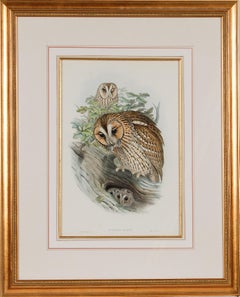
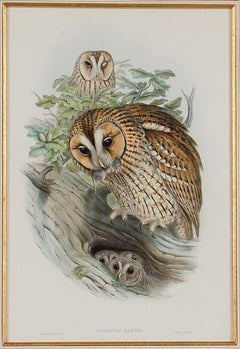
This is a framed original 19th century hand-colored folio-sized lithograph entitled “Syrnium Aluco" (Tawny or Brown Owl) by John Gould, from his "Birds of G...
Category
Mid-19th Century Naturalistic Animal Prints
Materials
Lithograph
Honey Buzzard Bird: A Framed Original 19th C. Hand-colored Lithograph by Gould
By John Gould and Henry Constantine Richter
Located in Alamo, CA
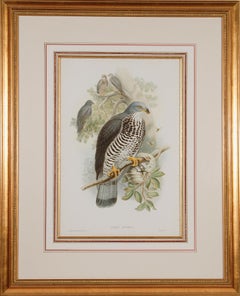
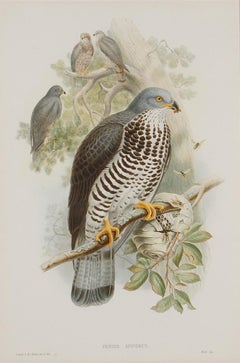
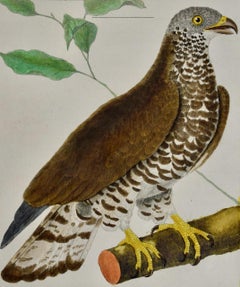
This is a framed original 19th century hand-colored folio-sized lithograph entitled “Pernis Apivorus (The Honey Buzzard) by John Gould, plate 6 in volume 1 of his "Birds of Great Britain", published in London between 1862 and 1873. The print depicts an adult Honey Buzzard perched on a branch of a leafy tree in the foreground and three others in the background. The bird in the foreground has an insect in its beak and others are in flight on the right
This striking framed Gould...
Category
Mid-19th Century Naturalistic Animal Prints
Materials
Lithograph
Eagle or Horned Owl: A Framed Original 19th C. Hand-colored Lithograph by Gould
By John Gould and Henry Constantine Richter
Located in Alamo, CA
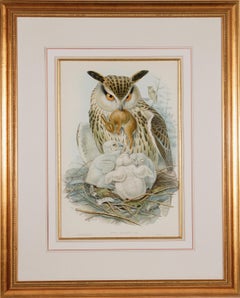
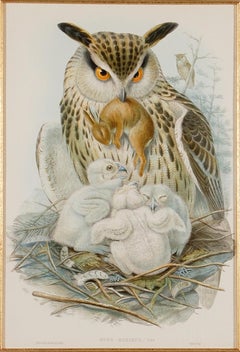
This is a framed original 19th century hand-colored folio-sized lithograph entitled “Bubo Maximus" (Great Horned or Eagle Owl) by John Gould, from the supplement to his "Birds of Great Britain", published in London between 1862 and 1873. The print depicts an adult Eagle Owl about to feed her brood of babies who are in the their nest. A another adult (possibly the male) is seen in the distant background in the upper right.
This striking framed Gould...
Category
Mid-19th Century Naturalistic Animal Prints
Materials
Lithograph
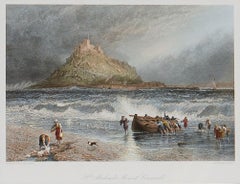
St. Michael's Mount, Cornwall: A Framed 19th C. Engraving After Myles Foster
By Myles Birket Foster
Located in Alamo, CA
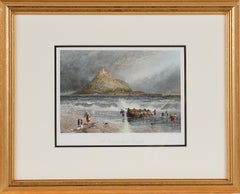
This beautiful 19th century framed hand-colored engraving is entitled "St. Michael's Mount, Cornwall" by J. Saddler after an original painting by the British artist Myles Birket Fost...
Category
Mid-19th Century Romantic Landscape Prints
Materials
Engraving
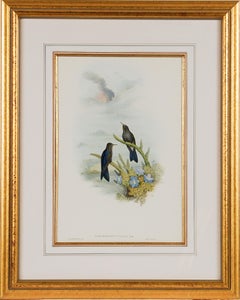
Thorn-Bill Hummingbirds: A Framed 19th C. Hand-colored Lithograph by Gould
By John Gould and Henry Constantine Richter
Located in Alamo, CA
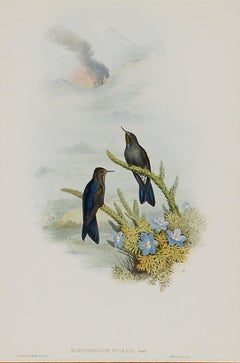
This is an original framed 19th century hand-colored folio-sized lithograph entitled "Ramphomicron vulcani" (Southern Thorn-Bill Hummingbirds) by John Gould, Pl. 186 from his "Monograph of the Trochilidae, or Family of Hummingbirds", published in London in 1853. The print depicts two Southern Thorn-Bill hummingbirds sitting on branches of a flowering plant.
This striking framed Gould hand-colored lithograph is presented in a antiqued gold frame, a gold-colored fillet, and a light tan French mat, embellished with a mint-colored broad band. The frame measures 32" high, 25.5" wide and 1.25" thick. The hand-coloring is enhanced by the use of gum-arabic paint...
Category
Mid-19th Century Naturalistic Animal Prints
Materials
Lithograph
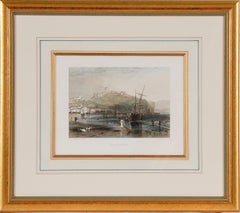
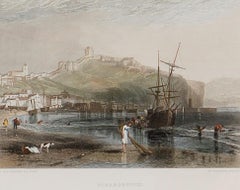
A View of Scarborough, England: A Framed 19th C. Engraving After J. M. W. Turner
By J.M.W. Turner
Located in Alamo, CA
This beautiful 19th century framed engraving "Scarborough" by W. Chapman is based on an original painting by the renowned British artist J.M.W. Turner. It was published in London by ...
Category
Mid-19th Century Romantic Landscape Prints
Materials
Engraving
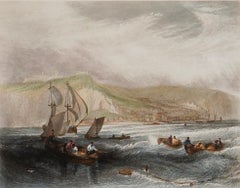
A View of Dover, England: A Framed 19th C. Engraving After J. M. W. Turner
By J.M.W. Turner
Located in Alamo, CA
This beautiful 19th century framed engraving "Dover" by Thomas Lupton is based on an original painting by the renowned British artist J.M.W. Turner, which depicts a panoramic view of the harbor of Dover, a town in southeastern England, that has been an important port for centuries. The engraving captures the dramatic sky and sea that Turner was known for, with billowing clouds and waves crashing against the shore. The town and its famous white cliffs are visible in the background, while ships and boats dot the harbor in the foreground. Several wooden rowboats...
Category
Mid-19th Century Romantic Landscape Prints
Materials
Engraving
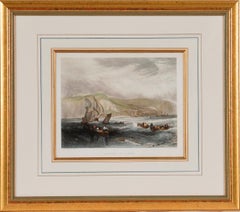
Fishing Off Hastings, England: A Framed 19th C. Engraving After J. M. W. Turner
By J.M.W. Turner
Located in Alamo, CA
This beautiful 19th century framed engraving "Line Fishing Off Hastings" by William Miller is based on an original painting by the renowned British artist J.M.W. Turner, which depicts a scene of fishermen at work off the coast of the town of Hastings in East Sussex, England. The Miller engraving faithfully reproduces Turner's painting, capturing the same atmospheric quality and sense of motion. In the foreground of the image, a group of fishermen are shown in a small boat, with one man using a fishing line to catch fish. In the background, there is a larger ship, along with a view of the town of Hastings and the cliffs beyond. Overall, the Miller engraving "Line Fishing Off Hastings" is a beautiful and detailed representation of Turner's original painting, and provides a glimpse into life in a 19th century fishing community.
This colorful 19th century engraving is presented in a gold-colored wood frame and a cream-colored French mat highlighted with a light blue band and thinner mustard and gold-colored bands. There is a gold-colored fillet which further embellishes the engraving. The frame measures 18" high, 20.5" wide and 1" deep. The engraving, frame and mat are in excellent condition.
Joseph Mallord William (J.M.W.) Turner (1775-1851) was an English painter who is widely considered one of the greatest landscape painters in Western art history. Born in London, he showed a remarkable talent for art from a young age, and studied at the Royal Academy of Arts from the age of 14. He quickly gained recognition for his watercolor landscapes, which were highly innovative and expressive. Turner's style evolved over time, and he became increasingly interested in the effects of light and color. He traveled extensively throughout Europe, and his experiences of the natural world, particularly the sea and the sky, had a profound influence on his art. His paintings are known for their luminosity, atmospheric effects, and dramatic use of color. Despite facing criticism and ridicule from some of his contemporaries, Turner continued to push the boundaries of art, experimenting with new techniques and styles throughout his career. He was a prolific artist, creating thousands of paintings, sketches, and watercolors, and his legacy continues to inspire artists today.
William Miller (1796-1882) was an English engraver and publisher, best known for his work in reproducing the paintings of J.M.W. Turner. Miller was born in Bristol and began his career as an engraver at a young age, working for a variety of publications and artists. In the early 1820s, Miller began working with Turner, engraving many of the artist's most famous works, including "The Fighting Temeraire...
Category
Mid-19th Century Romantic Landscape Prints
Materials
Engraving
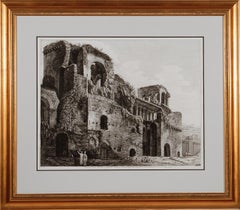
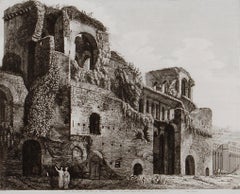
Ruins of the Roman Baths of Belisarius: A 19th C. Etching by Luigi Rossini
By Luigi Rossini
Located in Alamo, CA
This early 19th century etching entitled "Veduta degl' Avanzi delle Torri di Belisario Dalla parte che guarda l' Interno della Città, vicino a Porta S. Giovanni, A. Mura Aureliane" (...
Category
1820s Old Masters Landscape Prints
Materials
Etching
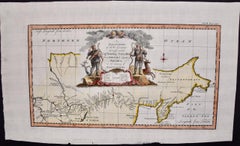
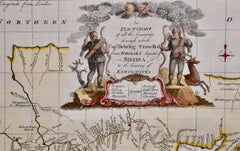
Siberia as Explored by Behring: Original 18th Century Hand-colored Map by Bowen
Located in Alamo, CA
This is an original 18th century hand-colored map entitled "An Exact Chart of all the Countries through which Capt. Behring Travelled from Tobolski, Capital of Siberia to the Country...
Category
Mid-18th Century Old Masters Landscape Prints
Materials
Engraving
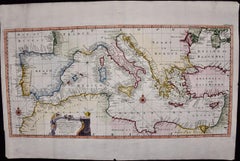
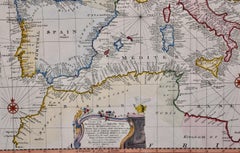
Mediterranean and Adriatic Seas: Original 18th Century Hand-colored Map by Bowen
Located in Alamo, CA
This is an original 18th century hand-colored map entitled "An Accurate Chart of The Mediterranean and Adriatic Sea's; with the Archipelago & Part of the Black Sea. Exhibiting all th...
Category
Mid-18th Century Old Masters Landscape Prints
Materials
Engraving
Map of the Russian Empire: An Original 18th Century Hand-colored Map by E. Bowen
Located in Alamo, CA
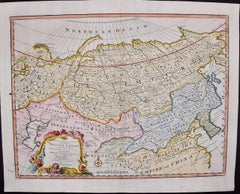
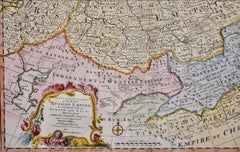
This is an original 18th century hand-colored map entitled "A New & Accurate Map of The Whole Russian Empire, As Contain'd Both In Europe and Asia, Drawn from Authentic Journals, Sur...
Category
Mid-18th Century Old Masters Landscape Prints
Materials
Engraving
Map of the East Indies: An Original 18th Century Hand-colored Map by E. Bowen
Located in Alamo, CA
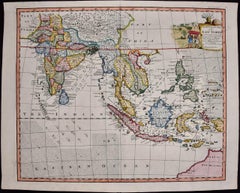
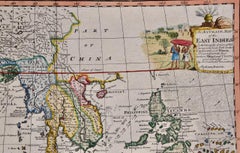
This is an original 18th century hand-colored map entitled "An Accurate Map of the East Indies Exhibiting the Course of the European Trade both on the Continent and Islands" by Emanu...
Category
Mid-18th Century Old Masters Landscape Prints
Materials
Engraving
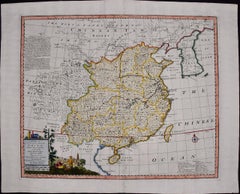
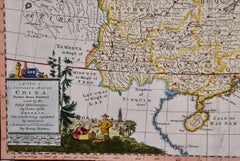
China: An Original 18th Century Hand-colored Map by E. Bowen
Located in Alamo, CA
This is an original 18th century hand-colored map entitled "A New & Accurate Map of China, Drawn from Surveys made by the Jesuit Missionaries, by order of the Emperor. The whole bein...
Category
Mid-18th Century Old Masters Landscape Prints
Materials
Engraving
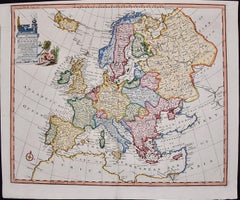
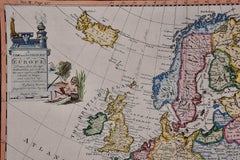
Europe: An Original 18th Century Hand-colored Map by E. Bowen
Located in Alamo, CA
This is an original 18th century hand-colored map entitled "A New & Accurate Map of Europe Drawn from the Best Authorities Assisted by the Most Improved Modern Charts and Maps." by E...
Category
Mid-18th Century Old Masters Landscape Prints
Materials
Engraving
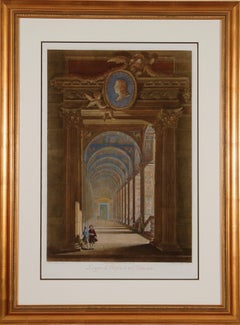
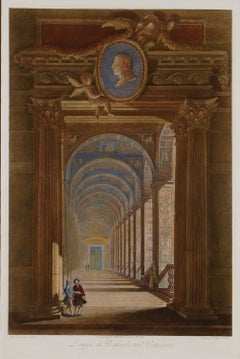
Vatican Hallway designed by Raphael: 18th C. Hand-colored Engraving by Volpato
By Giovanni Volpato
Located in Alamo, CA
This is an original 18th century hand-colored copper-plate engraving by Giovanni Volpato after a drawing by Camporesi. It was the frontispiece for volume one of the rare and valuable...
Category
Late 18th Century Old Masters Interior Prints
Materials
Engraving
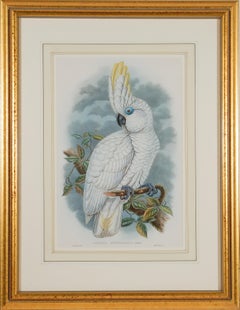
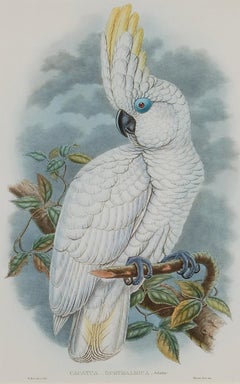
Blue-eyed Cockatoo: A Framed Original 19th C. Hand-colored Lithograph by Gould
By John Gould and Henry Constantine Richter
Located in Alamo, CA
This is a framed original 19th century hand-colored folio-sized lithograph entitled “Cacatua Ophthalimica” (Blue-eyed Cockatoo) by John Gould, from the supplement to his "Birds of Australia", published in London between 1851 and 1869. The print depicts a large blue-eyed cockatoo perched on a branch, with its head turned to the left. The scene is enhanced with leaves and sky and clouds in the background.
This striking framed Gould...
Category
Mid-19th Century Naturalistic Animal Prints
Materials
Lithograph
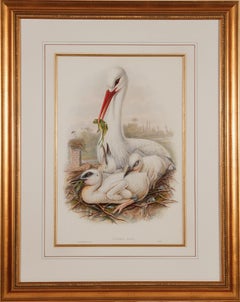
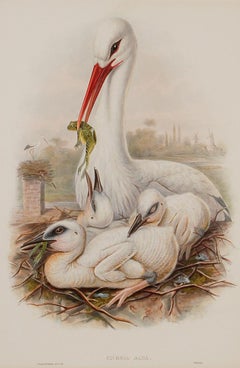
Stork Family: A Framed Original 19th C. Hand-colored Lithograph by Gould
By John Gould and Henry Constantine Richter
Located in Alamo, CA
This is a framed original 19th century hand-colored folio-sized lithograph entitled “Ciconia Alba” (A family of storks) by John Gould, from the supplement to his "Birds of Great Brit...
Category
Mid-19th Century Naturalistic Animal Prints
Materials
Lithograph
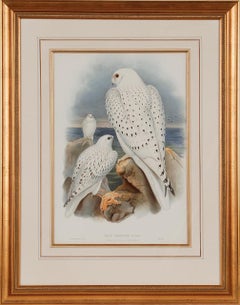
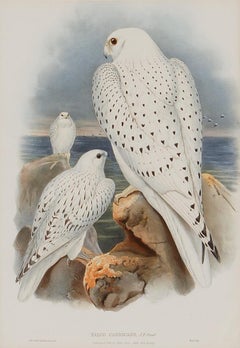
Greenland Falcon "Falco Candicans": A 19th C. Hand-colored Lithograph by Gould
By John Gould and Henry Constantine Richter
Located in Alamo, CA
This is an original 19th century hand-colored folio-sized lithograph entitled "Falco Candicans" (Greenland Falcon Light) by John Gould, from his "Birds of Great Britain", published i...
Category
Mid-19th Century Naturalistic Animal Prints
Materials
Lithograph
Cadiz Island: A Framed 17th Century Hand-colored Map from Blaeu's Atlas Major
By Joan (Johannes) Blaeu
Located in Alamo, CA
This is a 17th century hand-colored map entitled "Insula Gaditana Isla de Cadiz" from Johannes (Joan) Blaeu's Atlas Maior, published in Amsterdam in 1662.
The map provides an excellent plan of Cadiz Island on the southwest coast of Spain, with its harbor, fortifications, agricultural fields and several surrounding salt processing areas. Numerous sailing ships of various sizes are included in and around the harbor and bay, including five large sailing ships, as well as twenty-four smaller ships. There is a small compass rose overlying the bay. The bridge to the mainland from the island is shown on the right. There is an extremely ornate and colorful title cartouche in the lower left, with its mythological figures reminiscent of Raphael’s Galatea fresco at the Villa Farnesina in Rome. The vibrant colors are vividly preserved. The master colorist tried to emulate a painting by using various tones to create a three-dimensional effect.
Blaeu's name is present in the plate in the lower right. Blaeu stated in his description of Cadiz: “The main wealth of the islanders consists of salt, which they harvest, and
the tuna fisheries.”
This 17th century hand-colored map is framed in an ornate, partially textured bronze-colored wood frame and glazed with UV protected conservation glass. There is a vertical center fold, as issued. There is a faint crease in the lower right and faint color offset on the left from the right side of the map, resulting from having been in an atlas for hundreds of years. Small foci of paint are present in the upper portion of the left margin and in the left corner margin. The map is otherwise in very good condition.
Due in large part to their powerful trade empire, the Dutch became known for cartography in the seventeenth century. This period is considered the Golden Age of Dutch cartography. Their publishing houses produced the highest quality work in Europe, particularly those maps and charts of foreign lands, and Dutch map-making set the bar for cartographic accuracy and artistry into the early-eighteenth century. Some of the most well-known cartographers worked in Amsterdam during this period. Perhaps the most famous of these was the Blaeu family. Willem Janszoon Blaeu, set up shop in Amsterdam. His son, Johannes (Joan), succeeded him upon his death in 1638, continuing in his father’s position as Hydrographer to the Dutch East India Company and selling maps to the public. The Blaeu map presses, located near Amsterdam’s Dam Square...
Category
Mid-17th Century Old Masters Landscape Prints
Materials
Engraving
Midnight Wolf: A Limited Edition Clarence Mills Signed Haida Inuit Print
Located in Alamo, CA
"Midnight Wolf" is a framed signed limited edition abstract inuit native people's work by Northwest Coast Haida artist Clarence Mills. The print depicts a st...
Category
Late 20th Century Abstract Animal Prints
Materials
Woodcut
Qua-Ta-Wa-Pea, A Shawnee: 19th C. Folio Hand-colored McKenney & Hall Lithograph
By McKenney & Hall
Located in Alamo, CA
This is an original 19th century hand-colored folio-sized lithographic portrait of a Native American entitled "Qua-Ta-Wa-Pea, A Shawanoe Chief", from McKenney and Hall's 'History of the Indian Tribes of North America'. It was lithographed by J. T. Bowen after a painting by Charles Bird King and published by E. C. Biddle in Philadelphia in 1836. Quatawapea wears a maroon head covering, a white ruffled shirt and blue shawl with gray trim. His presidential peace medal is attached to a maroon fabric...
Category
Mid-19th Century Naturalistic Portrait Prints
Materials
Lithograph
Tah-Chee, Cherokee Chief: 19th C. Folio Hand-colored McKenney & Hall Lithograph
By McKenney & Hall
Located in Alamo, CA
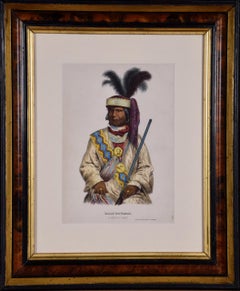
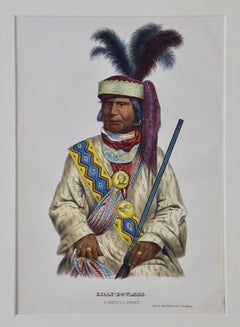
This is an original 19th century hand-colored folio-sized lithographic portrait of a Native American entitled "Tah-Chee, A Cherokee Chief", from McKenney and Hall's 'History of the Indian Tribes of North America'. It was lithographed by J. T. Bowen after a painting by Charles Bird King and published by E. C. Biddle in Philadelphia in 1838.
Tahchee's name translates to Dutch in Cherokee, and he became known as William Dutch. He was born in 1790 in the Cherokee Nation, which is now in a portion of Alabama. Tahchee became known as a skilled warrior and leader among his people, and he was eventually appointed as a chief of the Cherokee Nation "Old Settlers". During his time as chief, Tahchee was a rival of the Osage people and he worked to protect the Cherokee people and their land from encroachment by white settlers. He was a strong advocate for maintaining Cherokee sovereignty and cultural traditions, even as pressure mounted from the United States government to remove the Cherokee from their ancestral lands. In 1838, Tahchee and many other Cherokee people were forcibly removed from their homes in what is known as the Trail of Tears...
Category
Mid-19th Century Naturalistic Portrait Prints
Materials
Lithograph
Bermuda: An Early 17th Century Hand-colored Map by Henricus Hondius
By Henricus Hondius
Located in Alamo, CA
This attractive and interesting map of Bermuda by Henricus Hondius in 1633 is entitled "Mappa Aestivarum Insularum, Alias Barmudas". It is based on a ...
Category
Early 17th Century Old Masters Landscape Prints
Materials
Engraving
Asia Declineatio: A 17th Century Hand-colored Map of Asia by Justus Danckerts
Located in Alamo, CA
This is a scarce 17th century beautifully hand-colored copperplate engraved map of Asia entitled “Exactissima Asiae Delineatio in Praecipuas Regiones Caerterasque Partes divisa et de...
Category
Late 17th Century Old Masters Landscape Prints
Materials
Engraving
Roman Hills, Aqueducts and Roads: An Early 18th Century Map by Jan Goeree
Located in Alamo, CA
This richly engraved map of Rome and its environs entitled "Urbis Cum Vicis Seu Pagis Adiacentibus Dissertationi III De Aq et Aqueaed Veteris Promae Praemissa Authore Raph Fabretto G...
Category
Early 18th Century Old Masters Landscape Prints
Materials
Engraving
Crucifixion: 18th Century Etching by Conrad Metz after Daniele da Volterra
Located in Alamo, CA
"Crucifixion" is an etching and aquatint, printed in brown ink by Conrad M. Metz after a painting by Daniele da Volterra. It was published in London in 1789 in 'Imitations Of Ancient...
Category
Late 18th Century Old Masters Figurative Prints
Materials
Etching, Aquatint
Europa Regnorum Provinciarum: 18th Century Hand-colored Map of Europe by Lotter
By Tobias Conrad Lotter
Located in Alamo, CA
This is an 18th century hand-colored copperplate engraved map entitled "Europa Regnorum Provinciarum Regionum" created by the German cartographer Tobias Conrad Lotter. It was publish...
Category
Mid-18th Century Landscape Prints
Materials
Engraving
Richard Reynolds, Society of Friends: 19th C. Engraved Portrait by Wm. Sharp
By William Sharp
Located in Alamo, CA
This is an early 19th century engraved portrait of the industrialist and philanthropist Richard Reynolds by William Sharp after William Hobday. It was published in London by Rudolph Ackerman in 1817. The print is entitled "Richard Reynolds of the Society of Friends, Late of Bristol". This three-quarter length portrait of Reynolds depicts him seated, directed to right, looking towards the viewer. He is holding an open book, wearing a plain suit. A curtain in the background is pulled to the left, revealing bookshelves. Some of the books are labelled 'Addison & Watts' 'Kempis & Fenelon' 'Milton & Cowley' etc. The inscription above the portrait reads: "When the eye saw him it blessed him". The lettering below the image reads: "Richard Reynolds of the Society of Friends, Late of Bristol; Whose Life and Fortune were devoted to the Glory of God by relieving the humble in Distress.', This plate is dedicated by Permission to his Royal Highness, the Prince Regent by his most devoted very humble servant William Hobday."
This engraving is printed on thick paper. The sheet measures 16" high and 12" wide. It is adhered to an archival backing in the upper left corner. There is mild discoloration and toning in the margins, but it does not involve the image.
Richard Reynolds (1735-1816) was a prominent member of the Society of Friends, also known as Quakers, in the 18th and 19th centuries. He was born into a wealthy family in Bristol, England, and inherited a successful copper smelting, iron manufacturing business from his father. Despite his privileged upbringing, Reynolds was known for his deep concern for the poor and his commitment to social justice. He used his wealth and influence to support a range of philanthropic causes, including the abolition of slavery, the improvement of working conditions for miners and factory workers, and the provision of education for the poor. Reynolds was also a prominent supporter of the Quaker...
Category
Early 19th Century Portrait Prints
Materials
Engraving
Sir. John Powell, Knight: Early 18th C. Engraved Portrait After William Sherwin
Located in Alamo, CA
This is an early 18th century portrait of Sir John Powell entitled "The Honorable Sr. John Powell, Knight. one of the Justices of her Majesties' Court of Common Pleas. Ano. D 1711". It was engraved and published by John King in London in 1711, after an earlier work by William Sherwin. The engraving depicts a bust length portrait of Powell wearing an elaborate fir-trimmed robe and collar. The portrait is encompassed in an ornate oval frame, sitting on a pedestal with an impressive coat-of-arms below.
This engraved portrait is printed on laid, chain-linked watermarked cream-colored paper The sheet measures 15.25" high and 11.38" wide. It is adhered to an archival thick card at the upper corners, There is a 1/8" tear at the lower edge of the sheet, but the print is otherwise in very good condition. This engraving is held by museums and institutions, including the British Museum and the Harvard University Art Museum.
Sir John Powell (1632-1696) was an English lawyer and judge who served as a justice of the King's Bench from 1683 until his death. He was born in Glamorganshire, Wales, and studied at Jesus College, Oxford, before being called to the bar at the Middle Temple in 1656. Powell was known for his staunch support of the monarchy and the Church of England, and he played a prominent role in the trial of the Whig leader Lord William Russell in 1683, which resulted in Russell's execution for his alleged involvement in a plot to assassinate King Charles II. Powell was also involved in the trials of several other prominent Whig politicians, including Algernon Sidney and Titus Oates. In addition to his work as a judge, Powell was also a member of Parliament for various constituencies throughout his career, and he served as Solicitor General and Attorney General for Wales under King James II. However, he opposed James's efforts to promote Catholicism and supported the Glorious Revolution of 1688, which led to James's overthrow and the installation of William and Mary as joint monarchs.
Powell was known for his intellectual rigor and his legal expertise, and he authored several influential legal treatises during his lifetime. He was widely respected by his peers and by the legal community as a whole, and his legacy as a jurist and judge continues to be celebrated today.
William Sherwin (1645-1709) was an English engraver who worked during the late 17th and early 18th centuries. He was born in Chesterfield, Derbyshire, and is known for his high-quality engravings of various subjects, including portraits, landscapes, and architectural views. Sherwin was trained as an engraver and worked as an apprentice to the renowned engraver Robert White. After completing his training, he went on to establish his own studio in London, where he produced a significant body of work over the course of his career. One of Sherwin's most famous works is his engraving of the portrait of John Locke...
Category
Early 18th Century Old Masters Portrait Prints
Materials
Engraving
Johannes Wesselius Portrait: An 18th Century Engraving/Etching by Houbraken
By Jacobus Houbraken
Located in Alamo, CA
This is an 18th century engraved and etched portrait of Johannes Wesselius by Jacobus Houbraken after a painting by Jan Maurits Quinkhard. It depicts a half-height image of Wesselius...
Category
Mid-18th Century Old Masters Portrait Prints
Materials
Engraving, Etching
Parmigiani Amica: An 18th Century Engraving and Etching by Strange After Mazzola
Located in Alamo, CA
This is an 18th century engraving and etching entitled "Parmigiani Amica" by Robert Strange after a painting by Girolamo Francesco Maria Mazzola, better known as Parmigianino, who lived during the Renaissance period. It was published in London in 1774. As the inscription states, the painting was in the collection of the King of Naples at the time the engraving was made. The engraving depicts a half-length portrait of a young woman, known as Parmigiani's Amica (meaning "female friend" in Italian). She is depicted wearing a simple but elegant dress with a low-cut neckline, which reveals her delicate features and graceful neck. Her hair is arranged in a simple yet stylish manner. She is turning to the right to look lovingly at her infant, which she is holding with her right arm. She is touching the baby's mouth with her left hand. The background of the engraving is plain and unadorned, allowing the viewer to focus entirely on the subject of the portrait. The result is a beautiful and timeless image that captures the essence of Renaissance portraiture.
The engraving is printed on watermarked paper. The sheet measures 16.25" high and 12' wide. The sheet is adhered to paper in its upper corners and it has been removed from the paper in its lower corners. There is some mild discoloration and some wrinkling in the margins, including the lower inscription area, and a small dark spot in the upper margin, which may represent a drop of ink occuring at the time of printing. These issues do not involve the image, which is in very good condition. The print is held by several museums and institutions, including: The Metropolitan Museum of Art in New York, The British Museum in London, The Royal Museums of the UK, The British National Trust...
Category
Late 18th Century Portrait Prints
Materials
Engraving, Etching
Marquis de Marigny: An 18th C. Wille Engraved Portrait after a Tocque Painting
By Louis Tocqué
Located in Alamo, CA
This is a mid 18th century engraved portrait of Abel François Poisson de Vandières, Marquis de Marigny by Jean Georges Wille after a painting by Louis Tocque...
Category
Mid-18th Century Portrait Prints
Materials
Engraving
Elizabeth, Countess of Northumberland: Mezzotint After a Painting by J. Reynolds
By Joshua Reynolds
Located in Alamo, CA
This is an 18th century mezzotint portrait of Elizabeth, Countess of Northumberland, Baroness Percy by Richard Houston after a painting by Joshua Reynolds, published in London by Robert Sayer in 1763. It is a rare, full length portrait of Elizabeth, who was known as Lady Betty. Lady Betty stands, facing to the right, holding her coronet, and wearing her peeress’s ermine and velvet robes over a brocade dress. In the background are a column, a billowing drape, and the grounds of Alnwick Castle...
Category
Mid-18th Century Portrait Prints
Materials
Mezzotint
The Duchess of St. Albans: A 17th C. Portrait After a Kneller Painting
By (After) Sir Godfrey Kneller
Located in Alamo, CA
This is a 17th century engraved mezzotint portrait of the Duchess of St. Albans by John Smith, after a painting by Sir Godfrey Kneller. It was published in London by John Boydell in 1694.
The Duchess of St. Albans (1642-1712) was a woman named Diana de Vere. She was born in 1642, the daughter of Aubrey de Vere, the 20th Earl of Oxford. In 1662, she married Charles Beauclerk, the illegitimate son of King Charles II and his mistress, Nell Gwyn. As a result of her marriage, Diana became the Duchess of St. Albans, and she and Charles had several children together. Diana was known for her beauty and charm, and she was a prominent figure in the court of King Charles II. Despite her husband's illegitimate birth, Diana was highly respected in the royal court and was known for her intelligence and wit. She was a patron of the arts and supported many artists and writers of the time. Diana lived through a tumultuous period of English history, including the Great Fire of London and the Glorious Revolution, which saw King James II replaced by William of Orange. She died in 1712 at the age of 70 and was buried in Westminster Abbey. Descendants of Diana and her husband, who was an illegitimate son of King Charles II, include Diana, Princess of Wales and her son William, Duke of Cambridge.
An author wrote of her: "The line of Vere, so long renown’d in arms,
Concludes with luster in St. Albans’s charms;
Her conquering eyes have made their race complete,
It rose in valor, and in beauty set."
This striking mezzotint engraving depicts Diana, Duchess of St Albans in a three-quarter length pose, standing, wearing loose flowing dress and a wrap. She has a very serene, calm appearance as she is looking straight at the viewer. There is a landscape of trees in the background. The print is adhered in the corners to an archival backing, which is itself adhered in the upper corners to a larger backing. The print is trimmed to just beyond the plate mark. There are areas of discoloration in the margins and in the inscription area, but the print is otherwise in very good condition. The sheet measures 14.5" high and 10" wide. This mezzotint is held by multiple museums and institutions, including The British Museum, The National Portrait Gallery London, The Fine Arts Museum of Boston, The Lewis Walpole Library at Yale, The Yale Center for British Art, The Fitzwilliam Museum at Cambridge and The National Galleries of Scotland. The original Kneller painting is part of the British Royal Collection Trust and hangs in the King's Private Dining Room at Hampton Court Palace.
Sir Godfrey Kneller (1646-1723) was a leading portrait painter of his time, particularly renowned for his depictions of the British aristocracy and royalty. He was born in Lübeck, Germany, and trained in Amsterdam under the painter Ferdinand Bol...
Category
Late 17th Century Portrait Prints
Materials
Mezzotint
"Inspection Tour in the Wine Vaults", 1876 Philadelphia Centennial Exposition
Located in Alamo, CA
This engraving is entitled "Philadelphia, PA- The Centennial Exposition - the Jury of Award on an Inspection Tour in the Wine Vaults of Agricultural Hall", ...
Category
Late 19th Century Naturalistic Interior Prints
Materials
Engraving
An Antique Engraved View of Copper Mining in Sweden in the 17th C. by Dahlberg
By Erik Dahlberg
Located in Alamo, CA
This is an antique engraved view entitled "Fodinae aerariae Falunenfis, qui orientem fpectat, delineatio" (Copper mining in Falun), Sweden in 1705 from "Sueciae Antiquae et Hodiernae"' published in Stockholm by Erik Dahlberg (1625-1703). The engraving was created by Johannes van den Aveelen (1650-1727), who was an accomplished copperplate engraver who emigrated to Sweden to work on Dahlberg's spectacular book, "Sueciae Antiquae et Hodiernae", which was focused on the views and architecture of Sweden, both in the ancient past and at the time of the publication.
This engraving depicts a very active 17th century working scene...
Category
Early 18th Century Naturalistic Landscape Prints
Materials
Laid Paper, Engraving
18th Century Engraving "Attack with a Battering Ram" by Montfaucon
Located in Alamo, CA
This early original copper-plate engraving entitled "Attaque avec le Belier" from 'L'antiquité expliquée et représentée en figures' (Antiquity Explained and Represented in Diagrams), published in Paris in 1719 by Bernard de Montfaucon. It depicts an ancient...
Category
Early 18th Century Old Masters Landscape Prints
Materials
Engraving
An Antique Engraved View of Waterfalls in Sweden in the 17th C. by Erik Dahlberg
By Erik Dahlberg
Located in Alamo, CA
Two antique engraved views on one sheet of "Cataractae Albi Gothicead Trollhaettan" and "Cataractae Albi Gothici ad Pontiff Raunum" (Waterfalls Near Trollhaettan and Raunum), Sweden ...
Category
Early 18th Century Naturalistic Landscape Prints
Materials
Laid Paper, Engraving
Tomb of the Virgin Mary: An Early 19th C. Aquatint after a Luigi Mayer Drawing
By Luigi Mayer
Located in Alamo, CA
"Tomb of the Virgin Mary", Pl. 10 in Luigi Mayer's publication 'Views in Egypt, Palestine, and Other Parts of the Ottoman Empire', published by Robert Bowy...
Category
Early 19th Century Interior Prints
Materials
Engraving
Cuvier's Sabre-wing Hummingbirds: A 19th C. Hand-colored lithograph by Gould
By John Gould and Henry Constantine Richter
Located in Alamo, CA
This is an original 19th century hand-colored folio-sized lithograph entitled "Campylopterus Cuvieri" (Cuvier's Sabre-wing Hummingbird) by John Gould, as plate 52 published in his "A Monograph of the Trochilidae, or Family of Humming-birds", published in London between 1849 and 1861. The print, which was drawn by Gould and Henry Richter and lithographed by Hullmandel and Walton, depicts two mostly green-colored hummingbirds with brown wings perched on a branch of a tropical long leafed plant, possibly bamboo with ferns in the background.
This beautiful Gould hand-colored hummingbird lithograph is augmented with gum-arabic paint. It is in very good condition, other than some discoloration at the edges of the upper and lower right corners and residual binding material where the print was bound in the 19th century publication. The original descriptive text page from Gould's 19th century publication is included.
There are several other unframed Gould hummingbird lithographs available on our 1stdibs and InCollect storefronts. Two or more of these striking lithographs would make an attractive display grouping. A discount is available for purchase of a set depending on the number. These additional Gould hummingbirds may be viewed by typing Timeless Intaglio...
Category
Mid-19th Century Naturalistic Animal Prints
Materials
Lithograph
Papaya and Moth Metamorphosis: 18th C. Hand-colored Engraving by Maria Merian
By Maria Sibylla Merian
Located in Alamo, CA
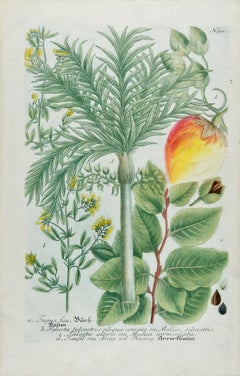
This exquisite hand-colored 18th century folio-sized engraving of a papaya plant and moth metamorphosis is plate 64 from Maria Sibylla Merian's publication '...
Category
Early 18th Century Academic Still-life Prints
Materials
Engraving
American Bittern: An Original 1st Ed. Audubon Hand-colored Bird Lithograph
By John James Audubon
Located in Alamo, CA
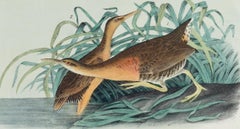
This is an original 19th century 1st octavo edition John James Audubon hand-colored lithograph entitled "American Bittern, 1. Male 2. Female", No. 73, Plate 365 from Audubon's "Birds of America, lithographed, printed and colored by J. T. Bowen and published in Philadelphia between 1840-1844. It depicts male and female American Bittern birds standing on the ground, each looking in opposite directions. There is high grass in the background.
This original 1st octavo edition hand-colored Audubon American Bittern lithograph is in excellent condition, other than a few tiny spots, which appear most likely inclusions related to the paper manufacture. The sheet measures 6.5" high by 10.25" wide. The original text pages, 94-98, from Audubon's 19th century publication are included with the lithograph.
John James Audubon (1785-1851) was a naturalist and artist. He was initially unsuccessful financially prior to the publication of his famous work “The Birds of America”, spending time in debtor’s prison, once stabbing a disgruntled investor in self-defense. However, his obsession with birds and art motivated him to persist in his goal of documenting every bird in America via his watercolor paintings and publishing his works for all to enjoy. Audubon's first illustrations were published in a large elephant folio...
Category
Mid-19th Century Naturalistic Animal Prints
Materials
Lithograph
Canada Grouse: An Original 19th C. Audubon 1st Ed. Hand-colored Bird Lithograph
By John James Audubon
Located in Alamo, CA
This is an original rare first octavo edition John James Audubon hand-colored lithograph entitled "Canada Grouse, 1. 2 Males, 3. Females, 4. Trillium pic...
Category
Mid-19th Century Naturalistic Animal Prints
Materials
Lithograph
Black-billed Cuckoo: An Original 1st Ed. Audubon Hand-colored Bird Lithograph
By John James Audubon
Located in Alamo, CA
This is an original 1st octavo edition John James Audubon hand-colored lithograph entitled "Black-billed Cuckoo, 1. Male, 2, Female, Magnolia Grandiflora", No. 56, Plate 276 from Audubon's "Birds of America, lithographed, printed and colored by J. T. Bowen and published in Philadelphia between 1840-1844. It depicts a female black-billed cuckoo perched on a branch of a magnolia tree reaching for a flying insect. The male appears to be in flight in front of magnolia leaves on the right, perhaps after the same insect. Magnolia flowers are depicted, as well.
This original 1st octavo edition hand-colored Audubon Black-billed Cuckoo lithograph is in excellent condition, other than a few tiny spots in the upper margin and a tiny faint spot in the lower inscription area. The sheet measures 6.5" high by 10.13" wide. The original text pages, 300-302, from Audubon's 19th century publication are included with the lithograph.
John James Audubon (1785-1851) was a naturalist and artist. He was initially unsuccessful financially prior to the publication of his famous work “The Birds of America”, spending time in debtor’s prison, once stabbing a disgruntled investor in self-defense. However, his obsession with birds and art motivated him to persist in his goal of documenting every bird in America via his watercolor paintings and publishing his works for all to enjoy. Audubon's first illustrations were published in a large elephant folio size. Due to their expense they were purchased in rather small numbers by the wealthy. To reach a larger audience, Audubon, with the help of his sons and J. T. Bowen, published a smaller octavo sized lithograph version, which were much more affordable.
With the success of his bird projects, Audubon then turned his attention to four-legged animals. He explored the Missouri River in 1843 sketching the four-legged animals he encountered in their natural setting. His expedition covered some of the same regions recently explored by Lewis and Clark, traveling from present day Alaska to Mexico. Audubon realized that this was an opportunity to document these animals in the still relatively pristine American wilderness, before man encroached on their environment.
Between 1845 and 1848, Audubon and his sons John Woodhouse Audubon and Victor Gifford Audubon produced a set of elephant folio sized lithographs that were primarily engraved and hand colored by J. T. Bowen in Philadelphia. The publication, which included text descriptions of the animals was published 3 years before Audubon died. As with the birds, this was followed by a three-volume set of 155 octavo-sized plates entitled “The Quadrupeds of North America” completed and published by Audubon’s sons, John, Jr. and Victor.
Audubon prints continue to be popular and a wise investment. The double elephant folio set...
Category
Mid-19th Century Naturalistic Animal Prints
Materials
Lithograph
Yellow-billed Cuckoo: An Original 1st Ed. Audubon Hand-colored Bird Lithograph
By John James Audubon
Located in Alamo, CA
This is an original 1st octavo edition John James Audubon hand-colored lithograph entitled "Yellow-billed Cuckoo, 1. Male, 2, Female, Papaw Tree", No. 55, Plate 275 from Audubon's "B...
Category
Mid-19th Century Naturalistic Animal Prints
Materials
Lithograph
Limited Ed. Etching of a Scholar, Possibly a Cleric, with a Book in Deep Thought
Located in Alamo, CA
This is a large framed limited edition etching depicting an older white haired bearded scholar, possibly a cleric, with a hat, sitting with a book, but deep in thought. It is eligibl...
Category
20th Century Other Art Style Portrait Prints
Materials
Etching
Hoo-Wan-Ne-Ka, A Winnebago Chief: Original Hand-colored McKenney & Hall Litho
By McKenney & Hall
Located in Alamo, CA
This is an original 19th century 1st octavo edition hand-colored McKenney and Hall lithograph of a Native American entitled "Hoo-Wan-Ne-Ka, A Winnebago Chief", lithographed by J. T. Bowen after a painting by Charles Bird King and published by Rice and Hart in Philadelphia in 1848. For this portrait, Hoo-Wan-Ne-Ka appeared in the costume that he wore at the time of his address to Congress. McKenney described his costume as "...fantastic style, and clad in these wild and picturesque habiliments". This included a single feather and a comb in his hair, two metallic bands on each arm, a large medallion over his abdomen, a silver necklace and his presidential peace medal...
Category
Mid-19th Century Naturalistic Portrait Prints
Materials
Lithograph
Shar-I-Tar-Ish, A Pawnee Chief: Original Hand-colored McKenney & Hall Lithograph
By McKenney & Hall
Located in Alamo, CA
This is an original 19th century 1st edition octavo hand-colored McKenney and Hall lithograph of a Native American entitled " Shar-I-Tar-Ish, A Pawnee Chief", lithographed by J. T. Bowen after a painting by Charles Bird King and published by Rice and Hart in Philadelphia in 1848. Shar-I-Tar-Ish's portrait has a reddish hue from the feathers in his headdress and amulet chain, with a brownish taupe color of the upper trim of his costume. He is wearing his presidential peace medal. He has a very serious and thoughtful expression.
This original McKenney and Hall hand-colored lithograph is printed on a sheet measuring 10.38" high and 7" wide. There are faint smudges in the margins. The print is otherwise in very good condition. The original descriptive text pages, 33-34, from McKenney and Hall's 19th century publication are included.
A famous Pawnee chief, Shar-I-Tar-Ish led his people during the early part of the 19th century. He was descended from a line of chiefs. Shar-i-tar-ish was a young man when he went to Washington in 1822 at the invitation of President James Monroe...
Category
Mid-19th Century Naturalistic Portrait Prints
Materials
Lithograph
Chez Panisse 21st Birthday Celebration: Limited Ed. Goines Graphic Art Poster
By David Lance Goines
Located in Alamo, CA
This original limited edition graphic art lithographic poster entitled "Chez Panisse Twenty-First Birthday" was created by David Lance Goines in 1992 in h...
Category
Late 20th Century Interior Prints
Materials
Lithograph
Chez Panisse 12th Birthday Celebration: Limited Ed. Goines Graphic Art Poster
By David Lance Goines
Located in Alamo, CA
This original graphic art lithographic poster entitled "Twelve, Chez Panisse Twelfth Birthday" was created by David Lance Goines in 1983 in his Berkeley s...
Category
Late 20th Century Interior Prints
Materials
Lithograph
Chez Panisse Restaurant Birthday Celebration: Original Goines Graphic Art Poster
By David Lance Goines
Located in Alamo, CA
This original framed graphic art lithographic poster entitled "Chez Panisse Cafe & Restaurant Sixteenth Birthday" was created by David Lance Goines in 198...
Category
Late 20th Century Interior Prints
Materials
Lithograph
Flowering Plant Paintings: A Pair of Framed Original Botanical Watercolors
Located in Alamo, CA
This is a pair of framed original one-of-a-kind watercolor paintings of flowering plants entitled "Monandria Monogymia, Costus Speciosus" and "Tetrandria Monogynia, Ixorci Stricta" by an anonymous artist.
This striking and detailed pair of framed watercolor botanical paintings are presented in identical gold-colored wood frames with cream-colored mats and gold-colored fillets. They are glazed with UV conservation glass. Each of the frames measures 21.5" high, 19.25" wide and 1" deep. The watercolors are painted on very thin Japanese or India paper, which have some wrinkling due in part to the nature of the production and the mounting on a backing of this kind of very thin paper. The paintings are otherwise in very good condition.
Monandria is a class of flowers with one stamen. Cheilocostus speciosus, also know as crêpe ginger, is in the family Costaceae. It is native to southeast Asia and surrounding regions, from India to China to Queensland and Indonesia. It has also been cultivated in Puerto Rico, Mauritius, Réunion, Fiji, Hawaii, Costa Rica, Belize, Melanesia, Micronesia, and the West Indies, mainly for its ornamental beauty and for its medicinal uses. It has been used to treat fever, rash, asthma, bronchitis, kidney and other urinary problems, as and intestinal worms. It is mentioned in the Kama Sutra as an ingredient in a cosmetic to be used on the eyelashes to increase sexual attractiveness.
Tetrandria is a class of flowers with four stamens. Ixorci Stricta, also known as Ixora chinensis, is native to Southeast China, Indo-China and the Philippines. Although native to the tropical and subtropical areas throughout the world, it is most common in tropical Asia...
Category
20th Century Naturalistic Still-life Paintings
Materials
Watercolor
Tournai (Tournay), Belgium: A 16th Century Hand-colored Map by Braun & Hogenberg
By Franz Hogenberg
Located in Alamo, CA
This is a 16th century original hand-colored copperplate engraved map of Tournai, Belgium, entitled "Tornacum" by Georg Braun & Franz Hogenberg, in volume IV of their famous city atlas "Civitates Orbis Terrarum", published in Cologne or Augsberg, Germany in 1575. The map provides a bird's-eye view of the walled city of Tournai, the second oldest city in Belgium. It lies approximately one hour by car southwest of Brussels or from Ghent. The names of thirty of its streets, prominent buildings, churches and squares are listed in a key within a strap-work cartouche in the lower left. These locations are numbered in the key corresponding to their locations on the map.
This colorful map of Tournai (Tornacum or Tournay as it was called in the 16th century) includes the title in Latin in a cartouche in the upper center. Three crests are present across the upper map. A man and two woman are standing on a hill in the foreground in the lower right dressed in the style of 16th century upper class residents of the town.
This is an English translation of an excerpt of Braun's description of Tornai: “Tornacum or Turnacum is a city in Gallia Belgica, situated on the Schelde in the territory of the Nervii, called Tournai by its French inhabitants, but Dorneck by the Germans. Tournai has always been a large and powerful city, with an abundance of goods and commercial activities and wonderfully resourceful craftsmen, who invent new articles every day, and although some of these go out of use they constantly conceive of other new things, both useful and delightful, so that they have at all times something that provides work and a means of livelihood for the poor."
ReferencesVan der Krogt 4, 4435, State 1; Taschen, Braun and Hogenberg...
Category
16th Century Old Masters Landscape Prints
Materials
Engraving
Rugen Island, Germany: An Early 17th Century Map by Mercator and Hondius
By Gerard Mercator
Located in Alamo, CA
This is an early 17th century map entitled "Nova Famigerabilis Insulae Ac Ducatus Rugiae Desciptio" (Map of Rugen Island, Germany) by Gerard Mercator and Henricus and Joducus Hondiu...
Category
Early 17th Century Old Masters Landscape Prints
Materials
Engraving
Cartusia Bruxellensis Monastery in Brussels: A 17th C. Hand-colored Engraving
By Lucas Vorsterman the Younger
Located in Alamo, CA
This is a 17th century hand-colored copperplate engraving entitled "Cartusia Bruxellensis" by Lucas Vorsterman, the Younger, after a drawing by Jacob van Werden or Jacques van Weerden, published in 1659 in Antonius Sanderus' book 'Chorographia sacra Brabantiae sive celebrium aliquot in ea provincia ecclesiarum et coenobiorum descriptio . . . Brussel' (A sacred chorography of Brabant, or a description of several famous churches and convents in that province). It also appeared in other publications by Sanderus. In the 17th century, Brussels was within the Duchy of Brabant.
This engraving depicts a bird's-eye view of the Scheut Carthusian Monastery in Brussels. Scheut is a district of Anderlecht, a municipality of Brussels, Belgium. The monastery housed monks, who took a vow of silence, in 20 rooms. There is a central courtyard with trees and shrubs. Monks are depicted strolling along its pathways. The cells for the friars are in the middle the cloister. There are people along the streets in the foreground and to the right of the large, imposing monastery. Some are on horseback, others are walking. In the lower right, what appears to be a dog pulls a small cart containing barrels, possibly of beer or wine. Districts and neighborhoods are labelled in the background, including Scheut, Anderlecht and Ransfort. A very ornate cartouche in the lower left contains Latin and the artist's attribution. Another decorative cartouche in the upper central area contains the title.
This beautifully hand-colored and detailed engraving is printed on laid, chain-linked paper with wide, full margins. The sheet measures 17.25" high and 21.25" wide. It has Latin text on the verso. It has a central vertical fold, as issued, which is reinforced on the verso. Two small spots in the lower margin may actually represent drops of watercolor paint used to color the engraving. It is otherwise in very good condition.
Antonius Sanderus (1586-1664) was a Flemish Catholic cleric and historian. He was born "Antoon Sanders", but Latinized his name like many writers and scholars of his time. He was the author of several books, including 'Chorographia Sacra Brabantiae', which was illustrated with this engraving.
Lucas Vorsterman the Younger (1624-between 1666 & 1676) was a Flemish Baroque engraver and draughtsman. He produced engravings after the work of contemporary painters and for books by Antwerp publishers.
Jacob van Werden or Jacques van Weerden (active 1643-1669), was a Flemish draughtsman, cartographer, military engineer and archer who was active in the Habsburg Netherlands. His drawings were used as designs for prints executed by various printmakers. He worked on maps, topographical views, historical scenes, portraits and book illustrations. He had a career as a military engineer and a member of the guard of the Spanish King. He advised on various military engineering projects and was an engineer of the Spanish army...
Category
Mid-17th Century Old Masters Landscape Prints
Materials
Engraving