Timeless Intaglio

631 Results
to
327
279
259
187
91
88
82
49
46
46
35
33
25
23
20
19
15
11
10
10
10
9
7
7
7
7
6
5
5
5
5
4
3
3
2
2
2
2
1
1
1
1
1
1
1
1
84
81
38
34
26
Spain and Portugal: A Hand-colored 17th/18th Century Map by Visscher

Spain and Portugal: A Hand-colored 17th/18th Century Map by Visscher

By Nicolaus Visscher

Located in Alamo, CA

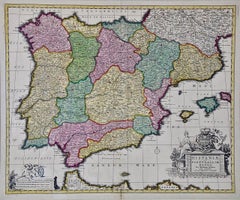
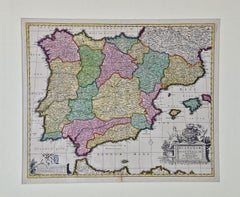
This is an early 18th century map of Spain and Portugal, with attractive original hand-coloring, entitled "Hispaniae et Portugalliae Regna per Nicolaum Visscher cum Privilegio Ordinum Hollandiae et Westfrisiae" first published by Nicolaes Visscher II (1649-1702) in 1688, and later re-published from Visscher's original copper plate by Peter Schenk, Junior in Amsterdam in 1725. The cartouche in the right lower corner depicts a coat of arms representing one combined kingdom of Spain and Portugal before their break-up. Putti hold up the coat-of-arms of Phillip II on the right and a queen reaches for it on the left. There is a scale cartouche in the lower left corner surmounted by two putti and a wheel. This is an outstanding depiction of the Iberian peninsula, showing Spain and Portugal and Balearic Islands. The map includes portions of North Africa and the Strait of Gibralter. This copperplate engraved map is presented in a cream-colored mat. It is printed on fine chain-linked, laid paper. The mat measures 26.5" high by 30" wide and the sheet measures 21.75" high by 26.375" wide. There is a central fold, as issued. The lower portion of the fold is reinforced on the verso. There is a small paper defect at the lower edge of the fold and another at the edge of the right corner, as well as a few small tears along the lower edge; none affecting the map and all covered by the mat. There are a few small faint spots in the upper margin and on the left. The map is otherwise in very good condition. The Visscher family were one of the great art and cartographic printing families of the 17th century. Begun by Claes Jansz Visscher...

Category

Late 17th Century Other Art Style Landscape Prints

Materials

Engraving
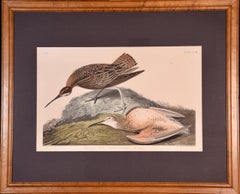
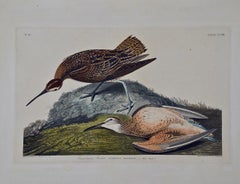
"Esquimaux Curlew": A Framed Original Audubon Hand-colored Folio Engraving
"Esquimaux Curlew": A Framed Original Audubon Hand-colored Folio Engraving
By John James Audubon

Located in Alamo, CA

This is an original hand-colored folio edition John James Audubon engraving entitled "Esquimaux Curlew", Folio, Pl. CCVIII", No. 42, Plate 208, from Audubon's "Birds of America". It was engraved, printed and colored in London by Robert Havell, Jr. in 1834. It depicts a male and a female Esquimaux Curlew birds...
Category

Mid-19th Century Naturalistic Animal Prints

Materials

Engraving
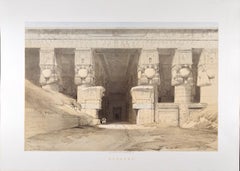
Dendera, Egypt, Dec 7th, 1838: David Roberts' 19th C. Duotone Lithograph

Dendera, Egypt, Dec 7th, 1838: David Roberts' 19th C. Duotone Lithograph

By David Roberts

Located in Alamo, CA

This is an original 19th century hand-colored lithograph entitled "Dendera, Dec 7th, 1838" by David Roberts, from his Egypt and Nubia volumes of the large folio edition, published in...

Category

1840s Realist Interior Prints

Materials

Lithograph

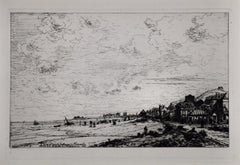
The Beach in Normandy, France, Near Bayeux: A 19th C. Etching by Maxime Lalanne

The Beach in Normandy, France, Near Bayeux: A 19th C. Etching by Maxime Lalanne

By Maxime Lalanne

Located in Alamo, CA

This is a mid 19th century etching entitled "Point de Depart de Guillaume de Normandie, Beuzeval, Emboucher de la Dives Calvados (The point of departure of William of Normandy (William the Conqueror)), created by Maxime Lalanne and published in 'L'Illustration Nouvelle' in 1868 by Alfred Cadart. The etching depicts the beach at Beuzeval in Normandy; with the shore in the foreground on the right lined by a row of houses, the sea at the left, and an expansive sky above. There are people on the beach and sailboats in the water. This is the point of departure of William the Conqueror for his voyage to England in 1066, resulting in his victory over the Anglo-Saxons at the Battle of Hastings and the establishment of Norman rule. The events are memorialized in the Bayeux tapestry, created by William's wife. This etching is presented in a white mat that is suitable for framing. This excellent impression is printed on thick chain-linked, laid cream-colored paper with wide margins. It is signed in plate in the lower right and titled in the plate in the lower left. There is a collector's stamp (either an "NC" or a "CN") in the lower right corner. The sheet measures 9.5" high by 12.75" wide and the mat measures 13.5" high by 16" wide. There are two tiny faint spots in the periphery of the upper margin, but the print is otherwise in excellent condition. This etching is held by many museums and institutions, including The British Museum, The Yale University Art Gallery, The Cleveland Museum of Art, The Philadelphia Museum of Art, Columbia University Libraries and The William Morris Gallery...

Category

Late 19th Century Landscape Prints

Materials

Etching

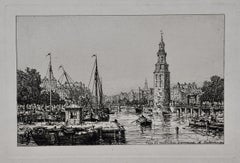
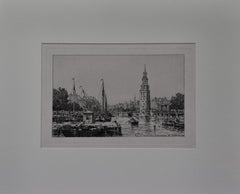
Tour De Montalban, Amsterdam: A 19th C. Etching by Maxime Lalanne

Tour De Montalban, Amsterdam: A 19th C. Etching by Maxime Lalanne

By Maxime Lalanne

Located in Alamo, CA

This is a 19th century etching entitled "Tour De Montalban, Amsterdam" (Montalban Tower, Amsterdam) by Maxime Lalanne, published by Phillip Gilbert Hamerton in 1884. The etching depicts a canal scene in Amsterdam with Montalban Tower on the right. Row boats are moored along a dock in the foreground on the left and larger sail boats are seen on the other side of the dock. A boat in the middle of the canal is being rowed by one man. Many buildings are seen along both shores. This etching is presented in a white mat that is suitable for framing. This excellent impression is printed on thick chain-linked, laid cream-colored paper with wide margins and two watermarks; "Portfolio" along the left margin and "MBM" along the right margin. It is signed, titled and dated in the plate in the lower right. There is a collector's stamp (either an "NC" or a "CN") in the lower right corner. The sheet measures 10" high by 15" wide and the mat measures 13" high by 16" wide. There is a small spot in the right margin and some mild discoloration in the periphery on the upper margin. The print is otherwise in excellent condition. This etching is held by many museums and institutions, including The Fine Arts Museums of San Francisco, The Museum of Fine Arts, Boston, The Yale University Art Gallery and The Philadelphia Museum of Art. References: Beraldi (1889) 105; Villet (2016) 148, IV; Lalanne (1882) 137; Bibliothèque Nationale (1932) 82; Gutekunst (1905) 105. François Antoine Maxime Lalanne (1827-1886) was a leading French etcher and painter of landscapes and urban views, who was at the forefront of the French revival of etching during the 1860's. He grew up in Bordeaux, but he refined his artistic skills and worked in Paris. His art was first exhibited at the Paris Salon in 1852 and he continued to regularly show both etchings and paintings there until the mid 1880's. He was also the author of several important books on the subjects of etching and other graphic arts. He was a founding member of the Societe des Aquafortistes, along with Auguste Delatre, Cadart, Ribot and Bracquemond. Lalanne created over one hundred and fifty fine etchings. Lalanne's unique style of art influenced many French and English artists in the twentieth century. Philip Gilbert Hamerton (1834-1894) was a British artist, art critic and author. He was particularly focussed on contemporary graphic art and printmaking techniques. He frequently wrote about the theory of the English Etching...

Category

Late 19th Century Landscape Prints

Materials

Etching

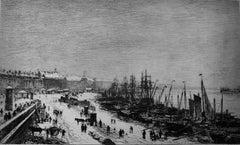
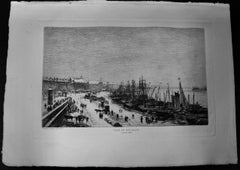
The Port Of Bordeaux, France In Winter: A 19th C. Etching by Maxime Lalanne

The Port Of Bordeaux, France In Winter: A 19th C. Etching by Maxime Lalanne

By Maxime Lalanne

Located in Alamo, CA

This is a mid 19th century etching entitled "Rade de Bordeaux, Janvier" (Port Of Bordeaux In Winter), etched by Phillip Gilbert Hamerton after a drawing by Maxime Lalanne in London in 1868. The etching depicts many boats in the busy harbor of Bordeaux, including small sailboats, as well as tall ships. Another harbor is seen in the distance across the river on the left. Snow covered buildings are on the left and extending long distances in the distant background. Many people occupy the road and ground centrally and on the left along with some horses or mules attached to carts. The sky is a wintery gray. This etching is an excellent impression printed on thick chain-linked, laid, deckle-edge paper with wide margins, watermarked with a 2 in the lower left corner. It is signed in the plate in the lower left, the title and date are in the center and Bordeaux and the year are included in script along the top of a wall in the lower left of the engraving. The sheet measures 8.75" high by 12" wide. The print is in excellent condition. This etching is held by many museums and institutions, including The National Gallery of Art, Washington, D.C. François Antoine Maxime Lalanne (1827-1886) was a leading French etcher and painter of landscapes and urban views, who was at the forefront of the French revival of etching during the 1860's. He grew up in Bordeaux, but he refined his artistic skills and worked in Paris. His art was first exhibited at the Paris Salon in 1852 and he continued to regularly show both etchings and paintings there until the mid 1880's. He was also the author of several important books on the subjects of etching and other graphic arts. He was a founding member of the Societe des Aquafortistes, along with Auguste Delatre, Cadart, Ribot and Bracquemond. Lalanne created over one hundred and fifty fine etchings. Lalanne's unique style of art influenced many French and English artists in the twentieth century. Philip Gilbert Hamerton (1834-1894) was a British artist, art critic and author. He was particularly focussed on contemporary graphic art and printmaking techniques. He frequently wrote about the theory of the English Etching...

Category

Mid-19th Century Landscape Prints

Materials

Etching

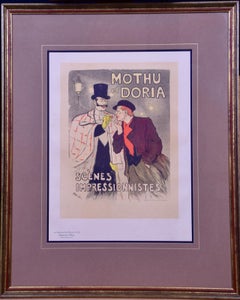
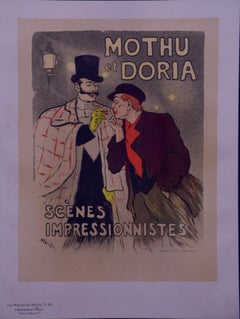
Mothu et Doria: A 19th C. Lithograph from Les Maitres de l'Affiche by Steinlen

Mothu et Doria: A 19th C. Lithograph from Les Maitres de l'Affiche by Steinlen

By Théophile Alexandre Steinlen

Located in Alamo, CA

This is a framed 19th century color lithograph entitled "Mothu et Doria" created by Theophile Alexandre Steinlen and published between 1896 and 1899 in Paris, France by Jules Cheret in his famous series of miniature colored stone lithographs of popular Belle Epoch posters...

Category

Late 19th Century Landscape Prints

Materials

Lithograph

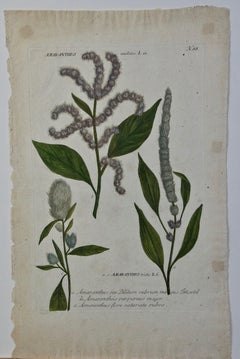
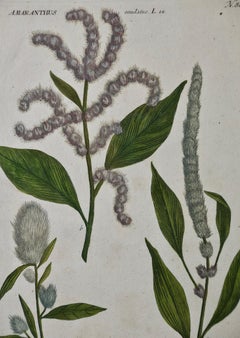
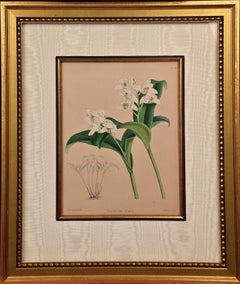
Flowering Livid Amaranth: 18th Century Hand-colored Weinmann Botanical Engraving
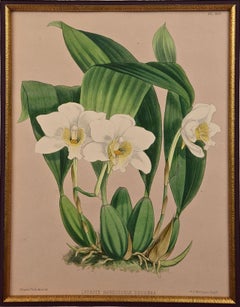
Flowering Livid Amaranth: 18th Century Hand-colored Weinmann Botanical Engraving
By Johann Wilhelm Weinmann

Located in Alamo, CA

An 18th century color printed in addition to hand colored botanical mezzotint and line engraving by Johann Wilhelm Weinmann (1683-1741) depicting the following flowering amaranthus p...
Category

Mid-18th Century Naturalistic Still-life Prints

Materials

Engraving, Mezzotint

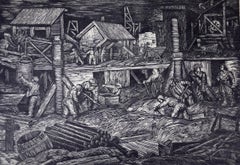
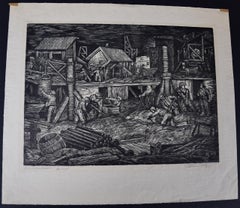
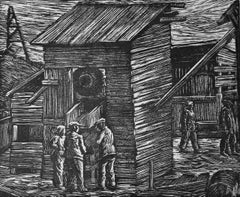
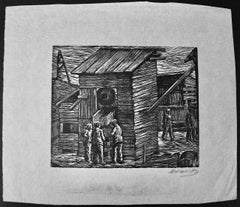
"Concrete Mixer, Moscow": Early 20th C. Woodcut Engraving by Albert Abramovitz

"Concrete Mixer, Moscow": Early 20th C. Woodcut Engraving by Albert Abramovitz

By Albert Abramovitz

Located in Alamo, CA

This is a woodcut engraving entitled "Concrete Mixer, Moscow" by Albert Abramovitz created in 1935 after a visit to the Soviet Union. It depicts three Russian workers talking in front of a wooden structure housing a cement mixer...

Category

1930s Landscape Prints

Materials

Woodcut

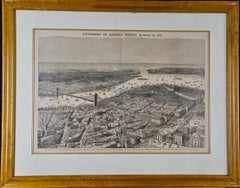
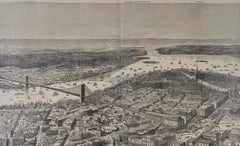
1870 View of Proposed Brooklyn Bridge and New York City

1870 View of Proposed Brooklyn Bridge and New York City

By Theodore R. Davis

Located in Alamo, CA

This framed engraving entitled "Birds-eye View of the Southern End of New York and Brooklyn, Showing the Projected Suspension-Bridge Over the East River, From the Western Terminus in Printing-House Square, New York" by Theodore R. Davis (1840–1894) was published as a supplement of Harper's Weekly, November 19, 1870. The print is presented in a maple frame and a double mat. The frame measures 23.5" high, 29" wide and 0.75" deep. There is a vertical center fold and additional vertical lines, where wood engraving blocks were joined for the printing process. It is in excellent condition. This framed image depicting New York in 1870 was a centerfold for the November 19, 1870 issue of Harper's Weekly. It includes the site and eventual appearance of the East River New York-Brooklyn Bridge; the name later shortened to the Brooklyn Bridge. The print was issued eleven months after the start of construction of the bridge on January 2, 1870, which would take another 12.5 years to complete. When this view was drawn, work on the bridge was all below ground, constructing the supports for the bridge’s towers. Labels in the upper portion of the print identify locations in the background including "Light Ship...

Category

Late 19th Century Naturalistic Landscape Prints

Materials

Woodcut

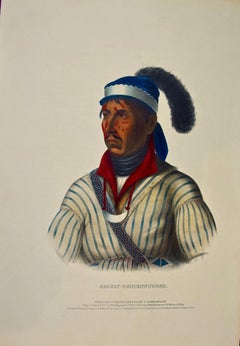
Apauly-Tustennuggee: 19th C. Hand-colored McKenney & Hall Folio-sized Lithograph

Apauly-Tustennuggee: 19th C. Hand-colored McKenney & Hall Folio-sized Lithograph

By McKenney & Hall

Located in Alamo, CA

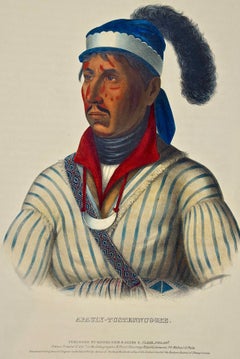
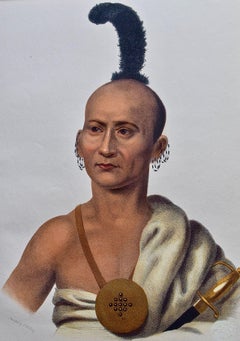
This is an original 19th century hand-colored folio size McKenney and Hall engraving of a Native American entitled "Apauly-Tustennuggee, A Creek Chief" after a painting by Charles Bird King from McKenney and Hall's "History of the Indian Tribes of North America", published in Philadelphia by Daniel Rice and James G. Clark in 1843. McKenney described him as “a chief and a warrior...a firm, brave man - and of good sense.” This original McKenney and Hall large hand-colored folio-size engraving measures 20" high and 14" wide. The print is in excellent condition. Col. Thomas J. McKenney was Superintendant of The Bureau of Indian Affairs from 1816 until 1830. He was one of a very few government officials to defend American Indian interests and attempt to preserve their culture. He travelled to Indian lands meeting the Native American leaders. He brought with him an accomplished artist, James Otto Lewis...

Category

1840s Naturalistic Portrait Prints

Materials

Engraving
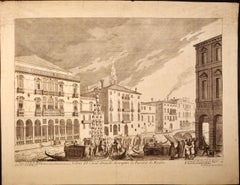
Venice: 18th Century View of the Grand Canal by Lovisa

Venice: 18th Century View of the Grand Canal by Lovisa

By Domenico Lovisa

Located in Alamo, CA

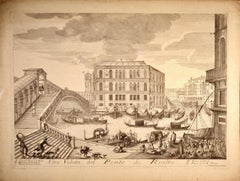
This is an early 18th century etching of the Grand Canal in Venice entitled "Veduta del Canal Grande dirimpetto la Pescaria di Rialto" by Domenico Lovisa, first published in 1720 in ...

Category

Early 18th Century Landscape Prints

Materials

Etching

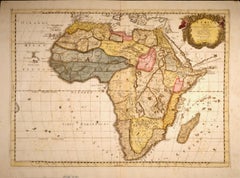
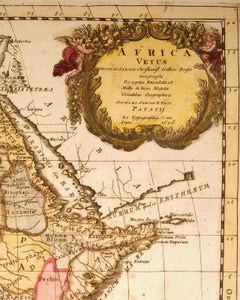
"Africa Vetus": A 17th Century Hand-colored Map By Sanson

"Africa Vetus": A 17th Century Hand-colored Map By Sanson

By Nicholas Sanson d'Abbeville

Located in Alamo, CA

This original hand-colored copperplate engraved map of Africa entitled "Africa Vetus, Nicolai Sanson Christianiss Galliar Regis Geographi" was originally created by Nicholas Sanson d...

Category

1690s Landscape Prints

Materials

Engraving
Red Roses: A Framed 17th C. Hand-colored Botanical Engraving by Basilius Besler
Red Roses: A Framed 17th C. Hand-colored Botanical Engraving by Basilius Besler
By Basilius Besler 1

Located in Alamo, CA

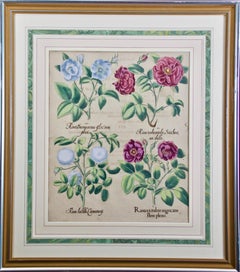
"Rosa ex rubro nigricans" (Red Roses); a hand-colored copper engraving from Basilius Besler's landmark work, Hortus Eystettensis (Garden at Eichstatt), first published in 1613 in Eichstatt, Germany near Nuremberg and later in 1640 and 1713. This engraving is presented in a glossy silver and matte gold-colored wood frame with a green edge and an elaborate double cream-colored French mats with light mauve bands; each accented by a broad decorative marbleized green band. It is glazed with plexiglass. There is text offset and a very small crease in the left margin, but the print is otherwise in excellent condition. Provenance: W. Graham Arader Gallery...
Category

17th Century Old Masters Landscape Prints

Materials

Engraving
Peaches, Nectarines: George Brookshaw's 19th C. Framed Hand-colored Aquatint

Peaches, Nectarines: George Brookshaw's 19th C. Framed Hand-colored Aquatint

By George Brookshaw

Located in Alamo, CA

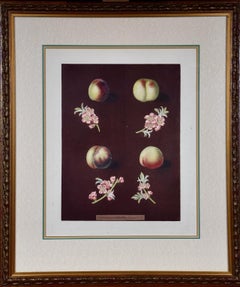
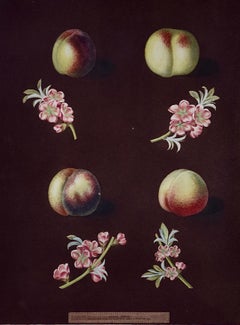
George Brookshaw's (1751-1823) beautiful "Peaches, Nectarines" hand colored aquatint engraving, plate 38 from his "Pomona Brittanica", considered to be the finest British botanical large format treatise of the 19th-century. His engravings were unique for their rich tones and colors, elegant compositions with the fruit seeming to float on a mottled sumptuous background. The pale green and peach-colored peaches and the pink and green flowers lie on a rich dark brown-colored background. The print is presented in an ornate bronze-colored wood frame with gold-colored inner and outer trims and a triple mat. The outer mat is a marbled light...
Category

Early 19th Century Academic Figurative Prints

Materials

Aquatint

Plums: George Brookshaw's Framed Hand-colored 19th C. Aquatint

Plums: George Brookshaw's Framed Hand-colored 19th C. Aquatint

By George Brookshaw

Located in Alamo, CA

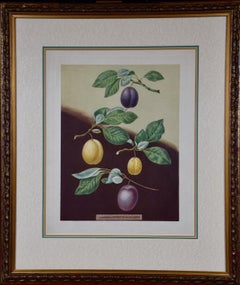
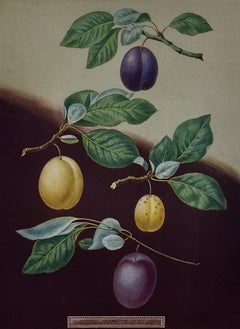
George Brookshaw's (1751-1823) beautiful "Plums" hand colored aquatint engraving from his "Pomona Brittanica", considered to be the finest British botanical large format treatise of the 19th-century. His engravings were unique for their rich tones and colors, elegant compositions with the fruit seeming to float on a mottled sumptuous background. There are purple, mustard-colored plums on brown branches with green leaves over a two-tone dark brown and light tan background. The print is presented in an ornate bronze-colored wood frame with gold-colored inner and outer trims and a triple mat. The outer mat is a marbled light...
Category

Early 19th Century Academic Figurative Prints

Materials

Aquatint

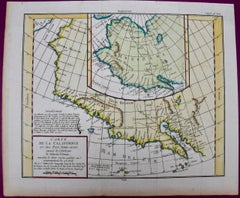
California: 18th Century Hand-colored Map by de Vaugondy

California: 18th Century Hand-colored Map by de Vaugondy

By Didier Robert de Vaugondy

Located in Alamo, CA

This is an 18th century hand-colored map of the western portions of North America entitled "Carte de la Californie et des Pays Nord-Ouest separés de l'Asie par le détroit d'Anian, ex...

Category

1770s Landscape Prints

Materials

Engraving

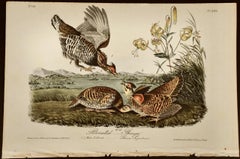
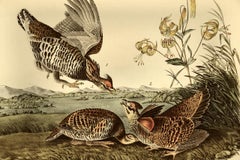
"Pinnated Grouse", an Original Audubon Hand-colored First Edition Lithograph

"Pinnated Grouse", an Original Audubon Hand-colored First Edition Lithograph

By After John James Audubon

Located in Alamo, CA

An original extremely collectible first octavo edition John James Audubon hand-colored royal octavo lithograph entitled "Pinnated Grouse", No. 60, Pl. 296, from Audubon's "Birds of A...

Category

Mid-19th Century Naturalistic Animal Prints

Materials

Lithograph

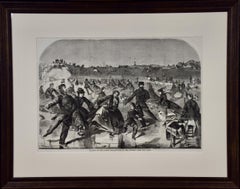
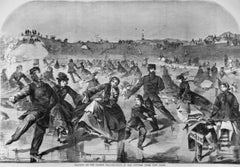
"Skating on Ladies' Pond Central Park": Winslow Homer 19th C. Woodcut Engraving

"Skating on Ladies' Pond Central Park": Winslow Homer 19th C. Woodcut Engraving

By Winslow Homer

Located in Alamo, CA

This Winslow Homer woodcut engraving entitled "Skating on the Ladies' Skating-Pond in Central Park, New York", was published in Harper's Weekly in the January 28, 1860 edition. It depicts a large number of men, women and children skating on a recently opened pond in Central Park. At the time of publication of this engraving, Central Park was in the early stages of construction. This engraving documents the very early appearance of Frederick Law Olmstead and Calvert Vaux's masterpiece of landscape design. According to Olmsted, the park was "of great importance as the first real Park made in this century – a democratic development of the highest significance". The people of New York were very proud of the plans for their park. It was stated at the time: "Our Park, which is progressing very satisfactorily under the management of the Commissioners, will undoubtedly be, one of these days, one of the finest place of the kind in the world...Those who saw the Park before the engineers went to work on it are amazed at the beautiful sites which have been contrived with such unpromising materials; all fair persons believe that the enterprise is managed with honesty and good taste." Skating was rapidly rising in national popularity in part due to the opening of Central Park’s lake to skaters on a Sunday in December 1858 with 300 participants. The following Sunday it attracted ten thousand skaters. By Christmas Day, a reported 50,000 people came to the park, most of them to skate. There were rules governing who could use the skating pond. “The Ladies’ Pond...

Category

1870s American Impressionist Landscape Prints

Materials

Engraving, Woodcut

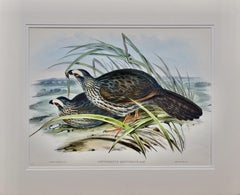
White Eye-browed Partridges: Hand-colored Folio-sized Bird Lithograph by Gould

White Eye-browed Partridges: Hand-colored Folio-sized Bird Lithograph by Gould

By John Gould

Located in Alamo, CA

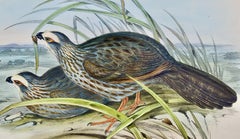
This is a 19th century hand-colored folio-sized lithograph entitled "Dendrortyx Leucophrys" (White Eye-browed Partridges) by John Gould, published in his monograph 'A Monograph of the Odontophorinae, or Partridges of America' in London between 1844-1850. Reportedly only 250 copies were printed. The print depicts two partridges, one standing and the other lying apparently on sand, surrounded by high grass. A landscape of plants and possibly water is seen in the background. This beautiful hand-colored lithograph is presented in a double cream-colored mat. There is one tiny spot in the left lower corner, faint spots in the right upper print and mild toning about the periphery which is covered by the mat. It is otherwise in excellent condition. It is accompanied by the original text page. John Gould (1841-1881) was an English contemporary of the American John James Audubon. Gould published his first illustrated book on birds in 1831 entitled "A Century of Birds from the Himalaya Mountains", followed by "Ramphastidae" and "Birds of Europe". He then extended the scope of his travels and research to include Australia, New Zealand and New Guinea, drawing birds in their natural habitat. Artists, such as his wife Elizabeth Gould, Henry Richter and Edward Lear, transferred his drawings to hand printed and hand colored stone lithographs, which are known for their beauty, detail and accuracy. As well as an exceptional and prolific artist, Gould was an outstanding scientific naturalist. In approximately 50 years he created approximately 3,000 lithographs of birds...

Category

1840s Naturalistic Animal Prints

Materials

Lithograph

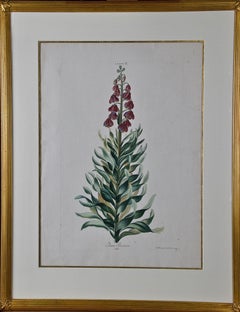
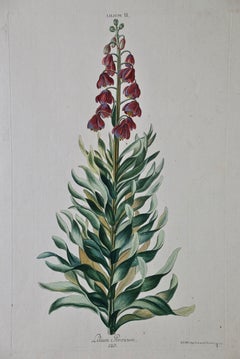
"Lilium Persicum" Ehret 18th Century Hand Colored Botanical Engraving

"Lilium Persicum" Ehret 18th Century Hand Colored Botanical Engraving

By Georg Dionysius Ehret

Located in Alamo, CA

A beautiful and important 18th century hand colored copperplate engraving of lillies which was most likely designed by Georg Dionysius Ehret (1708-1770) and engraved by Johann Michae...

Category

Late 18th Century Naturalistic Still-life Prints

Materials

Engraving

Spider Lily: An Original 18th C. Hand-colored Botanical Engraving by J. Weinmann

Spider Lily: An Original 18th C. Hand-colored Botanical Engraving by J. Weinmann

By Johann Wilhelm Weinmann

Located in Alamo, CA

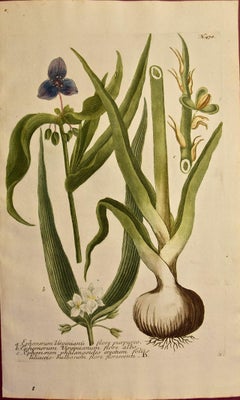
This colored botanical mezzotint and line engraving finished with hand coloring by Johann Wilhelm Weinmann (1683-1741) is entitled "A. Ephemerum Virginianu flore Purpureo, B. Ephemer...

Category

Mid-18th Century Naturalistic Still-life Prints

Materials

Engraving, Mezzotint

Canada Pouched Rat: An Original 19th Century Hand-colored Lithograph by Audubon

Canada Pouched Rat: An Original 19th Century Hand-colored Lithograph by Audubon

By John James Audubon

Located in Alamo, CA

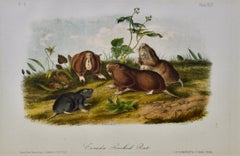
This is an original John James Audubon hand-colored lithograph entitled "Canada Pouched Rat", No. 9, Plate XLIV from John James Audubon's Quadrupeds of North America, published in Ph...

Category

Mid-19th Century Naturalistic Animal Prints

Materials

Lithograph

19th Century Daumier Satirical Lithograph "Triumph of the Botanist"

19th Century Daumier Satirical Lithograph "Triumph of the Botanist"

By Honoré Daumier

Located in Alamo, CA

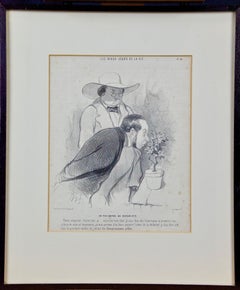
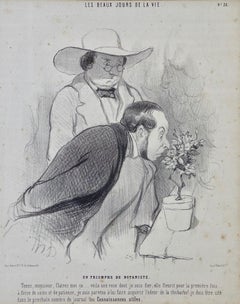
A satirical lithograph by Honoré Daumier (1808-1879) entitled "Un Triomphe de Botaniste" (Triumph of the Botanist), which depicts a proud and nervous botanist in glasses and a wide brimmed hat awaiting the critique of a snobby critic, who is smelling his blooming flowers. The French text beneath the image roughly translates: "Here, sir, sniff me that ... here is a rose of which I am proud, it blooms for the first time .... and by dint of patience, I managed to make it acquire the smell of rhubarb! .. I must be quoted in the next Journal of Useful Knowledge" or "Look at this, sir, go ahead, smell it ... I am proud of this particularly pink flower ... it's flourishing for the first time ... with patience, and care I was able to give it an odor of rhubarb! .. . Surely I should be mentioned in the next edition of the Journal of Useful knowledge". The lithograph was published in the famous and very popular French satirical...

Category

1840s Interior Prints

Materials

Lithograph

Pair of 19th C. Hand-colored Lithographs of Ducks by John Gould

Pair of 19th C. Hand-colored Lithographs of Ducks by John Gould

By John Gould

Located in Alamo, CA

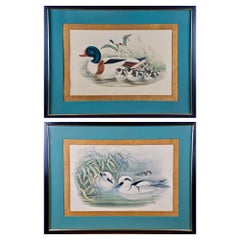
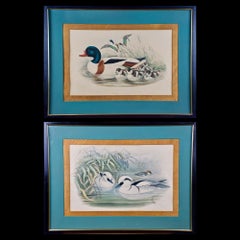
A pair of hand-colored lithographs of ducks entitled "Tadorna Vulpanser" (Sheldrake Ducks) and "Mergus Umbellus' (Smew or Nun Ducks) from John Gould's publication "Birds of Great Br...

Category

1860s Naturalistic Animal Prints

Materials

Lithograph

Pair of Hand-colored Romantic French Engravings after Francois Boucher

Pair of Hand-colored Romantic French Engravings after Francois Boucher

By (After) Francois Boucher

Located in Alamo, CA

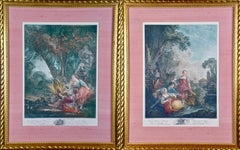
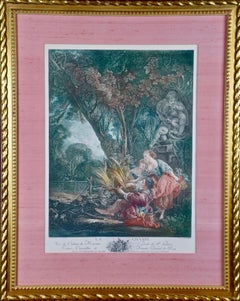
A pair of French classical romantic prints original created in the 18th century by Jacques-Firmin Beauvarlet (1731-1797) after paintings by Francois Boucher (1703-1770), utilizing ...

Category

18th Century Romantic Figurative Prints

Materials

Engraving, Etching

Three 19th C. Engravings of Classical Italian Bronze Architectural Elements

Three 19th C. Engravings of Classical Italian Bronze Architectural Elements

Located in Alamo, CA

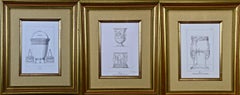
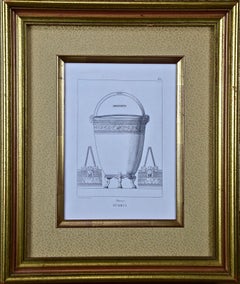
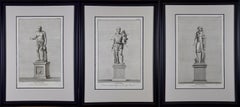
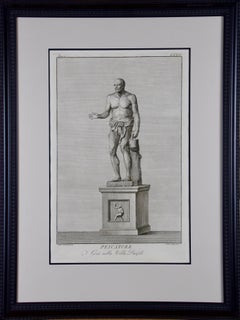
A grouping of three engravings depicting classical Italian architectural features held in the National Museum of Naples, entitled "Bronze Hydria", "Marbre Naissance de Bacchus" and "...

Category

1880s Other Art Style Still-life Prints

Materials

Engraving

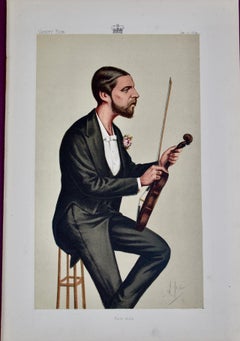
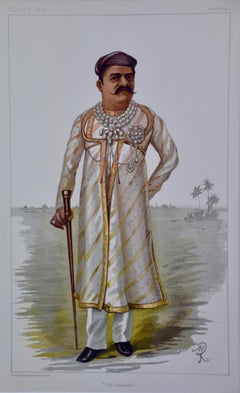
Colored Vanity Fair Caricature of the "Gaekwar of Baroda" (Prince of India)

Colored Vanity Fair Caricature of the "Gaekwar of Baroda" (Prince of India)

Located in Alamo, CA

A hand-colored caricature entitled the "Gaekwar of Baroda" (Prince of India), from Vanity Fair, Plate 23 , published July 3, 1901. Sayajirao Gaekwad III (1863-1939) was the Maharaja ...

Category

Early 1900s Other Art Style Portrait Prints

Materials

Lithograph

18th Century French Map and City View of Joppe/Jaffa (Tel Aviv) by Sanson

18th Century French Map and City View of Joppe/Jaffa (Tel Aviv) by Sanson

By Nicholas Sanson d'Abbeville

Located in Alamo, CA

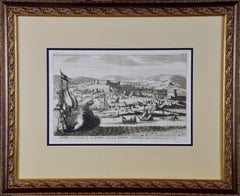
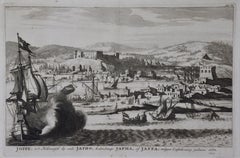
An original antique engraving entitled "Joppe; in ’t Hebreeusch by ouds Japho; hedendaags Japha, of Jaffa; volgens d’aftekening gedaan 1668", by Nicholas Sanson d'Abbeville (1600 - 1667). This is a view of the city of Joppe (in Hebrew Japho), now called Japha or Jaffa, the harbor portion of modern day Tel Aviv, Israel as it appeared in 1668 . It depicts a very busy harbor with numerous boats. A large ship on the left appears to be firing its canons and a small ship on the right appears to be sitting very low in the water, either heavily loaded with cargo or sinking. The town is seen on the far shore with a fortress on a hill across in the background. The map is printed from the original Sanson copperplate and was published in 1709 by his descendants. The map is presented in an ornate brown wood frame embellished by gold-colored leaves and gold inner trim with a double mat; the outer mat is cream-colored and the inner mat is black. There is a central vertical fold, as issued. There are two small spots in the lower margin and one in the upper margin, as well as two tiny spots adjacent to the central fold. 1717 is written below the date 1668 in the inscription. The map is otherwise in very good condition. Another map of the "Holy Land" (by Claes Visscher in 1663), with an identical style frame and mat is available. This pair of maps would make a wonderful display grouping. Please see Reference #LU117324709892. Artist: Nicholas Sanson d'Abbeville (1600 - 1667) and his descendents were important French cartographer's active through the 17th century. Sanson started his career as a historian and initially utilized cartography to illustrate his historical treatises. His maps came to the attention of Cardinal Richelieu and then King Louis XIII of France, who became a supporter and sponsor. He subsequently appointed Sanson 'Geographe Ordinaire du Roi' the official map maker to the king. Sanson not only created maps for the king, but advised him on geographical issues and curated his map collection...

Category

Early 1700s Prints and Multiples

Materials

Engraving