Large French Wrought-Iron and Heavy Perforated-Metal Fireplace Screen, circa 1940–1950
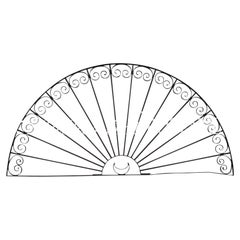
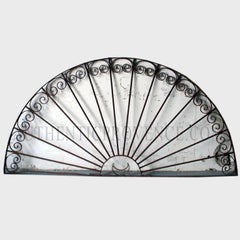
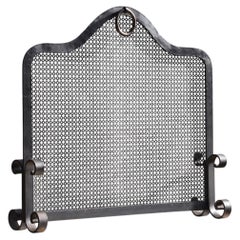
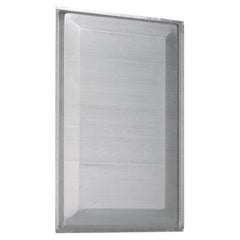
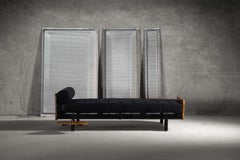
An important large-scale French fireplace screen of particularly generous width, crafted from wrought iron and heavy perforated metal. With its substantial proportions and strongly defined design, it functions as much as a decorative object in its own right as a practical fireplace accessory.
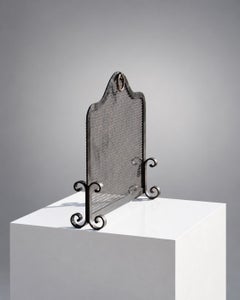
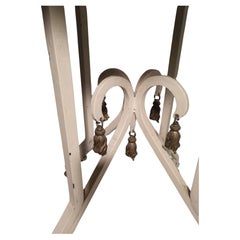
Its composition stands at the crossroads of several stylistic influences. The design retains something of late Art Deco and French Neoclassicism of the 1940s, visible in the overall symmetry, the presence of the framing structure, and the traditional mastery of wrought iron. Yet this discipline is softened by the sensuality of the lines, the free movement of the upper section, and above all by the large, generously coiled scrolls that extend from the uprights and form the feet.
These curves give the screen an almost calligraphic presence. The iron appears to unfold freely around the central panel, opposing the regularity of the perforated grid with a succession of fluid, continuous movements. This freedom of form already places the piece firmly within the aesthetic of the 1950s, when French furniture and decorative arts gradually moved away from strict geometry toward more organic and sensual lines.
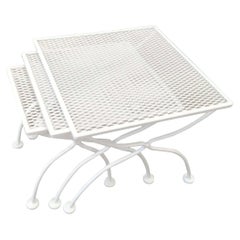
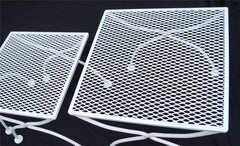
The central panel is not made from thin sheet metal, but from a substantial, heavy-gauge perforated metal, characteristic of a type of construction still strongly associated with the 1940s. Its physical density clearly distinguishes the piece from the much lighter perforated sheets that would later become common. Yet the repeating pierced pattern introduces remarkable transparency and naturally invites comparison with the experiments developed during the 1950s by Mathieu Matégot, particularly his exploration of perforated metal and its ability to visually dematerialize the mass of an object.
Placed in front of a fire, this perforated surface comes fully to life: the movement of the flames is seen through the grid and fragmented by the repetition of the pattern, creating a genuine optical effect. As the fire shifts, the points of light appear to move and vibrate across the surface of the screen. The perforated metal therefore acts as a visual filter between the viewer and the flames, producing an almost kinetic effect, constantly animated by their movement.
A comparison with Jean Royère may also be suggested in this balance between structure and fantasy: less for the use of perforated metal itself than for the sensuality of the curves, the freedom of the line, and the expressive character of the large scrolls, which transform a functional object into a particularly lively decorative composition.
This large fireplace screen...
Category
French Neoclassical Vintage 1950s Building and Garden Elements