Located in Downingtown, PA
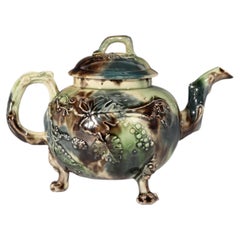
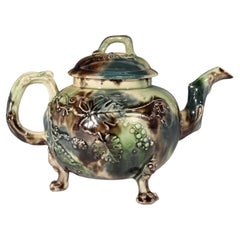
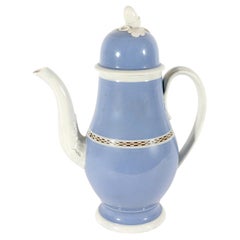
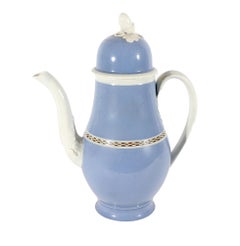
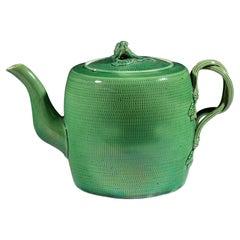
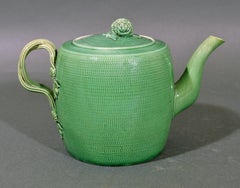
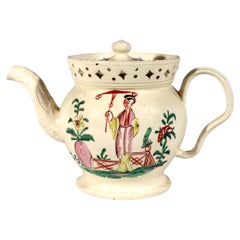
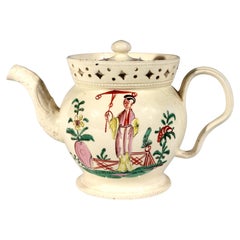
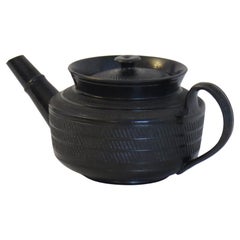
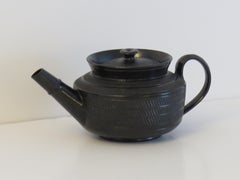
English Pearlware Blue Slip Teapot & Cover, Engine-Turned Fluting, Acorn Finial
English, probably Staffordshire or Yorkshire, Circa 1790
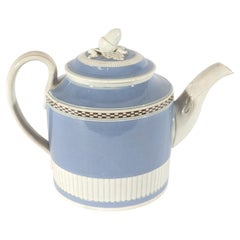
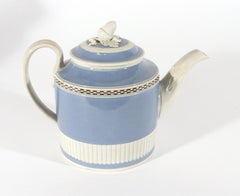
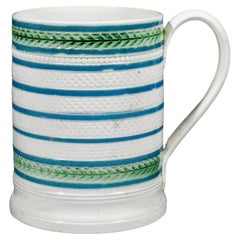
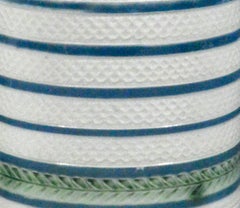
This English pearlware teapot of restrained neoclassical form has a straight-sided cylindrical, or drum-shaped, body covered in a light blue slip ground, its broad upper section unadorned save for the decorative band encircling the shoulder: a checkered band of rouletting inlaid with dark brown slip, flanked by fine raised turned fillets. The lower section is distinguished by a broad band of closely spaced vertical fluting, cut on the engine-turning lathe through the blue slip to expose the pale body beneath, the flutes stopping in a neat scalloped edge against the blue above and below. The fluting is a crisp textural counterpoint to the smooth blue-slipped upper body and a quality of workmanship that speaks to the more refined end of English earthenware production of the period.
Engine-turning was carried out before firing, while the clay was leather-hard, on a lathe whose cams rocked the revolving pot against a fixed cutting tool, so that a repeated pattern could be cut with mechanical regularity; where the pot had first been dipped or banded in colored slip, as here, the cut revealed the contrasting color of the body. It is a characteristic feature of the more accomplished Staffordshire and Yorkshire manufactories, among them the Leeds Pottery.
The domed cover, with its broad stepped rim, repeats the engine-turned reeding in a concentric ring at the crown and is surmounted by a finely modeled applied finial in the form of a white pearlware acorn in its textured cup, resting upon naturalistic oak leaves with a twig and an empty acorn cup beside it, a motif of considerable delicacy widely employed in English ceramics of the 1780s and 1790s. The curved spout, in uncolored pearlware, is press-molded at its base with leafage in low relief, and the reeded loop handle ends in press-molded foliate terminals at both its upper and lower junctions, reinforcing the neoclassical character of the design. The flat glazed base shows the blue-green pooling characteristic of the pearlware glaze.
Dimensions:
Height: 6½ inches (16.5 cm)
Width, handle to spout: 8½ inches (21.6 cm)
Depth: 4¾ inches (12.1 cm)
Marks:
Unmarked.
Provenance:
Earle D. Vandekar of Knightsbridge
Condition:
Good condition, with a chip to the tip of the spout, visible in the photographs.
References:
T. A. Lockett and P. A. Halfpenny, eds., Creamware and Pearlware, Stoke-on-Trent: City Museum and Art Gallery, 1986.
Donald Towner, Creamware, London: Faber & Faber, 1978.
Peter Walton, Creamware and Other English Pottery at Temple Newsam House, Leeds, Bradford and London: Manningham Press, 1976, p. 246, pls. 1071–1072.
Geoffrey A. Godden, British Pottery: An Illustrated Guide, London: Barrie & Jenkins, 1974.
Philip Miller and Michael Berthoud, An Anthology of British Teapots, Broseley, Shropshire: Micawber Publications, 1985.
Donald Carpentier and Jonathan Rickard, “Slip Decoration in the Age of Industrialization,” Ceramics in America 2001, Milwaukee: Chipstone Foundation, 2001, pp. 115–134.
Jonathan Rickard and Donald Carpentier, “The Little Engine That Could: Adaptation of the Engine-Turning Lathe in the Pottery Industry,” Ceramics in America 2004, Milwaukee: Chipstone Foundation, 2004, pp. 78–99.
Bonhams, London, 18 May 2011, lot 96: a Leeds pearlware...
Category
Late 18th Century English Antique Georgian Pottery
MaterialsCeramic, Pearlware, Pottery