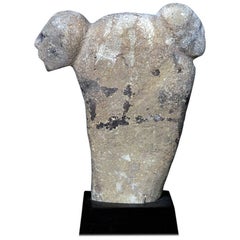
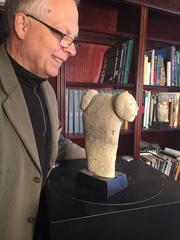
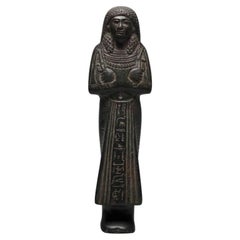
The XIX Dynasty of Ancient Egypt was part of the Egyptian New Kingdom and was founded by Vizier Ramasses I, whom Pharaoh Horemheb chose as his successor to the throne. The XIX Dynasty is best remembered for its military conquests in the lands of Canaan. The relative peace of the XVIII Dynasty gave way to a century of wars, which produced art that attempted to maintain ancestral traditions in order to claim its dynastic lineage and succession to the throne.This large serpentine statue tells of the prominence of administrative art during this period. The figure is an ushabti, a funerary statue that would have been placed in a tomb among the grave goods of the inhabitant, intended to act as a servant for the deceased in the afterlife. The ushabtis would be called upon to perform their menial tasks, each figure's purpose is often attested to by objects in their hands, such as bread-baker holding grain or farmer holding a scythe, and they would be donated by the workers of the deceased to fulfill their roles for them in death. Hieroglyphics could often also be found running the length of their legs giving further clues to their roles and stating whom they intended to work for. These inscriptions were called answers and asserted the figures readiness to be summoned to the gods work The practice of placing ushabtis inside tombs originated in the Old Kingdom, with the earliest evidence from the middle of the third millennium B.C. when they buried next to mummies[2]. They are normally miniature in size, of hard stones such as limestone, granite or serpentine (and occasionally of faience or bronze), and produced in multiples to provide the important deceased with an army of workers. Sometimes so many were produced that they world cover the entire surface floor of a tomb. Due to this commonness, many extant examples survive, in varying qualities, and as a collection of artifacts they provide a unique insight in to the fascinating death customs of the Ancient Egyptians, highlighting their very real belief in an eternal afterlife.This beautifully carved statue holds hoes and a seed sack, indicating they were destined for manual toil in the eternal afterlife amongst the fields growing grain to produce food for the interred. Another agricultural implement with crisscrossing ropes is tucked in to the back of the figure's kilt, making sure he is ready for any farming situation necessary. He wears a long-sleeved shirt with a long pleated kilt, which has a large over-fold and broad beaded collar. He also wears a double wig composed of zig-zags and echeloned curls, and his face has a slightly aquiline nose, with almond-shaped eyes a fixed, determined gaze.A column running the length of his over-fold contains five lines of hieroglyphic inscription that name the owner of the worker (Kenj), and recite chapter VI from the Ancient Egyptian Book of...
Category
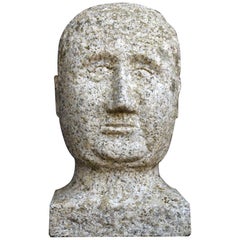
15th Century and Earlier Egyptian Antique Granite Folk Art