Vitrines

4 Results
to
1
Height
to
Width
to
Depth
to
3
1
3
1
1
1
1
2
1
2
1
1
4
2
2
2
2
4
1
1
1
1
4
3
3
1
Vitrines For Sale
Color:  Red
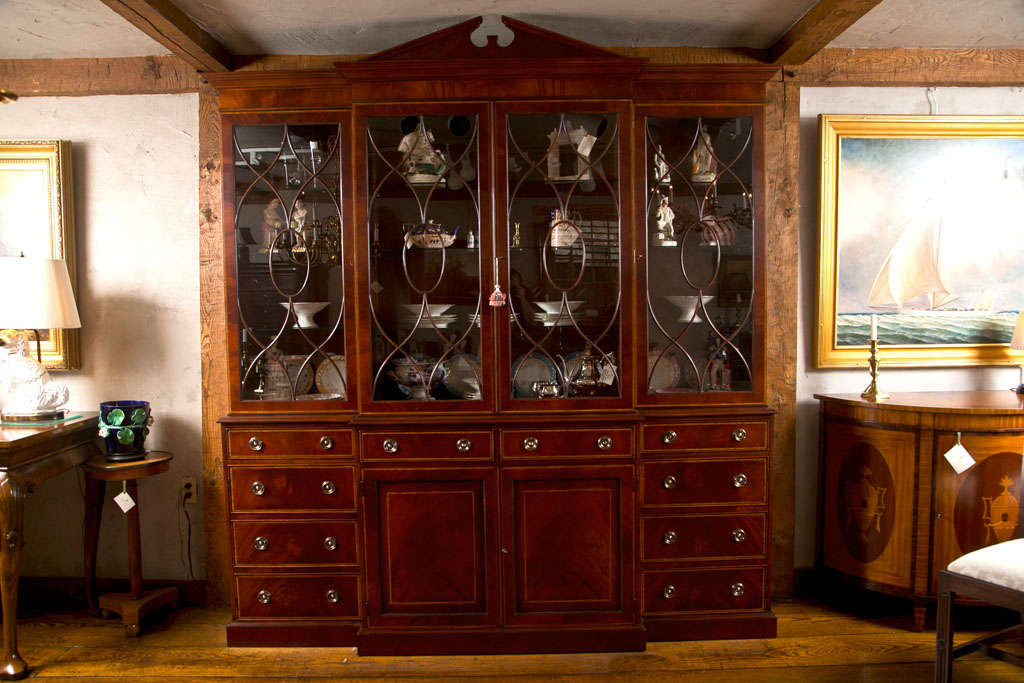
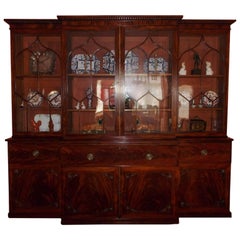
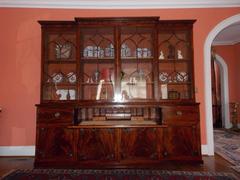
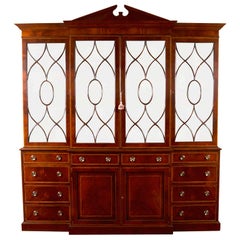
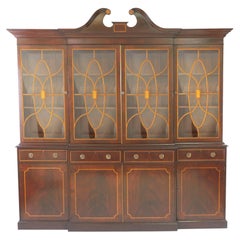
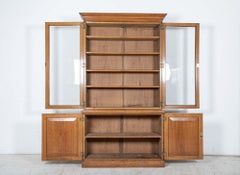
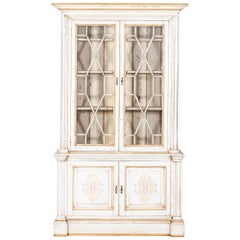
English Mahogany Glazed Door Breakfront

English Mahogany Glazed Door Breakfront

Located in Woodbury, CT

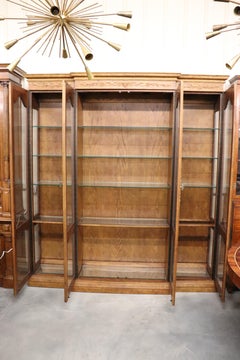
We designed this breakfront to look the part of an 18th century piece, but offer 21st century functionality. From the glass shelves that allow for the option of interior lighting to ...

Category

21st Century and Contemporary British Georgian Vitrines

Materials

Mahogany, Satinwood

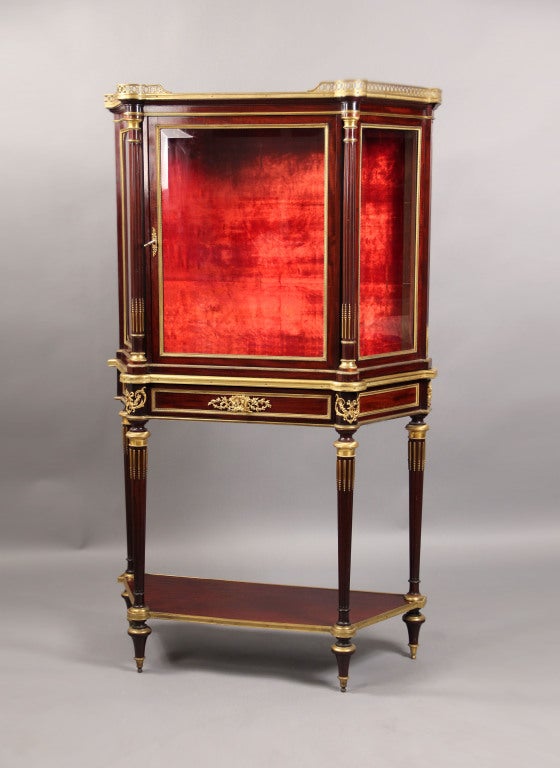
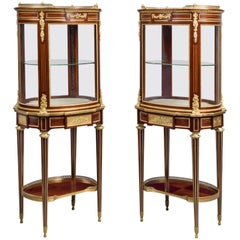
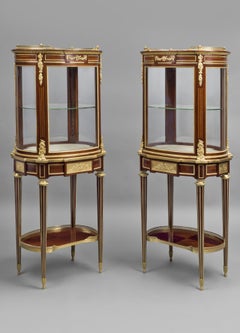
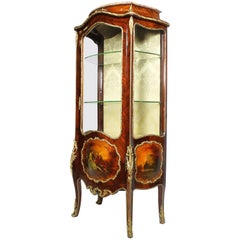
A Fine French 19th-20th C. Marquetry Gilt-Bronze Mounted, François Linke Attr.

A Fine French 19th-20th C. Marquetry Gilt-Bronze Mounted, François Linke Attr.

By François Linke

Located in Los Angeles, CA

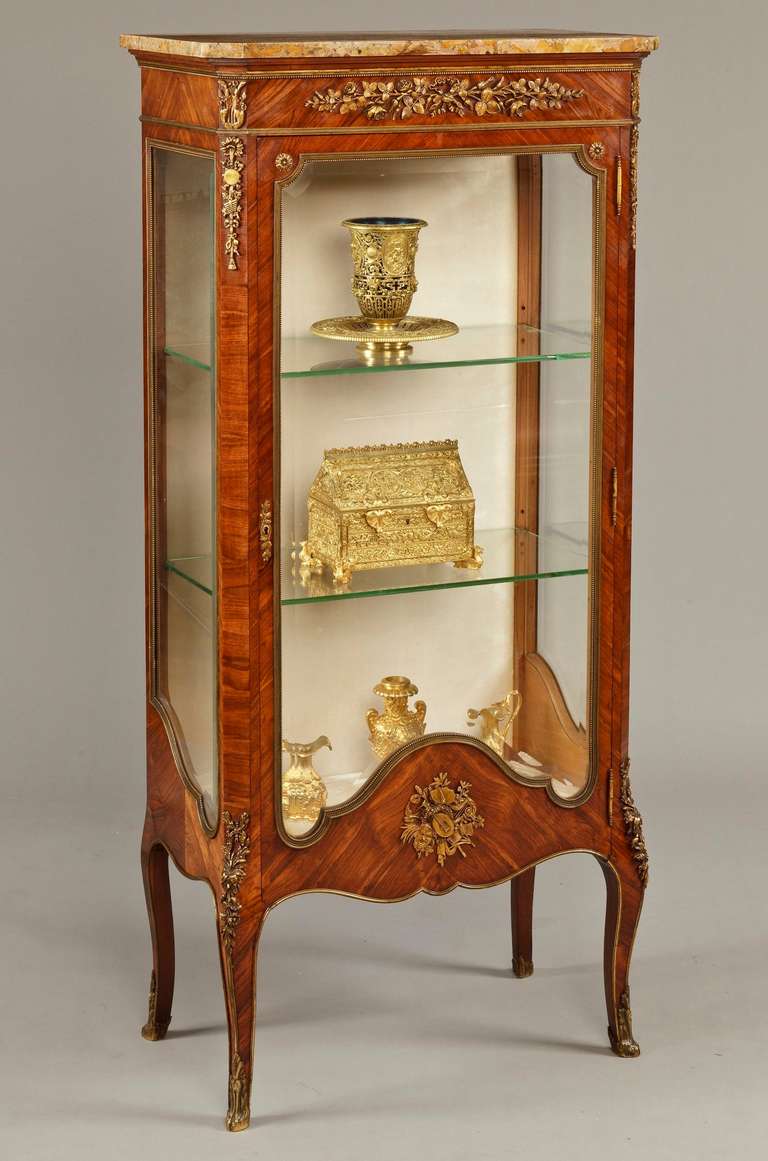
A fine French 19th-20th century kingwood and tulipwood marquetry and gilt-bronze mounted vitrine - display case, in the manner of François Linke (1855-1946). The slender single door display cabinet with a red-velvet backing and bowed glass panels surmounted with acanthus and floral gilt-bronze mounts in the style of Léon Messagé (French, 1842-1901), the serpentine shaped front door with an ornate marquetry and ink colored panel depicting wreaths, ribbons and tied acantus leaves, all raised on four cabriolet legs ending with gilt-bronze paw-feet, Paris, circa 1900. Linke was born on 17 June 1855 in the small village of Pankraz, in what is now the Czech Republic. Records show that Linke served an apprenticeship with the master cabinet maker, Neumann, which he completed in 1877. Linke’s work book or Arbeits-Buch records that he was in Vienna from July 1872 to October 1873 at the time of the International Exhibition held there in 1873. He subsequently travelled to Prague, Budapest & Weimar before finally arriving in Paris in 1875. It is documented that he obtained employment with an unknown German cabinetmaker in Paris, and stylistic similarities, photographs and geographical proximity have led some to suggest that Emmanuel Zwiener was the most likely candidate. After a period back in his home town of Pankratz, he returned once and for all to Paris in 1877. In 1878 Paris hosted the third great International Exhibition, a remarkable success for a country ravaged by war only seven years earlier. It is known that the fledgling Linke workshops were active in the Faubourg St. Antoine as early as 1881, during this time he supplied furniture for other more established makers such as Jansen and Krieger. By 1889 another World’s Fair, as they were often referred to in America, took place in Paris. Monsieur Eiffel erected what has become the most iconic building in Paris for the exhibition and the atmosphere of wealth and confidence may well have encouraged Linke to think that he could contribute an important part to the next great exhibition. As early as 1892 this was decreed to take place at the end of the century, in an attempt to pre-empt Berlin from staging the last great show of the century. In 1892, Victor Champier (fr) one of the commissioners for the 1900 Paris Fair had appealed, “Create in the manner of the masters, do not copy what they have made”. It was an appeal against mere reproduction and Linke rose to this challenge in an unparalleled way with his unique display that was to include the Grand Bureau. Determined to outshine the competition at the Exhibition, Linke had set about creating the most ambitious pieces he could envisage, and more extravagant than had ever been displayed before. The items he exhibited marked a transition from the historicist interpretation of Louis XV and Louis XVI styles, an interpretation that was the mainstay of his nearest rivals, to something startlingly new and vital in its immediacy. [6] Together with Léon Messagé he developed a new style for the 1900 Exhibition that paid homage to the Louis XV rococo in the fluidity of its approach, but an approach fused with the lively flowing lines of the contemporary and progressive 'art nouveau'. The Art Journal reported in 1900 on Linke's stand: "The work of M. Linke ... was an example of what can be done by seeking inspiration amongst the classic examples of Louis XV and XVI without in any great sense copying these great works. M. Linke's work was original in the true sense of the word, and as such commended itself to the intelligent seeker after the really artistic things of the Exhibition. Wonderful talent was employed in producing the magnificent pieces of furniture displayed". Linke's stand would have appeared refreshingly new to contemporary onlookers, the traditional designs of the eighteenth century melting seamlessly into an exuberant naturalism. The 'Revue' described Linke's style as 'entièrement nouveaux' and noted "This opinion is universally accepted. Linke's stand is the biggest show in the history of art furniture in the year 1900". It is perhaps the most extraordinary and remarkable aspect of Linke’s personal history that he produced such expensive and luxurious furniture of exquisite quality for the 1900 exhibition without any commission or any potential buyer in mind. [9] At a time when other more established furniture businesses such as those of Beurdeley and Dasson were closing down, he made a huge investment in his stand and the furniture he supplied for it. Linke recognised that to move his business forward he needed to appeal to a more International clientele and the new emerging rich who were at this time amassing fortunes on an unprecedented scale. For this reason he gambled everything he had on his display for the 1900 exhibition. Had this not succeeded he would almost certainly have succumbed to bankruptcy. Linke’s notebook records visitors to his stand from England, Europe, the Americas, Egypt and Japan and including; the King of Sweden, three visits from the King of Belgium, Prince Radziwill, the Prince d’Arenberg, the Comte Alberic du Chastel, Miss Anna May Gould, the American heiress, distinguished furniture makers and the President of France Emile Loubet. This risky endeavour was a resounding success, and with his reputation established, La Maison Linke became the pre-eminent furniture house until outset of the Second World War. The technical brilliance of his work and the artistic change that it represented was never to be repeated. His showrooms expanded into prestigious premises in Paris, in the Place Vendôme as well as the Faubourg St. Antoine where his workshop had been established. He embarked on many important commissions in the years up to the outbreak of the First World War, making and designing furniture for leading international industrialists and bankers. After the 1914-1918 World War, Linke undertook the extraordinary commission to furnish the Ras al-Tin Palace in Alexandria for King Fuad of Egypt, possibly the largest single furniture commission ever conceived, eclipsing even Versailles. Linke flourished and remained active until the middle years of the 1930s and died in 1946 Léon Messagé (1842-1901) was a French sculptor, best known for his sculptural collaboration with François Linke for the 1900 Paris Exposition Universelle. Messagé was also responsible for much of the design and creative work for Roux et Brunet...

Category

Early 1900s French Louis XV Antique Vitrines
Materials

Bronze

A Fantastic Late 19th Century Gilt Bronze Mounted Vitrine By Paul Sormani

A Fantastic Late 19th Century Gilt Bronze Mounted Vitrine By Paul Sormani

By Paul Sormani

Located in Long Island City, NY

A Late 19th Century Gilt Bronze Mounted Louis XVI Style Vitrine By Paul Sormani Paul Sormani Bronze gallery above a centered glass door, flanked by glass panels, four bronze mount...

Category

19th Century French Belle Époque Antique Vitrines

Materials

Bronze, Ormolu

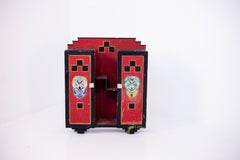
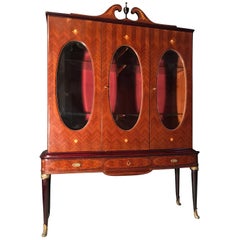
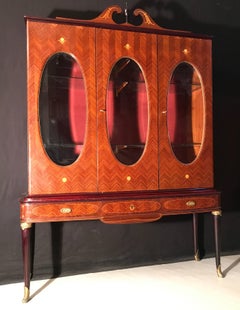
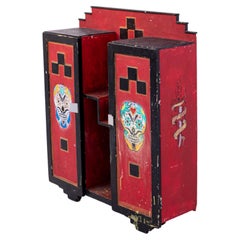
Italian Futurist Cabitet in Red Wood and Applications

Italian Futurist Cabitet in Red Wood and Applications

Located in Milano, IT

Eccentric Italian futurist showcase cabinet from the 20's. The cabinet has applications inserted later, such as skull-shaped designs and designs on the sides of the cabinet in the sh...

Category

1920s Italian Futurist Vintage Vitrines

Materials

Wood

Related Items
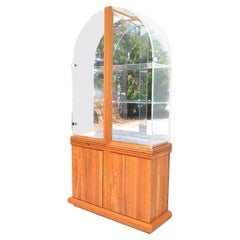
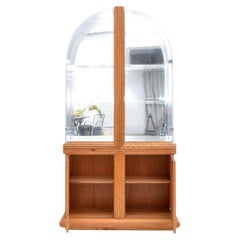
American Arch Shape Lucite, Mirror & Oak Wood Vitrine, Showcase, Display Cabinet

American Arch Shape Lucite, Mirror & Oak Wood Vitrine, Showcase, Display Cabinet

Located in Miami, FL

Mid-Century Modern two piece arched Lucite top Vitrine, showcase, bookshelf made in America 1980 with a blonde Oak Wood Cabinet Base. Features a mirrored Back and 2 tier clear Lucit...

Category

1980s American Mid-Century Modern Vintage Vitrines

Materials

Chrome

19th Century French Vitrine of Kingwood and Gilt Bronze Mounts

19th Century French Vitrine of Kingwood and Gilt Bronze Mounts

By François Linke

Located in London, GB

A fine vitrine in the manner of Francois Linke Constructed in kingwood, with gilt bronze mounts, in the Louis XVI Transitional style; rising from bronze foliate sabots, with gent...

Category

19th Century French Louis XVI Antique Vitrines

Materials

Marble, Bronze

Large Solid Oak French Louis XV Style Breakfront Bookcase Vitrine, circa 1980

Large Solid Oak French Louis XV Style Breakfront Bookcase Vitrine, circa 1980

Located in Swedesboro, NJ

This impressive French Louis XV style breakfront bookcase vitrine, crafted in solid oak circa 1980, is a striking example of fine European craftsmanship. The substantial design featu...

Category

1980s American Louis XV Vintage Vitrines

Materials

Oak

English Chippendale Mahogany Breakfront With Secretary, Circa 1790

English Chippendale Mahogany Breakfront With Secretary, Circa 1790

Located in Charleston, SC

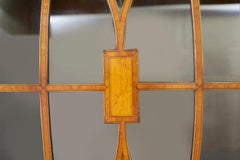
English Chippendale mahogany breakfront with carved molded cornice, four upper case glass doors with arched oval mullions, adjustable interior shelving, lower case concealing a slidi...

Category

1790s English George III Antique Vitrines

Materials

Brass

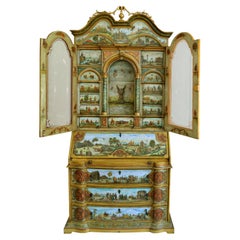
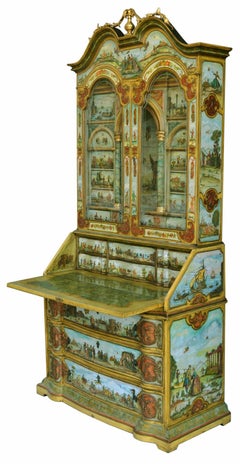
Midcentury Trumeau Handpainted in Italy Wood Venetian Art Technique by Cupioli

Midcentury Trumeau Handpainted in Italy Wood Venetian Art Technique by Cupioli

By Cupioli made in Italy

Located in Rimini, IT

This Trumeau has been handmade using the technique of Venetian art. In the 18th century in Venice the fashion of lacquering spread. Using small prints, cut out and then glued on the wood, then handpainted and lacquered at the end. The finishing was in fact in shellac which, passed in several very thin layers, gave brightness and uniformity to the decoration. This type of finishing was placed both on the outside of the Venetian furniture of the eighteenth century, and on the inside of the drawers and doors . The wooden structure of this piece of furniture is hidden by a flowering of pleasant designs. The craquelé finishing tipical of ancient painting...

Category

20th Century Italian Other Vitrines

Materials

Wood, Art Glass

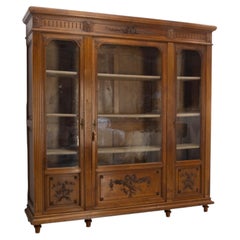
French Louis XVI Style Oak & Walnut Three Doors Vitrine Bookcase circa 1900

French Louis XVI Style Oak & Walnut Three Doors Vitrine Bookcase circa 1900

Located in Labrit, Landes

A grand Louis XVI-style bookcase crafted around 1900 from solid oak and walnut veneer. This elegant piece stands out for its balanced design featuring three glass-paned doors, offeri...

Category

Early 1900s French Louis XVI Antique Vitrines

Materials

Glass, Oak, Walnut

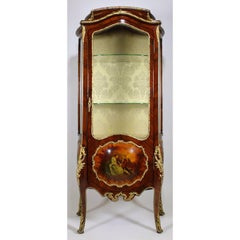
A French 19th Century Louis XV & Vernis-Martin Style Gilt Bronze-Mounted Vitrine

A French 19th Century Louis XV & Vernis-Martin Style Gilt Bronze-Mounted Vitrine

$12,985Sale Price|23% Off

H 63.75 in W 29 in D 16.25 in

A French 19th Century Louis XV & Vernis-Martin Style Gilt Bronze-Mounted Vitrine

By Vernis Martin

Located in Los Angeles, CA

A fine French 19th century Louis XV Style gilt bronze-mounted and "Vernis Martin" style bombé tulipwood veneered vitrine cabinet with a Breche d' Alep marble top. The serpentine fron...

Category

Late 19th Century French Louis XV Antique Vitrines
Materials

Marble, Bronze

Monumental 19thC English Ebonised Mahogany Glazed Breakfront Bookcase

Monumental 19thC English Ebonised Mahogany Glazed Breakfront Bookcase

Located in Staffordshire, GB

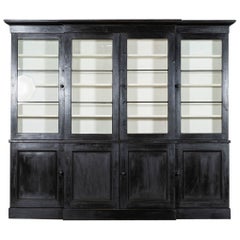
circa 1880 Monumental 19thC English Ebonised Mahogany Glazed Breakfront Bookcase sku 2007 Together W258 x D38 x H223 cm Base W247 x D38 x H88 cm Base right section internal shelf dep...

Category

19th Century Antique Vitrines
Materials

Mahogany

19thC English Glazed Oak Bookcase Cabinet

19thC English Glazed Oak Bookcase Cabinet

$9,495

H 92.52 in W 53.94 in D 18.9 in

19thC English Glazed Oak Bookcase Cabinet

Located in Staffordshire, GB

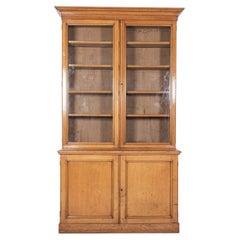
Circa 1870 19thC English Glazed Oak Bookcase Cabinet Adjustable Shelves and original hardware with good form and colour. With original Key for top cabine...

Category

1860s English Antique Vitrines
Materials

Oak

19thC English Painted Astragal Glazed Bookcase Cabinet

19thC English Painted Astragal Glazed Bookcase Cabinet

$8,115

H 84.65 in W 49.61 in D 16.54 in

19thC English Painted Astragal Glazed Bookcase Cabinet

Located in Staffordshire, GB

circa 1880 19thC English Painted Astragal Glazed Bookcase Cabinet With keys and working locks (2 parts) W126 x D42 x H215 Base: W120 x D42 x H...

Category

1870s English Antique Vitrines
Materials

Pine

Previously Available Items
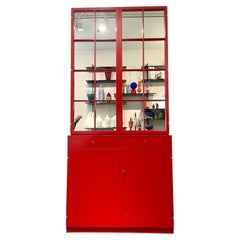
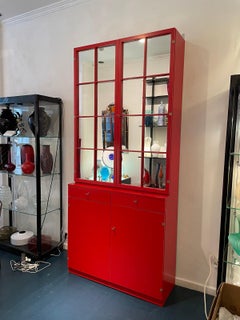
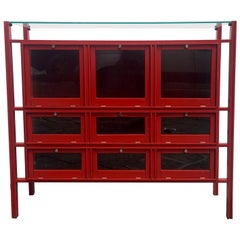
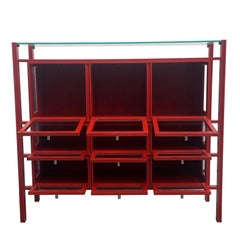
Carlo de Carli Rare Red Lacquered Wood Showcase or Credenza, Italy, 1950s

Carlo de Carli Rare Red Lacquered Wood Showcase or Credenza, Italy, 1950s

By Carlo di Carli

Located in Naples, IT

Structure with orthogonal frame in red lacquered wood, sides with transparent glass insert, flap doors with lacquered wood and crystal frame, upper top in ground glass. Year 1950. O...

Category

1950s Italian Mid-Century Modern Vintage Vitrines
Materials

Glass, Wood

Antique and Vintage Vitrines
Why not give your precious collectibles the case pieces they deserve? Antique and vintage vitrines can be used to safely store and display your most treasured objects.
While they were initially used to display relics in churches or to preserve specimens for scientific observation, vitrines are best known for their place in retail spaces and museums. The name for these glass display cases comes from the Latin word “vitrum,” meaning glass, as well as the Old French word “vitre,” which also refers to glass. Instead of simply showcasing collector’s items on shelves, you can bestow extra importance on them by displaying them in a vitrine for passers-by to observe and admire.
Not all vitrines are created equal. Over time, furniture makers have explored different shapes and sizes for vitrines. A display case you’ll find in a retail store will likely look drastically different from what you’ll see in a museum or art gallery. A vitrine in a shop is likely there to best market specific wares to the general public, while in museums there is usually a range of different vitrines intended to house and protect single objects or to display a grouping of artifacts.
Most of us have an antique, new or vintage case piece in our home. Though the terms “case pieces” and “case goods” may cause even the most decor-obsessed to stumble, these furnishings have been a vital part of the home for centuries. Any furnishing that is unupholstered and has some semblance of a storage component — cabinets, dressers, buffets — may be properly termed a case piece.

Mirror-backed vitrines, which refer to cases that usually feature shelved and mirrored interiors, are a most appropriate home for your jewelry or decorative objects. Adding such items to a vitrine already suggests that there is an irreplaceable preciousness to the case’s contents, and the mirrors will emphasize as much as well as refract more light to render the display eye-catching.

On 1stDibs, find a wide variety of antique and vintage vitrines to protect and preserve your most prized items. The collection of mid-century modern vitrines and Art Deco vitrines is mostly inclusive of those built with a wooden frame, but there are many other types to choose from as well. It’s time to give your collectibles a good home!