Located in Myrtle Beach, SC
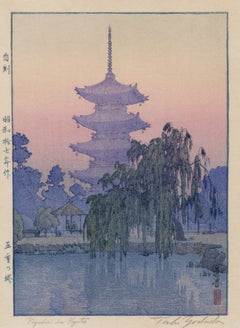
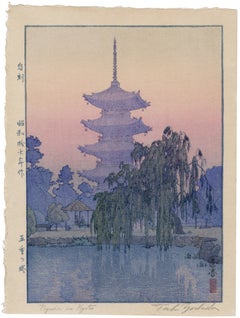
Toshi Yoshida, 'Five-Storied Pagoda,' also titled 'Pagoda in Kyoto' (Gojū no tō / 五重の塔), color woodblock print, 1942, edition not stated. Signed 'Toshi Yoshida' in pencil; signed 遠志 (Tōshi) and sealed in the image, lower right; titled 'Five-Storied Pagoda', and dated in Japanese in the left margin, and bearing the characters 自刻 (jikoku, “self-carved”), confirming that Yoshida himself carved the blocks. A superb, atmospheric, impression, with skilled bokashi (gradations) and finely nuanced colors, on cream wove Japanese paper; the full sheet, in excellent condition, (apparently never mounted or framed). Self-carved and self-printed by the artist. Archivally sleeved, unmatted.
Image size 9 1/2 x 6 3/4 inches (241 x 171 mm); sheet size approximately 10 1/2 x 7 7/8 inches (267 x 200 mm).
Catalog References:
The design is catalogued in the developing Toshi Yoshida Catalogue as Pagoda in Kyoto / 五重の塔, 1942, color woodblock.
It is also documented by Art Platform Japan from the Fukuoka Art Museum's own collection data as 'Five-Storied Pagoda', 1942.
Literature:
Thomas Tabery and Kevin Schumacher-Shoji, eds., Farben Japans: Holzschnitte aus der Sammlung der Bayerischen Staatsbibliothek, Kerber Verlag, 2025, no. 146.
Exhibited:
Farben Japans – Holzschnitte aus der Sammlung der Bayerischen Staatsbibliothek, Bayerische Staatsbibliothek, Munich, March 27–July 6, 2025, no. 146. The Bavarian State Library's 2025 annual exhibition and the first exhibition in the institution's history devoted specifically to its Japanese color woodblock collection. More than 130 works spanning the 18th through 20th centuries were presented.
Collections:
Allen Memorial Art Museum, Oberlin College; Art Gallery of Greater Victoria, British Columbia; Bavarian State Library (Bayerische Staatsbibliothek), Munich; British Museum, Fukuoka Art Museum, Japan; Smithsonian National Museum of Asian Art.
ABOUT THIS WORK
Created in 1942, Pagoda in Kyoto (Gojū no tō / 五重の塔) is an early work by Toshi Yoshida, still closely connected to the shin-hanga aesthetic associated with his father, Hiroshi Yoshida, yet already demonstrating Toshi's exceptional command of the woodblock medium. A five-storied pagoda rises behind a screen of weeping willows beside a quiet pond, its architectural mass softened by the atmospheric light of evening. The composition is constructed through overlapping silhouettes and unusually delicate gradations of blue, violet, green, and rose, giving the scene a dreamlike stillness.
This impression is distinguished by the exceptional subtlety of its printing. The sky passes almost imperceptibly from warm pink through lavender and violet, allowing the pagoda to dissolve into the surrounding atmosphere. The willow is built from several closely related greens and blue-greens, while the water is printed with restrained tonal modulation. These effects depend upon sophisticated bokashi and careful hand application of pigment and are markedly more nuanced than those seen in later impressions of the design.
ABOUT THE ARTIST
Yoshida Toshi (1911–1995) began training at the age of fourteen under his father, Yoshida Hiroshi, a leading artist of the twentieth-century Japanese printmaking revival known as shin-hanga (“new prints”), which continued the traditional collaborative system of Japanese woodblock printing. From 1932 to 1935, Toshi studied at the Taiheiyo-Gakai (Pacific Painting Association), which his father had helped establish.
Before the Pacific War, Toshi traveled extensively with his father in Asia, Europe, Egypt, and the United States. He later continued his international travels, particularly in Mexico, the United States, Canada, and Africa. His early prints remained strongly influenced by Hiroshi's work and the highly refined techniques practiced in the Yoshida studio. Following his father's death in 1950, Toshi assumed responsibility for the studio while increasingly pursuing an independent artistic direction.
Beginning in the early 1950s, he undertook a highly personal exploration of abstraction, creating and printing his own works in the sōsaku-hanga (“creative print”) manner, in which the artist assumes direct responsibility for the design, carving, and printing. During this exceptionally productive period, Toshi produced a large body of nonobjective woodcuts characterized by complex geometric structures, richly layered color, and experimentation with the expressive possibilities of the woodblock medium. His abstract work placed him among the more adventurous Japanese printmakers of the postwar period. The British Museum holds a substantial group of these works, including Misty Dance (1957), Frontier (1962), Mystery (1964), Isotope (1968), and Where (1972).
In the early 1960s, Toshi also returned to representational subjects, eventually concentrating on large-scale scenes of African wildlife in its natural habitat. In 1984 he published the first of a series of illustrated children's books devoted to African animals (Dōbutsu Ehon Shirīzu), which he continued into the early 1990s.
In 1966, with artist Yuki Rei...
Category
1940s Showa Continental US