By Edgar Degas
Located in Southampton, NY
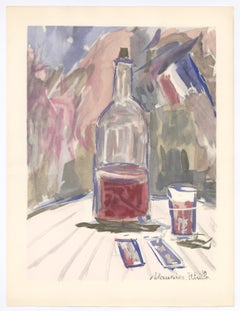
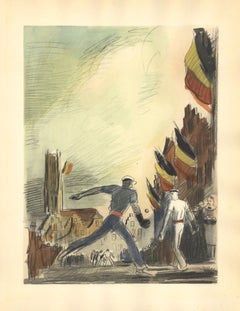
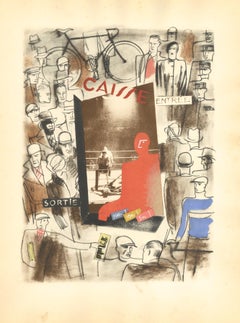
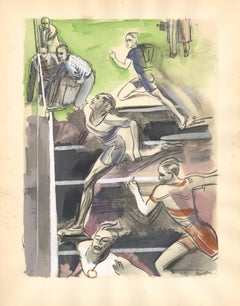
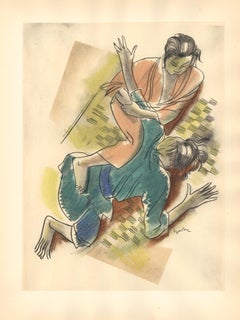
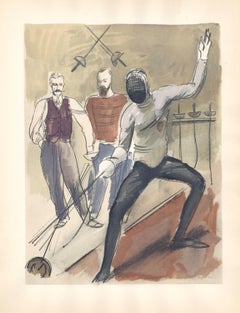
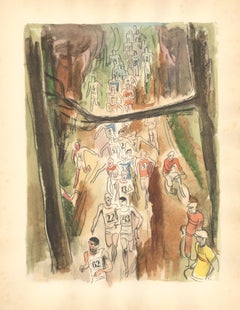
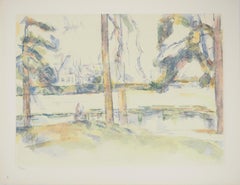
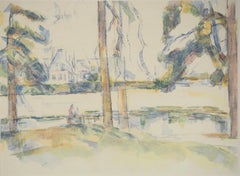
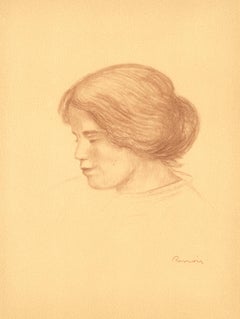
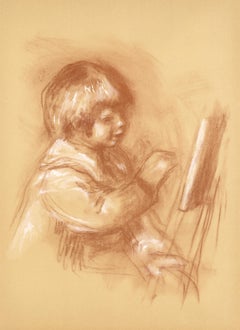
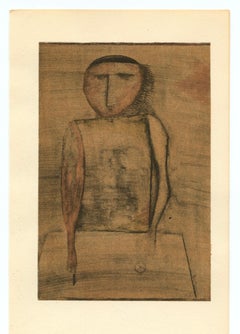
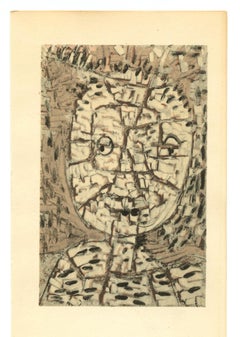
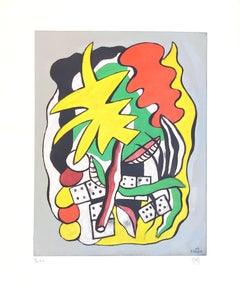
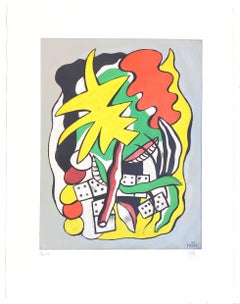
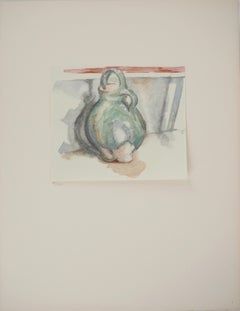
This exquisite lithograph and pochoir after Edgar Degas (1834–1917), titled Portrait de Julie Belleli (Portrait of Julie Belleli), originates from the 1968 folio Visages d Enfants. Quinze Dessins de Durer a Dufy Appartenant aux Collections des Musees Nationaux (Faces of Children. Fifteen Drawings from Durer to Dufy from the Collections of the National Museums), published by Editions Artistiques et Documentaires, Paris, and Daniel Jacomet, Editeur, Paris, and rendered and printed by Daniel Jacomet et Cie, Paris, 1968. The composition reflects Degas’s penetrating psychological insight and disciplined draftsmanship, translating the intimacy and structural clarity of the original drawing into a refined modern printmaking language.
Executed as a lithograph and pochoir on velin paper, archivally hinged on a velin support sheet as issued, this work measures 18.5 x 14 inches overall, with the image measuring approximately 9.45 x 7.87 inches. Signed in the plate and unnumbered as issued. Rendered and printed by Daniel Jacomet et Cie, Paris.
Artwork Details:
Artist: After Edgar Degas (1834–1917)
Title: Portrait de Julie Belleli (Portrait of Julie Belleli), from Visages d Enfants. Quinze Dessins de Durer a Dufy Appartenant aux Collections des Musees Nationaux (Faces of Children. Fifteen Drawings from Durer to Dufy from the Collections of the National Museums), 1968
Medium: Lithograph and pochoir on velin paper, archivally hinged on velin support sheet, as issued
Dimensions: 18.5 x 14 inches overall; image size 9.45 x 7.87 inches
Inscription: Signed in the plate and unnumbered as issued
Date: 1968
Publisher: Editions Artistiques et Documentaires, Paris; Daniel Jacomet, Editeur, Paris
Printer: Daniel Jacomet et Cie, Paris
Condition: Well preserved, consistent with age and medium
Provenance: From the 1968 folio Visages d Enfants. Quinze Dessins de Durer a Dufy Appartenant aux Collections des Musees Nationaux, published by Editions Artistiques et Documentaires and Daniel Jacomet, Paris
Notes:
Excerpted from the folio (translated from French), This album, first of the series of pochoirs similar to masters drawings, published by Daniel Jacomet, publisher, was completed printing on March XXXI, MCMLXVIII. The fifteen drawings have been rendered in similar pochoirs in Les Ateliers Daniel Jacomet. Composition and typographic printing are from the Union Printing. It was drawn in LXX numbered examples and L examples, out of the trade.
About the Publication:
Visages d Enfants. Quinze Dessins de Durer a Dufy Appartenant aux Collections des Musees Nationaux, issued in 1968, represents a landmark achievement in Parisian printmaking devoted to the faithful translation of historic master drawings into modern pochoir and lithographic form. Conceived and published by Daniel Jacomet in collaboration with Editions Artistiques et Documentaires, the album inaugurated a series dedicated to rendering canonical drawings with exceptional fidelity to line, tone, and original intent. Jacomets atelier was internationally respected for its rigorous technical standards and scholarly approach, bridging museum collections and contemporary print culture through meticulous craftsmanship. By uniting works spanning centuries and artistic traditions, the publication reflects a curatorial vision rooted in preservation, education, and aesthetic continuity. Produced in strictly limited examples, including a small number outside the trade, it exemplifies the highest standards of mid twentieth century Parisian printmaking and remains valued for its role in transmitting the legacy of master draftsmanship to collectors, institutions, and scholars.
About the Artist:
Edgar Degas (1834–1917) was a French painter, draughtsman, printmaker, and sculptor whose groundbreaking fusion of classical draftsmanship, modern experimentation, and psychological depth helped define the trajectory of Western art, positioning him as one of the most influential figures of the nineteenth and early twentieth centuries. Renowned for his depictions of ballet dancers, racehorses, theater scenes, cafe life, domestic interiors, milliners, laundresses, and women at their toilette, Degas reimagined observational realism through radical compositional innovation, employing extreme cropping, asymmetrical framing, oblique viewpoints, and dramatic lighting that anticipated photographic and cinematic language long before these technologies shaped visual culture. Although associated with Impressionism, he rejected plein air spontaneity in favor of studio based discipline rooted in the linear precision of Jean Auguste Dominique Ingres, the expressive chromaticism of Eugene Delacroix, and the modernity of Edouard Manet, while also drawing inspiration from Japanese ukiyo e prints, classical sculpture, and early photography. His independent artistic philosophy resonated with and helped shape the innovations of Pablo Picasso, Alexander Calder, Alberto Giacometti, Salvador Dali, Joan Miro, Wassily Kandinsky, Marcel Duchamp, and Man Ray, whose explorations of movement, form, abstraction, and conceptualism find antecedents in Degas’s investigations into seriality, temporality, and the fragmented figure. Degas’s pioneering use of pastel, monotype, and wax sculpture fundamentally transformed each medium, influencing artists from Henri Matisse and Francis Bacon to Lucian Freud, Giacomo Manzu, and contemporary practitioners across visual and performing arts. His works are held in nearly every major museum collection worldwide, including the Musee dOrsay, the Louvre, the Metropolitan Museum of Art, the National Gallery of Art, the Art Institute of Chicago, the Courtauld Institute, and the National Gallery, London. The highest auction record for Degas was achieved at Sothebys London on February 3, 2015, when Danseuses en Bleu sold for 37,033,000 GBP, confirming his enduring stature as one of the most sought after artists in the Western canon.
Edgar Degas lithograph...
Category
1960s Impressionist Art by Medium: Stencil
MaterialsLithograph, Stencil