Abstract More Art

ABSTRACT STYLE

Beginning in the early 20th century, abstract art became a leading style of modernism. Rather than portray the world in a way that represented reality, as had been the dominating style of Western art in the previous centuries, abstract paintings, prints and sculptures are marked by a shift to geometric forms, gestural shapes and experimentation with color to express ideas, subject matter and scenes.

Although abstract art flourished in the early 1900s, propelled by movements like Fauvism and Cubism, it was rooted in the 19th century. In the 1840s, J.M.W. Turner emphasized light and motion for atmospheric paintings in which concrete details were blurred, and Paul Cézanne challenged traditional expectations of perspective in the 1890s.

Some of the earliest abstract artists — Wassily Kandinsky and Hilma af Klint — expanded on these breakthroughs while using vivid colors and forms to channel spiritual concepts. Painter Piet Mondrian, a Dutch pioneer of the art movement, explored geometric abstraction partly owing to his belief in Theosophy, which is grounded in a search for higher spiritual truths and embraces philosophers of the Renaissance period and medieval mystics. Black Square, a daringly simple 1913 work by Russian artist Kazimir Malevich, was a watershed statement on creating art that was free “from the dead weight of the real world,” as he later wrote.

Surrealism in the 1920s, led by artists such as Salvador Dalí, Meret Oppenheim and others, saw painters creating abstract pieces in order to connect to the subconscious. When Abstract Expressionism emerged in New York during the mid-20th century, it similarly centered on the process of creation, in which Helen Frankenthaler’s expressive “soak-stain” technique, Jackson Pollock’s drips of paint, and Mark Rothko’s planes of color were a radical new type of abstraction.

Conceptual art, Pop art, Hard-Edge painting and many other movements offered fresh approaches to abstraction that continued into the 21st century, with major contemporary artists now exploring it, including Anish Kapoor, Mark Bradford, El Anatsui and Julie Mehretu.

Find original abstract paintings, sculptures, prints and other art on 1stDibs.

to
279
457
356
353
369
698
Overall Width
to
Overall Height
to
1
223
2,010
1
2
16
28
43
35
25
3,217
2,656
2,132
1,524
397
388
259
146
80
69
54
39
3
907
718
424
29
18
17
16
11
10
9
6
3
3
3
3
2
2
2
2
2
2
2
2
1,536
804
799
707
692
53
48
46
38
37
20
33
1,394
434
Style: Abstract
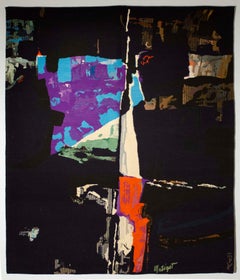
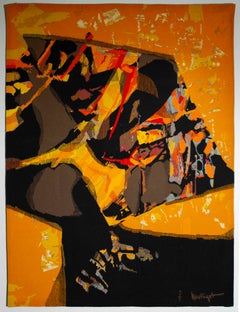
Mathieu Matégot - Apollo, tapestry, french, modern, abstract, aubusson, design

Mathieu Matégot - Apollo, tapestry, french, modern, abstract, aubusson, design

By Mathieu Matégot

Located in London, GB

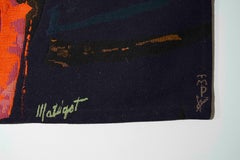
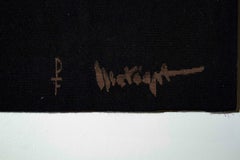
Mathieu Matégot (1910-2001) Apollo c.1950s Aubusson tapestry, Manufactura de Tapeçarias de Portalegre; edition 3 of 6 142 x 118 cm signed ‘Matégot’ with the Manufactura de Tapeçarias de Portalegre monogram (lower right); titled, inscribed, numbered and signed (workshop label on the verso) Price: $13,000 USD Provenance: Barry Friedman Ltd, New York (stock no. BF19383.3) Notes: Mathieu Matégot was a Hungarian-born French designer, architect and artist. After studying at Budapest's School of Fine Arts in 1929, Matégot travelled across Italy and the USA until settling in Paris in 1931 where he worked as a set designer, window dresser and tapestry maker. Matégot volunteered for the French resistance at the start of the Second World War, only to be captured by the Nazis. A dreadful fate for most, however, it was during his time as a prisoner of war that the artist discovered metalworking techniques (such as Rigitulle) which he later patented and became renowned for. Upon his release, Matégot was awarded French citizenship. After the war, the artist's interest in tapestry was renewed after being introduced to contemporary tapestry revivalist, Jean Lurçat. However, in order to make ends meet, Matégot pursued furniture design; he established a workshop in Paris and dedicated his time to translating the groundbreaking metal techniques into popular handcrafted objects. In 1959, Matégot abandoned furniture design and focused exclusively on his passion for abstract tapestries. He continued his work as a pioneer of French Modern...

Category

1950s Abstract More Art

Materials

Tapestry

Abstract more art for sale on 1stDibs.

Find a wide variety of authentic Abstract more art available for sale on 1stDibs. Works in this style were very popular during the 21st Century and Contemporary, but contemporary artists have continued to produce works inspired by this movement. If you’re looking to add more art created in this style to introduce contrast in an otherwise neutral space in your home, the works available on 1stDibs include elements of blue, purple, orange, red and other colors. Many Pop art paintings were created by popular artists on 1stDibs, including Onelio Marrero, Nicky Marais , Andrea Stajan-Ferkul, and Janet Dyer. Frequently made by artists working with Paint, and Oil Paint and other materials, all of these pieces for sale are unique and have attracted attention over the years. Not every interior allows for large Abstract more art, so small editions measuring 1.38 inches across are also available. Prices for more art made by famous or emerging artists can differ depending on medium, time period and other attributes. On 1stDibs, the price for these items starts at $11 and tops out at $98,000, while the average work sells for $1,281.