1860s Art

to
82
891
226
67
43
39
Overall Width
to
Overall Height
to
7,573
21,469
159,322
234,594
2,043
2,299
4,510
6,192
5,157
14,030
19,458
25,446
18,442
14,104
5,380
779
48
28
6
5
1
1
1
695
531
3
901
463
356
261
258
204
134
94
70
65
56
56
56
51
48
47
47
43
37
36
667
237
209
171
89
31
11
9
7
6
217
806
987
256
Period: 1860s
Early Signed Portrait of Giuseppe Garibaldi - Original Albumen Print 1860

Early Signed Portrait of Giuseppe Garibaldi - Original Albumen Print 1860

Located in Roma, IT

Early Signed Portrait of Giuseppe Garibaldi is an albumen print signed on clichè and dated 26 June 1860. Excellent conditions, size 11 x 17,5 This very rare and unpublished photogr...

Category

1860s Art

Materials

Photographic Paper

"Candy Seller" Japanese Woodblock on Rice Paper

"Candy Seller" Japanese Woodblock on Rice Paper

By Utagawa Yoshiiku

Located in Soquel, CA

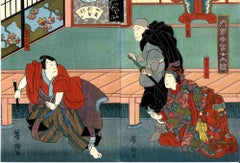
"Candy Seller" (飴売りうずまつ 市村羽左衛門) Japanese Woodblock on Rice Paper This piece depicts Ichimura Uzaemon as the Candy Peddler Uzumatsu. He is playing a stringed instrument (the shamisen) to attract people to come buy canbdy. The spiral on his clothing is the symbol of the candy seller, along with his crest of the mandarin orange. This Utagawa Yoshiiku print, titled "Umegoyomi mitate hachi shojin" (梅暦見立八笑人), depicts a scene from the Edo period. The print features a prominent male figure playing a shamisen, a traditional Japanese stringed instrument. The text on the print is in Japanese, and the overall style is characteristic of Ukiyo-e, a genre of Japanese woodblock prints. Utagawa Yoshiiku was a significant artist of the Meiji era, known for his contributions to woodblock printmaking. He was a student of Utagawa Kuniyoshi and worked alongside Tsukioka Yoshitoshi. His works often portray historical events, scenes from Kabuki plays, and contemporary life. This print, in particular, showcases the artist's skill in capturing the details of clothing, facial expressions, and the musical instrument. Presented in a new blue mat with foam core backing. Mat size: 18"H x 14"W Paper size: 16"H x 12"W Born the son of teahouse proprietor Asakusa Tamichi in 1833, Utagawa Yoshiiku (also known as Ochiai Yoshiiku) became a student of ukiyo-e artist Utagawa Kuniyoshi toward the end of the 1840s. His earliest known work dates to 1852 when he provided the backgrounds to some actor prints by his master. Yoshiiku's earliest works were portraits of actors (yakusha-e), beauties (bijin-ga), and warriors (musha-e). He later followed Kuniyoshi into making satirical and humorous pieces, and became the leading name in the field after Kuniyosh's death in 1861. He illustrated the Tokyo Nichi Nichi...

Category

Edo 1860s Art

Materials

Ink, Rice Paper, Woodcut

19th Century Original Scottish Loch Painting in the style of Alexander Nasmyth

19th Century Original Scottish Loch Painting in the style of Alexander Nasmyth

Located in Soquel, CA

Mid 19th Century Original Oil Painting of Fishing on Scottish Loch in the Style of Alexander Nasmyth Gorgeous 19th Century landscape painting of a Scottish loch with fisherman and castle ruins in the style of Alexander Nasmyth (Scottish, 1758 - 1840). This painting features the rough-hewned nature of Scotland's landscape while juxtaposing the peacefulness of a fisherman casting his line into the loch. Adding interest is the castle ruins on the cliff's edge with a sailboat beneath. There is something new to see with each viewing of this picture. Signed: Illegible monogram lower left corner. (See image) Framed: Presented in rustic giltwood frame of the period. Condition: Good Canvas size: 18"H x 24"W. Framed Size: 22"H x 28"W x 3"D Alexander Nasmyth was a painter, illustrator, landscape gardener and engineer. Alexander Nasmyth's style appears to have been molded principally on that of Claude Lorrain in arrangement, color and mood, and on Jacob van Ruysdael...

Category

Impressionist 1860s Art

Materials

Canvas, Oil, Stretcher Bars

1867 original lithography for the Exposition Universelle in Paris

1867 original lithography for the Exposition Universelle in Paris

Located in PARIS, FR

The 1867 Exposition Universelle in Paris was one of the grandest World’s Fairs of the 19th century, showcasing industrial progress, cultural achievements, and artistic excellence. Th...

Category

1860s Art

Materials

Paper, Lithograph

'At the Beach, Scene at Sandbath', Punch Magazine, Thomas Agnew, Victoriana

'At the Beach, Scene at Sandbath', Punch Magazine, Thomas Agnew, Victoriana

Located in Santa Cruz, CA

Signed lower left, outside of design, 'John Leech' (British, 1817-1864) and created circa 1865. Titled verso, 'Scenes at Sandbath', and inscribed, 'The female Blondin out done! Grand...

Category

1860s Art

Materials

Paper, Cardboard, Lithograph

Set of Four Hand-Colored Lithograph Ornithological Prints from "The Ibis" Birds

Set of Four Hand-Colored Lithograph Ornithological Prints from "The Ibis" Birds

By Philip Lutley Sclater

Located in Saint Augustine, FL

Artist: Philip Lutley Sclater (English, 1829-1913) Titles: "Circaetus Zonurus (Brown Snake-Eagle)", "Spizaetus Ayresii (Ayres's Hawk-Eagle)", "Tinnunculus Alopex (Fox Kestrel)", and ...

Category

Victorian 1860s Art

Materials

Watercolor, Lithograph

Uses and Customs - Russian - Lithograph - 1862

Uses and Customs - Russian - Lithograph - 1862

Located in Roma, IT

Uses and Customs - Russian is a lithograph on paper realized in 1862. The artwork belongs to the Suite Uses and customs of all the peoples of the universe: " History of the governme...

Category

Modern 1860s Art

Materials

Lithograph

“Scene in Union Square, New York on a March Day

“Scene in Union Square, New York on a March Day

By Winslow Homer

Located in Southampton, NY

Original wood engraving on paper. Taken from Harper’s Weekly, April 7, 1860. Signed “Homer” in the plate. Condition is good. Slight staining lower left. Very slight tear to the l...

Category

Academic 1860s Art

Materials

Archival Paper, Engraving

Japanese Costumes  - Lithograph - 1862

Japanese Costumes - Lithograph - 1862

Located in Roma, IT

Japanese Costumes  is a Hand-colored lithograph on paper realized in 1862. The artwork belongs to the Suite Uses and customs of all the peoples of the universe: " History of the gov...

Category

Modern 1860s Art

Materials

Lithograph

Uses and Customs - Ducal Palace in Venice - Lithograph - 1862

Uses and Customs - Ducal Palace in Venice - Lithograph - 1862

Located in Roma, IT

Uses and Customs - Ducal Palace in Venice is a lithograph on paper realized in 1862. The artwork belongs to the Suite Uses and customs of all the peoples of the universe: " History ...

Category

Modern 1860s Art

Materials

Lithograph

The Beach at Long Branch

The Beach at Long Branch

By Winslow Homer

Located in Fairlawn, OH

The Beach at Long Branch Woodengraving, 1869 Signed in the block lower right "WH" ( see photo ) Published in Appleton’s Journal of Literature, Science and Art, August 21, 1869 Condit...

Category

American Realist 1860s Art

Materials

Engraving

Map of Palace of Diocletian- Lithograph - 1862

Map of Palace of Diocletian- Lithograph - 1862

Located in Roma, IT

Uses and Customs - Map of Diocletian's Palace is a lithograph on paper realized in 1862. The artwork belongs to the Suite Uses and customs of all the peoples of the universe: " Hist...

Category

Modern 1860s Art

Materials

Lithograph

19th Century Victorian British Oil Painting Genre Scene Roadside Inn Hampshire

19th Century Victorian British Oil Painting Genre Scene Roadside Inn Hampshire

By Henry Charles Woollett

Located in Stockholm, SE

This beautiful Victorian oil painting titled "Roadside Inn in Hampshire" is attributed to the renowned British artist Henry Charles Woollett (c.1826-1893), and depicts a picturesque ...

Category

Victorian 1860s Art

Materials

Canvas, Wood, Oil

Uses and Customs - Asian - Lithograph - 1862

Uses and Customs - Asian - Lithograph - 1862

Located in Roma, IT

Uses and Customs - Asian is a lithograph on paper realized in 1862. The artwork belongs to the Suite Uses and customs of all the peoples of the universe: " History of the government...

Category

Modern 1860s Art

Materials

Lithograph

Figure of the Bread which They use in the Eucharist - Lithograph - 1862

Figure of the Bread which They use in the Eucharist - Lithograph - 1862

Located in Roma, IT

Figure of the Bread which they use in the Eucharist is a lithograph on paper realized in 1862. The artwork belongs to the Suite Uses and customs of all the peoples of the universe: ...

Category

Modern 1860s Art

Materials

Lithograph

Uses and Customs - The Carnival of Venice - Lithograph - 1862

Uses and Customs - The Carnival of Venice - Lithograph - 1862

Located in Roma, IT

Uses and Customs - the Carnival of Venice is a lithograph on paper realized in 1862. The artwork belongs to the Suite Uses and customs of all the peoples of the universe: " History ...

Category

Modern 1860s Art

Materials

Lithograph

Castelbarco in Tyrol - Lithograph - 1862

Castelbarco in Tyrol - Lithograph - 1862

Located in Roma, IT

Castelbarco in Tyrol on paper realized in 1862. The artwork belongs to the Suite Uses and customs of all the peoples of the universe: " History of the government, of the laws, of th...

Category

Modern 1860s Art

Materials

Lithograph

Exterior of the Parthenon - Lithograph - 1862

Exterior of the Parthenon - Lithograph - 1862

Located in Roma, IT

Exterior of the Parthenon is a lithograph on paper realized in 1862. The artwork belongs to the Suite Uses and customs of all the peoples of the universe: " History of the governmen...

Category

Modern 1860s Art

Materials

Lithograph

Uses and Customs - Objects of Funerals - Lithograph - 1862

Uses and Customs - Objects of Funerals - Lithograph - 1862

Located in Roma, IT

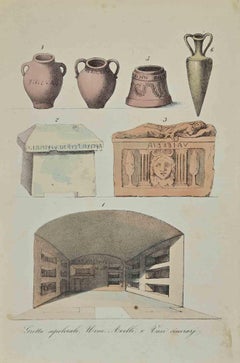
Uses and Customs - Objects of Funerals is a lithograph on paper realized in 1862. The artwork belongs to the Suite Uses and customs of all the peoples of the universe: "History of t...

Category

Modern 1860s Art

Materials

Lithograph

Customs - Persian Deities - Lithograph - 1862

Customs - Persian Deities - Lithograph - 1862

Located in Roma, IT

Customs - Persian Deities is a lithograph on paper realized in 1862. Titled on the lower. The artwork belongs to the Suite Uses and customs of all the peoples of the universe: " Hi...

Category

Modern 1860s Art

Materials

Lithograph

"Portrait of John Bellini" original etching

"Portrait of John Bellini" original etching

Located in Henderson, NV

Medium: original etching. This impression on laid paper was printed in London in 1868 for the rare first volume of Philip Gilbert Hamerton's "Etching and Etchers". Plate size: 5 5/8 ...

Category

1860s Art

Materials

Etching
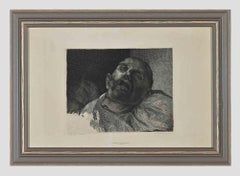
Florentine singer / - The Renaissance of the Renaissance -

Florentine singer / - The Renaissance of the Renaissance -

By Paul Dubois

Located in Berlin, DE

Paul Dubois (1829 Nogent-sur-Seine - 1905 Paris), Florentine singer, 1865. Light brown patinated bronze with cast round plinth mounted on a square marble base (3.5 cm high). Total height 53 cm. Bronze dimensions: 49.5 cm (height) x 20 cm (length) x 10 cm (width), weight 5.6 kg. Inscribed on the plinth "P.[aul] DUBOIS", dated "1865", with the foundry's mark "F. BARBEDIENNE FONDEUR" and the signet "REDUCTION MECANIQUE A. COLLAS". - Patina very occasionally darkened, lute with loss of one tuning peg, otherwise in excellent condition. - The renaissance of the Renaissance - The bronze is a precisely executed and masterfully cast contemporary reduction of Paul Dubois 155 cm tall masterpiece "Florentine Singer", which is exhibited in the Musée d'Orsay and for which the artist was awarded the Medal of Honor at the Paris Salon in 1865. The work acted as a beacon, and was followed by a plethora of depictions of juveniles. Inspired by Donatello and Luca della Robbia, but also by painters such as Piero della Francesca, Benozzo Gozzoli, and Pinturicchio, the "Florentine Singer" is not an epigonal work that pays homage to a vanished era, but a successful attempt to draw vitality from the art of the past and thus give it new life. The effect of vitality is the core of Italian Renaissance art theory. In order to fulfill itself as art, art had to appear like nature. This naturalism also characterizes the "Florentine Singer". The young man appears to have been taken from life, which is reinforced by the momentary nature of his action. He has just struck a now fading chord. In addition, the natural appearance is enhanced by the detailed shaping of the figurative details, such as the laces with the slightly curved leather of the shoes, the belt buckle, or the ornamentation on the body of the lute. Even the fingernails are clearly defined. Unlike the Renaissance, however, the effect of liveliness here is not based on the "discovery" of nature and the human body, but primarily on the rediscovery of the art of the Quattrocento. The liveliness of the artwork is therefore at the same time a revitalization of this art, so that we can speak of a Renaissance of the Renaissance, just as the Pre-Raphaelites in England at the same time transferred the Quattrocento to contemporary art. Dubois takes on the most difficult of all subjects, the depiction of singing through silent sculpture. He was preceded in this by Luca della Robbia and Donatello with their pulpits of singers created in the 1430s in the Museo dell'Opera del Duomo in Florence. Compared to these works, the physiognomy of Dubois singer is far less animated, yet he also depicts singing in a convincing manner. He uses the whole body. He takes the ancient contrapposto, which was essential to Renaissance sculpture, and transforms the standing leg-playing posture into a late medieval S-swing, giving the body an elegant beauty and at the same time setting it in melodic motion. In the equally elegant finger position, the music is expressed in a much more literal way with the beating of the lute. Finally, the musicality of the sculpture culminates in the face with the mouth open to sing. Through the act of singing, which is a great challenge to the artistic will to depict perfect beauty, the gracefulness of the classical face is not diminished, but enhanced. Starting from the face with the singing mouth and the gaze absorbed by the sounds, the inner vitality spreads, giving the bronze sculpture an intense aura, enhanced by the music. Dubois transfers the beauty of the Renaissance to the musical, sublimating the visible sculpture to the invisible of music. He took up the challenge of transcending the Renaissance with the Renaissance, thus responding to the Querelle des Anciens et des Modernes, which arose at the end of the 17th century around the French Academy and remained virulent into the 19th century, in which antiquity was regarded either as an unattainable ideal or as a standard to be surpassed. With his work, Dubois proved that the Renaissance, which had championed the art of the ancients, could lead to a new renaissance of art. About the artist Paul Dubois' great-uncle was the famous French Baroque sculptor Jean-Baptiste Pigalle, in whose footsteps the talented great-nephew followed. When he debuted at the Paris Salon in 1858, he signed his work "Dubois-Pigalle". At his father's request, however, he first studied law before devoting himself to sculpture under the tutelage of François Christophe Armand Toussaint in 1856 and entering the École des Beaux-Arts in 1858. From 1859 to 1863, he lived in Rome and traveled to Naples and Florence. Inspired by Florentine art of the quattrocento, Dubois initiated a school-forming neo-Florentine style that combined the elegantly simple forms of youthful grace with a precise wealth of detail.Two purchases by the French state (“envois de Rome”) were made during his stay in Rome, which brought him recognition in Paris. After his return there, he quickly became an internationally sought-after artist. Dubois was also active as a creator of monuments. His most famous work is the equestrian statue of Joan of Arc (1896) on the forecourt of Reims Cathedral. He was also a sought-after portraitist who produced around 50 busts and - Dubois was also a passionate painter - around 100 portraits in oil. From 1873 to 1878 he was curator of the Museum du Luxembourg, in 1876 he became a member of the Institut de France and from 1878 to 1905 he was director of the École des Beaux-Arts. In 1865, Dubois was awarded the Paris Salon Medal of Honor for his “Florentine Singer”. In 1867 he became Chevalier, in 1874 Officier, in 1886 Commandeur of the Légion d'honneur, which awarded Dubois the Grande Croix in 1896. Selected Bibliography Stole, Elmar: Paul Dubois. In: Saur. Allgemeines Künstlerlexikon, vol. 30, Munich - Leipzig 2001, pp. 677-678. GERMAN VERSION Paul Dubois (1829 Nogent-sur-Seine - 1905 Paris), Florentinischer Sänger, 1865. Hellbraun patinierte Bronze mit gegossener runder Plinthe auf quadratischem Marmorsockel montiert (3,5 cm Höhe). Gesamthöhe 53 cm. Maße der Bronze: 49,5 cm (Höhe) x 20 cm (Länge) x 10 cm (Breite), Gewicht 5,6 kg. Auf der Plinthe mit „P.[aul] DUBOIS“ bezeichnet, auf „1865“ datiert, mit dem Gießereistempel „F. BARBEDIENNE FONDEUR“ und dem Signet „REDUCTION MECANIQUE A. COLLAS“ versehen. - Patina sehr vereinzelt nachgedunkelt, Laute mit Verlust eines Stimmwirbels, ansonsten ausgezeichnet erhalten. - Die Renaissance...
Category

Realist 1860s Art

Materials

Bronze

Le Paradis - Lithograph by E. Lavrate - 1860s

Le Paradis - Lithograph by E. Lavrate - 1860s

By Edmond Lavrate

Located in Roma, IT

Le Paradis is an amusing original color lithograph on paper, realized by the French artist Edmond Lavrate (Orleans, 1829 - Paris 1888). Original Title: Le Paradis séjour du bonheur simpiternel Signed vertically on plate on lower right margin in the cloud. A really amusing satiric and anti-clerical print representing a modern allegory of the Paradise: to each character corresponds an identification number with a detailed capture. We could understand who are the characters in the Modern sky of Paradise. In excellent conditions except for some signs of the time, the original sheet is glued on Canson cardboard sheet. Gaspard Edmond Lavrate (Orleans, 1829 - Paris 1888) French lithographer, anticlerical draftsman, inventor of the "affiche" advertisements. With the advent of the Republic, the draftsman attacks the figure of Napoleon III. One of his legendary watercolors, with the caption "Badinguet going to war, Rolled Sedan", is seized in 1872 at Leloup, print dealer, (rue de la Lune in Paris). This merchant is then described by a police report as "known for his political exaltation," that is, advanced Republican. Émile Bayard...

Category

Modern 1860s Art

Materials

Lithograph

Uses and Customs -  Duomo of Siena - Lithograph - 1862

Uses and Customs - Duomo of Siena - Lithograph - 1862

Located in Roma, IT

Uses and Customs -  Duomo of Siena is a lithograph on paper realized in 1862. The artwork belongs to the Suite Uses and customs of all the peoples of the universe: " History of the ...

Category

Modern 1860s Art

Materials

Lithograph