1890s Art

to
188
1,033
356
231
99
144
Overall Width
to
Overall Height
to
7,729
21,750
164,520
227,603
2,024
2,313
4,989
6,562
5,869
15,106
20,678
25,913
18,755
14,163
5,510
205
198
71
30
8
8
7
5
3
2
1,092
690
10
1,239
667
410
362
327
195
193
181
177
146
126
123
103
93
90
82
65
62
53
51
724
615
470
425
307
58
37
25
23
16
674
232
958
825
Period: 1890s
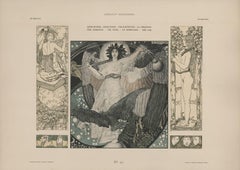
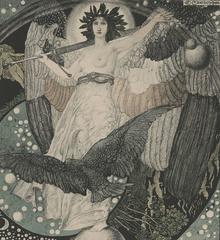
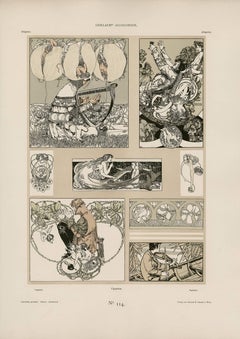
Gerlach's Allegorien Plate #89: "Bookplate Spring" Lithograph

Gerlach's Allegorien Plate #89: "Bookplate Spring" Lithograph

By Koloman Moser

Located in Palm Beach, FL

Koloman Moser (1868 –1918), AUSTRIAN Instead of applying his flair and art education solely to painting, Koloman Moser embodied the idea of Gesamt Kunstwerk (all-embracing art work) by designing architecture, furniture, jewelry, graphics, and tapestries meant to coordinate every detail of an environment. His work transcended the imitative decorative arts of earlier eras and helped to define Modernism for generations to come. Moser achieved a remarkable balance between intellectual structure (often geometric) and hedonistic luxury. Collaborating with Gustav Klimt and Josef Hoffmann, the artist was an editor and active contributor to Ver Sacrum, (Sacred Spring), the journal of the Viennese Secession that was so prized for its aesthetics and high quality production that it was considered a work of art. The magazine featured drawings and designs in the Jugendstil style (Youth) along with literary contributions from distinguished writers from across Europe. It quickly disseminated both the spirit and the style of the Secession. In 1903 Moser and Hoffmann founded and led the Wiener Werkstatte (Viennese Workshop) a collective of artisans that produced elegant decorative arts items, not as industrial prototypes but for the purpose of sale to the public. The plan, as idealistic then as now, was to elevate the lives of consumers by means of beautiful and useful interior surroundings. Moser’s influence has endured throughout the century. His design sensibility is evident from the mid-century modern furniture of the 1950s and ‘60s to the psychedelic rock posters...

Category

Vienna Secession 1890s Art

Materials

Lithograph

French Battleships at Sea, Marine scene

French Battleships at Sea, Marine scene

Located in New York, NY

An interesting moment in history, captured in a marine scene that has a stark but attractive color palette! A sensational empire frame custom made for the work and 23 karat. Henri R...

Category

French School 1890s Art

Materials

Oil

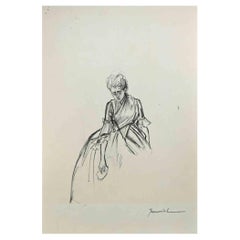
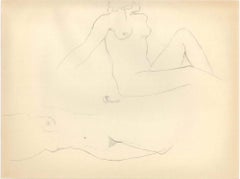
Woman with Bicycle: Two Views

Woman with Bicycle: Two Views

By Frank Duveneck

Located in Fairlawn, OH

Woman with Bicycle: Two Views Graphite on paper, c. 1890 Unsigned Graphite study of standing female nude verso Provenance: Rookwood Pottery Factory Collection, Cincinnati Spanierman Gallery, New York (label) Drawings from the sketchbook are in the collections of the Munson Williams Proctor Institute in Utica, New York and the Picker Art Gallery, Colgate University, Hamilton, New York. A sister drawing from the same sketchbook was sold at Cowman’s Auction, Cincinnati, October 6, 2018. Accompanied by a letter from the Spanierman Gallery, dated 1997, stating that the drawing is from a sketchbook that was held in the Rookwood Factory Collection. Sister drawing provenance: Provenance: Terry DeLapp...

Category

American Realist 1890s Art

Materials

Graphite

Les ruban verts, 1897

Les ruban verts, 1897

By Theo van Rysselberghe

Located in BLARICUM, NL

THEO VAN RYSSELBERGHE Gent 1862-1926 Saint-Clair, Var LES RUBANS VERTS Portrait of Marquerite Mommen-Ithiers 1897 Pastel on paper 90 x 65 cm. Signed and dated: lower right with mo...

Category

Impressionist 1890s Art

Materials

Pastel

Clay jug on a bench - The essence of the clay jar revealed by the sunlight -

Clay jug on a bench - The essence of the clay jar revealed by the sunlight -

By Hans Richard von Volkmann

Located in Berlin, DE

Hans Richard von Volkmann (1860 Halle (Saale) - 1927 ibid.), Clay jug on a bench. Pencil and Watercolour on paper. 20 x 26,7 cm (visible size), 37 x 45 cm (frame), dated and monogrammed lower left "Februar 1890 - HR. V. V." - Minimally tanned. Framed behind glass in a passepartout. About the artwork Using the technique of his early youth - pencil and watercolour - Hans Richard von Volkmann depicts a still life. However, this is not a conventional indoor still life, but an open-air depiction, painted outdoors and not in the studio. It is therefore an open-air painting, characteristic of von Volkmann's oeuvre, which could have been painted in the Willingshausen colony of painters, where open-air painting was programmatically practised there and the artist stayed there that year. And indeed, this painting is a manifesto of open-air painting. Von Volkmann demonstrates that leaving the studio for the light of nature leads to an entirely new quality of art. To prove this, he uses the genre of still life, which can be described as the studio subject par excellence. Moreover, light plays an essential role in the classical still life. It is the real protagonist of the still life. And it is precisely this moment, essential to the still life, that von Volkmann exploits to demonstrate the potential of plein-air painting: He presents the objects as they appear in the sunlight. The date of February and the bare branches in the foreground make it clear that this is a clear winter day in bright sunlight. The delicate plant in the foreground casts a clearly defined shadow, as does the jug. However, the shadow is most pronounced on the jug itself: The underside of the handle appears almost black, making the top, and therefore the jug itself, shine all the more brightly. The shining of the objects in the sunlight is also visible on the bench. As complementary phenomena to the shadow zones, light edges can be seen on the boards of the seats and the upper foot of the bench shines entirely in the light. To achieve this intensity of light, von Volkmann activated the bright white of the painting ground. By depicting the objects in glistening sunlight, von Volkmann demonstrates that this quality of light is only to be found outdoors. And this light leads to a new way of looking at the objects themselves. The jug on the bench seems like an accidental arrangement, as if the artist had stumbled upon this unintentional still life and captured it with fascination. And in this fascination there is a moment of realisation that refers to the objects themselves. It is only when they shine brightly in the sunlight that their true nature is revealed. In this way, sunlight allows the objects to come into their own, so to speak. Sunlight, which is not present in the studio, gives the still life an entirely new dimension of reality, which is also reflected in the colours interwoven by the sunlight: The bench and the jug stand in a harmonious grey-pink contrast to the green of the implied meadow. The emphasis on the jug as the central subject of the picture also implies that the watercolour has not been completed. This non finito inscribes a processuality into the picture, making it clear that something processual has been depicted, the temporality of which has been made artistically permanent. This is why von Volkmann signed the painting and dated it to the month. About the Artist Von Volkmann made his first artistic attempts at the age of 14. He painted many watercolours of his home town of Halle. This laid the foundation for his later outdoor painting. In 1880 his autodidactic beginnings were professionalised with his admission to the Düsseldorf Art Academy. There he studied under Hugo Crola, Heinrich Lauenstein, Johann Peter Theodor Janssen and Eduard von Gebhardt until 1888. Von Volkmann then moved to the Karlsruhe Academy, where he was Gustav Schönleber's master pupil until 1892. In 1883 he came for the first time to Willingshausen, Germany's oldest painters' colony, at the suggestion of his student friend Adolf Lins...

Category

Naturalistic 1890s Art

Materials

Watercolor

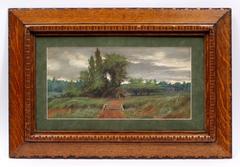
Brittany : Women in the Harbour - Original Lithograph, 1898

Brittany : Women in the Harbour - Original Lithograph, 1898

Located in Paris, IDF

Louis BORGEX Brittany : Women in the Harbour , 1898 Original lithograph (Champenois workshop) Printed signature in the plate On vellum, 40 x 31 cm (c. 16 x 12 in) INFORMATION: Lith...

Category

Art Nouveau 1890s Art
Materials

Lithograph

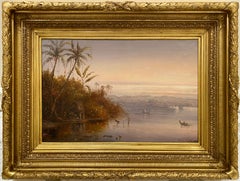
Fishermen in Paris - Original Lithograph, 1898

Fishermen in Paris - Original Lithograph, 1898

By Charles Huard

Located in Paris, IDF

Charles HUARD Fishermen in Paris, 1898 Original lithograph (Champenois workshop) Printed signature in the plate On vellum, 40 x 31 cm (c. 16 x 12 in) INFORMATION: Lithograph create...

Category

Art Nouveau 1890s Art
Materials

Lithograph

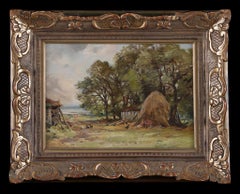
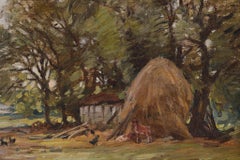
Barbizon/Impressionism School Haystack Landscape

Barbizon/Impressionism School Haystack Landscape

Located in San Francisco, CA

Fabulous late 19th or early 20th century oil on canvas. It looks to be in the style of the Barbizon School moving into impressionim. Most of the earl...

Category

Barbizon School 1890s Art

Materials

Oil

"Lorenzaccio" by Alphonse Mucha from Les Maitres de l'Affiche

"Lorenzaccio" by Alphonse Mucha from Les Maitres de l'Affiche

By Alphonse Mucha

Located in Hinsdale, IL

Alphonse Mucha "Lorenzaccio, a play in five acts and an epilogue by Alfred de Museet" Plate #114 Image Size: 15" x 11" 1896 Alphonse Mucha was born in Southern Moravia on July 24, 1860. At the age of seventeen the artist left his home, to work as a painter of stage decorations...

Category

Art Nouveau 1890s Art
Materials

Lithograph

The Thames, 1894 - Victorian aquatint etching of London by Joseph Pennell

The Thames, 1894 - Victorian aquatint etching of London by Joseph Pennell

By Joseph Pennell

Located in London, GB

JOSEPH PENNELL (1857-1926) The Thames, 1894 Signed Aquatint Plate size 20.5 by 26.5 cm., 8 by 10 ½ in. (frame size 42 by 46 cm., 16 ½ by 18 in.) Pennell was born in Philadelphia where he studied at School of Industrial Art and the Academy of Fine Arts. In 1884 he was commissioned by the Century Magazine to supply a series of drawings of London...

Category

Realist 1890s Art

Materials

Aquatint

Mountain landscape, XIX c. - Oil on canvas, 27x35 cm., framed.

Mountain landscape, XIX c. - Oil on canvas, 27x35 cm., framed.

By Leon Joubert

Located in Nice, FR

Léon Joubert (1870-1920) was a pupil of Léon Germain Pelouse ans Fernand Cormon. He exposed at the Salon des artistes français very often from 1876. he was a landscape painter, most...

Category

Barbizon School 1890s Art

Materials

Oil

Jeune Fille de Rosporden

Jeune Fille de Rosporden

By Emile-Alfred Dezaunay

Located in New York, NY

Emile-Alfred Dezaunay (1854-1938) Jeune Fille de Rosporden, c. 1890 etching and aquatint printed in color on cream-colored laid ARCHES paper; Referen...

Category

Impressionist 1890s Art

Materials

Etching, Aquatint

L'Aurore by Eugène Carrière, Symbolist lithograph, 1898

L'Aurore by Eugène Carrière, Symbolist lithograph, 1898

By Eugène Carrière

Located in Chicago, IL

Shrouded in light and shadow, a figure halts in anxiety while a precipice forms the horizon. Carrière echoes fellow Symbolist Edvard Munch’s Der Schrei der Natur (also known by the popular name “The Scream”) in L’Aurore, a quintessential example of Carrière’s misty and spectral body of work. An 1897 oil study for this work sold for 26,400 GBP (approximately $36,190) at Christie’s in 2007. Stone lithograph of Eugène Carrière...

Category

Symbolist 1890s Art

Materials

Lithograph

Gerlach's Allegorien Plate #75: "Hunting, Fishing, Rowing, Cycling"

Gerlach's Allegorien Plate #75: "Hunting, Fishing, Rowing, Cycling"

By Koloman Moser

Located in Palm Beach, FL

Koloman Moser (1868 –1918), AUSTRIAN Instead of applying his flair and art education solely to painting, Koloman Moser embodied the idea of Gesamt Kunstwerk (all-embracing art work) by designing architecture, furniture, jewelry, graphics, and tapestries meant to coordinate every detail of an environment. His work transcended the imitative decorative arts of earlier eras and helped to define Modernism for generations to come. Moser achieved a remarkable balance between intellectual structure (often geometric) and hedonistic luxury. Collaborating with Gustav Klimt and Josef Hoffmann, the artist was an editor and active contributor to Ver Sacrum, (Sacred Spring), the journal of the Viennese Secession that was so prized for its aesthetics and high quality production that it was considered a work of art. The magazine featured drawings and designs in the Jugendstil style (Youth) along with literary contributions from distinguished writers from across Europe. It quickly disseminated both the spirit and the style of the Secession. In 1903 Moser and Hoffmann founded and led the Wiener Werkstatte (Viennese Workshop) a collective of artisans that produced elegant decorative arts items, not as industrial prototypes but for the purpose of sale to the public. The plan, as idealistic then as now, was to elevate the lives of consumers by means of beautiful and useful interior surroundings. Moser’s influence has endured throughout the century. His design sensibility is evident from the mid-century modern furniture of the 1950s and ‘60s to the psychedelic rock posters...

Category

Vienna Secession 1890s Art

Materials

Lithograph

'Berks and Bucks' Vanity Fair cartoon by Roland "Ao" / "Armadillo" L'Estrange

'Berks and Bucks' Vanity Fair cartoon by Roland "Ao" / "Armadillo" L'Estrange

Located in London, GB

Roland "Ao" / "Armadillo" L'Estrange for Vanity Fair Magazine Berks and Bucks 5 November 1903 Lithograph 21 x 37 cm Depicting Sir Robert Rodney Wilmot, in red hunting clothes and whip, of the Berks & Bucks Draghounds at their opening meet. Wilmot was educated at Eton and Oxford, and his hobbies famously included croquet. The Vanity Fair magazine of 1868 to 1914 was subtitled 'A Weekly Show of Political, Social and Literary Wares'. Founded by Thomas Gibson...

Category

Victorian 1890s Art

Materials

Lithograph

Storm Sky Over the Farm

Storm Sky Over the Farm

By Amos Sangster

Located in Buffalo, NY

An original antique watercolor by American artist Amos Sangster featuring a dramatic allegorical composition and spectacular hand carved frame.

Category

American Realist 1890s Art

Materials

Paper, Watercolor

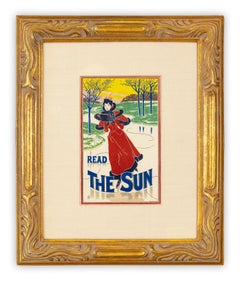
Read the Sun by Louis Rhead, Art Nouveau Japon lithograph, 1897

Read the Sun by Louis Rhead, Art Nouveau Japon lithograph, 1897

By Louis Rhead

Located in Chicago, IL

“America was quick to reveal strong Art Nouveau voices; it was Louis Comfort Tiffany who encouraged Bing to open his salon, and artists Will Bradley and Ethel Reed exhibited a Japonist simplicity that presented a strong, refined take on the Art Nouveau ideal. Louis Rhead was born in England but emigrated to the United States in 1883 at the age of 24, and quickly found himself celebrated both in the United States and in France, exhibiting his designs in the prestigious Salon des Cent in Paris in 1897.” -Quoted from Flowering Lines: Rare Art Nouveau Graphics 1883-1911 by Thomas Negovan (2017) Lithograph of Louis Rhead’s Read The Sun, published in 1897 by Imprimerie Chaix, the printing house known for publishing the works of Belle Epoque master Jules Chéret. While this poster was printed in multiple sizes and formats, this 1897 edition of 25 strikes on Japon paper is the most desirable and extremely scarce edition. Japon paper allows inks to rest upon its surface rather than being absorbed by a more permeable paper stock. The rare, small format poster lithographs created at this time were printed using rich, dense, lead inks. This world-class example of lithography captures superior resolution and color-richness to that of its large-format counterpart. This piece is presented professionally framed using all archival materials, including a hand-wrapped silk mat. This work arrives accompanied by a certificate of authenticity. Notable museum collections featuring works by John Louis...

Category

Art Nouveau 1890s Art
Materials

Lithograph

Antique American Impressionist Red Barn In Winter Framed Landscape Oil Painting

Antique American Impressionist Red Barn In Winter Framed Landscape Oil Painting

Located in Buffalo, NY

Antique American impressionist barn landscape oil painting. Oil on canvas. Framed. Measuring: 23 by 25 inches overall, and 20 by 22 painting alone. Excellent condition, ready to ha...

Category

Impressionist 1890s Art

Materials

Oil, Canvas

Antique Coastal Hudson River School Framed Seascape Original Oil Painting

Antique Coastal Hudson River School Framed Seascape Original Oil Painting

Located in Buffalo, NY

Antique American Hudson River School seascape oil painting. Oil on canvas. Framed. Measuring: 10 by 13 inches overall, and 7 by 10 painting alone. Excellent condition, ready to hang ...

Category

Hudson River School 1890s Art

Materials

Oil, Canvas

Delftsche Slaolie
Delftsche Slaolie

Delftsche Slaolie

By Jan Toorop

Located in Palm Beach, FL

Jan Toorop was born in Java, studied in Holland and then spent three key years in Brussels, where he was a member of the circle of artists, "Les XX," during which time he befriended ...

Category

Art Nouveau 1890s Art
Materials

Lithograph

"Snow Ball" Pochior - Grasset

"Snow Ball" Pochior - Grasset

By Eugène Grasset

Located in Hinsdale, IL

Pochoir (French for stencil) is a fine art printing technique that was especially popular in France from the late 19th to the early 20th century. It involves applying layers of color...

Category

Art Nouveau 1890s Art
Materials

Lithograph

St Catherine (The Miraculous Wedding)

St Catherine (The Miraculous Wedding)

Located in London, England

Alfred Gilbert (1854–1934) was probably the greatest and best known sculptor in pre-20th century British art. Works such as The Shaftesbury Memorial (Eros) located at the southeaster...

Category

Victorian 1890s Art
Materials

Bronze

Griselda
Griselda

Griselda

Located in London, England

Alfred Drury's (1856-1944) body of work locates him as a leading figure in the New Sculpture movement, yet his position as an innovator and conduit between British and European artis...

Category

Victorian 1890s Art
Materials

Bronze