Located in Myrtle Beach, SC
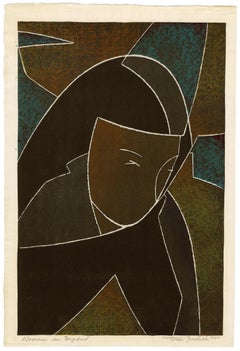
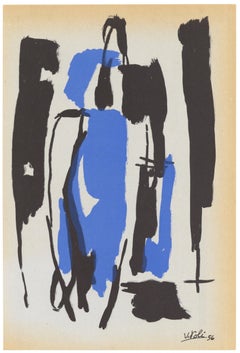
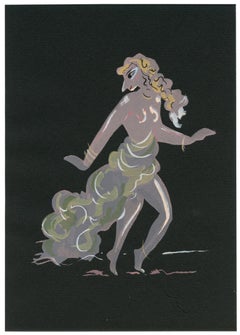
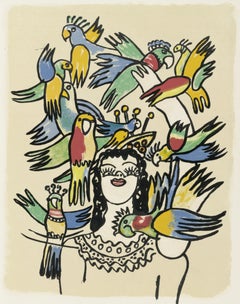
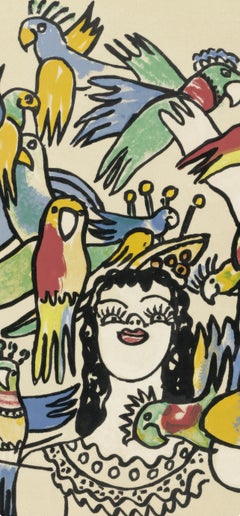
Toshi Yoshida, 'Woman In Bagdad', color woodblock print, 1954, edition not stated. Signed, dated, and titled, in pencil. A fine, richly-inked impression, with fresh colors, on cream-wove Japan paper; the full sheet with margins (1/2 to 7/8 inch); minor toning in the margins, otherwise in excellent condition. Self-carved and self-printed by the artist. Archivally sleeved, unmatted.
Image size 14 13/16 x 9 7/8 inches; sheet size 16 1/4 x 11 inches (oban tate-e).
Literature:
Oliver Statler, Modern Japanese Prints: An Art Reborn, 1959, pp. 168–69.
Eugene M. Skibbe, “Yoshida Toshi 1911–1999: Diversity, Change, and Continuity in the Yoshida Art Tradition,” Andon, no. 53, Society for Japanese Arts, 1996, pp. 5–14.
Kendall H. Brown, “Yoshida Toshi: The Nature of Tranquility,” in A Japanese Legacy: Four Generations of Yoshida Family Artists, Minneapolis Institute of Arts, 2002, pp. 72–80; Woman in Bagdad catalogued p. 91, no. 55.
Exhibitions:
'Japan & Beyond: The Yoshida Family Legacy in Japanese Woodblock Prints', curated by Kendall Brown and Quyen Le, The Ruth and Sherman Lee Institute for Japanese Art, Hanford, CA. February 3, 2004 - March 27, 2004.
'Color in Relief: Wood Block Prints from Origins to Abstraction', Georgetown University Library, 2016.
Collections: Art Institute of Chicago, Clark Center for Japanese Art and Culture, Minneapolis Institute of Art, University of California Merced, University of Oregon (The Lavenberg Collection of Japanese Prints).
ABOUT THIS WORK
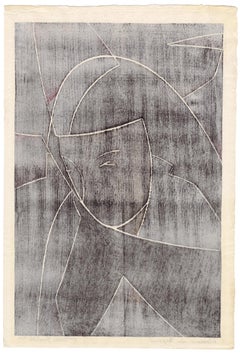
Woman in Bagdad belongs to an important group of figure studies Yoshida created in 1954 as he moved beyond the naturalistic landscape tradition associated with his father, Hiroshi Yoshida. The veiled figure is reduced to broad, interlocking shapes of deep brown, ochre, and blue-green, separated by narrow carved white lines. Yoshida appears to have printed the composition from a single block, applying individual colors to separately defined areas—a technique closely related to the white-line color woodcut developed by B. J. O. Nordfeldt and the Provincetown Printers and refined by Blanche Lazzell. The continuous white channels serve as both boundaries between colors and an active linear structure, transforming the figure into a near-abstract arrangement of flattened forms while retaining its human presence. Created at a pivotal moment in Yoshida's development, the print anticipates the increasingly nonobjective woodcuts that occupied him during the following two decades.
ABOUT THE ARTIST
Yoshida Toshi (1911–1995) began training at the age of fourteen under his father, Yoshida Hiroshi, a leading artist of the twentieth-century Japanese printmaking revival known as shin-hanga (“new prints”), which continued the traditional collaborative system of Japanese woodblock printing. From 1932 to 1935, Toshi studied at the Taiheiyo-Gakai (Pacific Painting Association), which his father had helped establish.
Before the Pacific War, Toshi traveled extensively with his father in Asia, Europe, Egypt, and the United States. He later continued his international travels, particularly in Mexico, the United States, Canada, and Africa. His early prints remained strongly influenced by Hiroshi's work and the highly refined techniques practiced in the Yoshida studio. Following his father's death in 1950, Toshi assumed responsibility for the studio while increasingly pursuing an independent artistic direction.
Beginning in the early 1950s, he undertook a highly personal exploration of abstraction, creating and printing his own works in the sōsaku-hanga (“creative print”) manner, in which the artist assumes direct responsibility for the design, carving, and printing. During this exceptionally productive period, Toshi produced a large body of nonobjective woodcuts characterized by complex geometric structures, richly layered color, and experimentation with the expressive possibilities of the woodblock medium. His abstract work placed him among the more adventurous Japanese printmakers of the postwar period. The British Museum holds a substantial group of these works, including Misty Dance (1957), Frontier (1962), Mystery (1964), Isotope (1968), and Where (1972).
In the early 1960s, Toshi also returned to representational subjects, eventually concentrating on large-scale scenes of African wildlife in its natural habitat. In 1984 he published the first of a series of illustrated children's books devoted to African animals (Dōbutsu Ehon Shirīzu), which he continued into the early 1990s.
In 1966, with artist Yuki Rei...
Category
Abstract 1950s Art