Mid-18th Century Art

to
103
462
126
75
44
60
Overall Width
to
Overall Height
to
7,597
21,404
163,086
224,913
2,000
2,268
4,984
6,535
5,776
15,006
20,637
25,690
18,594
13,933
5,383
263
154
14
3
1
1
402
337
7
480
234
157
148
145
143
90
71
53
51
47
43
40
38
29
27
27
26
21
19
350
201
172
138
91
42
41
41
19
14
225
329
411
224
Period: Mid-18th Century
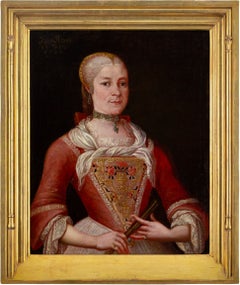
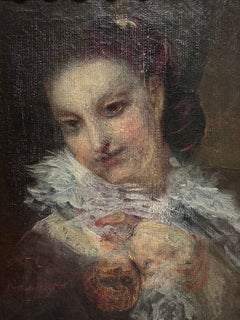
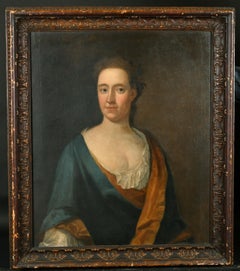
18th Century French Rococo Period Portrait of Women Oil Painting on Canvas

18th Century French Rococo Period Portrait of Women Oil Painting on Canvas

Located in Cirencester, Gloucestershire

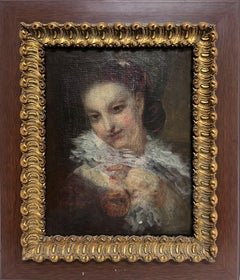
Portrait of a Lady French artist, Rococo period 18th century oil on canvas, framed framed: 15 x 12.5 inches canvas: 10.5 x 8.5 inches provenance: private collection, France condition...

Category

Rococo Mid-18th Century Art

Materials

Oil

Large 18th Century English Oil Painting Portrait of Aristocratic Lady in Blue

Large 18th Century English Oil Painting Portrait of Aristocratic Lady in Blue

Located in Cirencester, Gloucestershire

Portrait of a Noble Lady English artist, mid 18th century circle of Thomas Gainsborough (English 1727-1788) oil on canvas, unframed canvas: 30 x 25 inches provenance: private collect...

Category

Old Masters Mid-18th Century Art

Materials

Oil, Canvas

Fine 18th Century Italian Oil Painting Elegant Figures Rococo Interior Setting

Fine 18th Century Italian Oil Painting Elegant Figures Rococo Interior Setting

Located in Cirencester, Gloucestershire

Elegant Figures in Interior *see notes below Italian School, mid 18th century most likely of Venetian origin oil on canvas, unframed canvas: 10.75 x 11.75 inches provenance: private ...

Category

Rococo Mid-18th Century Art

Materials

Oil, Canvas

18th century French Old Master Portrait of a woman in oriental costume

18th century French Old Master Portrait of a woman in oriental costume

Located in Aartselaar, BE

French 18th century old master portrait of a majestic lady dressed "à la Turque" The sitter at the viewer with a kind and enigmatic smile and twinkling eyes. She looks elegant and kind, yet also has an intelligent and determined aura, reflecting the character of someone who is in charge of her own life and destiny. De Silvestre paid great attention to her spectacular outfit, which is striking in its portrayal of the sumptuous fabrics and their decorative richness. She is wearing a luxurious royal blue robe à la...

Category

Old Masters Mid-18th Century Art

Materials

Canvas, Oil

17-18 century, Original Antique Oil Painting in canvas, Genre Scene, Gold Frame

17-18 century, Original Antique Oil Painting in canvas, Genre Scene, Gold Frame

Located in Palm Coast, FL

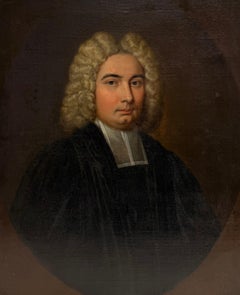
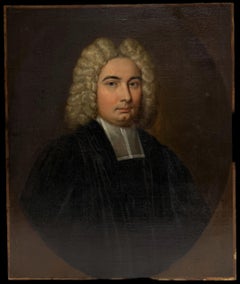
Up for sale is a compelling and atmospheric original antique oil painting on canvas, depicting a poignant genre scene. A gentleman dressed in formal black robes—likely a figure of au...

Category

Impressionist Mid-18th Century Art

Materials

Oil

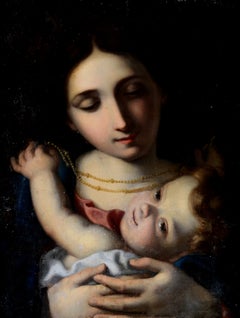
Escuela italiana (Siglo VIII) - Seguidor de Jacopo Amigoni - Virgen con niño

Escuela italiana (Siglo VIII) - Seguidor de Jacopo Amigoni - Virgen con niño

Located in Sant Celoni, ES

Muy interesante oleo sobre lienzo de la Virgen y el Niño realizado en el siglo xviii de escuela italiana La tela está reentelada Existe una versión de esta pieza muy parecida que e...

Category

Mid-18th Century Art

Materials

Oil

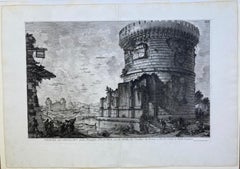
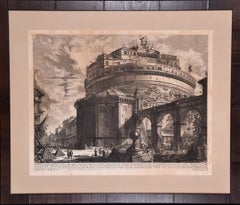
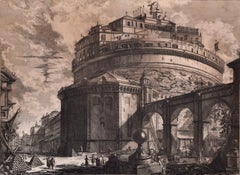
Hadrian's Mausoleum, Castel S. Angelo: A Framed 18th Century Etching by Piranesi

Hadrian's Mausoleum, Castel S. Angelo: A Framed 18th Century Etching by Piranesi

By Giovanni Battista Piranesi

Located in Alamo, CA

This large framed 18th century etching by Giovanni Battista Piranesi entitled "Veduta del Mausoleo d'Elio Adriana ora chiamato Castello S. Angelo nella parte opposta alla Facciata de...

Category

Old Masters Mid-18th Century Art

Materials

Etching

French School 18th century, Portrait of a gentleman, oil

French School 18th century, Portrait of a gentleman, oil

Located in Paris, FR

French School 18th Century Portrait of a gentleman holding his hat Oil on paper transferred on wood panel 34 x 27 cm Not signed which is normal for this type of artwork In a beautifu...

Category

Old Masters Mid-18th Century Art

Materials

Oil

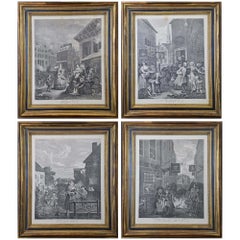
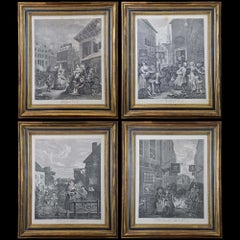
Four Framed Hogarth Engravings "Four Times of the Day"

Four Framed Hogarth Engravings "Four Times of the Day"

By William Hogarth

Located in Alamo, CA

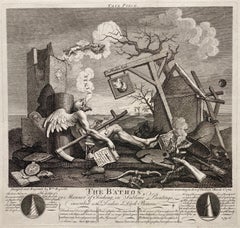
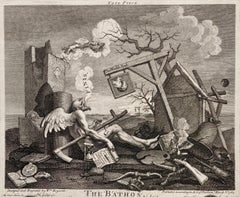
The four plates in this "Four Times of the Day" set were created utilizing both engraving and etching techniques by William Hogarth in 1738. Hogarth's original copper plates were refurbished where needed by James Heath and these engravings were republished in London in 1822 by Braddock, Cradock & Joy. This was the last time Hogarth's original copper plates were used for printing. Most were melted down during World War I for the construction of bombs. Printed upon early nineteenth century wove paper and with large, full margins as published by William Heath in 1822. The inscription below each print reads "Invented Painted & Engraved by Wm. Hogarth & Publish'd March 25. 1738 according to Act of Parliament". These large folio sized "Four Times of the Day" engravings/etchings are presented in complex gold-colored wood frames with black bands and scalloped gold inner trim. A majority of each thick impressive frame is covered with glass applied near the outer edge. Each frame measures 25.75" high, 22.25" wide and 1.88" deep. There are a few small dents in the edge of these frames, which are otherwise in very good condition. "Morning" has two focal areas of discoloration in the upper margin and some discoloration in the right margin, a short tear in the left margin and a short tear or crease in the right margin. "Noon" has a spot in the upper margin that extends into the upper image, but it is otherwise in very good condition. "Evening" has a faint spot in the upper margin, but it is otherwise in very good condition. "Night" is in excellent condition. The "Four Times of the Day" series is in the collection of many major museums, including: The British Museum, The Metropolitan Museum of Art, The Tate Museum, The Chicago Art Institute and The Victoria and Albert Museum. Through this series Hogarth is portraying early 18th century London street life at "Four Times of the Day". His characters are exhibiting their personalities, quircks, strange activities, but he also wants to draw attention the disparities between the wealthy aristocracy and the common working class. Plate 1, "Morning" depicts morning in Covent Garden in the winter in front of Tom King...

Category

Old Masters Mid-18th Century Art

Materials

Engraving, Etching

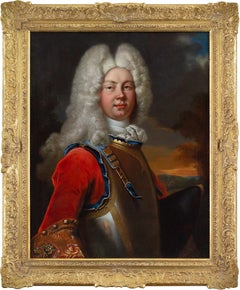
Portrait of Frédéric III De Saxe-Gotha-Altenbour, 18th-century Oil Painting

Portrait of Frédéric III De Saxe-Gotha-Altenbour, 18th-century Oil Painting

By Nicolas de Largillière

Located in Cheltenham, GB

This early 18th-century oil painting by an artist working in the circle of Nicolas De Largillière (1656-1746) depicts Frédéric III, Duke of Saxe-Gotha-Altenbourg (1699-1772), shown h...

Category

Rococo Mid-18th Century Art

Materials

Canvas, Oil

Portrait of Maria Vittoria Queen of Portugal - Italian Old Master oil painting

Portrait of Maria Vittoria Queen of Portugal - Italian Old Master oil painting

Located in Hagley, England

This lovely Italian Old Master portrait oil painting is by Domenico Maria Sani. Painted circa 1732 the sitter is of Maria Anna Vittoria (1718 - 1788), daughter of Philip V and Elisabetta Farnese, who in 1729 married Joseph prince of Brazil and king of Portugal...

Category

Old Masters Mid-18th Century Art

Materials

Oil

Piazza del Popolo con Obelisco Egizio

Piazza del Popolo con Obelisco Egizio

By Giuseppe Vasi

Located in Fairlawn, OH

Piazza del Popolo con Obelisco Egizio Etching, 1752 Signed in the plate lower left (see photo) From: Della Magnificenze di Roma Antica e Moderna ( The Magnificense of Ancient and Modern Rome) , (1747-1761) Volume II, The Main Squares and Obelisks, columns and other ornaments, 1752, Plate No. 21 Della Magnificenze di Roma Antica e Moderna_ (1747-61), a collection of 238 plates that was published in ten volumes. Vasi recorded all types of architecture and organized these images of contemporary Rome by subject, with each volume representing a different category of architecture. This comprehensive project provides one of the most complete views of eighteenth-century Rome Condition: Excellent Image/Plate size: 8.25 x 12.63 inches Sheet size: 11 x 15 7/8 inches Vasi was Giovanni Battista Piranesi’s teacher. Piranesi (1720-1778) entered Vasi’s studio as an apprentice at age 20 c. 1740. Piranesi left Vasi’s employment after stabbing Vasi over the perception that Vasi was withholding secrets of the etching process. Giuseppe Vasi was an Italian engraver and painter born and trained in Sicily. He received a classical education in his hometown of Corleone and trained as a printmaker in nearby Palermo, perhaps under the tutelage of the etchers Antonino Bova and Francesco Cichè. He moved to Rome in 1736, already an established printmaker, and spent most of his career documenting the urban landscape of the city in engravings. Through his patron, the politically and culturally influential Cardinal Troiano Acquaviva d’Aragona, Vasi met other artists working in Rome, such as Sebastiano Conca, Ferdinando Fuga, and Luigi Vanvitelli. He was also influenced by his predecessors, including Giovanni Paolo Panini, Giovanni Battista Falda...

Category

Old Masters Mid-18th Century Art

Materials

Etching

Mid-18th-Century French School, Portrait Of A Gentleman With A Letter

Mid-18th-Century French School, Portrait Of A Gentleman With A Letter

Located in Cheltenham, GB

This mid-18th-century French oil painting depicts a composed gentleman shown half-length against a softly graduated background, dressed in a finely cut brown coat fastened with gilt ...

Category

Rococo Mid-18th Century Art

Materials

Canvas, Oil

The South West Prospect of London – English School 18th century

The South West Prospect of London – English School 18th century

Located in Middletown, NY

A stunning 18th century optical view of London from the Thames. London: 1760. Copper plate engraving with hand coloring in watercolor on cream laid paper with a large circular wate...

Category

English School Mid-18th Century Art

Materials

Watercolor, Handmade Paper, Engraving

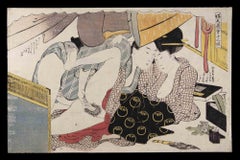
Shunga - Woodcut by Katsukawa Schuncho - Mid-18th Century

Shunga - Woodcut by Katsukawa Schuncho - Mid-18th Century

By Katsukawa Shunshō

Located in Roma, IT

Shunga is an original modern artwork realized by Katsukawa Schuncho (1726 – 1793) in the half of the 18th Century. Erotic scene from the series "Koshuko zue juni ko". A courtesan with a customer under a kimono stand...

Category

Modern Mid-18th Century Art

Materials

Paper, Woodcut

Portrait of a senior naval officer, c. 1740s

Portrait of a senior naval officer, c. 1740s

By Thomas Hudson

Located in Henley-on-Thames, England

Thomas Hudson (Devon 1701 - London 1779) Portrait of a senior naval officer, c. late 1740s Probably a captain or admiral; half-length, holding a telescope, with a warship beyond Oil on canvas 91.3 x 71.1 cm.; (within frame) 114.3 x 93.8 cm. (Unsigned) Provenance: Christie’s, London, 22 November 1985, lot 105 (as Thomas Hudson); Private collection, United Kingdom; Haynes Fine Art, Broadway, Worcestershire; Where acquired, private collection, United States, 16 August 1988; Neal Auction, New Orleans, 14 September 2025, lot 302 (as Attributed to Thomas Hudson); Where acquired by Haveron Fine Art. Literature: Bridgeman Art Library, The Bridgeman Art Library (London: The Library, 1995), p. 89 Christie’s, London, Important English Pictures (London: Christie’s, 22 November 1985) Archival: Witt Library, Courtauld Institute of Art (no. 061487); Heinz Archive and Library, National Portrait Gallery, 1725-50, Thomas Hudson: Men Authentic (1) (Box) This attractive and quintessential half-length is exemplary of Hudson’s leading portrait practice, produced in the years immediately preceding his decade-long dominance over the London market, beginning in 1749. The work is stylistically typical of Hudson's prime 1750s output, displaying a deliberate refinement of his technique: namely the emphasis of directional brushstrokes, which sensitively follow the contours of the facial features. However, since the sitter wears civilian dress and not a naval uniform (introduced officially in April 1748), a late 1740s date of creation is most likely. Displaying the merits of Hudson's evolving handling, a distinctive feathery quality is combined here with a striking chiaroscuro effect, which Hudson borrowed directly from Rembrandt. Amalgamating the rich colouring of the Rococo with a mannered Baroque posing, Hudson renders the senior naval officer with a characteristic presence. Resting one hand assuredly at his hip, the finely worked telescope illustrates the officer’s seniority; the warship sailing on the horizon beyond provides further indication of his commanding rank. The telescope is held by a hand modelled with sculptural poise, and the typically Van Dyck manner (seen elsewhere, e.g. Princess Amelia Sophia Eleonore of Great Britain, YCBA B2001.2.246) further illustrates Hudson's studied grounding. The sitter wears civilian clothes, and not the naval uniform first introduced in 1748 (which officers afterwards invariably chose to be shown in). His red waistcoat is of a type popular amongst British officers before 1748, perhaps inspired by French naval uniforms. The officer has previously been suggested as Edward Henry Sartorius, of the prominent naval Sartorius family; however, this identification is improbable on biographical and documentary grounds. Hudson was regularly commissioned by leading naval officers, and produced highly satisfactory portraits praised for their great likeness and genteel swagger. He charged 24 guineas for a standard 50 x 40 inch half-length in the 1750s period, and the present work (somewhat smaller in size) would have cost not much less. Comparable works include those of Admirals of the Fleet George Anson, 1st Baron Anson, and Sir John Norris; Admiral Sir George Pocock; Admiral Sir Peter Warren; Vice-Admiral The Honourable John Byng; and Rear-Admiral Richard Tyrrell. The present portrait is particularly similar in composition to Hudson’s Portrait of a Flag Officer of The White Squadron, which similarly employs the narrative device of a telescope held at a dynamic angle across the composition, with a warship to the left side of the officer’s retracted arm. Thomas Hudson (Devon 1701 - London 1799) Thomas Hudson rose to become the leading British portraitist of the mid-18th century, albeit in close competition with his Scottish counterpart Allan Ramsay. Born in Devon, Hudson studied alongside George Knapton under Jonathan Richardson the Elder (marrying his daughter in 1725, expressly against Richardson’s wishes), and inherited a dignified formality jointly derived from Van Loo. His work is first recorded in 1728, and between 1730-40 he practised in Bath and the West Country, where in addition to portrait commissions, he was employed to retouch and reline old pictures. He returned permanently to London thereafter, and devised a series of stock poses to which he would return with variation throughout his career. Beginning in 1745 with the death of Richardson and the departure of Van Loo, Hudson became the city’s most successful portraitist, and embarked on ambitious defining works such as his Portrait of Theodore Jacobsen ‒ not drastically unlike the continental heights of Pompeo Batoni in conception. Profiting from his success, he relocated from Lincoln’s Inn Fields to a house in Great Queen Street previously inhabited by Van Loo, and one door down from Kneller’s old rooms. An exceptionally productive period began in 1749 which lasted until the late 1750s. Among this output were highly praised portraits of the Prince and Princess of Wales, commissions for most of the preeminent aristocrats, and superlative group portraits including Benn’s Club of Aldermen, and those of the Thistlethwayte, Marlborough and Radcliffe families. Hudson relocated to King Street, Covent Garden, operating a prolific studio operation which resulted in some four hundred paintings ‒ of which at least eighty were engraved. A prodigious assembly of young pupils included Sir Joshua Reynolds (1740-3), Joseph Wright of Derby (1751-3, 1756), Richard Cosway, John Hamilton Mortimer, and the drapery painters Joseph and Alexander van Aken (also employed by Ramsay). As one later reviewer expressed: ‘Hudson, his art may well display to sight / Who gave Mankind a Reynolds and a Wright’ (Miles, ‘Introduction’). The ambitious young Reynolds made many drawings from classical statuary under Hudson’s instruction, and wrote home that, ‘While doing this I am the happiest creature Alive (sic.)’ (Sweetser, p.12). However, he was later dismissed from his pupilage some two years prematurely for refusing to carry a painting to Van Aken’s studio in the rain. It was at this point that Reynolds returned to Plymouth (Devonport), and produced some thirty portraits of the local gentry (including one example presently owned by Haveron Fine Art). Hudson was one of a number of artists who congregated in Old Slaughter’s Coffee House, alongside Hogarth, Ramsay, Hayman, and Rysbrack. Together they supported Thomas Coram’s Foundling Hospital, of which they each belonged to the 600 governors (in whom Hudson met many of his future clients), and promoted the building as London’s first public space of artistic exhibition. He visited the Netherlands and France for five weeks in 1748 accompanied by St Martin’s Lane colleagues, and was arrested with Hogarth for making drawings of the Bastille fortifications. He afterwards stayed in Rome and Naples in 1752 with Roubiliac, meeting Reynolds twice on the return journey. He returned to England and bought a house at Cross Deep, Twickenham (upstream from Pope’s villa), and made an effective museum of the space. He lived there with his second wife, a wealthy widow named Mrs Fynes. Having been involved with early attempts to establish a royal academy of the arts, Hudson exhibited at the Society of Arts in 1761 and 1766, although he had effectively retired from painting by the latter date. His last painting was in 1767, and he died at Twickenham in January 1779 aged seventy-eight. Hudson was also exceptional for the extensive collection of artworks which he amassed during his lifetime. The collection was thoroughly impressive in extent, and included outstanding Old Masters: Breughel, Canaletto, van Dyck, Hals, Holbein, Kneller, Lely, Michelangelo, Parmigianino, Poussin, Raphael, Rembrandt, Rubens, Tintoretto, Titian, Vasari, and Velázquez. His earliest recorded purchase was in 1741, and he spent heavily at the sale of his father-in-law, even buying works jointly with Van Aken. Likewise, at the posthumous 1750 sale of Van Aken, Hudson spent £215 on the second day (nearly half that day’s sale total). As a pupil, Reynolds had been sent to bid for Hudson in Lord Oxford’s sale of 1742, and proudly recalled having been greeted with a handshake by Hudson’s friend Pope at another picture sale. Hudson also collected extensively from within his own generation, acquiring works by contemporaries including Gainsborough, Reynolds, Richardson, Rysbrack, Vanderbank, and his predecessor Van Loo. Following his death, the works were dispersed in two sales at Messrs. Langford, with the finer works sold at Christie’s in 1785 after the death of his second wife. However, his connoisseurship was not without flaw ‒ having outbid Benjamin Wilson for a Rembrandt drawing, Wilson etched and printed a new ‘Rembrandt’ plate...

Category

Old Masters Mid-18th Century Art

Materials

Oil

Turin Countryside - Original Ink and Watercolor by Jan Pieter Verdussen - 1744

Turin Countryside - Original Ink and Watercolor by Jan Pieter Verdussen - 1744

By Jan Pieter Verdussen

Located in Roma, IT

China ink and Watercolour. With handwritten notes, indicating the place and date of the artwork in lower margin: "Fait proche de Turin, ce 13 Juin 1744". Numbered on the lower right ...

Category

Old Masters Mid-18th Century Art

Materials

Paper, Ink, Watercolor

18th Century Oil on Canvas French Painting Halt of the Mounted Grenadiers

18th Century Oil on Canvas French Painting Halt of the Mounted Grenadiers

By Charles Parrocel

Located in Vicoforte, IT

A magnificent 18th-century French painting. This oil on canvas artwork depicts the halt of the mounted grenadiers of the King's Guard by Charles Parrocel (1688-1752), one of the most representative works of 18th-century French military painting...

Category

Mid-18th Century Art

Materials

Canvas, Oil

Scultura Barocca di Angelo in Terracotta Policroma Italia XVIII secolo

Scultura Barocca di Angelo in Terracotta Policroma Italia XVIII secolo

Located in Pistoia, IT

Scultura in terracotta policroma raffigurante un angelo alato, Italia, XVIII secolo. L'angelo è plasmato con grande maestria, dalle forme rotonde tipiche del Barocco italiano. Gli ...

Category

Baroque Mid-18th Century Art

Materials

Terracotta

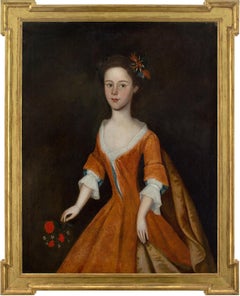
Fine 18th Century British Portrait of an Aristocratic Lady, Large oil painting

Fine 18th Century British Portrait of an Aristocratic Lady, Large oil painting

Located in Cirencester, Gloucestershire

Circle of Thomas Hudson (1701-1779) British. 18th Century Bust Portrait of a Lady, Oil on Canvas, Inscribed on a label verso, canvas: 30" x 25" (76.2 x 63.5cm). frame: 30 x 25 in...

Category

Old Masters Mid-18th Century Art

Materials

Canvas, Oil

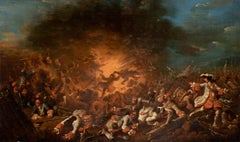
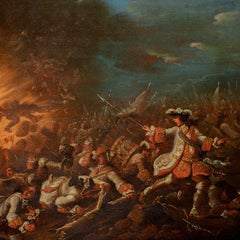
18th Century Oil on Canvas French Battle Painting Alexander the Great and Porus

18th Century Oil on Canvas French Battle Painting Alexander the Great and Porus

Located in Vicoforte, IT

Monumental 18th-century French battle. Oil painting on canvas depicting the Battle of Hydaspes, in which Alexander the Great defeated the Indian king Porus. A painting of considerabl...

Category

Mid-18th Century Art

Materials

Canvas, Oil

18th century antique portrait Edmund Hoyle Circle of James Latham, Edmund Hoyle

18th century antique portrait Edmund Hoyle Circle of James Latham, Edmund Hoyle

Located in York, GB

18th century Bust portrait of a gentleman in a blue coat with gold buttons (Said to be Edmund Hoyle, inventor of Whist) oil on canvas circle of James Latham. Housed in a gilt frame the size overall is 71 x 84 cm (28 x 33 inches approx) whilst the painting is 56 x 69 cm ( 22 x 27 inches approx) unsigned The overall condition is very good having had some restoration. The painting has been relined, cleaned and re varnished. There has been some strengthening/overpainting. There is a Rectangular patch repair along lower edge, centre, reverse approximately 5 x 7cm with associated retouching to front,all essentially done sympathetically. some fine stable craquelure throughout. Some minor self coloured losses to frame. None of the above detracting from a very attractive portrait. Edmond Hoyle Edmond Hoyle English card game authority, "the Father of whist" Born 1672 England Died 29 August 1769 (aged 96–97) London, England Edmond Hoyle (1672 – 29 August 1769)[1] was a writer best known for his works on the rules and play of card games. The phrase "according to Hoyle" came into the language as a reflection of his generally perceived authority on the subject James Latham James Latham was born in Thurles, County Tipperary, Ireland and possibly related to the family of Lathams of Meldrum and Ballysheehan. After some practice of his art, Latham studied for an academic year in Antwerp (1724–25) where he became a Master of the Guild of St Luke. He returned to Dublin by 1725, and may have visited England in the 1740s, as the influence of Joseph Highmore, as well as Charles Jervas and William Hogarth, is evident in his work of this period. Anthony Pasquin memorably dubbed Latham "Ireland's Van Dyck". Latham died in Dublin on 26 January 1747. Several of James Latham's portraits are in the National Gallery of Ireland collection in Dublin; one is of the famous MP Charles Tottenham (1694–1758) of New Ross, Co. Wexford, "Tottenham in his Boots" (Cat. No.411) and a second is a portrait of Bishop...

Category

Old Masters Mid-18th Century Art

Materials

Oil

Studies of arms in draped sleeves

Studies of arms in draped sleeves

Located in Middletown, NY

Charcoal and graphite on grayish laid paper, 10 1/2 x 7 3/4 inches (265 x 195 mm), the full sheet. Scattered light, minor and unobtrusive foxing, several non-archival cellophane tape...

Category

Italian School Mid-18th Century Art

Materials

Handmade Paper, Laid Paper, Graphite, Charcoal

18th Century Oil on Canvas Antique Flemish Mythological Painting, 1760s

18th Century Oil on Canvas Antique Flemish Mythological Painting, 1760s

Located in Vicoforte, IT

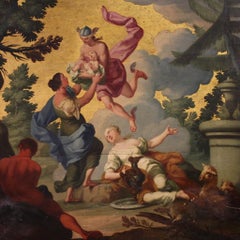
Great Flemish painting from the mid-18th century. Oil on canvas artwork depicting a famous episode from Ovid's Metamorphoses. Jupiter and Mercury, disguised as wayfarers, are rejecte...

Category

Mid-18th Century Art

Materials

Canvas, Oil

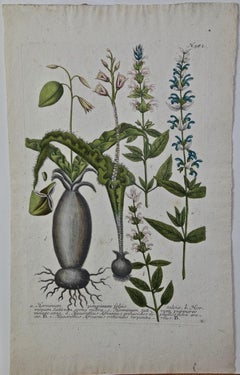
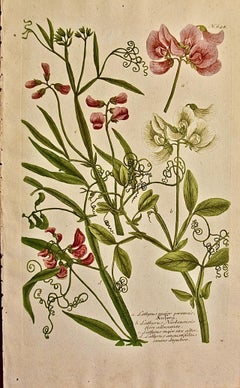
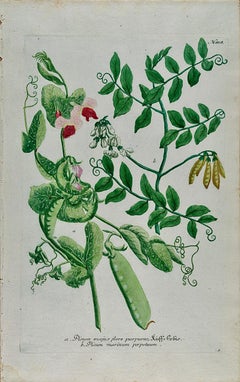
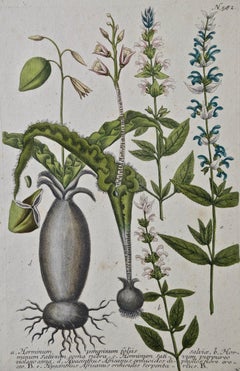
Flowering Pea Plant: An 18th C. Hand-colored Botanical Engraving by J. Weinmann

Flowering Pea Plant: An 18th C. Hand-colored Botanical Engraving by J. Weinmann

By Johann Wilhelm Weinmann

Located in Alamo, CA

This hand-colored botanical mezzotint and line engraving by Johann Wilhelm Weinmann (1683-1741) is entitled "A. Lathyrus Major Peremis Richern B. Lathyrus Narbonensis Flore Albescen...

Category

Naturalistic Mid-18th Century Art

Materials

Engraving, Mezzotint

Penitent Mary Magdalene c1750 Oil on Copper Old Master

Penitent Mary Magdalene c1750 Oil on Copper Old Master

Located in Holywell, GB

A finely painted picture, possibly of the penitent Mary Magdalene, painted in oil on to a copper plate and dating to c1750. Condition Two old touch ins, tiny chip to the forehead...

Category

Old Masters Mid-18th Century Art

Materials

Oil

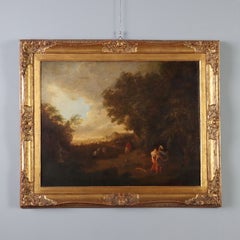
Manor House with Cottages - British 18thC Old Master art oil painting VG prov.

Manor House with Cottages - British 18thC Old Master art oil painting VG prov.

By George Lambert

Located in Hagley, England

This stunning British Old Master landscape oil painting, with excellent provenance, is by George Lambert. Lambert was a pioneer of British landscape in art for its own sake. Painted in 1744, the painting is entitled View of a Manor House and Cottages in Elizabeth Einberg's 63rd volume of the Walpole Society 2001 and is described as follows: In the foreground a road emerges from a wood to cross a ford and then leads up the hill to the right, towards a manor house seemingly built into the remains of a medieval or Tudor edifice. The main track, crowded with sheep and rustic figures, passes the massive square gateposts lower down the hill on the left. Further to the left is a thatched cottage with smoke coming out the chimney. In the distance is a wide coastal view. The main buildings, which are in the dead centre of the composition, represent almost certainly an as yet unidentified English view. The colouring and detail in the trees and foliage are superb. This is an excellent Old Master oil painting by one of the all time great British landscape artists with extensive provenance. Signed and dated 1744 lower left on rock in black. Provenance. Elizabeth Einberg, “Catalogue Raisonnè of the works of George Lambert” The Annual Volume of the Walpole Society, 2001 Vol. 63, page 149 no P1744, fig.71. Antonacci Efrati Antichità Rome Gallery. Burden sale, Parke Bernet, New York, 20-21, April 1938 (376 repr.) Robert E. Peters, Sotheby Parke Bernet, New York, March 1975 (41 repr.) Lit. Schnackenburg 1995, pp 83-84, cat. no.14 fig 13. Condition. Oil on canvas, 54 inches by 52 inches and in good condition. Frame. Housed in an ornate gilt frame, 64 inches by 62 inches and in good condition. George Lambert (1700-1765) was an English landscape artist and theatre scene painter. With Richard Wilson he is recognised as a pioneer of British landscape in art, for its own sake. Lambert was born in Kent and studied art under Warner Hassells and John Wootton, soon attracting attention by the quality of his landscape painting. He painted many large and fine landscapes in the style of Gaspar Poussin and Salvator Rosa. Many of his landscapes were finely engraved by François Vivares, James Mason (1710–1785), and others, including a set of views of Plymouth and Mount Edgcumbe (painted conjointly with Samuel Scott), a view of Saltwood Castle in Kent, another of Dover, and a landscape presented to the Foundling Hospital in London. Lambert also obtained a great reputation as a scene-painter, working at first for the Lincoln's Inn Fields Theatre, in London, under John Rich. When Rich moved to Covent Garden Theatre, Lambert secured the assistance of Amigoni, and together they produced scenery of far higher quality than any previously executed. Lambert was a man of jovial temperament and shrewd wit, and frequently spent his evenings at work in his painting-loft at Covent Garden Theatre, to which men of note in the fashionable or theatrical world resorted to share his supper of a beef-steak, freshly cooked on the spot. Out of these meetings arose the well-known "Beefsteak Club" which long maintained a high social reputation. Most of Lambert's scene-paintings unfortunately perished when Covent Garden Theatre was destroyed by fire in 1808. Lambert was a friend of William Hogarth and a member of the jovial society that met at 'Old Slaughter's' Tavern in St Martin's Lane. In 1755 he was one of the committee of artists who proposed a royal academy of arts in London. He was a member of the Society of Artists of Great Britain, exhibited with them in 1761 and the three following years, and during the same period contributed to the Academy exhibitions. In 1765 he and other members seceded and formed the Incorporated Society of Artists of Great Britain, of which he was elected the first president. In conjunction with Samuel Scott, Lambert painted a series of Indian views for the old East India House in Leadenhall Street. He also etched two prints after Salvator Rosa. Lambert was associated in 1735 with George Vertue, Hogarth, and John Pine (engraver, 1660–1756) in obtaining a bill from parliament securing artists a copyright on their works. Lambert's portraits were painted by Thomas Hudson, John Vanderbank (engraved in mezzotint by John Faber the younger in 1727, and in line by H. Robinson and others), and Hogarth. Lambert's most famous painting is "A view of Box Hill, Surrey" (1733) which depicts a well-known beauty spot south of London. Hogarth considered Lambert a rival to the famous French landscape painter Claude Lorrain (1600–1682) with respect to his use of soft light to unify the scene in this painting. Though he never visited Italy he was inspired by the classical tradition of landscape painting. Lambert died on 30 November 1765 at his home on the Piazza in Covent Garden. His pupils included John Inigo Richards...

Category

Old Masters Mid-18th Century Art
Materials

Oil

Escuela española (XVIII) El bautismo de San Jeronimo según Juan de Valdes Leal

Escuela española (XVIII) El bautismo de San Jeronimo según Juan de Valdes Leal

Located in Sant Celoni, ES

La obra no va firmada Se presenta sin enmarcar la pintura El estado de la obra se puede ver, es aceptable ya que en su momento se acondicionó debidamente Medidas de la obra: 38 x ...

Category

Old Masters Mid-18th Century Art
Materials

Oil

"February Bouquet" from 'The Twelve Months of Flowers' series by Robert Furber

"February Bouquet" from 'The Twelve Months of Flowers' series by Robert Furber

By Robert Furber

Located in Alamo, CA

This framed hand-colored engraving entitled "February Bouquet" is from 'The Twelve Months of Flowers' by Henry Furber, published in London in 1730 by Robert Sayer and John King. Each of the twelve hand-colored engravings in the book were produced from paintings by Pieter Casteels (1684-1749) and engraved by Henry Fletcher (1710-1753). The book featured twelve detailed engravings of seasonal plants in bloom in the form of a bouquet. More than 400 different species of flowering plants were included with each plant numbered and accompanied by a list of the corresponding species names. Thirty-five species of flowers are depicted in this engraving in a bouquet sitting in an ornate attractive bowl. A few of the flowers lie loose on a table. The flower species are listed in a table in the lower portion of the plate, along with the month that these flowers are in bloom. This colorful print is presented in a gold-colored wood frame with a cream-colored double mat with a heather green inner mat. The frame measures 23.5" High, 19" wide and 1.63" deep. There are a few small frame abrasions, but the print is in very good condition. Robert Furber...

Category

Naturalistic Mid-18th Century Art
Materials

Engraving

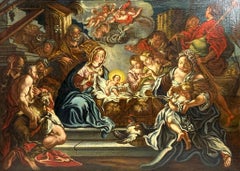
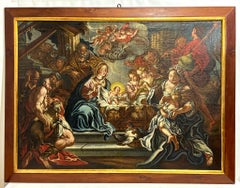
18th Century Oil on Canvas Flemish Framed Religious Painting Holy Family, 1750

18th Century Oil on Canvas Flemish Framed Religious Painting Holy Family, 1750

Located in Vicoforte, IT

Antique Flemish painting from the 18th century. Framework oil on canvas depicting religious subject Holy family of good pictorial quality. Nice sized and pleasantly decorated framewo...

Category

Mid-18th Century Art
Materials

Canvas, Oil

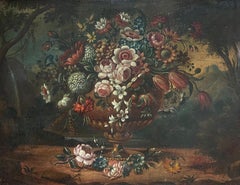
18th-Century Baroque Oil Still Life Flowers Floral Arrangement in an Ornate Urn

18th-Century Baroque Oil Still Life Flowers Floral Arrangement in an Ornate Urn

Located in Cirencester, Gloucestershire

Elaborate Floral Arrangement French artist, 18th Century oil on canvas, framed Framed: 27 x 34 inches Canvas: 22 x 29 inches Provenance: private collection, England Condition: very...

Category

Baroque Mid-18th Century Art
Materials

Oil, Canvas

Flowering Sweet Pea: 18th Century Hand-colored Botanical Engraving by Weinmann

Flowering Sweet Pea: 18th Century Hand-colored Botanical Engraving by Weinmann

By Johann Wilhelm Weinmann

Located in Alamo, CA

This is an original antique colored botanical mezzotint and line engraving of flowering Red Sweet Peas which is finished with hand-coloring. It is entitled "Lathyrus Flore Majore Pur...

Category

Naturalistic Mid-18th Century Art
Materials

Engraving, Mezzotint

Flowering Sweet William Plant: 18th C. Hand-colored Weinmann Botanical Engraving

Flowering Sweet William Plant: 18th C. Hand-colored Weinmann Botanical Engraving

By Johann Wilhelm Weinmann

Located in Alamo, CA

This hand-colored botanical mezzotint and line engraving by Johann Wilhelm Weinmann (1683-1741) is entitled "a. Caryophyllus Arborescens, b. Caryophyllus Barbatus". It is plate 327 i...

Category

Naturalistic Mid-18th Century Art
Materials

Engraving, Mezzotint

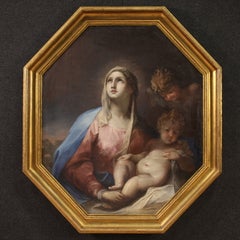
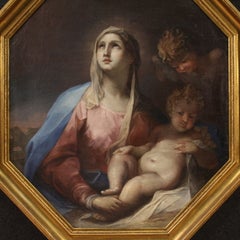
18th Century Oil on Canvas Italian Religious Painting Madonna with Child, 1750

18th Century Oil on Canvas Italian Religious Painting Madonna with Child, 1750

Located in Vicoforte, IT

A refined 18th-century Italian painting. This artwork oil on canvas depicts a splendid Madonna and Child with a cherub, crafted with exquisite skill. The composition dates stylistica...

Category

Mid-18th Century Art
Materials

Canvas, Oil

Chrysanthemum: An 18th Century Hand-colored Botanical Engraving by J. Weinmann

Chrysanthemum: An 18th Century Hand-colored Botanical Engraving by J. Weinmann

By Johann Wilhelm Weinmann

Located in Alamo, CA

This is an original antique hand-colored botanical mezzotint and line engraving of flowering Chrysanthemum matricaria plants. It is entitled "A. Chrysanthemum Matricarice Folus Flore...

Category

Naturalistic Mid-18th Century Art
Materials

Engraving, Mezzotint