Abstract Geometric Art

to
605
1,016
736
1,019
636
1,270
Overall Width
to
Overall Height
to
3
10
1,741
2,921
1
1
9
10
45
213
705
283
155
118,061
64,527
56,640
28,639
14,576
9,628
6,900
6,034
4,177
3,157
2,548
2,317
2,144
603
1,795
1,389
979
112
109
71
54
51
50
42
30
27
26
26
24
23
21
20
20
19
18
18
17
2,192
1,205
1,196
986
978
218
128
93
77
54
924
827
3,269
1,080
Style: Abstract Geometric
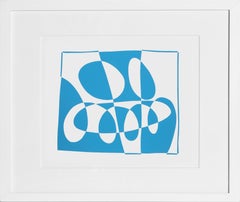
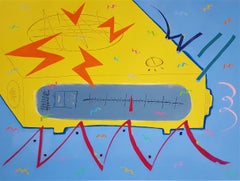
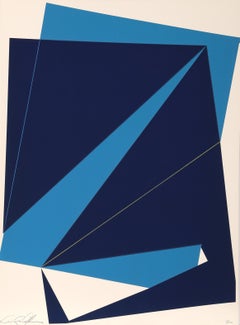
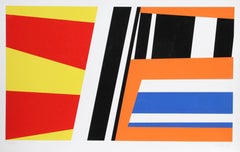
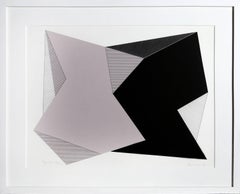
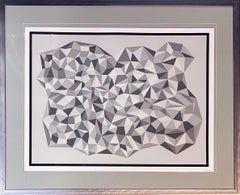
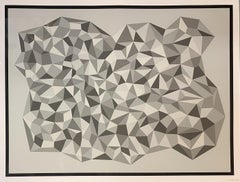
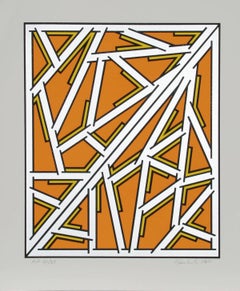
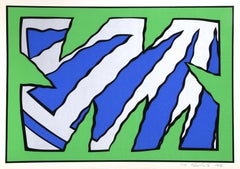
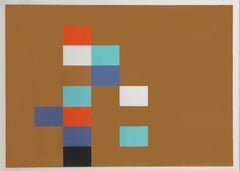
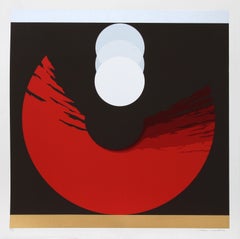
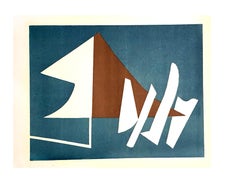
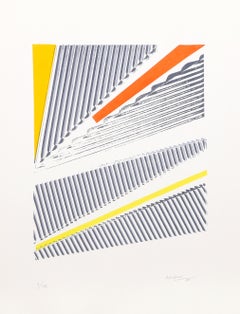
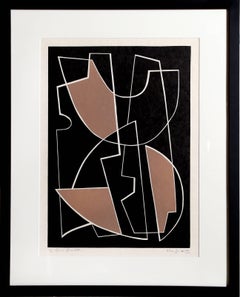
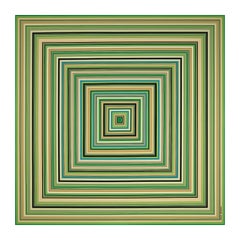
Geometric Abstract Lithograph by Jasha Green

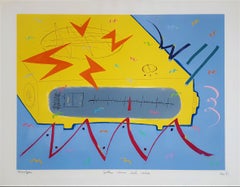
Geometric Abstract Lithograph by Jasha Green

By Jasha Green

Located in Long Island City, NY

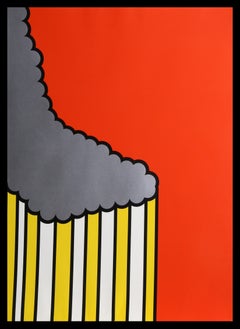
Artist: Jasha Green, American (1923 - 2006) Title: Untitled 30 Year: circa 1976 Medium: Lithograph, signed and numbered in pencil Edition: 200 Size: 29 x 35 in. (73.66 x 88.9 cm)

Category

1970s Abstract Geometric Art

Materials

Lithograph

High Desert Composition - 3-D Steel Wall Sculpture, Linear Geometric Form

High Desert Composition - 3-D Steel Wall Sculpture, Linear Geometric Form

By Chris Hill

Located in Chicago, IL

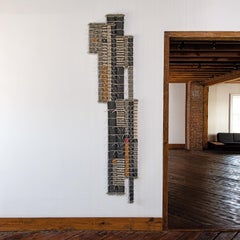
"High Desert Composition" is a welded steel wall sculpture where the lines between two- and three-dimensional art are blurred. The viewer has a variety of experiences from multiple vantage points where volumes and angles disconnect and reconnect as one moves around the piece. The hand welded steel is painted with acrylic paint in a kaleidoscope of color tones. Chris Hill High Desert Composition welded steel, acrylic paint 80h x 48w x 7d in 203.20h x 121.92w x 17.78d cm CHI024 Chris Hill is a Santa Fe based sculptor. Chris was born in Port Arthur, Texas but grew up in small town North Mississippi. He began welding at age 18 at the Tennessee Valley Authority...

Category

21st Century and Contemporary Abstract Geometric Art

Materials

Steel

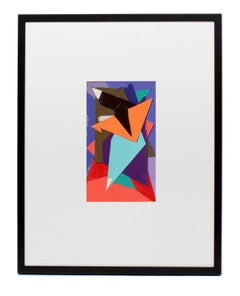
Blue, Orange and Pink Geometric Abstract Painting

Blue, Orange and Pink Geometric Abstract Painting

By John O'Neil

Located in Houston, TX

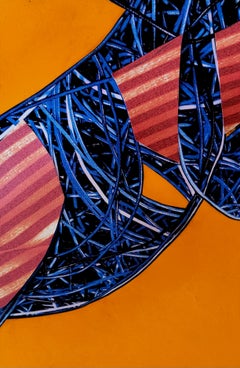
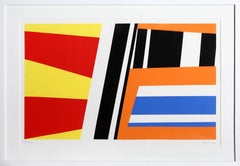
Blue, orange and pink pastel work done in an abstract geometric style. It is framed in a black frame with a white matte. The artist signed the work in the bottom right corner along a...
Category

1970s Abstract Geometric Art

Materials

Oil Pastel

Mid Century Modern Vintage Swedish Abstract Cityscape Oil Painting -Urban Blocks

Mid Century Modern Vintage Swedish Abstract Cityscape Oil Painting -Urban Blocks

Located in Bristol, GB

URBAN BLOCKS Size: 48 x 63.5 cm (including frame) Oil on board A striking mid-century abstract cityscape rendered in a restrained muted palette, executed in oil onto board. The pai...

Category

Mid-20th Century Abstract Geometric Art

Materials

Oil, Board

"Abstract" Neha Puri Dhir, Contemporary Hand-dyed Textile

"Abstract" Neha Puri Dhir, Contemporary Hand-dyed Textile

Located in Wilton, CT

Abstract, Neha Puri Dhir, patchwork of resist dyed cotton, 37.5” x 73”, 2014 Fiber artist, Neha Puri Dhir (1983, Inda) explains her motives and feelings behind this colorful, geomet...

Category

2010s Abstract Geometric Art

Materials

Fabric, Textile, Cotton, Dye

Untitled
Untitled

Untitled

Located in New York, NY

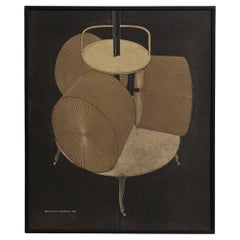
This sophisticated sculpture was realized from lymed French oak circa 1950. The perimeter of the piece consists of a mosaic of rectilinear blocks, while the interior rectangular pane...

Category

1960s Abstract Geometric Art

Materials

Oak

Nautic - Abstract Geometric Acrylic Painting

Nautic - Abstract Geometric Acrylic Painting

Located in Boston, MA

Nautic 51.2 x 31.5 x 0.8, 5.5 lbs Acrylic paint Signed by the artist Artist's Commentary: "Original painting on stretched canvas named 'Nautic'. Dimensions: 130cm x 80cm. Art work...

Category

21st Century and Contemporary Abstract Geometric Art

Materials

Acrylic

Prismatic Variation IV/Gold, Serigraph, Geometric

Prismatic Variation IV/Gold, Serigraph, Geometric

By Ruth Leavitt

Located in Milwaukee, WI

The work of Ruth Leavitt (1944, Saint Paul, Minnesota) employs computation to manipulate and alter abstract forms by virtually stretching, rotating and deforming them across three ax...

Category

1970s Abstract Geometric Art

Materials

Screen

Geometric Abstraction Oil Painting on Masonite by Juliette Steele, Framed

Geometric Abstraction Oil Painting on Masonite by Juliette Steele, Framed

By Juliette Steele

Located in Encino, CA

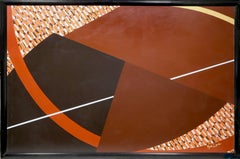
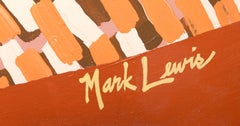
Untitled Geometric Abstraction, an original oil on masonite by Juliette Steele, is a piece for the true collector. Steele's use of color and patterns immediately captivates the viewer, reminding us of works by other pioneer abstractionists, such as Piet Mondrian and Wassily Kandinsky. Steele's puzzle-like, discontinuous sections draw you across and into the work. This masterful original artwork comes with a minimalist frame and would make a great addition to an art collection, enhancing most any home, and perfect for those who have an affinity for abstracts, contemporary paintings, and color-rich works of art. Artist: JULIETTE STEELE (1909-1980) Title: UNTITLED GEOMETRIC ABSTRACTION Medium & Surface: ORIGINAL OIL ON MASONITE (framed) Signed: HAND SIGNED AND DATED BY ARTIST ON VERSO Year Created: CIRCA 1950 Country of Creation: UNITED STATES Image Area Dimensions: 22 x 28 INCHES Frame Dimensions:* 23 x 29 x 1.875 INCHES *This work of art is being sold framed. If you would like to change the frame to better match your style or environment, please contact us for Custom Archival Framing options. Additional Info: HIGHLY COLLECTIBLE WORK BY JULIETTE STEELE IN GREAT CONDITION CONSISTENT WITH AGE. THIS IS AN EXCEPTIONAL EXAMPLE OF THE ARTIST'S STYLE AND TECHNIQUE. THE FRAME IS A MINIMALIST WOOD FRAME WITH VERY MINOR SIGNS OF WEAR CONSISTENT WITH AGE. About the Artist: Juliette Steele, an American artist, was an accomplished printmaker, painter and teacher. Steele was part of the Geometric Abstraction and Abstract Expressionism movements. Her peers included Jackson Pollock, Mark Rothko, Hans Hofmann, Willem de Kooning, Franz Kline, and Clyfford Still. Steele was born in 1909 in Union City, New Jersey. In the late 1920s, she moved to New York to study art and fashion design at the Traphagen School of Design. A decade later, she moved to San Francisco with husband Edward Steele, and earned a Bachelor of Art degree from San Francisco State College. In the 1940s, Steele found inspiration from the new city, and produced a series of lithographs depicting San Francisco landmarks. At the same time, she earned a Master of Fine Arts from Stanford University, and continued her studies at the California School of Fine Arts in San Francisco. Here, she studied with Ray Bertrand and Clay Spohn...
Category

1950s Abstract Geometric Art

Materials

Oil

Lovers Series No. 15

Lovers Series No. 15

By George North Morris

Located in Buffalo, NY

An original oil on canvas painting from the estate of George North Morris from the artist's "Lovers" series. This piece comes in its original wood frame presentation. George North Morris - painter, writer, teacher Born May 13, 1915 in East Liberty, PA Died Oct. 1, 1996 in Hudson, NY Studio locations over the years: varied from Hyannis (MA), Providence (RI), Oglethorp (GA), Montpelier (VT), Yonkers & Westchester Co. (NY) to the later years in Germantown (NY). Subject matter consisted mainly of seascapes and landscapes but in the 60's and 70's he experienced his abstract era. The later years, in fact most of his life was spent in New England and N.Y. state. Most of his more valuable paintings where along the Hudson River and Westchester County. His most frequent methods were oils and water colors, and in the 1940' his artistic expression was through the use of clay. Most of his pottery was made from local Cape Cod (Barnstable) clay which he and his family dug, washed and prepared. He wrote a part of the foreward, called "The Tradition", for a book "A Century and a Half of American Art 1825-1975". Published in 1975 by the "National Academy of Design". He was also an art critic and reporter for the Worcester Telegram and the Provincetown New Beacon. He was a person that felt time was by far better spent talking about and hearing ideas and thoughts. The following are some of his. George Morris's life was that of art and art critic as well as educator. "It was the two summers, 1938 and 1939" recalled Morris, "that I really learned how to paint". Though much of his work showed a strong Edward Hopper influence, at the same time it took many roads. It was, over the years, much too varied to categorize. He started with collage, moved to abstraction, and then to a period during the late 1960s and '70s when he completed what he called his "Lovers Series" - erotic paintings filled with large orchestrated flat color - that show him moving away from abstraction. Upon becoming bored with the concept of abstract painting, he looked for new challenges in pastels, acrylics and water colors, painting once again what he called "the world as it is recognizable by others". George firmly believed that all the best artists are good hucksters, too. Solo exhibitions as a painter were as follows: Columbia-Greene Community College - 1985 Barrett House - 1985 Smith Gallery - 1980, '81, '82 Swansborough Gallery, Wellfleet - 1983 Hopper House, Nyack, NY - 1981 Hudson River Museum, Yonkers Shepherd Gallery...

Category

1970s Abstract Geometric Art

Materials

Canvas, Oil

Geometric Abstract
Geometric Abstract

Geometric Abstract

Located in Buffalo, NY

A mid century modernist oil painting. No signature found. Circa 1960. Image size, 48"L x 32"H

Category

1950s Abstract Geometric Art

Materials

Canvas, Oil

Plaines & Mines, d'Ombre 2024.4, Abstract Geometric Grid Painting on Wood

Plaines & Mines, d'Ombre 2024.4, Abstract Geometric Grid Painting on Wood

By Melisa Taylor Metzger

Located in Quebec, Quebec

In Melisa’s optical and pulsating compositions, the natural world acts as blue-print while she explores the notion of the sublime through blur and precision. The artist develops an a...

Category

2010s Abstract Geometric Art

Materials

Spray Paint, Wood Panel

Magic Rainbow II, Limited Edition Signed Print

Magic Rainbow II, Limited Edition Signed Print

By Yaacov Agam

Located in San Rafael, CA

Yaacov Agam (b. 1928) Magic Rainbow II, late 20th century Screenprint in colors on wove paper LXIII/XC (edition 63/90) Signed and numbered in pencil along lower edge 13 x 15...

Category

Late 20th Century Abstract Geometric Art

Materials

Screen

Utopia #6
Utopia #6

Utopia #6

By Sergio Nates

Located in San Francisco, CA

Sergio Nates Utopia #6, 2014 Acrylic on canvas 21.75 x 21.75 inches This one-of-a-kind acrylic painting on canvas is stretched across wooden stretcher bars.

Category

21st Century and Contemporary Abstract Geometric Art

Materials

Canvas, Acrylic

Multimedia Nature Collage on Canvas

Multimedia Nature Collage on Canvas

By Nancy Pantirer

Located in New York, NY

Nancy Pantirer Untitled Mixed Media on Canvas 50 x 47 in Nancy Pantirer incorporates abstract expressionism and collage into her canvases, letting the properties of paint and paper ...

Category

21st Century and Contemporary Abstract Geometric Art

Materials

Canvas, Acrylic, Laid Paper

Return of the Goddess - Original Painting of Surreal, Symbolic Goddess Figure

Return of the Goddess - Original Painting of Surreal, Symbolic Goddess Figure

By Oliver Hazard Benson

Located in Chicago, IL

As is generally the case with my paintings, this work proceeded from a place of unknowing. The specificity of imagery and technique belie the non-specific character of the ideas and narratives presented. The imagery is not tied to any pre-existent source (textual or other). It is not preconceived by the artist, rather it is produced spontaneously in the process of painting. That said, it seems both easy and sensible to connect the imagery in this painting to common cultural material, especially that from very ancient sources. The central figure is very much like a totemic Neolithic goddess- the sort of which seem to be among the most ancient artistic works, examples are extant from eras stretching back tens of thousands of years. A lot has been written about figures of that kind but of course no one can reasonably claim to truly understand them. Here the great goddess appears with wings and entwined serpents. Crowned also with a glowing orb she has become an emblem of a matristic hermetica. The smaller figure may be less evidently archetypical. She is a younger goddess, a daughter like Persephone to Demeter. She lifts the breasts of her mother signifying perhaps how the presence of the child evokes the nurturing qualities of the mother or how Persephone’s seasonal ascent from the underworld awakens in her mother the impulse to again give life to the world. The cluster of gynomorphic figures contained by the crescent moon at the center of the painting refer to the balanced transformations of the lunar cycle and their mysteriously harmonic physical manifestation in the vital cycles of a woman’s body. At their axis is the cycloptical abdomen of the figure enthroned on the moon. The entire totem rises from a terrestrial gateway into an open landscape. In the background megaliths obscure the horizon. They represent a first boundary in time- the beginning of history. Below is the gateway, the opening to an inner earth...

Category

21st Century and Contemporary Abstract Geometric Art

Materials

Acrylic, Panel

R.S.P. (Perspective Space Search)

R.S.P. (Perspective Space Search)

By Paolo Minoli

Located in Como, IT

Paolo Minoli (1942-2004) R.S.P. (Perspective Space Search) 1969 Acrylic on Canvas Size 40x40 cm (63x63 cm including the frame with invisible glass) Bibliography: Pirovano, Paolo Minoli, General Catalog, volume 1, 1959-1979 Paolo Minoli was born in 1942 in Cantù (Como). He attended, at a very young age, the home of painter Enrico Sottili and, as a student, the studio of sculptor Gaetano Negri. He graduated "Master of Art" in 1961 from the State Art Institute of Cantù, where he taught from 1964 to 1978. Participated in 1968 in the national exhibition for young painters of the "San Fedele" prize in Milan. In 1969 he was featured in the exhibition "Urban Field. Aesthetic Interventions in the Urban Dimension," organized in Como, with a collective intervention on the theme "Signal Color." From 1977 to 1978 he was part of the research group "The Systematic Questioning" with Nato Frascà and Antonio Scaccabarozzi. Since 1979, at the Brera Academy of Fine Arts in Milan, he has taught the special course in "Chromatology" and collaborated, as a consultant, with companies for the application of chromatic solutions in industrial production. He was artistic director of the art series published by the "RS" editions in Como (1975-1986) and, from 1986 to 1989, of the "On Color" silkscreen printing workshop in Cantù, in collaboration with various artists, including Mario Radice, Carla Badiali...

Category

1960s Abstract Geometric Art

Materials

Canvas, Acrylic Polymer

SUNBLOC
SUNBLOC

SUNBLOC

By Robert Petrick

Located in Los Angeles, CA

Robert Petrick's paintings connect the lyricism of language with the vibrancy of urban culture, especially the rich milieu around the East Village and Alphabet City. Rendered in colo...

Category

2010s Abstract Geometric Art

Materials

Acrylic

Rhythm: Abstract Geometric Photography on Canvas

Rhythm: Abstract Geometric Photography on Canvas

By Wesden Studio

Located in Miami, FL

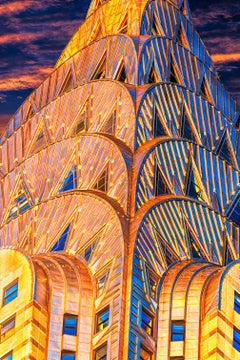
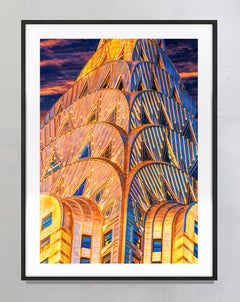
A study in light, geometry, and repetition. Rhythm transforms an architectural façade into an abstract composition of texture and shadow. The warm glow of the setting sun softens the...

Category

2010s Abstract Geometric Art

Materials

Cotton Canvas

Sonia Delaunay - Composition - Original Lithograph

Sonia Delaunay - Composition - Original Lithograph

By Sonia Delaunay

Located in Collonge Bellerive, Geneve, CH

Sonia Delaunay - Composition Original Lithograph 1969 Dimensions: 32 x 25 cm Revue XXe Siècle Cahiers d'art published under the direction of G. di San Lazzaro. Sonia Delaunay was known for her vivid use of color and her bold, abstract patterns, breaking down traditional distinctions between the fine and applied arts as an artist, designer and printmaker. Born Sarah Stern on November 14, 1885 in Gradizhsk, Ukraine, she was adopted in 1890 by her maternal uncle, Henri Terk, a lawyer in St. Petersburg, where she grew up, exposed to music and art, and learning several foreign languages. In 1903, she moved to Germany to study drawing with Ludwig Schmidt-Reutler (1863–1909) at the Karlsruhe academy of fine arts; Arnold Schoenberg (1874–1951), composer-to-be, was among her classmates there. In 1905, she traveled to Paris where she attended art classes at the Académie de la Palette, learned printmaking from Rudolf Grossman (1889–1941), and met Amédée Ozenfant (1886–1966), André Dunoyer de Segonzac (1884–1974), and Jean-Louis Boussingault (1883–1943). Sonia spent much of her time at exhibitions and galleries in Paris, which showed works by Paul Cézanne, Vincent Van Gogh, Pierre Bonnard, and Edouard Vuillard, as well as Les Fauves, Henri Matisse and André Derain. She did, however, maintain contact with Germany, exhibiting at the Galerie Der Sturm, Berlin, in 1913, 1920 and 1921. During her first year in Paris, Sonia met the German collector and art-dealer, Wilhelm Uhde (1874–1947), whom she married on December 5, 1908, and whose Montparnasse gallery, the Galerie Notre-Dame des Champs, showed her first solo exhibition. Through Uhde, Sonia encountered many painters, including Pablo Picasso, Georges Braque, Maurice de Vlaminck, and Robert Delaunay (1885–1941). In 1910, Sonia divorced Uhde by mutual agreement, married Delaunay that same year, and gave birth to their son, Charles, in January 1911. Together Sonia and Robert Delaunay pursued the study of color, influenced by theories of Michel-Eugène Chevreul (1786–1889). Sonia’s interest in simultaneous contrast, as evidenced in her early collages, book bindings, small painted boxes, cushions, waistcoats and lampshades, led to one of her first large-scale works, the painting of the Bal Bullier (1912–1913), a popular Parisian dance-hall. Sonia’s first “simultaneous dresses,” a mix of squares and triangles of taffeta, tulle, flannelette, moiré, and corded silk, date from this period. Friendship with the poet Blaise Cendrars...

Category

1970s Abstract Geometric Art

Materials

Lithograph

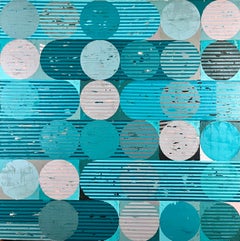
Circle, Pastel colors

Circle, Pastel colors

By Domenick Capobianco

Located in New York, NY

Super attractive geometric abstraction in a rare to find pastel color palette. Circles is a striking and impactful large-format painting created in the 1960s by Domenick Capobianco. ...

Category

1970s Abstract Geometric Art

Materials

Oil

Cascadia 9 (grid painting abstract wood contemporary vivid colors optical art)

Cascadia 9 (grid painting abstract wood contemporary vivid colors optical art)

By Melisa Taylor Metzger

Located in Quebec, Quebec

In Melisa’s optical and pulsating compositions, the natural world acts as blue-print while she explores the notion of the sublime through blur and precision. The artist develops an a...

Category

2010s Abstract Geometric Art

Materials

Spray Paint, Wood Panel

Erebos

Gerd LeufertErebos, 1991

$2,700Sale Price|40% Off

Erebos

Located in Miami, FL

Gerd Leufert Title: Erebos Signed, titled, dated ‘91 and inscribed P/A in pencil (lower center) Screenprint on paper 23⅝ by 22⅜ in. / 60 by 56.8 cm. Executed in 1991, this work is an artist’s proof from an edition of 35 plus 1 artist’s proof. Provenance: Private Collection, Venezuela - Acquired from the above by the present owner - Sotheby's Auction “The first duty of the creator: restlessness,” Gerd Leufert wrote in 1985, looking back on his 30-year career as an artist, designer, museum worker, and professor of art in Venezuela.1 Bridging the worlds of commerce and culture in Caracas, Leufert’s impact on art and design owed to his interdisciplinary approach: the influence of cutting-edge developments in abstract art appeared in his graphic design, while the efficiency and bold contrast of mid-century design characterized his paintings. An immigrant born in German-controlled Lithuania at the cusp of the first World War, Leufert studied arts and design in Hannover, Mainz, and, finally, in Munich with the German typographer Fritz H...

Category

1990s Abstract Geometric Art

Materials

Screen

Hedge Fun - Brickell Key - Street Art from the Affluent

Hedge Fun - Brickell Key - Street Art from the Affluent

By Robert Funk

Located in Miami, FL

Robert Funk’s photographs of elaborate landscaping redefine what Street Art is. Hedge Fun is a series that celebrates the landscaping commissioned by well-heeled homeowners, high-en...

Category

2010s Abstract Geometric Art

Materials

Inkjet, Archival Ink, Archival Paper, Archival Pigment

Untitled #5 Large Archival Pigment Print, Abstract Geometric, Unframed

Untitled #5 Large Archival Pigment Print, Abstract Geometric, Unframed

By Michael G Jackson

Located in London, GB

This artwork explores the delicate interplay between light and shadow, creating a harmonious balance of geometric forms. #Modern eclipse #serenade in #crimson #transcendent #forms #...

Category

2010s Abstract Geometric Art

Materials

Photographic Paper, Color, Photogram, Archival Pigment

Iris Crystals Wall Sculpture, blue Abstract Geometric, Wood, Signed back

Iris Crystals Wall Sculpture, blue Abstract Geometric, Wood, Signed back

By Chloe Hedden

Located in Quebec, Quebec

“Iris Crystals” is a rich blue colored wall sculpture made out of solid koa wood and then painted and sealed with a UV matte sealer. The geometric facets are hand carved and add intr...

Category

2010s Abstract Geometric Art

Materials

Wood, Spray Paint, Vinyl

"Crescent Rose" Mixed Media Handmade Paper Watercolor Abstract by Bruce Weinberg

"Crescent Rose" Mixed Media Handmade Paper Watercolor Abstract by Bruce Weinberg

By Bruce Weinberg

Located in Soquel, CA

"Crescent Rose" Mixed Media Handmade Paper Watercolor Abstract by Bruce Weinberg Soft lavenders, magentas and gray tones highlighted with purple thread and sheets of gold leaf mingle to create a soft and lovely abstract on handmade paper by California artist Bruce Weinberg (American, 1942-1994). Image is floated on a silk background. Pencil signed and dated "Bruce Weinberg 1980" lower right. Pencil signed title "Crescent Rose" lower left. Displayed in a giltwood frame with spacer. Image size: 24"H x 35"L. Framed size: 31"H x 43"W x 2"D. Bruce Weinberg was a long time resident of the San Francisco Bay Area. He studied Interior Design at the Philadelphia College of Art and Architectural Space Planning at Temple University. During the 1970s he studied printmaking and drawing at San Francisco's Fort Mason...

Category

1980s Abstract Geometric Art

Materials

Mixed Media, Handmade Paper

"Colorful Geometric Abstraction, " Simon Samsonian, Armenian Artist

"Colorful Geometric Abstraction, " Simon Samsonian, Armenian Artist

By Simon Samsonian

Located in New York, NY

Simon Samsonian (1912 - 2003) Colorful Geometric Abstraction, 1981 Oil on paper 16 x 22 inches Signed and dated lower right Provenance: Estate of the artist This survivor of the Armenian genocide wound up in a Cairo orphanage in 1927. He rose to fame as one of Egypt’s great modernists, but after moving to Long Island late in life he withdrew into anonymity. Now his compelling story is being told. Art historians are finally beginning to realize that the power of abstraction in its early years was a zeitgeist not limited to the major European centers of the avant-garde — Paris, Munich, and Moscow — but one that quickly rippled to major cities throughout the world. Within a few decades that original shock of a new vision had inspired thousands of artists from different cultures — particularly those the Middle East — whose translations were not slavish imitations of works by seminal figures like Picasso, Braque, Malevich, and Kandinsky but creative variants colored by their respective cultures. This essay focuses on an extraordinary Armenian artist, his harrowing survival of the genocide, his rise to fame in Cairo, and his creation of a unique style of abstraction. Art historians have typically formed a chorus that teaches the history of abstraction like this: Just before and during the World War I era, several avant-garde artists emerged to create shockingly different new forms by which artists could express themselves. In Paris, Picasso and Braque broke out with cubism, quickly followed by Mondrian. In Moscow, Malevich created Suprematism, the ultimate hard-edge geometric abstraction. And in Munich, Kandinsky emerged as the father of Abstract Expressionism. Within these few short years a zeitgeist was sensed throughout the art world. American pioneers, too — particularly Stanton Macdonald-Wright and Morgan Russell — felt this explosive freedom of expression. When Europe was recovering after World War I it became clear that Paris would retain its title as capitol of the art world, lasting through the Roaring Twenties and even through the Great Depression. But the end of World War II changed everything. A parallel war had been won by a group of irascible young Abstract Expressionists in New York — led by Pollock, Rothko, DeKooning, and Kline. No sooner had Paris been liberated from the Germans than Picasso, Matisse, Breton, and Duchamp surrendered to the Americans. From that point on New York would be the epicenter of the art world. But a lens that focuses myopically on the war between the avant-garde of Paris and New York misses the wider narrative of multiple aesthetic modernities that developed in the several decades following World War I. For Armenian artists the matter is even more complex owing to the genocide of 1915 where more than 1.5 million people — seventy-five percent of Armenians in the Ottoman Empire — were massacred. Those not shot on the spot were sent on death marches through the Mesopotamian desert without food or water. Frequently, the marchers were stripped and forced to walk naked under the scorching sun until they dropped dead. As a child Samsonian witnessed the murder of his parents and most of the members of his family. Soon thereafter, his older sister, Anahid, quickly shepherded him into a line of children being rescued by Greek nuns. But they became separated and he lost her, too. He was sent to a Greek orphanage in Smyrna (now Izmir), on Turkey’s west coast. Because he only knew his first name, the orphanage gave him a last name based on the place where they found him — Samsun — a major port on Turkey’s north coast on the Black Sea. His birth date was unknown, too. According to Samsonian’s vague recollections he assumed he was about three or four years old at the onset of the genocide, which would place his birth year in 1911 or 1912. In 1922, when Samsonian was about 10, the Turks ended their war with the Greeks by putting Smyrna to the torch in what has been called the “Catastrophe of Smyrna.” Once again, the child was on the run, escaping the fire and slaughter. He found temporary refuge in Constantinople, but within a year that major port would fall to the Turks, too, and become renamed as Istanbul. This time, Samsonian was whisked away to an orphanage in Greece founded by the American charity, Near East Relief — which is credited with saving so many Armenian orphans that the American historian Howard M. Sachar said it “quite literally kept an entire nation alive. Any understanding of Samsonian’s approach to modernism requires careful consideration of the impact of his early years because his art is inseparable from the anguish he experienced. In 1927, when he was a teenager, he was transferred to Cairo, Egypt, then a cosmopolitan city hosting a sizable portion of the Armenian diaspora. There he lived with thirty-two other children on the top floor of the Kalousdian Armenian School. Upon graduating in 1932 he won a scholarship to attend the Leonardo da Vinci Art Institute — an Italian art school in Cairo — where he won first prize in final examinations among one hundred students. He found work with an Armenian lithographic printer and he returned to the Kalousdian Armenian School to teach drawing. In 1939 he married one of his students, Lucy Guendimian. The Cairo in which Samsonian matured as an artist was home to many prominent art collectors after World War I. In this receptive environment Samsonian exhibited widely and won many awards. Beginning in 1937 and for the next thirty years he exhibited annually at the prestigious Le Salon du Caire hosted by the Société les Amis de l’Art (founded in 1921). After World War II he hit his stride as a modernist in Cairo, counting among his peers other artists of the Armenian diaspora such as Onnig Avedissian, Achod Zorian, Gregoire Meguerdichian, Hagop Hagopian...

Category

1980s Abstract Geometric Art

Materials

Paper, Oil

Wall Stack IV : contemporary modern geometric sculpture

Wall Stack IV : contemporary modern geometric sculpture

By Greg Chann

Located in New York, NY

Greg Chann creates contemporary modern abstract geometric sculptures. His constructions are complex interwoven systems of physical elements varying in size, material, and color. Thes...

Category

2010s Abstract Geometric Art

Materials

Acrylic

Untitled
Untitled

Untitled

By George Rickey

Located in New York, NY

Lithograph on white Arches Cover paper. One of 5 artist's proofs, aside from an edition of 35. Signed by the artist, dated and numbered, in Roman numerals, V/V in pencil, lower rig...

Category

1970s Abstract Geometric Art

Materials

Lithograph

"Untitled, " Seymour Fogel, Geometric Abstraction, Texas Hard-Edge

"Untitled, " Seymour Fogel, Geometric Abstraction, Texas Hard-Edge

By Seymour Fogel

Located in New York, NY

Seymour Fogel Untitled Oil on illustration board construction 10 x 7 1/2 inches Provenance: Estate of the artist Charles and Faith McCracken Larry and Trish Heichel Private Collection Seymour Fogel was born in New York City on August 24, 1911. He studied at the Art Students League and at the National Academy of Design under George Bridgeman and Leon Kroll. When his formal studies were concluded in the early 1930s he served as an assistant to Diego Rivera who was then at work on his controversial Rockefeller Center mural. It was from Rivera that he learned the art of mural painting. Fogel was awarded several mural commissions during the 1930s by both the Works Progress Administration (WPA) and the Treasury Section of Fine Arts, among them his earliest murals at the Abraham Lincoln High School in Brooklyn, New York in 1936, a mural in the WPA Building at the 1939-1940 New York World's Fair, a highly controversial mural at the U.S. Post Office in Safford, Arizona (due to his focus on Apache culture) in 1941 and two murals in what was then the Social Security Building in Washington, D.C., also in 1941. Fogel's artistic circle at this time included Phillip Guston, Ben Shahn, Franz Kline, Rockwell Kent and Willem de Kooning. In 1946 Fogel accepted a teaching position at the University of Texas at Austin and became one of the founding artists of the Texas Modernist Movement. At this time he began to devote himself solely to abstract, non-representational art and executed what many consider to be the very first abstract mural in the State of Texas at the American National Bank in Austin in 1953. He pioneered the use of Ethyl Silicate as a mural medium. Other murals and public works of art done during this time (the late 1940s and 1950s) include the Baptist Student Center at the University of Texas (1949), the Petroleum Club in Houston (1951) and the First Christian Church, also in Houston (1956), whose innovative use of stained glass panels incorporated into the mural won Fogel a Silver Medal from the Architectural League of New York in 1958. Fogel relocated to the Connecticut-New York area in 1959. He continued the Abstract Expressionism he had begun exploring in Texas, and began experimenting with various texturing media for his paintings, the most enduring of which was sand. In 1966 he was awarded a mural at the U.S. Federal Building in Fort Worth, Texas. The work, entitled "The Challenge of Space", was a milestone in his artistic career and ushered in what has been termed the Transcendental/Atavistic period of his art, a style he pursued up to his death in 1984. Painted and raw wood sculpture...

Category

Mid-20th Century Abstract Geometric Art

Materials

Oil, Board

Cascadia 1 (grid painting abstract wood round circular panel contemporary art)

Cascadia 1 (grid painting abstract wood round circular panel contemporary art)

By Melisa Taylor Metzger

Located in Quebec, Quebec

Melisa Taylor Metzger’s The Seismology of Cantilevered Hearts 1 transforms a circular tondo plywood panel into a multichromatic composition that blends traditional crafting technique...

Category

2010s Abstract Geometric Art

Materials

Spray Paint, Wood Panel

154 Squares V.4 - Modern Colorful Abstract Geometric Squares Acrylic Painting

154 Squares V.4 - Modern Colorful Abstract Geometric Squares Acrylic Painting

By Brandon Neher

Located in Los Angeles, CA

Brandon Neher is a California artist whose original paintings embody a profound exploration of space, structure, and balance, infused with a touch of modern minimalism. Drawing inspi...

Category

21st Century and Contemporary Abstract Geometric Art

Materials

Wood, Mixed Media, Acrylic

Record, Blair Tate, Geometric woven textile wall sculpture

Record, Blair Tate, Geometric woven textile wall sculpture

By Blair Tate

Located in Wilton, CT

Record, woven linen, cotton cord, 102" x 27", 2020. This abstract, geometric woven textile wall sculpture is by contemporary American fiber artist, Blair Tate. "In weaving there i...

Category

2010s Abstract Geometric Art

Materials

Fabric, Textile, Tapestry, Cotton, Linen

Rift Valley, sonde 2 (texture copper bronze gold emerald green abstract wine red

Rift Valley, sonde 2 (texture copper bronze gold emerald green abstract wine red

By Melisa Taylor Metzger

Located in Quebec, Quebec

"Rift Valley, Sonde 2" is a textural and elemental abstract painting on canvas. It explores the hybridization of chance-derived color-fields with textural topography. Various techniq...

Category

2010s Abstract Geometric Art

Materials

Acrylic Polymer, Found Objects, Oil, Acrylic

Abstract Geometric art for sale on 1stDibs.

Find a wide variety of authentic Abstract Geometric art available for sale on 1stDibs. Works in this style were very popular during the 21st Century and Contemporary, but contemporary artists have continued to produce works inspired by this movement. If you’re looking to add art created in this style to introduce contrast in an otherwise neutral space in your home, the works available on 1stDibs include elements of blue, purple, orange, red and other colors. Many Pop art paintings were created by popular artists on 1stDibs, including Mitchell Funk, Josef Albers, Mauro Oliveira, and Claudia Fauth. Frequently made by artists working with Paint, and Synthetic Resin Paint and other materials, all of these pieces for sale are unique and have attracted attention over the years. Not every interior allows for large Abstract Geometric art, so small editions measuring 0.04 inches across are also available.