Cubist Art

1,885 Results
CUBIST STYLE

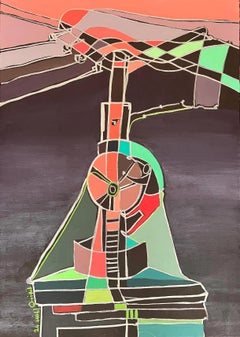
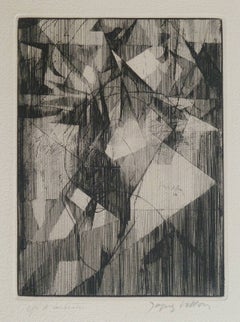
Inspired by the nontraditional ways Postimpressionists like Paul Cézanne and Georges Seurat depicted the world, Pablo Picasso and Georges Braque pioneered an even more abstract style in which reality was fragmented into flat, geometric forms. Cubism majorly influenced 20th-century Western art as it radically broke with the adherence to composition and linear perspectives that dated back to the Renaissance. Its watershed moments are considered Picasso’s 1907 Les Demoiselles d’Avignon, in which nude figures are fractured into angular shapes, and Georges Braque’s 1908 painting show, which prompted a critic to describe his visual reductions as “cubes.”

Although Cubism was a revolutionary art movement for European culture, it was informed by African masks and other tribal art. Its artists, which included Fernand Léger, Alexander Archipenko, Marcel Duchamp, Juan Gris and Jean Metzinger, experimented with compressing space and playing with the tension between solid and void forms in their work. While their subjects were often conventional, such as still lifes, nudes and landscapes, they were distorted without any illusion of realism.

Cubist art evolved through different distinct phases. In Analytic Cubism, from 1908 to 1912, figures or objects were “analyzed” into pieces that were reassembled in paintings and sculptures, as if presenting the same subject matter from many perspectives at once. The palette was usually monochromatic and muted, giving attention to the overlapping planes. Synthetic Cubism, dating from 1912 to 1914, moved to brighter colors and a further flattening of images. This unmooring from formal ideas of art would shape numerous styles that followed, from Dada to Surrealism.

Find a collection of authentic Cubist paintings, prints and multiples, sculptures and more art on 1stDibs.

to
691
813
361
460
212
163
Overall Width
to
Overall Height
to
3
1,536
494
5
34
52
114
148
308
227
119
63
43
119,510
64,241
57,677
29,682
14,514
9,836
6,939
6,533
4,288
3,241
2,518
2,234
2,008
585
750
534
411
280
259
240
159
120
78
59
51
37
30
28
27
27
24
24
23
23
1,217
778

Use search to find more

182
92
65
65
27

Use search to find more

Style: Cubist
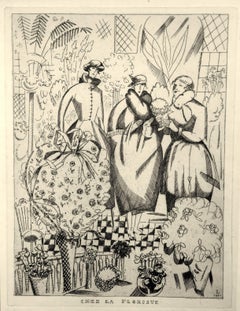
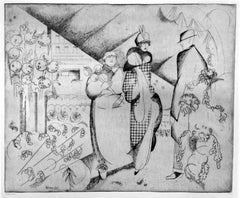
Chez la Fleuriste

Chez la Fleuriste

By Jean-Emile Laboureur

Located in New York, NY

Jean-Emile Laboureur (1877-1943), Chez la Fleuriste, etching, 1919-1920, unsigned [with initials and date in the plate]. Reference: Laboureur 192, second state (of 2), from the editi...

Category

1910s Cubist Art

Materials

Etching

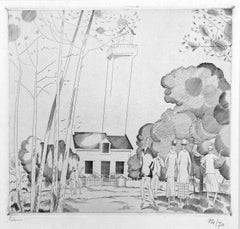
Le Promenade au Phare

Le Promenade au Phare

By Jean-Emile Laboureur

Located in New York, NY

Jean-Emile Laboureur (1877-1943), Le Promenade au Phare, engraving, 1925, signed in pencil lower left and numbered lower right (24/70) [with the initial in the plate lower left]. Ref...

Category

1920s Cubist Art

Materials

Engraving

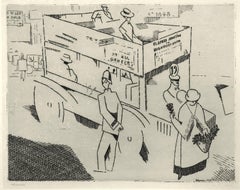
Le Policeman, Londres

Le Policeman, Londres

By Jean-Emile Laboureur

Located in New York, NY

Jean-Emile Laboureur (1877-1943), Le Policeman, Londres, 1913, etching on zinc. Signed lower left in pencil [also with the signature and date in the plate]. Reference: Godefroy, Sylv...

Category

1910s Cubist Art

Materials

Etching

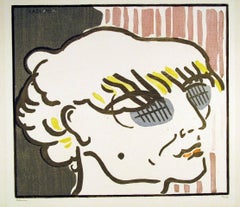
Lassitude

Lassitude

By Jean-Emile Laboureur

Located in New York, NY

Jean-Emile Laboureur, Lassitude, 1912, woodcut, signed and numbered (24/35) in pencil. Reference: Sylvain Laboureur 682, third state (of 3). From the edition of about 35, published b...

Category

1910s Cubist Art

Materials

Woodcut

At the Table #6, Painting, Acrylic on Canvas

At the Table #6, Painting, Acrylic on Canvas

By Sharon Webb

Located in Yardley, PA

I have painted around the edges of the canvas should you decide to hang this work unframed. :: Painting :: Cubism :: This piece comes with an official certificate of authenticity sig...

Category

2010s Cubist Art

Materials

Acrylic

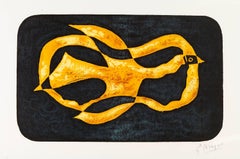
After Georges Braque - Antiborée - Lithograph

After Georges Braque - Antiborée - Lithograph

Located in Collonge Bellerive, Geneve, CH

Lithograph after Georges Braque. Signed in the plate Edition of 150 Dimensions: 76 x 117 cm Bibliography: « Les Métamorphoses de Braque» of Heger de Loewenfeld and Raphaël de Cuttoli , Editions FAC, Paris, 1989. In 1961 Georges Braque decided with his laidary friend Heger de Loewenfeld to pick up certain of his works to in order to create artworks, this beautiful litograph is one of them. Héméra in the Mythology: In Greek mythology Hemera was the personification of day and one of the Greek primordial deities. She is the goddess of the daytime and, according to Hesiod, the daughter of Erebus and Nyx (the goddess of night). Hemera is remarked upon in Cicero's De Natura Deorum, where it is logically determined that Dies (Hemera) must be a god, if Uranus is a god. The poet Bacchylides states that Nyx and Chronos are the parents, but Hyginus in his preface to the Fabulae mentions Chaos as the mother/father and Nyx as her sister. She was the female counterpart of her brother and consort, Aether (Light), but neither of them figured actively in myth or cult. Hyginus lists their children as Uranus, Gaia, and Thalassa (the primordial sea goddess), while Hesiod only lists Thalassa as their child. The father of Cubism Three Cubist that distinguishes art historian periods were initiated and developed by Georges Braque: The Cubist Cézanne (1907-1909), Executive (1909-1912) and synthetic (1912-1922). Post-Impressionist and fawn, Braque no longer adheres to the contingency of a decorative way or the other. Cézanne’s paintings exhibited at the Grand Palais during the retrospective of 1907 are a revelation: Cézanne sought and invented a pictorial language. In his footsteps, Braque went to the South with the reasons of the Master. He returned with Estaque landscapes and surprising Ciotat it keeps Cezanne geometric model and retains the “passages” continuity from one surface to another to create the sensation of “turning around” of the object represented. But he wants to go after the consequences of the vision of Cezanne. In his paintings Houses in L’Estaque (1908) it simplifies the volumes of houses, neglects detail by removing doors and windows: the plastic rhythm that builds the table. Large Nude , a masterpiece of the period, can be considered the first work of Cézanne cubism . Systematizing and deepening Braque discoveries open the door analytical cubism. In 1909, his painting became more cerebral than sensual. The pattern is recreated in the two-dimensionality of the canvas, leaving aside any illusionistic perspective. In Still Life with Violin, objects are analyzed facets according to their characteristic elements, each facet referring to a particular view of the object. There are so many facets of points selected view: Table reflects the knowledge of the object and the ubiquity of the eye. Moreover, Braque is looking for the essence of the objects in the world rather than their contingency, which explains the absence of light source and use of muted colors (gray, ocher), contingent aspects of the object . But formal logic has stepped facets, erased any anecdote to the object and ultimately led to his painting a hermetic more marked on the edge of abstraction (see the series of Castle Roche-Guyon ). Braque, anxious to keep the concrete and refusing at all costs that the logic of Cubism takes the paintings to abstract, reintroduced signs of reality in his paintings in 1912 marks the beginning of Synthetic Cubism. Historians speak of “signs of real” rather than reality because what interests Braque, this is not to put reality into a table, but to create a painting which, by its language, refers to the real. To do this, he invented two major techniques XX th century inclusions and contributions. The inclusions consist of painting objects that have no real depth, materials (wallpaper in Nature morte aux playing cards faux wood is a pictorial inclusion) or letters (calligraphic inclusion in Portuguese ), made first brush and a few months later stencil. Contributions are defined in contrast with the collage on canvas of foreign materials: glued or sand paper, sawdust, etc.. Regarding the collages, Braque used for the first time in September 1912 a piece of adhesive paper imitating faux wood Compote...

Category

1950s Cubist Art

Materials

Lithograph

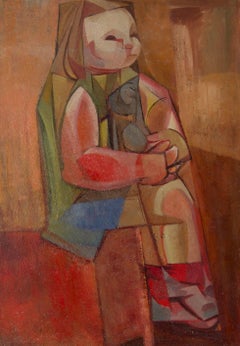
Abstract Cubist Girl on Chair - Mid 20th Century Oil by Dennis Henry Osborne

Abstract Cubist Girl on Chair - Mid 20th Century Oil by Dennis Henry Osborne

By Dennis Henry Osborne

Located in Watford, Hertfordshire

Osborne was born in Portsmouth, England in 1919 and died in 2016. He served in WW2 with the Royal Artillery and was a prisoner of war in Italy and Germany for over three years. After the war he pursued his art studies with a grant from the London County Council, and studied at the Camberwell School of Arts and Crafts. After Camberwell, it was his affinity for Irish landscape that brought him in 1950 to live in Donegal, Ireland. In this year he exhibited in the Royal Academy. In 1952 he emigrated to Ontario, Canada with his first wife the late artist Jean Osborne, a protegy of Paul Nietsche...

Category

1960s Cubist Art
Materials

Canvas, Oil

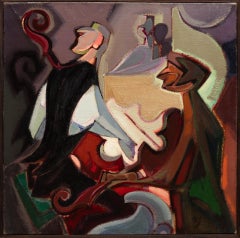
Homme Rêvant, Painting, Oil on Canvas

Homme Rêvant, Painting, Oil on Canvas

By Valerie Vescovi

Located in Yardley, PA

From my man dreaming ongoing series, I sometimes need to revisit certain themes. Themes that were inspired by my life experiences and characters that have come and gone or passed thr...

Category

21st Century and Contemporary Cubist Art

Materials

Oil

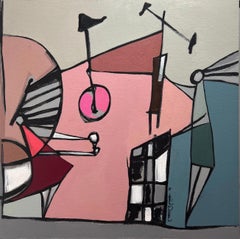
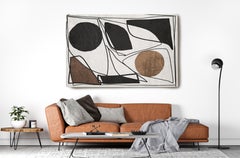
Midcentury Organic Shapes and Lines N-10-103 Mixed Media Canvas Painting 40x60"

Midcentury Organic Shapes and Lines N-10-103 Mixed Media Canvas Painting 40x60"

By Irena Orlov

Located in Los Angeles, CA

One of a kind Mixed Medium on Canvas Artwork: Original abstract mixed media work on canvas, which combines new media - digital original hand painting, printed on canvas, then hand p...

Category

2010s Cubist Art

Materials

Canvas, Varnish, Archival Ink, Mixed Media, Acrylic

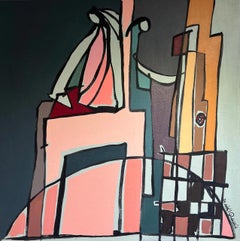
"Hold on to the Moment" Figurative Painting 24" x 24" inch by Tasneem El-Meshad

"Hold on to the Moment" Figurative Painting 24" x 24" inch by Tasneem El-Meshad

By Tasneem El Meshad

Located in Culver City, CA

"Hold on to the Moment" Figurative Painting 24" x 24" inch by Tasneem El-Meshad Acrylic on Canvas Academy of Fine Arts Cairo graduate Tasneem El Meshad describes her art, as “a ref...

Category

21st Century and Contemporary Cubist Art

Materials

Canvas, Acrylic

Roundism – 04-02-22, Painting, Oil on Other

Roundism – 04-02-22, Painting, Oil on Other

By Corne Akkers

Located in Yardley, PA

Something New This roundism oil painting is quite different from the last roundistic one, called ‘Singularity – 23-12-21’. Whereas the latter was all about the use of shiny ...

Category

21st Century and Contemporary Cubist Art

Materials

Oil

Zexquis et Zelda, Painting, Acrylic on Canvas

Zexquis et Zelda, Painting, Acrylic on Canvas

By Luc Villard 1

Located in Yardley, PA

Je peins ces bestioles depuis plus de dix ans. En cette année 2024, j'ai cherché a leur donner un nouveau souffle de vie. Leur côté minimaliste est accentué, sans pour autant qu...

Category

2010s Cubist Art

Materials

Acrylic

The Dance
The Dance

The Dance

By Georges Braque

Located in London, GB

GEORGES BRAQUE 1882-1963 Argenteuil-sur-Seine, 1882-1963 Paris Title: The Dance, 1934 Technique: Original Hand Signed Etching with Aquatint on paper Paper...

Category

1930s Cubist Art

Materials

Etching

In Between the Shadows 1, Framed Cubist Black-and-White Giclee Print

In Between the Shadows 1, Framed Cubist Black-and-White Giclee Print

By Sander Vos

Located in London, GB

The series ‘In Between the Shadows’ consists of structural and geometric photographs that take their inspiration from the cubist movement. The works aim to challenge the conventional perception of depth within the medium of photography by showing different viewpoints at the same time and within the same space. The chiaroscuro lighting embraces shadows and light as juxta- positional tools to deconstruct familiar objects and transform them into surreal compositions. Sander Vos...

Category

2010s Cubist Art

Materials

Photographic Paper, Black and White, Archival Pigment

Concert Champêtre – Pastoral Concert in a Soft Cubist Palette, Acrylic on Canvas

Concert Champêtre – Pastoral Concert in a Soft Cubist Palette, Acrylic on Canvas

By Grégoire Mathias

Located in PÉRIGUEUX, FR

Concert Champêtre (Pastoral Concert) 54 x 73 cm Acrylic on canvas Description: "Concert Champêtre" immerses the viewer in a serene yet vibrant scene, embodying Grégoire Mathias's ha...

Category

21st Century and Contemporary Cubist Art

Materials

Canvas, Acrylic

Cubist Mediterranean Coastal Landscape, Greece, Red and Blue, Acrylic on Canvas

Cubist Mediterranean Coastal Landscape, Greece, Red and Blue, Acrylic on Canvas

By Grégoire Mathias

Located in PÉRIGUEUX, FR

Après Midi en Grèce I (An Afternoon in Greece) Acrylic on canvas 46 x 38 cm Après-Midi en Grèce I presents a diachronic cubist interpretation of a Greek coastal afternoon, capturing...

Category

21st Century and Contemporary Cubist Art

Materials

Canvas, Acrylic

Portrait d’un Jeune Philosophe – Modern Cubist Abstract Figurative Portrait

Portrait d’un Jeune Philosophe – Modern Cubist Abstract Figurative Portrait

By Grégoire Mathias

Located in PÉRIGUEUX, FR

Portrait d'un Jeune Philosophe (Portrait of a Young Philosopher) 55 x 38 cm Acrylic on canvas Signed lower right Framed This expressive portrait captures a young man fragmented into overlapping profiles, planes, and architectural forms. Rendered in Mathias’s Diachronic Cubism, the figure appears at multiple moments of thought simultaneously—looking, reflecting, withdrawing—suggesting an inner dialogue rather than a fixed identity. Cool blues and greys dominate the composition, offset by warm ochres and muted greens that structure the space like a cityscape of ideas. The repeated faces and directional lines evoke both introspection and intellectual tension, reinforcing the title’s reference to philosophy as an active, layered process rather than a static pose. The composition balances human presence with abstract geometry, blurring the boundary between mind and environment. This creates a sense of movement in time: the same subject perceived across successive instants of contemplation. Collector’s Insight: This work exemplifies Mathias’s ability to merge portraiture with temporal fragmentation. Rather than depicting a likeness, he constructs a psychological landscape—ideal for collectors drawn to modern figurative abstraction with conceptual depth. The vertical format enhances its architectural rhythm and makes it particularly striking in intimate or transitional spaces. Perfect For: Collectors: – Figurative abstraction with intellectual or philosophical themes – Contemporary European cubist lineage Interior Designers & Decorators: – Studies, libraries, offices, or reading corners – Modern, contemporary, or intellectually curated interiors – Vertical wall art...

Category

2010s Cubist Art

Materials

Acrylic, Canvas

"Cheval 361" by Grégoire Mathias – Lascaux-Inspired Cubist Horse Painting

"Cheval 361" by Grégoire Mathias – Lascaux-Inspired Cubist Horse Painting

By Grégoire Mathias

Located in PÉRIGUEUX, FR

Cheval 361 Acrylic on Canvas 73 x 93 cm Cheval 361 is the inaugural piece in Grégoire Mathias’s celebrated series inspired by the Lascaux Horses, the prehistoric cave paintings of P...

Category

21st Century and Contemporary Cubist Art
Materials

Canvas, Acrylic

URBAN SYNTAX, Painting, Acrylic on Canvas

URBAN SYNTAX, Painting, Acrylic on Canvas

By Darlene Watson

Located in Yardley, PA

Urban Syntax drifts between graffiti and form, where the suggestion of a dress and hat moves through the city like a quiet presence. Lines, patterns, and marks gather and release, ec...

Category

2010s Cubist Art
Materials

Acrylic

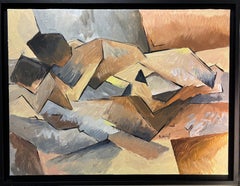
Oil Abstract Cubist Painting
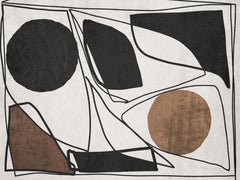

Oil Abstract Cubist Painting

Located in Fredericksburg, VA

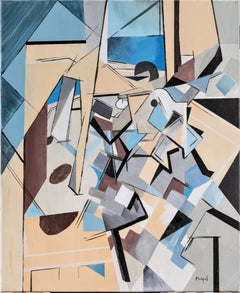
This cool-colored cubist painting by Edmund E. Niemann is a captivating exploration of form and color, embodying the essence of the Cubist movement. Through his unique artistic visio...

Category

Mid-20th Century Cubist Art

Materials

Canvas, Oil

Neo Deco – 12-01-25, Drawing, Pastels on Paper

Neo Deco – 12-01-25, Drawing, Pastels on Paper

By Corne Akkers

Located in Yardley, PA

Trude Fleischmann This pastel drawing ‘Neo Deco – 12-01-25’ pays tribute to Austrian photographer Trude Fleischmann. Last 26th December 2024 I had the pleasure to meet her ...

Category

2010s Cubist Art

Materials

Pastel

Le Petit Équilibriste

Le Petit Équilibriste

By Jacques Villon

Located in London, GB

JACQUES VILLON 1875-1963 (Gaston Duchamp) Damville 1875-1963 Paris (French) Title: Le Petit Équilibriste, 1914 Technique: Original Hand Signed and Numbered Etching with full m...

Category

1910s Cubist Art

Cubist art for sale on 1stDibs.

Find a wide variety of authentic Cubist art available for sale on 1stDibs. Works in this style were very popular during the 21st Century and Contemporary, but contemporary artists have continued to produce works inspired by this movement. If you’re looking to add art created in this style to introduce contrast in an otherwise neutral space in your home, the works available on 1stDibs include elements of blue, orange, purple, yellow and other colors. Many Pop art paintings were created by popular artists on 1stDibs, including Pablo Picasso, (after) Pablo Picasso, Borja Guijarro, and Corne Akkers. Frequently made by artists working with Paint, and Lithograph and other materials, all of these pieces for sale are unique and have attracted attention over the years. Not every interior allows for large Cubist art, so small editions measuring 1.5 inches across are also available. Prices for art made by famous or emerging artists can differ depending on medium, time period and other attributes. On 1stDibs, the price for these items starts at $1 and tops out at $265,000, while the average work sells for $2,400.