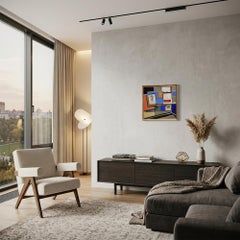
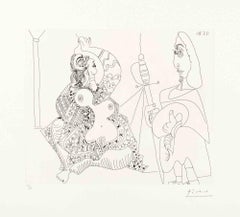
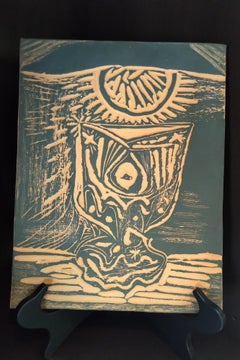
Cubist Art

CUBIST STYLE

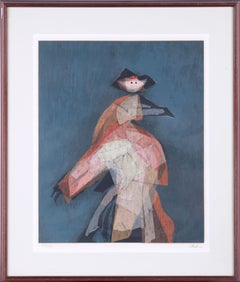
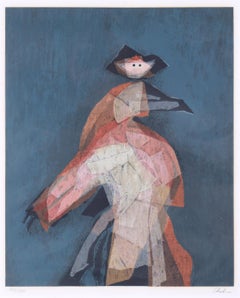
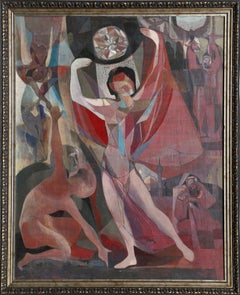
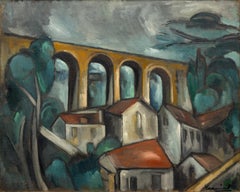
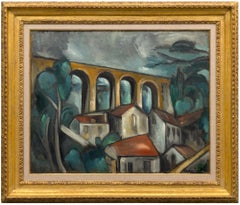
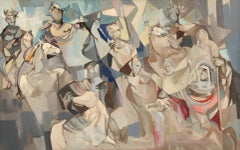
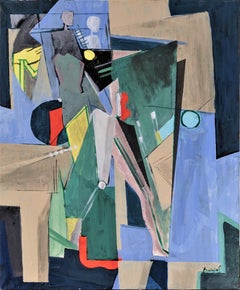
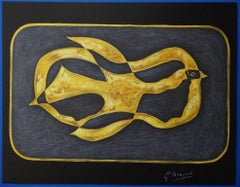
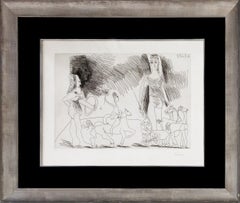
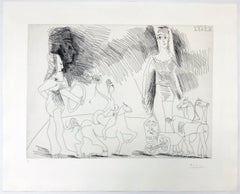
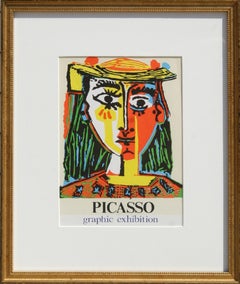
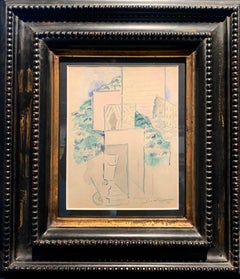
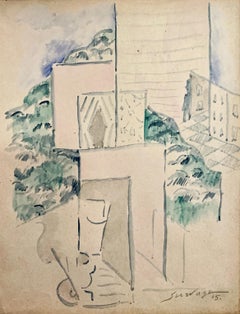
Inspired by the nontraditional ways Postimpressionists like Paul Cézanne and Georges Seurat depicted the world, Pablo Picasso and Georges Braque pioneered an even more abstract style in which reality was fragmented into flat, geometric forms. Cubism majorly influenced 20th-century Western art as it radically broke with the adherence to composition and linear perspectives that dated back to the Renaissance. Its watershed moments are considered Picasso’s 1907 Les Demoiselles d’Avignon, in which nude figures are fractured into angular shapes, and Georges Braque’s 1908 painting show, which prompted a critic to describe his visual reductions as “cubes.”

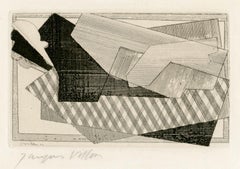
Although Cubism was a revolutionary art movement for European culture, it was informed by African masks and other tribal art. Its artists, which included Fernand Léger, Alexander Archipenko, Marcel Duchamp, Juan Gris and Jean Metzinger, experimented with compressing space and playing with the tension between solid and void forms in their work. While their subjects were often conventional, such as still lifes, nudes and landscapes, they were distorted without any illusion of realism.

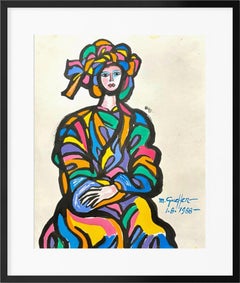
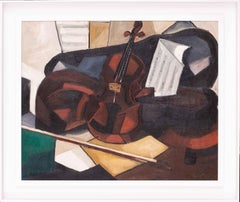
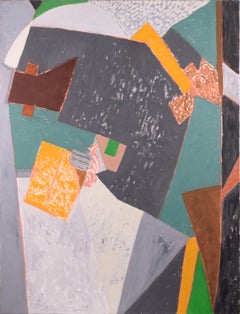
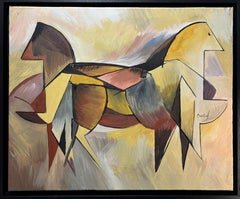
Cubist art evolved through different distinct phases. In Analytic Cubism, from 1908 to 1912, figures or objects were “analyzed” into pieces that were reassembled in paintings and sculptures, as if presenting the same subject matter from many perspectives at once. The palette was usually monochromatic and muted, giving attention to the overlapping planes. Synthetic Cubism, dating from 1912 to 1914, moved to brighter colors and a further flattening of images. This unmooring from formal ideas of art would shape numerous styles that followed, from Dada to Surrealism.

Find a collection of authentic Cubist paintings, prints and multiples, sculptures and more art on 1stDibs.

to
640
720
329
447
223
171
Overall Width
to
Overall Height
to
3
1,384
530
4
39
58
110
119
257
215
104
55
44
117,104
64,433
56,479
28,348
14,585
9,611
6,708
6,003
4,181
3,170
2,537
2,339
2,144
600
1,143
605
76
677
526
387
241
233
216
133
111
60
51
51
31
27
26
26
26
24
24
24
23
905
552
504
352
348
142
94
39
33
29
487
234
1,151
715
Style: Cubist
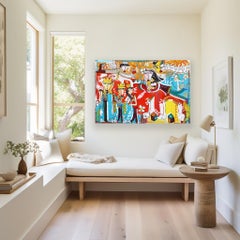
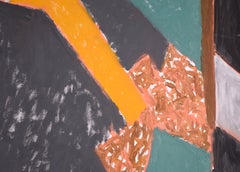
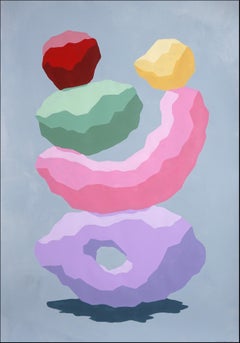
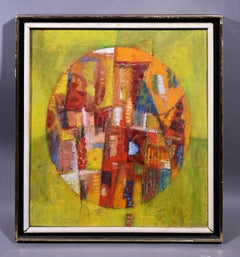
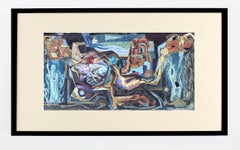
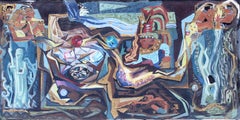
One Last Blues
One Last Blues

One Last Blues

By Pascal Jarrion

Located in Los Angeles, CA

Pascal Jarrion was born in Perpignan, France, in 1961. It is a region known for its Catalan culture and an area that has influenced many artists before him including Picasso, Van Gog...

Category

21st Century and Contemporary Cubist Art
Materials

Oil

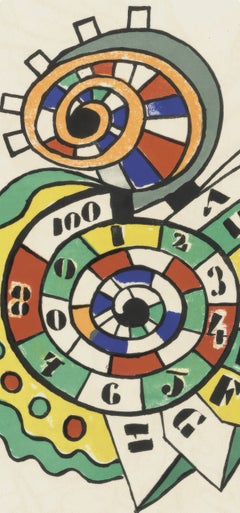
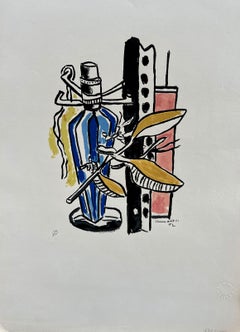
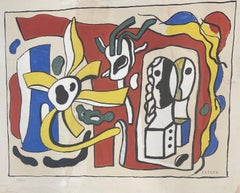
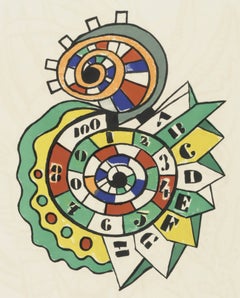
Fernand Leger, Green Leaves and Orange Background, from XXe siecle, 1971 (after)

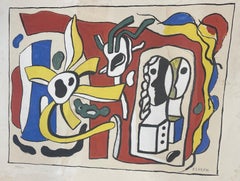
Fernand Leger, Green Leaves and Orange Background, from XXe siecle, 1971 (after)

By Fernand Léger

Located in Southampton, NY

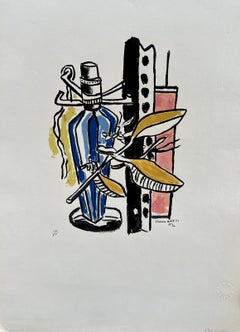
This exquisite lithograph after Fernand Leger (1881–1955), titled Feuilles vertes et fond orange (Green Leaves and Orange Background), from the album XXe Siecle, numero special hors abonnement, Cahiers d'art publies sous la direction de G. di San Lazzaro, Hommage a Fernand Leger, originates from the 1971 edition published by Societe Internationale d'Art XXe siecle, Paris, under the direction of Gualtieri di San Lazzaro, editeur, Paris, and printed by Mourlot Freres, Paris, 1971. Feuilles vertes et fond orange exemplifies Leger’s mastery of modern form and color, uniting bold geometry and organic vitality in a celebration of rhythm, balance, and the harmony between nature and mechanized abstraction. Executed as a lithograph on velin paper, this work measures 9.75 x 12.5 inches. Unsigned and unnumbered, as issued. The edition exemplifies the superb craftsmanship of Mourlot Freres, Paris. Artwork Details: Artist: After Fernand Leger (1881–1955) Title: Feuilles vertes et fond orange (Green Leaves and Orange Background), from the album XXe Siecle, numero special hors abonnement, Cahiers d'art publies sous la direction de G. di San Lazzaro, Hommage a Fernand Leger Medium: Lithograph on velin paper Dimensions: 9.75 x 12.5 inches (24.77 x 31.75 cm) Inscription: Unsigned and unnumbered, as issued Date: 1971 Publisher: Societe Internationale d'Art XXe siecle, Paris, under the direction of Gualtieri di San Lazzaro, editeur, Paris Printer: Mourlot Freres, Paris Catalogue raisonne reference: Leger, Fernand, and Lawrence Saphire. Fernand Leger: The Complete Graphic Work. Blue Moon Press, 1978, illustration 120. Condition: Well preserved, consistent with age and medium Provenance: From the album XXe Siecle, numero special hors abonnement, Cahiers d'art publies sous la direction de G. di San Lazzaro, Hommage a Fernand Leger, published by Societe Internationale d'Art XXe siecle, Paris; printed by Mourlot Freres, Paris, 1971 About the Publication: Gualtieri di San Lazzaro's XXe Siecle (Twentieth Century) was one of the most influential art journals of the modern era, founded in Paris in 1938 as a platform for the greatest painters, sculptors, and writers of the 20th century. San Lazzaro, a visionary editor, critic, and champion of modernism, believed that art and literature should coexist as expressions of a shared human imagination. Under his direction, XXe Siecle became a cultural bridge between Europe and the wider world, publishing special issues devoted to leading figures such as Picasso, Matisse, Chagall, Braque, Calder, Miro, Kandinsky, and Leger. Each edition combined essays by renowned critics and poets with original lithographs printed by the foremost ateliers of Paris, London, and New York, including Mourlot, Curwen, and Universal Graphics, creating a uniquely rich dialogue between text and image. Through XXe Siecle, San Lazzaro preserved the creative spirit of the avant-garde during and after World War II, championing freedom of expression and the evolution of abstraction, surrealism, and modern thought. Over nearly four decades, the journal shaped international taste and defined the intellectual landscape of postwar art publishing. Today, XXe Siecle remains celebrated for its extraordinary synthesis of art, literature, and design, an enduring testament to Gualtieri di San Lazzaro's belief that the visual arts are the soul of the modern age. About the Artist: Fernand Leger (1881–1955) was a French painter, sculptor, and filmmaker whose pioneering fusion of modern life, mechanization, and visual abstraction made him one of the most influential artists of the 20th century. Emerging from the Cubist movement, Leger developed a highly personal style distinguished by bold contrasts, cylindrical forms, and rhythmic compositions that celebrated the beauty of industrial progress and the vitality of modern urban life. Deeply influenced by the innovations of Paul Cezanne and the structural experimentation of Pablo Picasso and Georges Braque, Leger transformed Cubism’s fragmented perspective into a dynamic, machine-age aesthetic that bridged fine art, architecture, and design. His work often depicted workers, machinery, and everyday objects as monumental symbols of harmony between humanity and technology, reflecting both his optimism for modernity and his belief in the democratization of art. During his career, Leger was part of an extraordinary artistic circle that included Henri Matisse, Marc Chagall, Alexander Calder, Alberto Giacometti, Salvador Dali, Joan Miro, Wassily Kandinsky, Marcel Duchamp, and Man Ray—visionaries who shared his commitment to pushing the boundaries of artistic form and expression. A leading figure in the international avant-garde, Leger also explored large-scale murals, public art, and film, expanding the reach of modern art beyond the gallery. His works are represented in major museum collections worldwide, including the Museum of Modern Art, the Centre Pompidou, the Tate, and the Guggenheim, where they continue to inspire admiration for their bold geometry, humanist vision, and timeless modernity. The highest price ever paid for a Fernand Leger artwork is approximately $70 million USD, achieved in 2017 at Christie's New York for Contraste de formes (1913). Fernand Leger Feuilles vertes et fond orange, Leger Green Leaves and Orange Background, Leger 1971 XXe siecle, Leger Mourlot...

Category

1970s Cubist Art

Materials

Lithograph

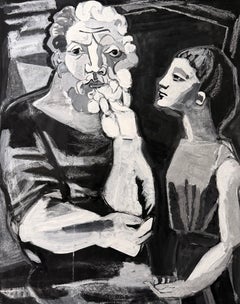
Stravinsky
Stravinsky

Stravinsky

Located in Los Angeles, CA

Natalya Prager was born in Moscow, Russia in 1938, the daughter of a famous Russian artist Vladimir Prager. She began her life as a ballerina studying at the Bolshoi Theater Ballet School. As a young woman she participated in the Bolshoi Theater performances, but the rigorous training damaged her health. Her exposure to music at a young age certainly influenced the subjects of her future endeavors in art. Her works are lyrical and with observation tell an intimate story. Encouraged by her father, she turned to painting and became a student at the Moscow College of Art. She had two exhibitions of large canvases to critical acclaim at the First Exhibition of Young Painters in Moscow when she was eighteen years old. After marrying her fellow artist Igor Kononov in 1957, she expanded her work in many different different areas, including book illustrations, circus and stage design, and puppet making for a children’s TV channel, receiving critical success and broad recognition. Prager- Kononov came to the United States with her husband and son in 1975. The first years were extremely difficult, but they never looked back. The family settled in Staten Island, New York and since 1985 in Bridgewater, New Jersey. Natalya displayed her works in some of the most prestigious locations in New York City including 57th street and SOHO galleries, Lincoln Center Gallery, Staten Island galleries and many others throughout the country. Her final show, jointly with her husband, was produced by Somerset Arts Association in 1999. Animals had a special place in Natalya’s life and art. Some of the enchanting New York City Toy Center soft animal toys had been designed by her and continue to bring joy to children of the world. Many national and local newspapers published extensive articles and personal interviews praising her enchanting work as a door to the Bewitching Fairy Kingdom...

Category

1970s Cubist Art

Materials

Oil

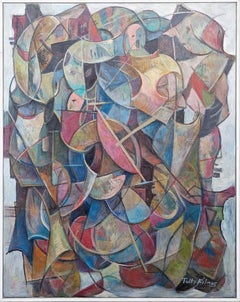
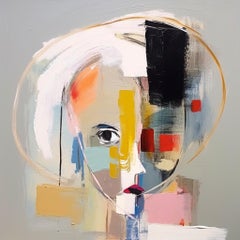
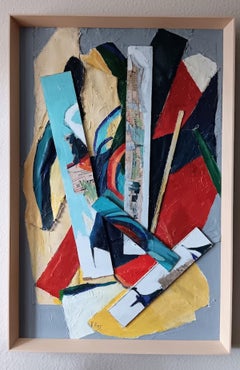
Post Cubist Composition by Eric K. Fiazi, Collage, Framed

Post Cubist Composition by Eric K. Fiazi, Collage, Framed

Located in Pasadena, CA

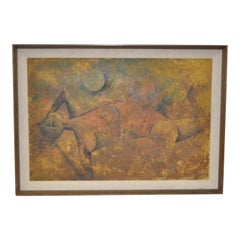
Eric K. Fiazi, Post Cubist Compostion, Collage and Oil on Canvas, Signed, dated 2010. Size is framed. Natural wood frame. Excellent condition of use. About : In Eric Fiazi's maste...

Category

Early 2000s Cubist Art

Materials

Oil, Mixed Media

Henri Laurens, Still Life, from XXe Siecle, 1956 (after)

Henri Laurens, Still Life, from XXe Siecle, 1956 (after)

By Henri Laurens

Located in Southampton, NY

This exquisite lithograph and pochoir after Henri Laurens (1885–1954), titled Nature morte (Still Life), from the album XXe Siecle, Nouvelle serie N°6 (double), Janvier 1956, origina...

Category

1950s Cubist Art

Materials

Lithograph

Fernand Leger, The Two Figures, from Derriere le miroir, 1955 (after)

Fernand Leger, The Two Figures, from Derriere le miroir, 1955 (after)

By Fernand Léger

Located in Southampton, NY

This exquisite lithograph after Fernand Leger (1881–1955), titled Le deux figures (The Two Figures), from the folio Derriere le miroir, No. 79-81, originates from the 1955 edition published by Maeght Editeur, Paris, and printed by Mourlot Freres, Paris, 1955. This composition exemplifies Leger’s rhythmic balance of color, form, and movement, translating the mechanical vitality of modern life into a harmonious, humanized geometry. Executed as a lithograph on velin paper, this work measures 15 x 11 inches. Signed in the plate and unnumbered as issued. The edition exemplifies the superb craftsmanship of Mourlot Freres, Paris. Artwork Details: Artist: After Fernand Leger (1881–1955) Title: Le deux figures (The Two Figures), from the folio Derriere le miroir, No. 79-81 Medium: Lithograph on velin paper Dimensions: 15 x 11 inches (38.1 x 27.94 cm) Inscription: Signed in the plate and unnumbered as issued Date: 1955 Publisher: Maeght Editeur, Paris Printer: Mourlot Freres, Paris Condition: Well preserved, consistent with age and medium Provenance: From the folio Derriere le miroir, No. 79-81, published by Maeght Editeur, Paris; printed by Mourlot Freres, Paris, 1955 About the Publication: Derriere le miroir (Behind the Mirror) was one of the most important art publications of the 20th century, created and published by Maeght Editeur in Paris from 1946 to 1982. Founded by the visionary art dealer and publisher Aime Maeght, the series served as both an exhibition catalogue and a work of art in its own right, uniting original lithographs by leading modern and contemporary artists with critical essays, poetry, and design of the highest quality. Printed by master lithographers such as Mourlot Freres and Arte, Derriere le miroir became synonymous with the artistic vanguard of postwar Europe. Each issue was devoted to a single artist or theme and published to accompany exhibitions at the Galerie Maeght in Paris, featuring works by Pablo Picasso, Henri Matisse, Georges Braque, Joan Miro, Marc Chagall, Alexander Calder, Fernand Leger, and Alberto Giacometti, among others. The publication reflected Maeght's belief that art should be both accessible and elevated—an ideal realized through its luxurious production values, meticulous printing, and collaboration with the greatest creative minds of its time. About the Artist: Fernand Leger (1881–1955) was a visionary French painter, sculptor, designer, and filmmaker whose groundbreaking fusion of modern industry, vivid color, and geometric form transformed the course of 20th-century art. Born in Argentan, Normandy, Leger began as an architectural draftsman before studying at the Academie Julian and the Ecole des Beaux-Arts in Paris, where he absorbed the lessons of Paul Cezanne’s structural rigor and the revolutionary ideas of Cubism. Alongside Pablo Picasso and Georges Braque, he became one of the leading innovators of the avant-garde, yet his work stood apart through its embrace of mechanical rhythm, bold contrasts, and industrial modernity—earning him the title “the painter of the machine age.” His art celebrated the beauty of technology, urban life, and the human form rendered in dynamic, interlocking cylinders and planes, evoking the pulse of the modern world. Immersed in the vibrant Parisian art scene, Leger worked in dialogue with peers and contemporaries such as Alexander Calder, Alberto Giacometti, Salvador Dali, Joan Miro, Wassily Kandinsky, Marcel Duchamp, and Man Ray, all of whom shared his commitment to innovation and the reimagining of artistic expression. Beyond painting, Leger’s creative reach extended into film, design, and monumental public art—his 1924 collaboration on Ballet Mecanique with Dudley Murphy and Man Ray remains a landmark of avant-garde cinema. His later works evolved toward greater clarity and monumentality, celebrating the unity of form, color, and humanity through large-scale murals and mosaics that bridged fine art and architecture. Leger’s synthesis of Cubism, Futurism, and abstraction paved the way for movements such as Pop Art and influenced generations of artists including Roy Lichtenstein, Ellsworth Kelly, Robert Indiana, and Alexander Calder, who admired his fusion of structure, energy, and optimism. Today, his works are prized by major museums and collectors worldwide for their bold visual power and enduring modernity. His highest auction record was achieved by La femme en rouge et vert (1914), which sold for 39,241,000 USD at Sotheby’s, New York, on May 7, 2008. After Fernand Leger Le deux figures 1955, Leger Derriere le miroir No. 79-81, Leger Mourlot...

Category

1950s Cubist Art

Materials

Lithograph

Fernand Leger, The Flower, from XXe Siecle, 1952

Fernand Leger, The Flower, from XXe Siecle, 1952

By Fernand Léger

Located in Southampton, NY

This exquisite lithograph by Fernand Leger (1881–1955), titled La Fleur (The Flower), from the album XXe Siecle, Nouvelle serie N°3 (double) Juin 1952, originates from the 1952 editi...

Category

1950s Cubist Art

Materials

Lithograph

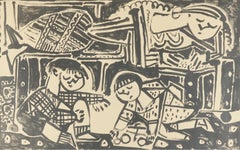
La Mère et les Enfants

La Mère et les Enfants

By Pablo Picasso

Located in New York, NY

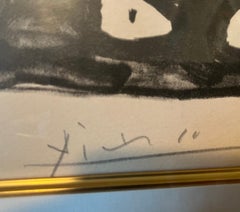
Signed by Picasso in pencil lower left. Numbered 32/50 in pencil lower right. Catalogue raisonne references: Bloch 739; Mourlot 239; Reuße 625. Framed print. Framed dimensions ...

Category

1950s Cubist Art

Materials

Lithograph

Henri Laurens, Still Life, 1929 (after)

Henri Laurens, Still Life, 1929 (after)

By Henri Laurens

Located in Southampton, NY

This exquisite lithograph and pochoir after Henri Laurens (1885–1954), titled Nature morte (Still Life), from the album L'Art Cubiste, Theories et Realisations, Etude Critique (Cubis...

Category

1920s Cubist Art

Materials

Lithograph, Stencil

Cubist Renaissance Woman - Oil on Canvas

Cubist Renaissance Woman - Oil on Canvas

Located in Soquel, CA

Abstracted portrait of a renaissance era woman by Sonia Gichner (20th Century). This piece is painted with splashes of bright colors, contrasting nicely with skin tones and black lin...

Category

1980s Cubist Art

Materials

Gesso, Canvas, Oil

Suzanne Benton, Caught in the Dark Waters of Life, 2024, oil, Spiritualism

Suzanne Benton, Caught in the Dark Waters of Life, 2024, oil, Spiritualism

By Suzanne Benton

Located in Darien, CT

In this ninth decade of life, and as a working artist for nearly70 years, Suzanne Benton has become interested in the concept of Late Style as described by the literary theorist Edward Said. “Each of us can supply evidence of late works, which crown a lifetime of aesthetic endeavor,” Matisse had it with his renowned paper cuts. While nearly blind, Monet created the water lily paintings as his final legacy to the history of art.  Benton's Late Style arrived as a surprise during the Covid pandemic. The resultant aloneness from sheltering in place brought her to an uncanny level of solitude that only painting could voice. She reached for the purest of colors, and entered a celebratory world to create the Neo-Transcendental paintings titled All About Color. The disappeared narrative came as a surprise. It had been the mainstay of the masks and mask tale performances, monoprints and paintings. This time though, the artist needed to bring a vibrancy to canvas, and to make tangible this sense of sheer essence that had pressed into her inner self in that time of stillness. Well educated in color by John Ferren, the abstract expressionist painter who’d taught the year’s color study at Queen College. The sensitivity developed further through four lengthy art-working journeys to India, starting in 1976-77, continuing with a 1992-1993 Fulbright, and additional South Asia residencies in 1995, and 2011. Those and others in Africa brought an ever more attuned palette to decades of monoprints with Chine collé that featured imagery from world culture, as well as her Americana of 19th and 20th century women writers, educators, suffragists, and feminists. These Late Style artworks explore the cosmic realm. Its deceptive simplicity reminds Benton of Buffie Johnson’s late work. She, an early celebrator of Great Goddess imagery turned to circles in her latter years. similarly, Benton had drawn on rich Goddess imagery since the 1970’s...

Category

2010s Cubist Art

Materials

Oil, Board, Gesso, Birch

Pablo Picasso, Untitled, from Carmen, 1949

Pablo Picasso, Untitled, from Carmen, 1949

By Pablo Picasso

Located in Southampton, NY

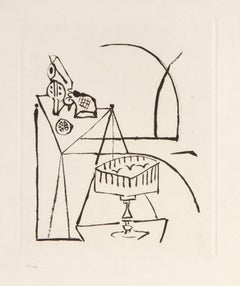
This exquisite engraving by Pablo Picasso (1881–1973), titled Sans titre (Untitled), from the folio Picasso, Carmen (Picasso, Carmen), originates from the 1949 edition published by L...

Category

1940s Cubist Art

Materials

Engraving

Pablo Picasso, Untitled, from Carmen, 1949

Pablo Picasso, Untitled, from Carmen, 1949

By Pablo Picasso

Located in Southampton, NY

This exquisite engraving by Pablo Picasso (1881–1973), titled Sans titre (Untitled), from the folio Picasso, Carmen (Picasso, Carmen), originates from the 1949 edition published by L...

Category

1940s Cubist Art

Materials

Engraving

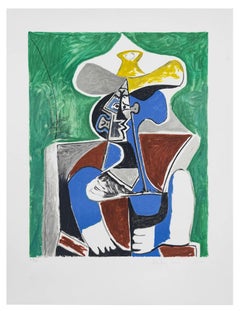
Square Head of a Man (Plate XXXI), from Carmen

Square Head of a Man (Plate XXXI), from Carmen

By Pablo Picasso

Located in Washington, DC

Artist: Pablo Picasso Title: Square Head of a Man (Plate XXXI) Portfolio: Carmen Medium: Etching on Montval wove paper Year: 1949 Edition: 32/289 Frame Size: 21" x 18" Sheet Size: 13...

Category

1940s Cubist Art

Materials

Etching

Woman with a Guitar, Cubism

Woman with a Guitar, Cubism

By Simka Simkhovitch

Located in New York, NY

A period work by a Russian artist working in a Cubist approach. The canvas is 24 1/4 x 22 1/4 inches and the above dimension is the framed size. The frame is an older frame, with a flat gold/brown finish. In Woman with Guitar, Simkhovitch plays on his his early fascination with Cubism and Constructivism (and his background in illustration) expressing and compressing with planes and color the spatiality of a domestic scene. Considered a master draftsman and an adherent of certain classicism, Simkhovitch’s compositions are often built up in a complicated but well-managed counterpoint, at heart, he is a romanticist preferring the dreamy colors of a Russian fairy tale.

Category

1940s Cubist Art

Materials

Oil

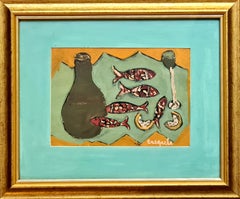
Antique American Modernist Signed Fish Still Life Cubist Framed Oil Painting

Antique American Modernist Signed Fish Still Life Cubist Framed Oil Painting

Located in Buffalo, NY

Vintage American school modernist fish still life painting. Oil on canvas. Signed. Framed. Measuring: 15 by 19 inches overall, and 12 by 16 painting alone.. In excellent original co...

Category

1970s Cubist Art

Materials

Oil, Board

Golf Players Limited Edition Textured Canvas Print

Golf Players Limited Edition Textured Canvas Print

By Irena Orlov

Located in Los Angeles, CA

Title: Golf Players - Limited Edition Textured Canvas Print Immerse yourself in the world of golf with "Golf Players," a limited edition textured canvas print that celebrates the spirit of the sport. This captivating artwork captures the essence of golfing moments...

Category

2010s Cubist Art

Materials

Canvas, Paint, Cotton Canvas, Mixed Media, Acrylic, Digital, Inkjet, Giclée

In Between Shadows 'Vintage Bottle', 20th Century Framed Large Fine Art Print

In Between Shadows 'Vintage Bottle', 20th Century Framed Large Fine Art Print

By Sander Vos

Located in London, GB

Intertwined silhouettes reveal the rhythmic dance of light and shadow in abstract form... The series ‘In Between the Shadows’ consists of structural and geometric photographs that ta...

Category

2010s Cubist Art

Materials

Photographic Paper, Black and White, Color, Giclée, Archival Pigment

Abstract Cubist Portrait - HFC 17" - Limited Edition Textured Canvas Print

Abstract Cubist Portrait - HFC 17" - Limited Edition Textured Canvas Print

By Irena Orlov

Located in Los Angeles, CA

Introducing "Abstract Cubist Portrait - HFC 17" - Limited Edition Textured Canvas Print Experience the brilliance of abstract art with "Abstract Cubist Portrait - HFC 17," a captivating limited edition textured canvas print inspired by the masterful works of Picasso. This artwork exudes originality and uniqueness, designed to leave a lasting impression. Artistic Craftsmanship: Feel the intricate brush strokes as you bring the essence of my studio into your home. Each canvas print is thoughtfully crafted to preserve the texture true to the original artwork, delivering an authentic and mesmerizing visual experience. Canvas Print Size: "Abstract Cubist Portrait - HFC 17" stands tall at an impressive size of 45" x 45", making it a striking centerpiece in any setting. Exclusive Limited Edition: To maintain the essence of exclusivity, only 300 prints of "Abstract Cubist Portrait - HFC 17" have been produced. Each print comes with a signature Certificate of Authenticity and a unique number, making it a collectible masterpiece. Fade-Resistant Inks: With archival eco-solvent inks, "Abstract Cubist Portrait - HFC 17" guarantees lasting brilliance and resistance to fading, ensuring its allure stands the test of time. Superior Quality: This canvas print is professionally hand-stretched over 1 ½" deep wood stretched bars...

Category

2010s Cubist Art

Materials

Acrylic, Giclée, Canvas, Paint, Cotton Canvas, Mixed Media, Digital, Inkjet

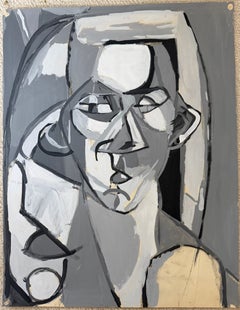
Geometric Figure #25

Geometric Figure #25

By Dave Fox

Located in San Francisco, CA

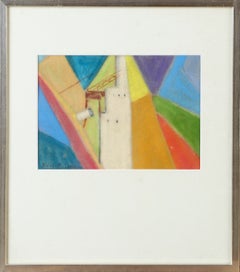
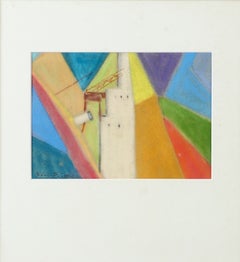
Artist: David Fox (American, 1920-2011) Title: Geometric Figure #25 Year: 2002 Medium: Acrylic on paper Paper: Watercolor paper Image size: 8 x 12...

Category

21st Century and Contemporary Cubist Art
Materials

Acrylic

Kiss, Contemporary Ceramic Sculpture by Mirkò Guida

Kiss, Contemporary Ceramic Sculpture by Mirkò Guida

By Mirko Guida

Located in Long Island City, NY

Artist: Mirkò Guida (Italian, b. 1980) Title: Kiss Year: 2006 Medium: Painted terracotta artistic vase, signed and dated Size: 31 x 19 x 13 in. (78.74 x 48.26 x 33.02 cm)

Category

Early 2000s Cubist Art
Materials

Ceramic, Terracotta

Cubist art for sale on 1stDibs.
Find a wide variety of authentic Cubist art available for sale on 1stDibs. Works in this style were very popular during the 21st Century and Contemporary, but contemporary artists have continued to produce works inspired by this movement. If you’re looking to add art created in this style to introduce contrast in an otherwise neutral space in your home, the works available on 1stDibs include elements of blue, orange, purple, yellow and other colors. Many Pop art paintings were created by popular artists on 1stDibs, including Pablo Picasso, (after) Pablo Picasso, Borja Guijarro, and Corne Akkers. Frequently made by artists working with Paint, and Lithograph and other materials, all of these pieces for sale are unique and have attracted attention over the years. Not every interior allows for large Cubist art, so small editions measuring 1.5 inches across are also available. Prices for art made by famous or emerging artists can differ depending on medium, time period and other attributes. On 1stDibs, the price for these items starts at $1 and tops out at $265,000, while the average work sells for $2,400.