Fauvist Art

to
395
438
182
156
82
63
Overall Width
to
Overall Height
to
10
771
140
13
15
25
43
76
192
73
110
51
35
113,855
62,326
57,347
26,925
14,653
9,371
6,501
5,547
4,309
3,076
2,406
2,347
2,217
604
521
366
31
276
212
154
108
67
52
43
37
36
33
30
27
26
23
20
19
19
17
17
15
425
406
266
189
185
24
20
18
18
17
223
44
610
299
Style: Fauvist
Clown au Timbale & Clown Assis (2 prints)

Clown au Timbale & Clown Assis (2 prints)

By Georges Rouault

Located in New York, NY

Both are color aquatints with same noted dimensions, the sheets with full margins. Both are from an edition of 270. From the portfolio "Cirque." Printed by Maurice Potin, Paris. P...

Category

1930s Fauvist Art

Materials

Aquatint, Color

Polish French Fauvist Judaica Art Oil Painting Rabbi at Prayer Frederick Serger

Polish French Fauvist Judaica Art Oil Painting Rabbi at Prayer Frederick Serger

By Frederick B. Serger

Located in Surfside, FL

Genre: Impressionist Subject: People Medium: Oil Surface: Canvas Hand signed lower right Frederick Serger (given name Frederick Bedrick Sinaberger) was born in 1889 to a family of Jewish manufacturers in the village of Ivancice near Brno Moravia, a province of Czechoslovakia. Showing artistic talent at a young age, he attended art schools in Brno, Vienna, and Munich. During World War I, Serger joined the Austrian Army...

Category

1940s Fauvist Art

Materials

Canvas, Oil

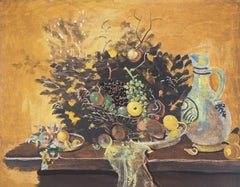
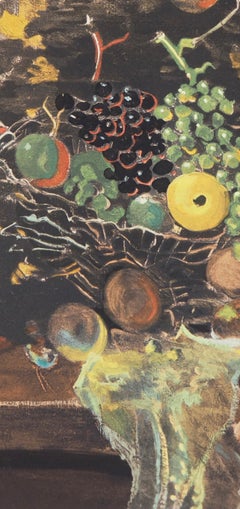
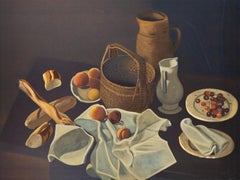
Colorful Still life. 1981. Canvas, oil, tempera, 65x88 cm

Colorful Still life. 1981. Canvas, oil, tempera, 65x88 cm

By Aija Zarina

Located in Riga, LV

Aija Zariņa is a prominent personality in Latvian art, actively advocating for idealism and personal freedom, against conformism. Her main theme is human existence, its fundamental c...

Category

1980s Fauvist Art

Materials

Canvas, Oil, Tempera

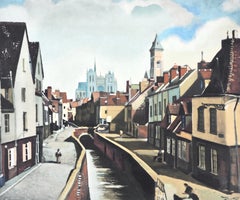
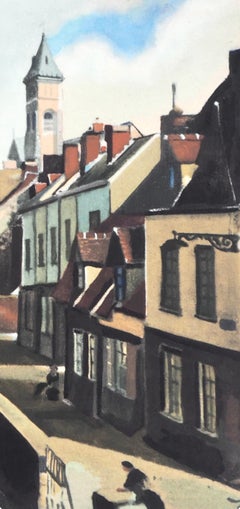
In the market square.  cardboard, oil, 41x81 cm

In the market square. cardboard, oil, 41x81 cm

Located in Riga, LV

In the market square. cardboard, oil, 41x81 cm Biruta Baumane (1922-2017) Born in Kalnamuizha in Tervetes school, in the teachers family. Since 1941, she studied at the Latvian State Academy of Arts, where she graduated painting department in 1948. In 1951 married with sculptor Karlis Baumanis. Daughter Laine Kainaze also is an artist. Since 1959, member of the Union of Artists, Biruta repeatedly was a manager of the union. In 1986 she became the honored worker of arts of the Latvian SSR. She has been involved in television and radio programs, movies, and has published articles in periodicals. In 1976 she received a diploma of the Union of Latvian SSR for the best creative work. One of the most important Latvian artists...

Category

1970s Fauvist Art
Materials

Oil, Cardboard

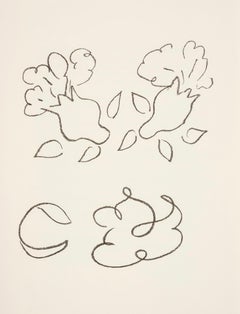
Composition - Lithograph

Composition - Lithograph

By (after) Raoul Dufy

Located in Collonge Bellerive, Geneve, CH

(after) Raoul Dufy Lithograph after a watercolor, published in the book "Lettre à mon peintre Raoul Dufy." Paris, Librairie Académique Perrin, 1965. Printed signature Di...

Category

1940s Fauvist Art

Materials

Lithograph

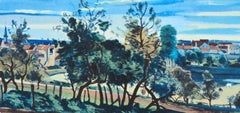
Paris. Oil on cardboard, 42, 4x64 cm

Paris. Oil on cardboard, 42, 4x64 cm

By Adamia Rezo

Located in Riga, LV

Paris. Oil on cardboard, 42,4x64 cm Paris landscape. View on the river from the top. Colorful painting with yellow-orange trees, dominant color blue

Category

20th Century Fauvist Art

Materials

Oil, Cardboard

"Beach Day", Woman in Black Bathing Suit, Figurative Painting, Oil on Linen

"Beach Day", Woman in Black Bathing Suit, Figurative Painting, Oil on Linen

By Betsy Podlach

Located in Carmel, CA

Betsy Podlach (American, born 1964) "Beach Day" 2010 Oil Paint, Linen, Stretcher Bars The artist signed the back of the painting. "Beach Day" by Betsy Podlach captures the serene introspection of a day spent by the shore. In this 45" x 38" oil on linen, the fauvist influences are clear, as Podlach forgoes strict realism to emphasize the emotional resonance of the moment. The subject, adorned in black swimwear...

Category

2010s Fauvist Art

Materials

Stretcher Bars, Oil, Linen

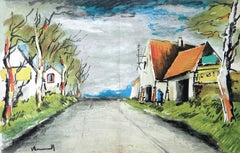
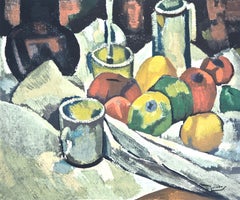
Woods in Chatou - Lithograph, 1972

Woods in Chatou - Lithograph, 1972

By Maurice de Vlaminck

Located in Paris, IDF

Maurice de VLAMINCK (after) Woods in Chatou Color lithograph after a painting Printed signature in the plate On Arches Vellum 50 x 65 cm (c. 20 x 26 inch) Excellent condition

Category

1970s Fauvist Art
Materials

Lithograph

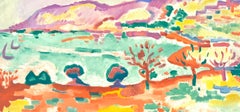
Homage to Renoir - Lithograph

Homage to Renoir - Lithograph

By (after) Raoul Dufy

Located in Collonge Bellerive, Geneve, CH

(after) Raoul Dufy Lithograph after a watercolor, published in the book "Lettre à mon peintre Raoul Dufy." Paris, Librairie Académique Perrin, 1965. Printed signature Dimensions: ...

Category

1940s Fauvist Art
Materials

Lithograph

Figures in a Strange Room

Figures in a Strange Room

Located in Austin, TX

This strange scene depicts two orange figures conversing in a large magenta room with a checkered wall, and a green furnace. This piece is executed in acrylic on canvas and measures ...

Category

20th Century Fauvist Art

Materials

Canvas, Acrylic

"Birds at the Chicago Zoo" Modernist Nature Scene

"Birds at the Chicago Zoo" Modernist Nature Scene

Located in Austin, TX

Artist: Gustav Likan Title: Pond in the Jungle Size: 50" x 39.5" Medium: Acrylic on Canvas Framing: Framed Condition: Excellent About the Artist: Born in Yugoslavia in 1912, Gustav...

Category

Mid-20th Century Fauvist Art

Materials

Canvas, Acrylic

Orchestra
Orchestra

Orchestra

By Evelyne Ballestra

Located in Miami, FL

Orchestra is a colorful painting made by Evelyne Ballestra, a French contemporary artist. The artist uses bright colors in this expressionist painting to show how she feels the music...

Category

21st Century and Contemporary Fauvist Art

Materials

Canvas, Oil

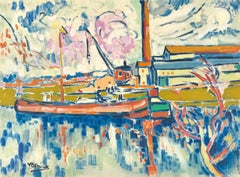
"Portrait of Barbara"

"Portrait of Barbara"

Located in Austin, TX

By Gustav Likan The only known portrait of Gustav Likan's wife Barbara. 16" x 9.25" Oil on Canvas Framed Size: 22" x 15" 1982

Category

1980s Fauvist Art
Materials

Canvas, Oil

Practical Advice on Waiting, bright colors, domestic, Latin objects

Practical Advice on Waiting, bright colors, domestic, Latin objects

By Barbara Rachko

Located in Brooklyn, NY

Works Her pastel-on-sandpaper series, "Domestic Threats" and "Black Paintings", both use cultural objects as surrogates for human beings acting in mysterious, highly charged narratives.[9][10] Rachko also has created a series of photographs entitled "Gods and Monsters".[11] In these chromogenic prints, she is "painting with a camera," creating variations that free the camera from being a mechanical recording device of what lies before it. She prints all of these images by hand. The earlier "Domestic Threats" pastel-on-sandpaper paintings used her West Village apartment or her 1932 Sears house in Virginia as a backdrop. The "Black Paintings" series grew directly from "Domestic Threats". In the "Black Paintings," the figures (actors) take center stage. All background details, furniture, rugs, etc. have been eliminated and replaced by intense dark black pastel. Each painting takes months to complete as she slowly builds up as many as 30 layers of soft pastel. Her long-standing fascination with traditional masks progressed in the spring of 2017 when she visited the National Museum of Ethnography and Folklore in La Paz, Bolivia where one exhibition included more than fifty festival masks. The resulting series is entitled “Bolivianos”.[12] She has also written an e-book, From Pilot to Painter[13] and writes a regular blog, Barbara Rachko...

Category

Early 2000s Fauvist Art
Materials

Pastel

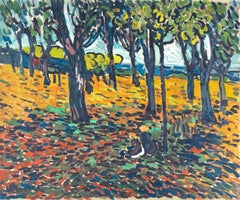
Orange and Blue Trees

Orange and Blue Trees

By Linda Jacobson

Located in Palm Desert, CA

A dynamic but lyrical depiction of trees in colorful saturated hues, they dance fluidity in tones of orange, blue and red. My work is a serpentine flow, embodying poetic and rhythmi...

Category

21st Century and Contemporary Fauvist Art
Materials

Canvas, Acrylic

After Raoul Dufy - Birds - Lithograph

After Raoul Dufy - Birds - Lithograph

By (after) Raoul Dufy

Located in Collonge Bellerive, Geneve, CH

(after) Raoul Dufy Lithograph after a watercolor, published in the book "Lettre à mon peintre Raoul Dufy." Paris, Librairie Académique Perrin, 1965. Printed signature Di...

Category

1940s Fauvist Art
Materials

Lithograph

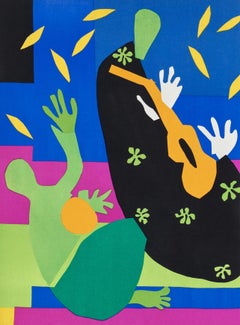
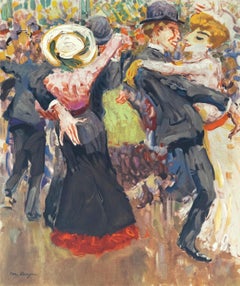
French Modern Art by Henri Matisse - Les Fauves

French Modern Art by Henri Matisse - Les Fauves

By Henri Matisse

Located in Paris, IDF

Les Fauves by Henri Matisse (1869-1954), hand-signed book cover lithography printed in Switzerland, 32 x 51 x 0,2 cm - 12,5 x 20 x 0,07 in, printed by Mourlot Editions Henri Matisse...

Category

1930s Fauvist Art
Materials

Cardboard, Lithograph

He Was So in Need of Botany, bright colors, domestic, Latin objects

He Was So in Need of Botany, bright colors, domestic, Latin objects

By Barbara Rachko

Located in Brooklyn, NY

Price and size includes frames (maple wood with white mats). Artwork 58" x 38" Her pastel-on-sandpaper series, "Domestic Threats" and "Black Paintings", both use cultural objects as surrogates for human beings acting in mysterious, highly charged narratives.[9][10] Rachko also has created a series of photographs entitled "Gods and Monsters".[11] In these chromogenic prints, she is "painting with a camera," creating variations that free the camera from being a mechanical recording device of what lies before it. She prints all of these images by hand. The earlier "Domestic Threats" pastel-on-sandpaper paintings used her West Village apartment or her 1932 Sears house in Virginia as a backdrop. The "Black Paintings" series grew directly from "Domestic Threats". In the "Black Paintings," the figures (actors) take center stage. All background details, furniture, rugs, etc. have been eliminated and replaced by intense dark black pastel. Each painting takes months to complete as she slowly builds up as many as 30 layers of soft pastel. Her long-standing fascination with traditional masks progressed in the spring of 2017 when she visited the National Museum of Ethnography and Folklore in La Paz, Bolivia where one exhibition included more than fifty festival masks. The resulting series is entitled “Bolivianos”.[12] She has also written an e-book, From Pilot to Painter[13] and writes a regular blog, Barbara Rachko...

Category

Early 2000s Fauvist Art
Materials

Pastel

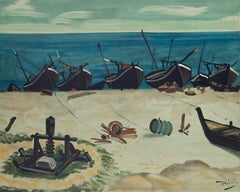
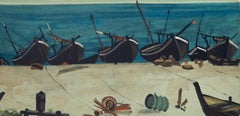
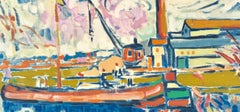
Fauvist Shipyard
Fauvist Shipyard

Fauvist Shipyard

Located in Soquel, CA

Bright and bold shipyard by an unknown artist. Presented in a new cream mat. Paper size: 10.25"H x 14.25"W; Mat size: 13"H x 18"W

Category

21st Century and Contemporary Fauvist Art
Materials

Paper, Watercolor

"Mlle Landsberg" (grade planche, pl. 16)

"Mlle Landsberg" (grade planche, pl. 16)

By Henri Matisse

Located in Missouri, MO

"Mlle Landsberg" (grade planche, pl. 16), 1914 Henri Matisse (French, 1869-1954) Signed and Numbered Lower Right Edition 12/15 Image size: 7 7/8 x 4 5/16 inches Sheet size: 17 11/16 x 12 1/2 inches With frame: 19 1/2 x 14 1/2 inches Henri Matisse came from a family who were of Flemish origin and lived near the Belgian border. At eight o'clock on the evening of December 31, 1869, he was born in his grandparents' home in the town of Le Cateau in the cheerless far north of France. His father was a self-made seed merchant who was a mixture of determination and tightly coiled tension. Henri had no clear idea of what he wanted to do with his life. He was a twenty-year-old law clerk convalescing from appendicitis when he first began to paint, using a box of colors given to him by his mother. Little more than a year later, in 1890, he had abandoned law and was studying art in Paris. The classes consisted of drawing from plaster casts and nude models and of copying paintings in the Louvre. He soon rebelled against the school's conservative atmosphere; he replaced the dark tones of his earliest works with brighter colors that reflected his awareness of Impressionism. Matisse was also a violinist; he took an odd pride in the notion that if his painting eye failed, he could support his family by fiddling on the streets of Paris. Henri found a girlfriend while studying art, and he fathered a daughter, Marguerite, by her in 1894. In 1898 he married another woman, Amelie Parayre. She adopted the beloved Marguerite; they eventually had two sons, Jean, a sculptor and Pierre who became an eminent art dealer. Relations between Matisse and his wife were often strained. He often dallied with other women, and they finally separated in 1939 over a model who had been hired as a companion for Mme. Matisse. She was Madame Lydia, and after Mme. Matisse left, she remained with Matisse until he died. Matisse spent the summer of 1905 working with Andre Derain in the small Mediterranean seaport of Collioure. They began using bright and dissonant colors. When they and their colleagues exhibited together, they caused a sensation. The critics and the public considered their paintings to be so crude and so roughly crafted that the group became known as Les Fauves (the wild beasts). By 1907, Matisse moved on from the concerns of Fauvism and turned his attention to studies of the human figure. He had begun to sculpt a few years earlier. In 1910, when he saw an exhibition of Islamic art, he was fascinated with the multiple patterned areas and adapted the decorative universe of the miniatures to his interiors. As a continuation of his interest in the "exotic", Matisse made extended trips to Morocco in 1912 and 1913. At the end of 1917, Matisse moved to Nice; he would spend part of each year there for the remainder of his life. A meticulous dandy, he wore a light tweed jacket amd a tie when he painted. He never used a palette, but instead squeezed his colors on to plain white kitchen dishes...

Category

1910s Fauvist Art
Materials

Drypoint, Etching

Bernard Buffet - Homage to Dufy - Lithograph

Bernard Buffet - Homage to Dufy - Lithograph

By Bernard Buffet

Located in Collonge Bellerive, Geneve, CH

(after) Bernard Buffet Lithograph after a watercolor, published in the book "Lettre à mon peintre Raoul Dufy." Paris, Librairie Académique Perrin, 1965. Printed signature Dimension...

Category

1940s Fauvist Art
Materials

Lithograph

"Teeny" lithograph by Henri Matissse

"Teeny" lithograph by Henri Matissse

By (after) Henri Matisse

Located in Hinsdale, IL

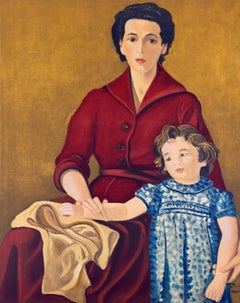
HENRI MATISSE (1869 – 1954) Teeny Duthuit-Garnaud 723 Linocut, c. 1938 From an edition of 1500 Image Size: 12.2” x 9.5” Published in The Homage to Henri Matisse Published by Galerie d’Art Contemporain de Paris Matisse's striking linocut shows Alexina "Teeny" Duchamp, the second wife of artist and pioneer of the ready-made, Marcel Duchamp. She was married to Pierre Matisse, Henri Matisse's eldest son, first and they had three children, Jacqueline, Paul and Peter. They separated in 1949 but Matisse was incredibly fond of his daughter-in-law until his death in 1954. Henri Matisse (French, 1869-1954) is primarily known as the founder of the Fauvist movement, a result of Impressionism, whose works fundamentally altered the course of Modern Art in the late 20th Century. Innovative in his original treatment of the human figure and an expressive use of color, Matisse forged his own pictorial language. Matisse's career can be divided into several stylistic periods, but he remained focused on discovering “the essential character of things” through his art. Matisse considered his drawing to be a very intimate means of expression. The method of artistic execution — whether it was charcoal, pencil, crayon, etcher’s burin, lithographic tusche or paper cut — varied according to the subject and personal circumstance. His favorite subjects were evocative or erotic — the female form, the nude figure or a beautiful head of a favorite model. Matisse’s etchings...
Category

1930s Fauvist Art
Materials

Lithograph, Linocut

Fauvist art for sale on 1stDibs.
Find a wide variety of authentic Fauvist art available for sale on 1stDibs. Works in this style were very popular during the 21st Century and Contemporary, but contemporary artists have continued to produce works inspired by this movement. If you’re looking to add art created in this style to introduce contrast in an otherwise neutral space in your home, the works available on 1stDibs include elements of blue, orange, purple, green and other colors. Many Pop art paintings were created by popular artists on 1stDibs, including Charles Cobelle, (after) André Derain, Evelyne Ballestra, and (after) Pierre Bonnard. Frequently made by artists working with Paint, and Oil Paint and other materials, all of these pieces for sale are unique and have attracted attention over the years. Not every interior allows for large Fauvist art, so small editions measuring 3.94 inches across are also available. Prices for art made by famous or emerging artists can differ depending on medium, time period and other attributes. On 1stDibs, the price for these items starts at $1 and tops out at $2,835,000, while the average work sells for $1,532.