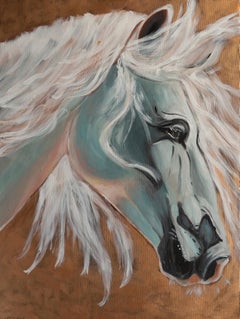
Horse Art

to
442
1,240
803
691
501
763
Overall Width
to
Overall Height
to
126
735
1,543
1,597
35
24
64
160
75
107
75
190
133
77
89
887
550
237
127
81
53
52
44
38
24
23
11
3
2,511
999
272
4,002
153,625
80,480
50,630
42,265
36,719
35,276
30,127
26,761
25,662
24,714
20,690
18,030
15,778
14,582
13,754
13,173
11,266
10,627
10,169
1,600
1,189
692
668
665
192
110
81
62
29
1,439
1,193
2,289
1,555
Art Subject: Horse
Cowboy Hunting Pronghorn Deer ("American Antelope") in Watercolor and Gouache

Cowboy Hunting Pronghorn Deer ("American Antelope") in Watercolor and Gouache

Located in Soquel, CA

Cowboy Hunting Pronghorn Deer ("American Antelope") in Watercolor and Gouache Detailed western scene by H. Rich (American, 20th Century). A cowboy is on a ridge, with two horses, ha...

Category

1960s American Modern Landscape Paintings

Materials

Paper, Watercolor, Gouache

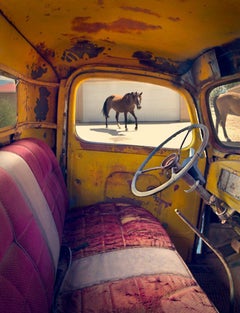
Mind Screen (Last Picture Show)

Mind Screen (Last Picture Show)

By Stefanie Schneider

Located in Morongo Valley, CA

Mind Screen (Last Picture Show), 2005, Edition 2/10, digital C-Print based on a Polaroid, Certificate and Signature label included artist Inventory Nr. 1043.11 not mounted LIFE’...

Category

1990s Pop Art Color Photography

Materials

Photographic Paper, C Print, Color, Polaroid

Fernand Audet French Impressionist Oil, The Circus Horse

Fernand Audet French Impressionist Oil, The Circus Horse

Located in Cirencester, Gloucestershire

"The Circus Horse" by Fernand Audet (French, Tarascon 1923- Mulhouse 2016) oil painting on canvas, unframed painting: 13 x 8.5 inches Condition report:...

Category

Early 20th Century Animal Paintings

Materials

Acrylic

Lucky
Lucky

Lucky

By Sila Sehrazat Yucel

Located in New York, NY

Sila Sehrazat Yucel is a talented artist based in Istanbul. Her background in landscape and interior architecture shapes her creative vision. With experience as an art director in ci...

Category

2010s Contemporary Animal Prints

Materials

Archival Pigment

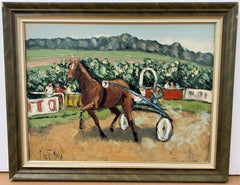
The Horse Race, Equestrian Watercolor on Paper, Framed, Mid-20th Century

The Horse Race, Equestrian Watercolor on Paper, Framed, Mid-20th Century

Located in Cotignac, FR

Equestrian, mid century horse racing painting, watercolour on paper by Henry Farion. The painting is signed bottom right and is presented in a distressed period gilt frame under glas...

Category

Mid-20th Century Animal Drawings and Watercolors

Materials

Paper, Watercolor

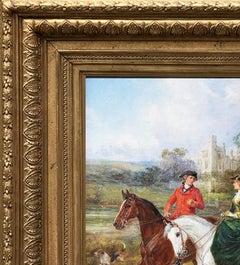
The Morning Ride
The Morning Ride

The Morning Ride

By Heywood Hardy

Located in Belgravia, London, London

Oil on canvas Canvas size: 24 x 18 inches Framed size: 35.5 x 30.5 inches Signed lower right

Category

19th Century Animal Paintings

Materials

Canvas, Oil

Portrait of a Pekingese Dog Vintage English Watercolour Painting

Portrait of a Pekingese Dog Vintage English Watercolour Painting

Located in Cirencester, Gloucestershire

Portrait of a Pekingese Dog English artist, late 19th century Watercolour drawing on paper stuck on card card: 10 x 8 inches paper: 5.5 x 4 inches Provenance: Private collection, UK ...

Category

Late 19th Century Impressionist Animal Paintings

Materials

Watercolor

Jim Rey b.1938. CA/CO artist. Oil on canvas, "Watching the Wild Ones" 24 x 36

Jim Rey b.1938. CA/CO artist. Oil on canvas, "Watching the Wild Ones" 24 x 36

Located in Basalt, CO

Jim Rey b. 1939. Original oil on canvas painting with custom frame. 24 x 36 canvas size. This work was painted in 2004, at a most expressive time in Rey's career. From the art...

Category

Early 2000s American Realist Figurative Paintings

Materials

Canvas, Oil

Polo game with Maple Leaf and Ellerston White 1992

Polo game with Maple Leaf and Ellerston White 1992

By Michael Grimsdale

Located in GB

Michael Grimsdale (b. 1936) Michael Grimsdale is a British painter known for his refined portrayals of horses, sporting subjects, and commissioned portraits. Born in London in 1936,...

Category

Late 20th Century English School Figurative Paintings

Materials

Canvas, Oil

The Haycart Mid 20th Century English Impressionist Signed Oil Painting

The Haycart Mid 20th Century English Impressionist Signed Oil Painting

Located in Cirencester, Gloucestershire

The Haycart by Wilfred Wilson (English, 1920 - 1978) signed oil on paper (laid on board), framed framed: 12 x 14 inches painting : 8 x 10 inches Provenance: private collection, Eng...

Category

Mid-20th Century Post-Impressionist Animal Paintings

Materials

Oil

Antique Gelatin Silver Print Photograph of 13th Calvary Soldier

Antique Gelatin Silver Print Photograph of 13th Calvary Soldier

Located in Soquel, CA

Antique Gelatin Silver Print Photograph of 13th Calvary Soldier - 1913. This photograph shows a member of the 13th Calvary Regiment, Company H of the United States Army, sitting ato...

Category

1910s American Realist Black and White Photography

Materials

Photographic Paper, Silver Gelatin

"Fire in Tobacco Barn" Molly Luce, Modernist, Female Artist, Western Scene

"Fire in Tobacco Barn" Molly Luce, Modernist, Female Artist, Western Scene

Located in New York, NY

Molly Luce Fire in Tobacco Barn, 1938 Signed lower right Oil on canvas 16 x 20 inches Provenance Childs Gallery, Boston Private Collection, Massachusetts (acquired from the above) ...

Category

1930s American Modern Figurative Paintings

Materials

Canvas, Oil

“Americana”
“Americana”

Ralph Fabri“Americana”, 1947

$675Sale Price|30% Off

“Americana”

By Ralph Fabri

Located in Southampton, NY

Here for your consideration is a wonderful original etching on archival paper by the well known American artist, Ralph Fabri. Strong impression; signed in pencil by the artist lower right margin. Titled and dated bottom left of the sheet “1947-Americana”. Condition of the etching is excellent. Top corner of sheet and bottom right corner of sheet have tiny creases. Not visible, under the mat. Sheet size is 12 by 15 inches. Image size is 8 by 9.75 inches. Matted but not framed. Provenance: A Long Island, New York collector. Painter and printmaker, commercial artist, writer, and teacher, Ralph Fabri was born Fabri Reszo in Hungary in 1894. He was educated in Budapest, first studying architecture at the Royal Institute of Technology from 1912 to 1914. He then enrolled in the Royal Academy of Fine Arts, from which he graduated in 1918 with a Professor's Diploma (M.A.) "for teaching drawing, painting and geometry – including descriptive and projective geometry – in schools of higher education." Fabri arrived in New York City in 1921 and soon adopted the anglicized version of his name, Ralph Fabri. He began doing commercial design work and during the academic year of 1923/24 was enrolled as an evening student at the National Academy of Design. After becoming an American citizen in 1927, he traveled extensively in Europe. Upon returning to New York that same year, Fabri decided his financial situation was stable enough to allow him to focus his attention on fine art. During the Great Depression, Fabri's already inadequate portrait commissions and art sales further declined and he returned to commercial work. He established a workshop known as the Ralph Fabri Studios, that designed theatrical and movie sets, window displays, and retail interiors. But Fabri found the workshop dirty and distasteful, and eventually was able to concentrate on advertising work which could be done from home. The largest clients for his pen and ink drawings were The Stamp and Album Co. of America, Inc. (for which he designed covers for stamp albums and produced illustrations for envelopes housing sets of stamps sold to collectors), Geographica Map Co., and Joseph H. Cohen & Sons (for whom he designed and illustrated mail order catalogs). Another source of income during this period was the design and construction of an addition to "Iroki," Theodore Dreiser...
Category

1940s American Modern Figurative Prints

Materials

Archival Paper, Etching

British Chalk Pencil Sketches of Four Sheep In Different Positions

British Chalk Pencil Sketches of Four Sheep In Different Positions

By John Rabone Harvey

Located in Cirencester, Gloucestershire

John Rabone Harvey ( 1966 - 1922) graphic and chalk deep green artist paper , unframed artist paper : 5.5 x 7 inches Provenance: private collection Condition: very good condition Ha...

Category

Mid-19th Century Realist Animal Paintings

Materials

Chalk, Graphite

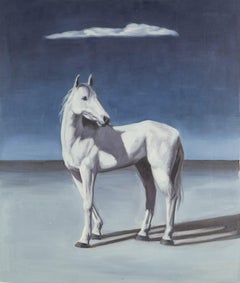
White Horse
White Horse

White Horse

By JingYu Wang

Located in New York, NY

Title: White Horse Medium: Oil on canvas Size: 19"" x 19"" Frame: Framing options available! Age: 2000s Condition: Painting appears to be in excellen...

Category

21st Century and Contemporary Contemporary Animal Paintings

Materials

Oil

French School Portrait Blue White Horse Impressionist th century  Original AUC

French School Portrait Blue White Horse Impressionist th century Original AUC

By Bazevian DelaCapuciniere

Located in Zofingen, AG

White Horse Animal portrait closeup. Technique: oil, acrylic, and ink on old book pages on wooden frame 40x40cm ■■ 15,8x15,8 inch Sustainability: Wooden frame is made by the arti...

Category

Early 1900s Tonalist Animal Paintings

Materials

Ink, Oil, Acrylic

There There
There There

There There

By Sila Sehrazat Yucel

Located in New York, NY

Sila Sehrazat Yucel is a talented artist based in Istanbul. Her background in landscape and interior architecture shapes her creative vision. With experience as an art director in ci...

Category

2010s Contemporary Animal Prints

Materials

Archival Pigment

A Standing Leap at a Gate

A Standing Leap at a Gate

By James Seymour

Located in Stoke, Hampshire

James Seymour (1702-1752) A Standing Leap at a Gate Mezzotint with hand colouring Image size 10 x 14 in Framed size 16 1/2 x 20 in James Seymour was an English artist renowned for h...

Category

18th Century Old Masters Animal Paintings

Materials

Mezzotint

Geometric Horse 1, Original Painting

Geometric Horse 1, Original Painting

By Guigen Zha

Located in San Francisco, CA

Artist Comments
A horse stands still, exhibiting a relaxed character. Geometric shapes render the equine's form into a simplified, modern image. The bright color contrasts add ...

Category

21st Century and Contemporary Contemporary Animal Paintings

Materials

Acrylic

The Edge
The Edge

The Edge

By Michelle Kondos

Located in Colorado Springs, CO

Original Oil Painting signed by the Artist on the lower left.

Category

21st Century and Contemporary Realist Figurative Paintings

Materials

Oil

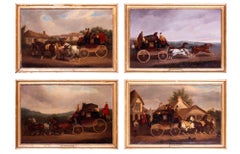
Set Four Antique English Oil Paintings Equestrian Horses Hunting Sanderson-Wells

Set Four Antique English Oil Paintings Equestrian Horses Hunting Sanderson-Wells

By John Sanderson-Wells

Located in London, GB

Set Four Antique English Oil Paintings Equestrian Horses Hunting Sanderson-Wells British, c. 1900 Canvas: Height 41cm, width 62cm Frame: Height 51cm, width 71cm, depth 4cm This cap...

Category

Early 20th Century Figurative Paintings

Materials

Canvas, Oil

'Tanks #1' — American Precisionism

'Tanks #1' — American Precisionism

By Louis Lozowick

Located in Myrtle Beach, SC

Louis Lozowick, 'Tanks #1', lithograph, 1929, edition 50, Flint 39. Signed, titled, and numbered '11/50' in pencil. Signed with the artist's monogram in the stone, lower left. A superb, richly-inked impression, on cream wove paper, the full sheet with margins (3/4 to 1 7/8 inches), in excellent condition. Matted to museum standards. Image size 13 15/16 x 8 1/16 inches (355 x 204 mm), sheet size 15 3/4 x 11 1/4 inches (400 x 286 mm). Exhibited: 'The American Scene: Prints from Hopper to Pollock', Stephen Coppel, The British Museum, 2008. Literature: 'Prints and Their Creators, A World History', Carl Zigrosser, Crown Publishers Inc, 1974; 'American Lithographers...

Category

1920s American Modern Figurative Prints

Materials

Lithograph

France Acrylic on canvas “Horse Race”, León Lafourcade

France Acrylic on canvas “Horse Race”, León Lafourcade

Located in Valladolid, ES

Exquisite painting by Léolaf, the artistic name of León Lafourcade, a French-born artist active between the 19th and 20th centuries. He participated in various exhibitions, including...

Category

Late 19th Century Impressionist Animal Paintings

Materials

Acrylic

19th century color lithograph landscape figures horseback house scene trees sky

19th century color lithograph landscape figures horseback house scene trees sky

By Nathaniel Currier

Located in Milwaukee, WI

The present print is one of several examples produced for Nathaniel Currier by his longtime collaborator Frances F. "Fanny" Palmer. Harry T. Peters wrote of her: "There is no more interesting and appealing character among the group of artists who worked for Currier & Ives than Fanny Palmer. In an age when women, well-bred women in particular, did not generally work for a living Fanny Palmer for years did exacting, full-time work in order to support a large and dependent family ... Her work ... had great charm, homeliness, and a conscientious attention to detail." One of a series of four prints showing American country life in different seasons, the image presents the viewer with a picturesque view of a successful American farm. In the foreground, a gentleman rides a horse with a young boy before a respectable Italianate country house. Two women and a young girl pick flowers in the garden and several farm workers attend to their duties. Beyond are other homes and a city on the coast. 16.63 x 23.75 inches, artwork 28.13 x 33.38 inches, frame Entitled bottom center "American Country Life - May Morning" Signed in the stone, lower left "F.F. Palmer, Del." Signed in the stone, lower right "Lith. by N. Currier" Copyrighted lower center "Entered according to Act of Congress in the year 1855 by N. Currier in the Clerk's office of the Southern District of N.Y." Inscribed bottom center "New York, Published by N. Currier 152 Nassau Street" Framed to conservation standards using silk-lined 100 percent rag matting and Museum Glass with a gold gilded liner, all housed in a stained wood moulding. Nathaniel Currier was a tall introspective man with a melancholy nature. He could captivate people with his piercing stare or charm them with his sparkling blue eyes. Nathaniel was born in Roxbury, Massachusetts on March 27th, 1813, the second of four children. His parents, Nathaniel and Hannah Currier, were distant cousins who lived a humble yet spartan life. When Nathaniel was eight years old, tragedy struck. Nathaniel’s father unexpectedly passed away leaving Nathaniel and his eleven-year-old brother Lorenzo to provide for the family. In addition to their mother, Nathaniel and Lorenzo had to care for six-year-old sister Elizabeth and two-year-old brother Charles. Nathaniel worked a series of odd jobs to support the family, and at fifteen, he started what would become a life-long career when he apprenticed in the Boston lithography shop of William and John Pendleton. A Bavarian gentleman named Alois Senefelder invented lithography just 30 years prior to young Nat Currier’s apprenticeship. While under the employ of the brothers Pendleton, Nat was taught the art of lithography by the firm’s chief printer, a French national named Dubois, who brought the lithography trade to America. Lithography involves grinding a piece of limestone flat and smooth then drawing in mirror image on the stone with a special grease pencil. After the image is completed, the stone is etched with a solution of aqua fortis leaving the greased areas in slight relief. Water is then used to wet the stone and greased-ink is rolled onto the raised areas. Since grease and water do not mix, the greased-ink is repelled by the moisture on the stone and clings to the original grease pencil lines. The stone is then placed in a press and used as a printing block to impart black on white images to paper. In 1833, now twenty-years old and an accomplished lithographer, Nat Currier left Boston and moved to Philadelphia to do contract work for M.E.D. Brown, a noted engraver and printer. With the promise of good money, Currier hired on to help Brown prepare lithographic stones of scientific images for the American Journal of Sciences and Arts. When Nat completed the contract work in 1834, he traveled to New York City to work once again for his mentor John Pendleton, who was now operating his own shop located at 137 Broadway. Soon after the reunion, Pendleton expressed an interest in returning to Boston and offered to sell his print shop to Currier. Young Nat did not have the financial resources to buy the shop, but being the resourceful type he found another local printer by the name of Stodart. Together they bought Pendleton’s business. The firm ‘Currier & Stodart’ specialized in "job" printing. They produced many different types of printed items, most notably music manuscripts for local publishers. By 1835, Stodart was frustrated that the business was not making enough money and he ended the partnership, taking his investment with him. With little more than some lithographic stones, and a talent for his trade, twenty-two year old Nat Currier set up shop in a temporary office at 1 Wall Street in New York City. He named his new enterprise ‘N. Currier, Lithographer’ Nathaniel continued as a job printer and duplicated everything from music sheets to architectural plans. He experimented with portraits, disaster scenes and memorial prints, and any thing that he could sell to the public from tables in front of his shop. During 1835 he produced a disaster print Ruins of the Planter's Hotel, New Orleans, which fell at two O’clock on the Morning of the 15th of May 1835, burying 50 persons, 40 of whom Escaped with their Lives. The public had a thirst for newsworthy events, and newspapers of the day did not include pictures. By producing this print, Nat gave the public a new way to “see” the news. The print sold reasonably well, an important fact that was not lost on Currier. Nat met and married Eliza Farnsworth in 1840. He also produced a print that same year titled Awful Conflagration of the Steamboat Lexington in Long Island Sound on Monday Evening, January 18, 1840, by which melancholy occurrence over One Hundred Persons Perished. This print sold out very quickly, and Currier was approached by an enterprising publication who contracted him to print a single sheet addition of their paper, the New York Sun. This single page paper is presumed to be the first illustrated newspaper ever published. The success of the Lexington print launched his career nationally and put him in a position to finally lift his family up. In 1841, Nat and Eliza had their first child, a son they named Edward West Currier. That same year Nat hired his twenty-one year old brother Charles and taught him the lithography trade, he also hired his artistically inclined brother Lorenzo to travel out west and make sketches of the new frontier as material for future prints. Charles worked for the firm on and off over the years, and invented a new type of lithographic crayon which he patented and named the Crayola. Lorenzo continued selling sketches to Nat for the next few years. In 1843, Nat and Eliza had a daughter, Eliza West Currier, but tragedy struck in early 1847 when their young daughter died from a prolonged illness. Nat and Eliza were grief stricken, and Eliza, driven by despair, gave up on life and passed away just four months after her daughter’s death. The subject of Nat Currier’s artwork changed following the death of his wife and daughter, and he produced many memorial prints and sentimental prints during the late 1840s. The memorial prints generally depicted grief stricken families posed by gravestones (the stones were left blank so the purchasers could fill in the names of the dearly departed). The sentimental prints usually depicted idealized portraits of women and children, titled with popular Christian names of the day. Late in 1847, Nat Currier married Lura Ormsbee, a friend of the family. Lura was a self-sufficient woman, and she immediately set out to help Nat raise six-year-old Edward and get their house in order. In 1849, Lura delivered a son, Walter Black Currier, but fate dealt them a blow when young Walter died one year later. While Nat and Lura were grieving the loss of their new son, word came from San Francisco that Nat’s brother Lorenzo had also passed away from a brief illness. Nat sank deeper into his natural quiet melancholy. Friends stopped by to console the couple, and Lura began to set an extra place at their table for these unexpected guests. She continued this tradition throughout their lives. In 1852, Charles introduced a friend, James Merritt Ives, to Nat and suggested he hire him as a bookkeeper. Jim Ives was a native New Yorker born in 1824 and raised on the grounds of Bellevue Hospital where his father was employed as superintendent. Jim was a self-trained artist and professional bookkeeper. He was also a plump and jovial man, presenting the exact opposite image of his new boss. Jim Ives met Charles Currier through Caroline Clark, the object of Jim’s affection. Caroline’s sister Elizabeth was married to Charles, and Caroline was a close friend of the Currier family. Jim eventually proposed marriage to Caroline and solicited an introduction to Nat Currier, through Charles, in hopes of securing a more stable income to support his future wife. Ives quickly set out to improve and modernize his new employer’s bookkeeping methods. He reorganized the firm’s sizable inventory, and used his artistic skills to streamline the firm’s production methods. By 1857, Nathaniel had become so dependent on Jims’ skills and initiative that he offered him a full partnership in the firm and appointed him general manager. The two men chose the name ‘Currier & Ives’ for the new partnership, and became close friends. Currier & Ives produced their prints in a building at 33 Spruce Street where they occupied the third, fourth and fifth floors. The third floor was devoted to the hand operated printing presses that were built by Nat's cousin, Cyrus Currier, at his shop Cyrus Currier & Sons in Newark, NJ. The fourth floor found the artists, lithographers and the stone grinders at work. The fifth floor housed the coloring department, and was one of the earliest production lines in the country. The colorists were generally immigrant girls, mostly German, who came to America with some formal artistic training. Each colorist was responsible for adding a single color to a print. As a colorist finished applying their color, the print was passed down the line to the next colorist to add their color. The colorists worked from a master print displayed above their table, which showed where the proper colors were to be placed. At the end of the table was a touch up artist who checked the prints for quality, touching-in areas that may have been missed as it passed down the line. During the Civil War, demand for prints became so great that coloring stencils were developed to speed up production. Although most Currier & Ives prints were colored in house, some were sent out to contract artists. The rate Currier & Ives paid these artists for coloring work was one dollar per one hundred small folios (a penny a print) and one dollar per one dozen large folios. Currier & Ives also offered uncolored prints to dealers, with instructions (included on the price list) on how to 'prepare the prints for coloring.' In addition, schools could order uncolored prints from the firm’s catalogue to use in their painting classes. Nathaniel Currier and James Merritt Ives attracted a wide circle of friends during their years in business. Some of their more famous acquaintances included Horace Greeley, Phineas T. Barnum, and the outspoken abolitionists Rev. Henry Ward, and John Greenleaf Whittier (the latter being a cousin of Mr. Currier). Nat Currier and Jim Ives described their business as "Publishers of Cheap and Popular Pictures" and produced many categories of prints. These included Disaster Scenes, Sentimental Images, Sports, Humor, Hunting Scenes, Politics, Religion, City and Rural Scenes, Trains, Ships, Fire Fighters, Famous Race Horses, Historical Portraits, and just about any other topic that satisfied the general public's taste. In all, the firm produced in excess of 7500 different titles, totaling over one million prints produced from 1835 to 1907. Nat Currier retired in 1880, and signed over his share of the firm to his son Edward. Nat died eight years later at his summer home 'Lion’s Gate' in Amesbury, Massachusetts. Jim Ives remained active in the firm until his death in 1895, when his share of the firm passed to his eldest son, Chauncey. In 1902, faced will failing health from the ravages of Tuberculosis, Edward Currier sold his share of the firm to Chauncey Ives...

Category

Mid-19th Century Romantic Figurative Prints

Materials

Watercolor, Lithograph

Original Oil on Canvas, Margaret Collyer. "Father O'Flynn"

Original Oil on Canvas, Margaret Collyer. "Father O'Flynn"

Located in Mere, GB

Margaret Collyer, (1872 - 1945). A London painter of animal scenes, whether horse portraits or dramatic highland scenes such as her "Lord of the Isles". She exhibited at the Royal Ac...

Category

1880s Animal Paintings

Materials

Oil

Antique Pair of Russian Wolf Hound/Borzoi Dog Portrait Sculptures circa 1930's

Antique Pair of Russian Wolf Hound/Borzoi Dog Portrait Sculptures circa 1930's

Located in SANTA FE, NM

Antique Pair of Russian Wolfhounds/Borzois Dog Portrait Sculptures by Scalini (aka Scali; Italian, 20th century) circa 1930's Patinated spelter 9 x 14 inches (on bases) Though rath...

Category

1920s Art Deco Figurative Sculptures

Materials

Cast Stone, Bronze

Traditional English Painting Water Mill in Winter Snow with Horse

Traditional English Painting Water Mill in Winter Snow with Horse

By English School

Located in Cirencester, Gloucestershire

Artist/ School: Norman A. Olley ( British, 20th Century, 1908-1996), dated 1990, signed to the front and inscribed verso Title - "Snow Bound" Road to the Green, Water Mill. English ...

Category

Late 20th Century Impressionist Landscape Paintings

Materials

Acrylic

19thC  portrait of the Duc De Chartres and Louis Philippe with their horses

19thC portrait of the Duc De Chartres and Louis Philippe with their horses

Located in Woodbury, CT

Well painted late 19th century watercolor of the Duc De Chartres and Louis Philippe with their horses out Fox hunting. The piece is a fine quality watercolor, well framed in an Eng...

Category

1890s Victorian Portrait Paintings

Materials

Watercolor

A light chaise and four

A light chaise and four

By John Cordrey

Located in Stoke, Hampshire

John Cordrey (c.1765-1825) A light chaise and four signed 'J.Cordrey/1793' lower left Oil on canvas Canvas Size 13 x 17 in Framed Size 15 1/2 x 20 1/2 in John Cordrey (active c. 179...

Category

18th Century Folk Art Animal Paintings

Materials

Oil

English Original Painting The Trojan Horse Entering City of Troy

English Original Painting The Trojan Horse Entering City of Troy

Located in Cirencester, Gloucestershire

Story of the wooden horse (The Trojan Horse entering Troy) Percy Tarrant (1855 - 1934) British oil on board, unframed 4.5 x 5.75 inches inscribed in penc...

Category

Early 20th Century English School Still-life Paintings

Materials

Oil

Girl with horse
Girl with horse

Girl with horse

By Cooper Seykens

Located in Paris, France

Cooper Seyken's photography is an estament to his ability to capture raw emotion and authenticity. His signature style attracted attention, leading people to request similar portrait...

Category

2010s Contemporary Black and White Photography

Materials

Black and White

Epic Western III
Epic Western III

Epic Western III

By Jim Krantz

Located in New York, NY

Listing includes framing with UV plexiglas (a $1,500 value) and a 14-day return policy. Shipping charged at a discounted rate worldwide via white glove delivery service. Please inquire if you would like to purchase an unframed print for a reduced rate. Available for local pick up at our Los Angeles gallery. Jim Krantz Epic Western III, 2019 40 x 68 inch chromogenic print Edition 5 of 5 Signed on signature label. Artist Biography - Krantz occupies a unique place in the history of contemporary art for his imagery blending western landscape photography with the figure of the cowboy as depicted and romanticized in American popular culture. The technical underpinning of his work was established when he studied with Ansel Adams and Paul Caponigro, but perhaps more importantly, Krantz’s work reflects a dictum that he learned from Adams: “Technical proficiency leads to artistic freedom.” His range and versatility are his forte, working with ease in demanding and ever-changing conditions. If Krantz’s work looks familiar, it is not surprising. Krantz, had been documenting the cinematic vistas of the American West for 20 years on commercial assignments and these much published images caught the eye of appropriation artist, Richard Prince, known for re-photographing advertisements and presenting the resulting images in a new “conceptual” context. Prince’s most famous series is his large scale reproductions of the cowboy images...

Category

2010s Color Photography

Materials

Photographic Paper, Archival Pigment

Four Framed Ghost Rider Cowboy - Pop Art Color Photograph

Four Framed Ghost Rider Cowboy - Pop Art Color Photograph

By Natasha Heidler

Located in Cambridge, GB

A set of four framed artworks, Ghost Rider Cowboy Blue, Purple Cyan and Mauve, pop art photograph by Natasha Heidler. Natasha Heidler’s seductive images are a playful collection of ...

Category

2010s Pop Art Color Photography

Materials

Photographic Paper, C Print, Color, Silver Gelatin

"Two Horses", Surreal Landscape with Astronaut, Giant Stone Head, and Two Horses

"Two Horses", Surreal Landscape with Astronaut, Giant Stone Head, and Two Horses

By Scott Listfield

Located in Philadelphia, PA

This piece titled "Two Horses" is an original artwork by Scott Listfield and is made of oil on canvas. It measures 20"h × 16"w and is signed en verso by the artist. Scott Listfield ...

Category

21st Century and Contemporary Contemporary Landscape Paintings

Materials

Canvas, Oil

19th century Beach Landscape in Scheveningen, Holland with fishing boats, people

19th century Beach Landscape in Scheveningen, Holland with fishing boats, people

By Edward William Cooke

Located in Woodbury, CT

Edward William Cooke RA (1811–1880) Dutch Beach at Scheveningen, oil on canvas, circa 1850 This sweeping coastal scene by Edward William Cooke, painted circa 1850, captures the bust...

Category

1850s Victorian Landscape Paintings

Materials

Canvas, Oil