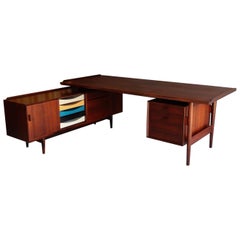
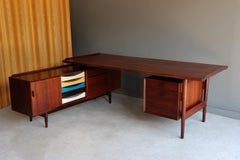
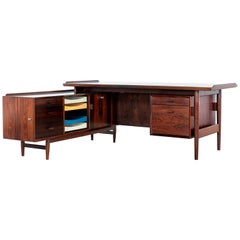
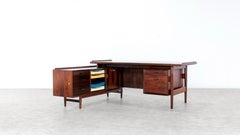
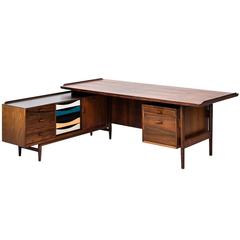
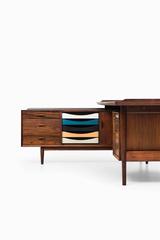
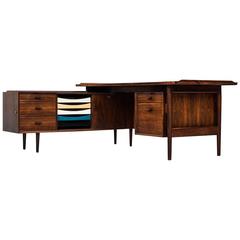
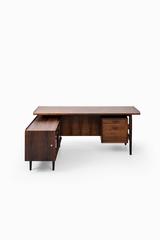
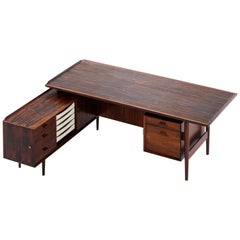
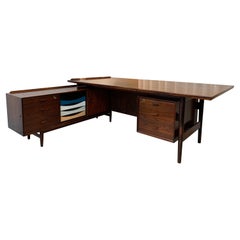
Along with Vernor Panton, cabinetmaker and architect Arne Vodder was a leading light of what might be called the “second generation” of forward-thinking 20th-century Danish furniture designers — those who, following in the footsteps of Hans Wegner, Arne Jacobsen, Finn Juhl and others, first applied the skills, traditions and philosophical tenets of Scandinavian craftsmanship to a modern furniture idiom.
Vodder was a graduate student in architecture trained by Juhl, a pioneer of furniture design credited with igniting the Scandinavian modernist movement that swept like wildfire across the United States in the postwar era. Vodder made his mark in the 1960s, when modern design had gained wide acceptance, particularly in the business world. Accordingly, many of Vodder's chairs, created for manufacturers such as France & Søn, Fritz Hansen and Sibast, are quiet in form — projecting an air of sturdiness and strength, rather than avant-garde styling.
Vodder’s aesthetic flair is very pronounced in his vintage cabinets and storage pieces — sideboards, bookcases, credenzas and buffets. In such pieces, the designer liked to play with asymmetry.
Vodder’s bookcases often have a seemingly random array of variously sized shelves and nooks. A typical Vodder sideboard of the mid-century period — his classic Model 29 case piece is known to collectors — might have four sections, each different in purpose and look: an open stack of vertical shelves, and other cupboards covered with sliding panels in contrasting colored laminates and wood veneers.
As you will see from the works on 1stDibs, Vodder had a sense of what kind of design was appropriate for which space: sobriety in the boardroom; playfulness at home.
Find vintage Arne Vodder furniture for sale on 1stDibs.
Choosing the perfect writing desk or writing table is a profoundly personal journey, one that people have been embarking upon for centuries.
Queen Atossa of Persia, from her writing table circa 500 B.C., is said to have been the originator of the art of handwritten letters. Hers was reportedly the first in a long and colorful history of penned correspondence that grew in popularity alongside literacy. The demand for suitable writing desks, which would serve the composer of the letters as well as ensure the comfort of the recipient naturally followed, and the design of these necessary furnishings has evolved throughout history.
Once people began to seek freedom from the outwardly ornate styles of the walnut and rosewood writing desks and drafting tables introduced in the name of Queen Victoria and King Louis XV, radical shifts occurred, such as those that materialized during the Art Nouveau period, when designers longed to produce furniture inspired by the natural world’s beauty. A prime example is the work of the famous late-19th-century Spanish architect Antoni Gaudí — his rolltop desk featured deep side drawers and was adorned with carved motifs that paid tribute to nature. Gaudí regularly combined structural precision with decorative elements, creating beautiful pieces of furniture in wood and metal.
Soon afterward, preferences for sleek, geometric, stylized forms in furniture that saw an emphasis on natural wood grains and traditional craftsmanship took hold. Today, Art Deco desks are still favored by designers who seek to infuse interiors with an air of luxury. One of the most prominent figures of the Art Deco movement was French decorator and furniture designer Émile-Jacques Ruhlmann. With his use of neoclassical motifs as well as expensive and exotic materials such as imported dark woods and inlays of precious metals for his writing desks, Ruhlmann came to symbolize good taste and modernity.
The rise in appreciation for Scandinavian modernism continues to influence the design of contemporary writing desks. It employs the “no fuss” or “less is more” approach to creating a tasteful, sophisticated space. Sweden’s master cabinetmaker Bruno Mathsson created gallery-worthy designs that are as functional as they are beautiful. Finnish architect Alvar Aalto never viewed himself as an artist, but, like Mathsson, his furniture designs reflected a fondness for organic materials and a humanistic approach. Danish designers such as Hans Wegner introduced elegant shapes and lines to mid-century desks and writing tables, often working in oak and solid teak.
From vintage desks to contemporary styles, 1stDibs offers a broad spectrum of choices for conducting all personal and business writing and reading activities.