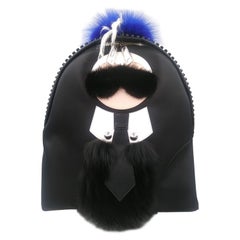
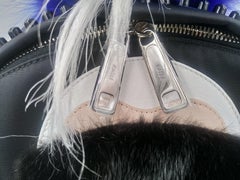
Fendi Karlito Black Backpack
By Karl Lagerfeld for Fendi, Fendi
Located in Lugano, Ticino
Fendi Karlito Backpack, Special edition "Karl Love Fendi" tribute to Karl Lagerfeld - 100
Category
Fendi Karlito Black Backpack
By Karl Lagerfeld for Fendi, Fendi
Located in Lugano, Ticino
Fendi Karlito Backpack, Special edition "Karl Love Fendi" tribute to Karl Lagerfeld - 100
Like other major European luxury fashion houses, Fendi started small. Adele Casagrande was an Italian creative who loved fashion and sold leather and fur accessories from a tiny workshop she opened in Rome in 1918. However, after marrying Edoardo Fendi in 1925, her business model was altered dramatically. Together, the couple changed the boutique’s name to Fendi and moved into a bigger storefront, which quickly became the favorite shop of women all over Italy’s capital city for furs and leathers, such as handbags, coats and accessories.
As time moved on for Adele and Edoardo, the couple began to distribute more responsibility to their five daughters, who assumed management of the company during the 1950s. Fendi’s audience broadened and its profitability has soared over the years, owing to the brand’s fresh perspective on fashion world happenings and innovative sensibility.
The maison also has a distinctive relationship with old-world Italian craftsmanship. The Selleria bags were the work of master saddlers in Rome, and Fendi partnered with lace artisans in southern Italy as well as craftsmen in the east trained in the intrecciato (intertwined) technique (an idea that Adele introduced during the 1940s), which, in Fendi’s case, sees an interwoven leather fabric integrated in the creation of its handbags, countering leather’s traditional rigidity with a bag that is soft, versatile and fitted with an alluring slouchy curve.
It wasn’t until 1965, however, when a young German designer named Karl Lagerfeld took the creative helm that Fendi became a world-renowned fashion house. In fact, Lagerfeld, who produced four to five collections yearly for the brand, is credited with creating Fendi’s instantly recognizable double-F logo (which stands for “Fun Furs”) in “less than five seconds.” Until Lagerfeld started designing for the brand, fur was a material mostly associated with heavy coats that few people actually wore. Lagerfeld reimagined fur in creative ways, using it as an accent on purses, cuffs on dress sleeves and collars on wool coats.
Over the ensuing years, Fendi has broken into the home-goods market with Fendi Casa and has become synonymous with luxury fashion, producing such pieces as the iconic Baguette, which was rendered ever popular on the television series Sex and the City. In fact, an entire episode during the third season was dedicated to the “original It bag,” a slim accessory tapered in a manner that recalls its namesake, designed in 1997 by Adele and Edoardo’s granddaughter Silvia Venturini Fendi, who was named creative director of accessories three years earlier.
Perhaps just as well known as its vintage Baguette handbags and creative use of fur is the brand’s devotion to its Italian roots. In 2013, Fendi donated more than 2 million euros to restore Rome’s Trevi Fountain, and when it was reopened to visitors, Fendi hosted its Autumn/Winter 2017 show on top of the landmark.
Fendi was a family-controlled brand until 1999 and is now owned by LVMH. In late 2020, British fashion designer Kim Jones was named the house’s artistic director for womens wear.
Find a wide variety of vintage Fendi handbags and purses, clothing and other accessories on 1stDibs.
Vintage and designer backpacks do more than carry our books, notebooks, electronic devices and other possessions to and fro. They are also a reflection of personal taste and style. Whether it’s an understated solid color — black backpacks will remain forever timeless — or it’s emblazoned with a dazzling graphic pattern or an iconic fashion house’s logo, a backpack makes a statement.
In 1908, decades before the JanSports and Eastpaks of the world materialized, Norwegian Ole Bergan crafted the first backpack, whittling and shaping a juniper branch to support a robust canvas rucksack on his back. Twenty-five years later, the patent on Bergan’s wildly convenient and functional accessory expired, and backpacks became popular with hikers, campers and other outdoor enthusiasts as other designers and companies scrambled to develop their own iterations. During the late 1930s, the first zippered backpack appeared — for students, it was a significant improvement over carrying their books with a leather belt.
Some designer backpacks are sleek and sporty, while others attract attention with flashy brass hardware and a textured exterior flap. While the innumerable handbag lovers of our modern times continue to gravitate toward iconic labels — classic bags still rule — today’s shoppers are savvier and have a wider range of shopping options. Backpacks designed by universally renowned brands such as Gucci, Dior and Burberry are similarly alluring when it comes to finding the perfect carryall.
Heavy-duty nylon backpacks or those made with polyester are likely the most common, but many alternatives can be found in canvas, leather and suede. The best backpack for you might be one that is modest in size and discreet, and thus ideal for carrying a few items. If that sounds like what you need, explore crossbody bags and messenger bags, as they’re a bit easier to access and you don’t have to remove the bag to get to its contents. Others may seek a bag that is spacious enough to fit all of the supplies for an overnight hike, in which case, a sturdy, structured backpack might be a better fit.
Whether it is for fashion, function or both, there is a backpack suited to every individual. Find yours in the extensive collection of vintage and designer backpacks on 1stDibs.
Iconic Italian fashion houses Fendi and Versace teamed up on this delightfully outrageous Fendace reimagining.
When the name of a bag is as well-known as its brand, you know it's a classic.