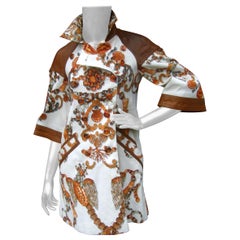
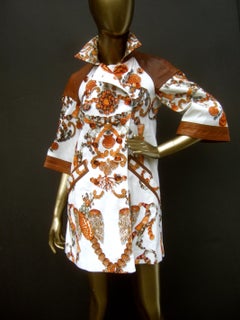
Gucci Rare Cotton & Leather Trim Sea Life Jacket Size 38 c 1990s
By Gucci
Located in University City, MO
Gucci Rare Italian cotton & leather trim sea life jacket Size 38 The chic Italian coat is
Category
Gucci Rare Cotton & Leather Trim Sea Life Jacket Size 38 c 1990s
By Gucci
Located in University City, MO
Gucci Rare Italian cotton & leather trim sea life jacket Size 38 The chic Italian coat is
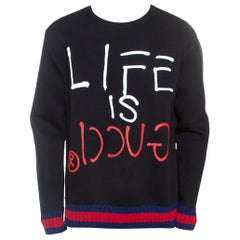
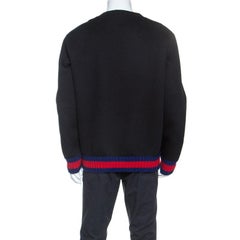
Gucci Black Printed Cotton Contrast Trim Life is Gucci Sweatshirt XXL
By Gucci
Located in Dubai, Al Qouz 2
you comfort and designed with their web trims and 'LIFE IS GUCCI' printed on the front. This creation
Long before trend-bucking creative director Alessandro Michele brought his hallucinatory “Utopian Fantasy” campaign to Gucci, it was a modest Italian leather shop. Today, it’s an internationally renowned luxury house with an iconic logo, and vintage Gucci clothing, handbags and shoes are among high fashion's most covetable goods.
Guccio Gucci (1881–1953) admired the stylish suitcases he saw wealthy guests arrive with at the Savoy Hotel in London, where he worked as a bellhop. So, in 1921, after a stint at Franzi, a luggage company in his hometown of Florence, he opened a leather goods shop of his own.
At first, Gucci’s Florence business specialized in equestrian accessories. But as its reputation flourished, particularly among the English aristocracy, so too did its footprint. In 1938, he brought three of his sons — Aldo, Vasco and Rodolfo — into the business and expanded it to Rome and later Milan. In the mid-1930s, a League of Nations embargo against Italy pushed Gucci to experiment with alternatives to imported leather. Its woven hemp fabric from Naples, adorned with the brand’s signature diamond print, was a hit, especially among A-list celebrities. The material was first used on suitcases before finding enduring popularity on handbags. (No list of revered designer purses would be complete without Gucci.)
In the 1950s, Elizabeth Taylor carried one of Gucci’s bamboo-handled tote bags, another adaptation to material rationing. After Jackie Kennedy was seen sporting a slouchy Gucci tote in 1961, it was renamed for the First Lady. Then Grace Kelly, on a visit to the boutique in Milan, inspired Rodolfo Gucci to work with Italian illustrator and Gucci textile designer Vittorio Accornero on the Flora print in 1966. Taking cues from Sandro Botticelli’s Primavera, with its pattern of flora and insects, it was painted entirely by hand and featured no fewer than 37 colors.
In 1953, just 15 days after opening his first store on New York’s 5th Avenue, Guccio passed away at 72. The early 1970s saw store openings in Tokyo and Hong Kong, but by the late 1980s, Gucci was floundering. Rodolfo Gucci took charge in 1982, but family drama and lawsuits ensued. In 1993, Rodolfo’s son, Maurizio, transferred his shares in the company to Investcorp, ending the family’s involvement in Gucci. Dawn Mello, then-president of Bergdorf Goodman, joined as creative director in 1989. But it was Tom Ford, who took over as creative director in 1994, who ultimately revived the brand.
Ford’s racy ads, shot by photographers such as Mario Testino, stirred controversy. And his potent vision of sexed-up femininity — with “jewel-toned satin shirts unbuttoned to there,” as Vogue described his breakthrough 1995 runway show — was wildly successful. The new millennium brought new ownership — Pinault Printemps Redoute in 2004 — and a more toned-down vision from Frida Giannini, who became sole creative director in 2006. Alessandro Michele was named creative director in 2015, and the storied brand took a giant leap forward.
Find vintage Gucci clothing and accessories on 1stDibs.
No matter if you’re preparing for a fashion event or a weather event — you’re going to need a good jacket.
What would become the modern jacket as we know it began as a strictly professional item. A lot of the vintage and designer jackets (and coat styles such as the Navy-inspired peacoat) in our closets were likely popularized by soldiers who battled aggressive climes with their regulation field jackets, bombers and parkas buttoned or zipped to the chin. Indeed, keeping troopers comfortable guided the design of the military surplus garments that have often become buzzy fashion trends. But now, jackets add far more than warmth to our wardrobe, and we hunt down outer layers branded with peerless fashion labels.
Fashion’s most iconic creations, despite their age, remain modern: Biker jackets originated in the 1920s, Balenciaga’s celebrated puffers are steeped in a tradition of down coats that began in the 1930s and your vintage denim jacket has come an even longer way, from California Gold Rush to wardrobe staple. Jeans bequeathed jean jackets during the 1880s, thanks to Levi Strauss, who crafted the former as a durable garment to be worn by miners and railroad workers. Later, jeans and jean jackets became synonymous with nonconformity and rebelliousness — with fashion legends such as actor James Dean in the 1950s and model Veruschka in the 1960s and ’70s leading the indigo-toned charge.
Another fashion rebel, Coco Chanel, used the classic tweed jacket to introduce more comfort and mobility into women’s daily lives. Debuting in 1954 and based on a cardigan, the groundbreaking Chanel jacket forever changed what women wear. The garment reacted against the fitted, constricting styles of Christian Dior’s New Look, which, as Chanel saw it, was making women dress like decorative objects.
On 1stDibs, find bold collections from cutting-edge contemporary designers who’ve taken the classic silhouette of the jacket to new heights or build out your array of vintage treasures (denim or otherwise) with dazzlers from Yves Saint Laurent, Gianni Versace, Moschino and more.