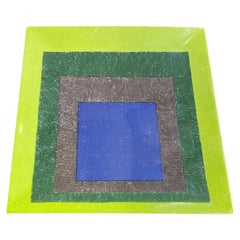
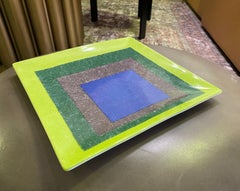
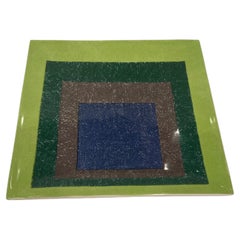
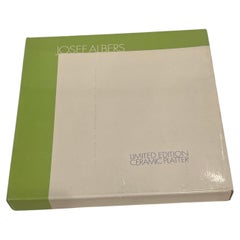
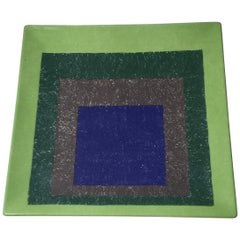
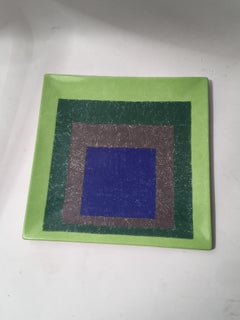
Surely you’ll find the exact josef albers ceramic you’re seeking on 1stDibs — we’ve got a vast assortment for sale. In our selection of items, you can find
contemporary examples as well as an
abstract version. Finding the perfect josef albers ceramic may mean sifting through those created during different time periods — you can find an early version that dates to the 20th Century and a newer variation that were made as recently as the 21st Century. On 1stDibs, the right josef albers ceramic is waiting for you and the choices span a range of colors that includes
beige,
gray,
black and
blue. Finding an appealing josef albers ceramic — no matter the origin — is easy, but
Lauren Mabry,
Audrey Flack,
Josef Albers and
Al Loving each produced popular versions that are worth a look. Artworks like these of any era or style can make for thoughtful decor in any space, but a selection from our variety of those made in
ceramic,
glaze and
acrylic paint can add an especially memorable touch.
The German-born American painter, writer, and educator Josef Albers was a pioneer of 20th century modernism, and an innovative practitioner of color theory. With his wife, the textile artist and printmaker Anni Albers (1899–1994), he shaped the development of a generation of American artists and designers through his teaching at the experimental Black Mountain College in North Carolina, and later at Yale University School of Art, where he was the chairman of the department of design from 1950–1958. Albers is widely known for his series of prints and paintings "Homages to the Square," which he created between 1950 and 1975. His influential volume on color theory The Interaction of Color was published in 1963.
Albers was born in Bottrop, Germany, and as a young man he studied art education, earning certification from the Königliche Kunstschule in Berlin in 1915. He entered the legendary Bauhaus school in Weimar in 1920. The Bauhaus had been established by Walter Gropius in 1919, in the immediate aftermath of World War I, with the hope that its innovative curriculum would foster connections between architecture, art, and traditional crafts. In 1923 Albers began teaching the Vorkurs, the introductory class in which new students learned to work with each of the key artists’ materials, along with color theory, composition, construction and design.
Albers was a polymath, and the multidisciplinary environment of the Bauhaus was fertile ground for his artistic ambitions. When the school moved from Weimar to Dessau in 1925, he became a full professor, and in addition to glass and metal, he designed typefaces and furniture. While at the Bauhaus, Albers drew inspiration from the work of his colleagues, the color theorist Johannes Itten, and the painter, photographer, and designer László Moholy-Nagy, with whom he co-taught the Vorkurs.
In 1933, the Bauhaus was shut down due to pressure from the Nazi Party, which perceived the school as being sympathetic to communist intellectuals. As Albers’ wife Anni was Jewish, the couple resolved to leave Germany, and settled in rural North Carolina. The architect Philip Johnson helped make arrangements for Albers to join the faculty of Black Mountain College as the head of the painting program, where he remained until 1949. While at Black Mountain, both Josef and Anni Albers became influential mentors to American artists including Ruth Asawa, Cy Twombly, and Robert Rauschenberg, while working alongside fellow professors Buckminster Fuller, John Cage, Merce Cunningham and William de Kooning.
In 1950, Albers joined the faculty of the Yale University School of Art where he would head the newly established Department of Design until his retirement in 1958. In the 1950s, the Alberses began taking trips to Mexico, where the colors and forms of the local art and architecture inspired both artists.
In 1971, Albers became the first living artist whose work was the subject of a solo retrospective at the Metropolitan Museum of Art. Though they worked in different mediums, Josef and Anni Albers’ work shares a fascination with color and geometry. Josef Albers’ compositions from the "Homages to the Square" series, such as Formulation: Articulation Portfolio II Folder 28 (B), from 1972, give deceptively simple shapes a novel vibrance as colors play off of one another. The hues in Articulation Portfolio II Folder 28 (B) work in concert to give the flat surface the distinct appearance of a tunnel or other three-dimensional space; while the form on the left appears to move towards the viewer, the form on the right seems to lead directly into the canvas. Similarly, Anni Albers’ designs for textiles use graphic design to lend a sense of dynamism to flat works. Her Study for Unexecuted Wall Hanging (Bauhaus), from 1984 is a Mondrian-like pattern for a weaving in which different colors alternately recede and advance into the foreground, giving the image a sense of complexity and uncanny depth.
Josef Albers also created works of public art, including a delicate, geometric gold leaf mural called Two Structural Constellations for the lobby of the Corning Glass building in New York City in 1959. He designed a work called Two Portals for the lobby of the Time & Life Building in 1961, in which which and brown bands move towards two square panels made of bronze. Walter Gropius invited Albers to create a piece for the Pan Am Building, which he was designing with the architectural firm of Emery Roth & Sons. Albers reworked an existing glass piece from his Bauhaus days called City, and, fittingly, renamed it Manhattan.
Find a collection of authentic Josef Albers art on 1stDibs.