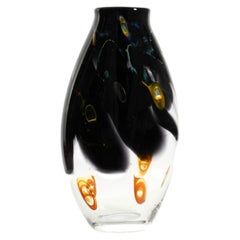
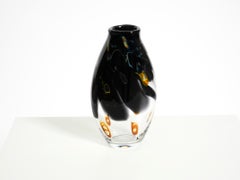
For almost 200 years, Val Saint Lambert of Seraing, Belgium, has produced some of the most elegant and prestigious works of crystal and glass. Holding the distinction of being the world’s only Belgian glassworks, Val Saint Lambert creates exquisite items including ashtrays, serveware, vases and sculptures.
Founded by chemist François Kemlin and engineer Auguste Lelièvre, the company opened its first glassworks in 1826. Its quality manufacturing of heavy-lead crystal and the expert craftsmanship of its wares quickly led to the company’s popularity.
In 1894, Val Saint Lambert exhibited its geometric-cut crystal at the World’s Fair in Antwerp, Belgium. The central piece was “le Vase des Neuf Provinces,” or “The Vase of the Nine Provinces.” Under the direction of French glassmaker Léon Ledru, it took 30 artisans over 2,000 hours to fashion it from 85 individually crafted pieces. The exposure led to Val Saint Lambert becoming the primary crystal used by the Tsars of Russia and the company’s pieces being sold internationally.
That same year, the company crafted two immense crystal chandeliers for the Maharaja of Gwalior to hang in his palace in India. Weighing almost five tons each and measuring over 42 feet high, they were the largest crystal chandeliers in the world at the time.
The company closed its doors for the duration of World War I but soon reopened. By 1926, it had over 5,000 employees and had a growing demand for its pieces made in the Art Deco style.
During World War II, bombing from German and Allied forces destroyed the main glassworks facility. The company rebuilt, but by 1950, crystal was becoming more of a household item and less of a luxury good.
In the subsequent decades, Val Saint Lambert collaborated with notable names to expand its offerings with sophisticated furniture, including work with Philippe Starck and Frans Van Praet. In 1992, Van Praet designed the famed Sevilla chair for Val Saint Lambert, a piece highly prized by collectors and designers.
In 2014, Belgian manufacturer Jacques Somville took over Val Saint Lambert. In 2018, Belgian entrepreneur George Arthur Forrest acquired the majority of the company. Val Saint Lambert continues to make some of the finest glass and crystal wares in the world.
Find Val Saint Lambert lighting, seating and decorative objects on 1stDibs.
Postmodern design was a short-lived movement that manifested itself chiefly in Italy and the United States in the early 1980s. The characteristics of vintage postmodern furniture and other postmodern objects and decor for the home included loud-patterned, usually plastic surfaces; strange proportions, vibrant colors and weird angles; and a vague-at-best relationship between form and function.
ORIGINS OF POSTMODERN FURNITURE DESIGN
- Emerges during the 1960s; popularity explodes during the ’80s
- A reaction to prevailing conventions of modernism by mainly American architects
- Architect Robert Venturi critiques modern architecture in his Complexity and Contradiction in Architecture (1966)
- Theorist Charles Jencks, who championed architecture filled with allusions and cultural references, writes The Language of Post-Modern Architecture (1977)
- Italian design collective the Memphis Group, also known as Memphis Milano, meets for the first time (1980)
- Memphis collective debuts more than 50 objects and furnishings at Salone del Milano (1981)
- Interest in style declines, minimalism gains steam
CHARACTERISTICS OF POSTMODERN FURNITURE DESIGN
- Dizzying graphic patterns and an emphasis on loud, off-the-wall colors
- Use of plastic and laminates, glass, metal and marble; lacquered and painted wood
- Unconventional proportions and abundant ornamentation
- Playful nods to Art Deco and Pop art
POSTMODERN FURNITURE DESIGNERS TO KNOW
VINTAGE POSTMODERN FURNITURE ON 1STDIBS
Critics derided postmodern design as a grandstanding bid for attention and nothing of consequence. Decades later, the fact that postmodernism still has the power to provoke thoughts, along with other reactions, proves they were not entirely correct.
Postmodern design began as an architectural critique. Starting in the 1960s, a small cadre of mainly American architects began to argue that modernism, once high-minded and even noble in its goals, had become stale, stagnant and blandly corporate. Later, in Milan, a cohort of creators led by Ettore Sottsass and Alessandro Mendini — a onetime mentor to Sottsass and a key figure in the Italian Radical movement — brought the discussion to bear on design.
Sottsass, an industrial designer, philosopher and provocateur, gathered a core group of young designers into a collective in 1980 they called Memphis. Members of the Memphis Group, which would come to include Martine Bedin, Michael Graves, Marco Zanini, Shiro Kuramata, Michele de Lucchi and Matteo Thun, saw design as a means of communication, and they wanted it to shout. That it did: The first Memphis collection appeared in 1981 in Milan and broke all the modernist taboos, embracing irony, kitsch, wild ornamentation and bad taste.
Memphis works remain icons of postmodernism: the Sottsass Casablanca bookcase, with its leopard-print plastic veneer; de Lucchi’s First chair, which has been described as having the look of an electronics component; Martine Bedin’s Super lamp: a pull-toy puppy on a power-cord leash. Even though it preceded the Memphis Group’s formal launch, Sottsass’s iconic Ultrafragola mirror — in its conspicuously curved plastic shell with radical pops of pink neon — proves striking in any space and embodies many of the collective’s postmodern ideals.
After the initial Memphis show caused an uproar, the postmodern movement within furniture and interior design quickly took off in America. (Memphis fell out of fashion when the Reagan era gave way to cool 1990’s minimalism.) The architect Robert Venturi had by then already begun a series of plywood chairs for Knoll Inc., with beefy, exaggerated silhouettes of traditional styles such as Queen Anne and Chippendale. In 1982, the new firm Swid Powell enlisted a group of top American architects, including Frank Gehry, Richard Meier, Stanley Tigerman and Venturi to create postmodern tableware in silver, ceramic and glass.
On 1stDibs, the vintage postmodern furniture collection includes chairs, coffee tables, sofas, decorative objects, table lamps and more.
Whether it’s a Chinese Han dynasty glazed ceramic wine vessel, a work of Murano glass or a hand-painted Scandinavian modern stoneware piece, a fine vase brings a piece of history into your space as much as it adds a sophisticated dynamic.
Like sculptures or paintings, antique and vintage vases are considered works of fine art. Once offered as tributes to ancient rulers, vases continue to be gifted to heads of state today. Over time, decorative porcelain vases have become family heirlooms to be displayed prominently in our homes — loved pieces treasured from generation to generation.
The functional value of vases is well known. They were traditionally utilized as vessels for carrying dry goods or liquids, so some have handles and feature an opening at the top (where they flare back out). While artists have explored wildly sculptural alternatives over time, the most conventional vase shape is characterized by a bulbous base and a body with shoulders where the form curves inward.
Owing to their intrinsic functionality, vases are quite possibly versatile in ways few other art forms can match. They’re typically taller than they are wide. Some have a neck that offers height and is ideal for the stems of cut flowers. To pair with your mid-century modern decor, the right vase will be an elegant receptacle for leafy snake plants on your teak dining table, or, in the case of welcoming guests on your doorstep, a large ceramic floor vase for long tree branches or sticks — perhaps one crafted in the Art Nouveau style — works wonders.
Interior designers include vases of every type, size and style in their projects — be the canvas indoors or outdoors — often introducing a splash of color and a range of textures to an entryway or merely calling attention to nature’s asymmetries by bringing more organically shaped decorative objects into a home.
On 1stDibs, you can browse our collection of vases by material, including ceramic, glass, porcelain and more. Sizes range from tiny bud vases to massive statement pieces and every size in between.