Find the exact john glover painting you’re shopping for in the variety available on 1stDibs. You can easily find an example made in the
contemporary style, while we also have 3
contemporary versions to choose from as well. Finding the perfect john glover painting may mean sifting through those created during different time periods — you can find an early version that dates to the 18th Century and a newer variation that were made as recently as the 21st Century. On 1stDibs, the right john glover painting is waiting for you and the choices span a range of colors that includes
brown,
beige,
black and
orange. There have been many interesting john glover painting examples over the years, but those made by
Ushio Shinohara,
Robin Winters,
Bartholomew Dandridge,
Jean-Honoré Fragonard and
Helen Enoch Gleiforst are often thought to be among the most thought-provoking. These artworks were handmade with extraordinary care, with artists most often working in
paint,
oil paint and
canvas.
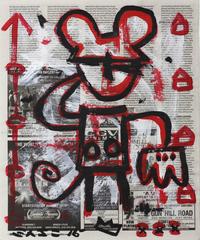
Gary John's passion for street art began in 1985 when he started creating eye-catching works that would eventually captivate audiences around the world. Originally from Seattle, he made his way to Venice Beach in 2003, where he started selling his drawings on the Venice Boardwalk.
After almost ten years of selling his work on the boardwalk and experiencing “a bout with homelessness,” John first exploded onto the international art scene during Art Basel Miami in 2013. John’s playfully bold work quickly gained attention and he was named one of 20 standout artists at the 2014 New York Affordable Art Fair. His artworks continue to be exhibited at galleries and major international art fairs in the United States, Asia, and Europe. Notable collectors include Kelly Clarkson.
John cites Pablo Picasso, Keith Haring, and Jean-Michel Basquiat as his artistic inspirations. Other influences are comic books and American Pop Culture, which he infuses with emotional and impulsive gestures. His mixed media works blur the boundaries between Pop Art and Abstract Expressionism with Street Art elements.
Street art is a style created for city walls, subway trains and other public spaces. Sometimes it is commissioned, yet most often it is an individual statement of defiant free expression. Although mostly an urban style, street art can be found all over the world, including JR’s pasted portraits on the separation wall in Palestine, Invader’s playful ceramic tile mosaics in Paris and the provocative stencil and spray-paint works by Banksy in London.
The Philadelphia-based Cornbread — aka Darryl McCray — is considered the first modern graffiti artist. He began tagging his name around the city in the 1960s. Graffiti art later flourished in New York City in the 1970s. There, young artists used spray paint and markers to create tags and large-scale graphic works, with Jean-Michel Basquiat and Keith Haring both developing their distinctive styles through the graffiti scene, which would evolve into street art. Artists such as Tracy 168 and Lady Pink pioneered the Wild Style of complex graffiti writing in the 1980s, pushing the movement forward.
Because of its unsanctioned, improvisational and frequently covert nature, street art involves a range of techniques and aesthetics. Some street artists use quick and effective stenciling, whereas others wheat-paste posters, commandeer video projectors or freehand draw elaborate illustrations and murals. Shepard Fairey made his mark with street art stickers before designing the iconic “Hope” poster for Barack Obama’s 2008 presidential campaign.
While the origins of street art are rooted in a strictly noncommercial creative act that confronted political issues, sexuality and more for a general audience of passersby, the art form has moved inside the galleries over the years. Today, just as Basquiat and Haring took their works from Manhattan’s Lower East Side alleyways into Soho galleries, artists including KAWS, Barry McGee and Osgemeos are in demand with collectors of fine art.
Find a collection of street art paintings, sculptures, prints and multiples and more on 1stDibs.
Bring audacious experiments with color and textures to your living room, dining room or home office. Abstract paintings, large or small, will stand out in your space, encouraging conversation and introducing a museum-like atmosphere that’s welcoming and conducive to creating memorable gatherings.
Abstract art has origins in 19th-century Europe, but it came into its own as a significant movement during the 20th century. Early practitioners of abstraction included Wassily Kandinsky, although painters were exploring nonfigurative art prior to the influential Russian artist’s efforts, which were inspired by music and religion. Abstract painters endeavored to create works that didn’t focus on the outside world’s conventional subjects, and even when artists depicted realistic subjects, they worked in an abstract mode to do so.
In 1940s-era New York City, a group of painters working in the abstract mode created radical work that looked to European avant-garde artists as well as to the art of ancient cultures, prioritizing improvisation, immediacy and direct personal expression. While they were never formally affiliated with one another, we know them today as Abstract Expressionists.
The male contingent of the Abstract Expressionists, which includes Jackson Pollock, Willem de Kooning and Robert Motherwell, is frequently cited in discussing leading figures of this internationally influential postwar art movement. However, the women of Abstract Expressionism, such as Helen Frankenthaler, Lee Krasner, Joan Mitchell and others, were equally involved in the art world of the time. Sexism, family obligations and societal pressures contributed to a long history of their being overlooked, but the female Abstract Expressionists experimented vigorously, developed their own style and produced significant bodies of work.
Draw your guests into abstract oil paintings across different eras and countries of origin. On 1stDibs, you’ll find an expansive range of abstract paintings along with a guide on how to arrange your wonderful new wall art.
If you’re working with a small living space, a colorful, oversize work can create depth in a given room, but there isn’t any need to overwhelm your interior with a sprawling pièce de résistance. Colorful abstractions of any size can pop against a white wall in your living room, but if you’re working with a colored backdrop, you may wish to stick to colors that complement the decor that is already in the space. Alternatively, let your painting make a statement on its own, regardless of its surroundings, or group it, gallery-style, with other works.