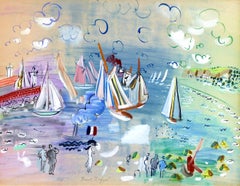
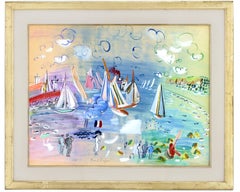
Raoul Dufy Pastel For Sale on 1stDibs
You are likely to find exactly the raoul dufy pastel you’re looking for on 1stDibs, as there is a broad range for sale. Find
Post-Impressionist versions now, or shop for
Post-Impressionist creations for a more modern example of these cherished works. Finding the perfect raoul dufy pastel may mean sifting through those created during different time periods — you can find an early version that dates to the 20th Century and a newer variation that were made as recently as the 20th Century. If you’re looking to add a raoul dufy pastel to create new energy in an otherwise neutral space in your home, you can find a work on 1stDibs that features elements of
gray,
beige,
brown,
blue and more. There have been many interesting raoul dufy pastel examples over the years, but those made by
(after) Pablo Picasso,
Pierre Jerome,
Théo Tobiasse,
Raoul Dufy and
Claude Gaveau are often thought to be among the most thought-provoking. Artworks like these — often created in
lithograph,
paint and
crayon — can elevate any room of your home.
How Much is a Raoul Dufy Pastel?
The price for an artwork of this kind can differ depending upon size, time period and other attributes — a raoul dufy pastel in our inventory may begin at $544 and can go as high as $398,500, while the average can fetch as much as $2,650.
Raoul Dufy for sale on 1stDibs
Raoul Dufy was a renowned French Fauvist painter, famous for his colorful, decorative designs. He was born in Le Havre, Normandy, in 1877. Dufy had a simple upbringing, leaving school at 14 to work at a Brazilian coffee-importing company. His formal artistic education began when he was eighteen at Le Havre's École des Beaux-Arts, where he took evening art classes. He continued to paint within the purlieu of Le Havre and was greatly inspired by the Impressionist landscape painters Claude Monet and Camille Pissarro. In 1900, after serving in the military for one year, Dufy won a scholarship to the École Nationale Supérieure des Beaux-Arts in Paris.
Dufy began painting watercolors of the Norman landscapes but was soon widely celebrated for his brightly colored and bold contoured paintings – in dialogue with the Fauvist style. He remained faithful to Fauvism until Paul Cézanne’s work guided him to embrace a subtler aesthetic. This new mode of sobriety saw his work return to a lighter style, which he celebrated through rapid inscription-like drawings over vivid backgrounds of color washes.
The rise of Cubism in Paris during the first two decades of the 20th century influenced him to develop a systematic approach that was later known as stenographics. Using this he experimented with foreshortened perspective, thin washes of paint and skeletal structures. In this style, he portrayed the lavish scenes of the French Riviera, leisureliness of the period, and chic revelries. Dufy was also fascinated by other amusements such as regattas, horse races and concerts and loved to depict the excitement and commotion of the crowds.
Dufy had his first exhibition in 1901 at the Salon des Artistes Français, following a string of exhibitions over the following years. In 1906 he took part in the Cercle de l’Art Moderne Exhibition in Le Havre with artists Georges Braque, Henri Matisse and Henri Charles Manguin. Dufy was given his first retrospective in 1921 at the Galerie Bernheim-Jeune and in 1932 his first painting was accepted into a national collection. He celebrated two large commissions for the 1937 Exposition Internationals des Artes et Techniques dans la Vie Moderne. The most notable of the two was the adornment for the Pavilion of Light and Electricity. He was commissioned with the task to illustrate the history of electricity from the classical era to its current position in 20th century developments. He painted La Fée électricité, a huge fresco which was donated to the Musée d’Art Moderne in 1964. In 1952 he represented France at the 26th Venice Biennale, where he won the Gran Premio. A year later he died aged 75, of polyarthritis, an illness he had been suffering from since 1937.
Find authentic Raoul Dufy prints, paintings and other art on 1stDibs.
(Biography provided by Stern Pissarro Gallery)
A Close Look at Post-impressionist Art
In the revolutionary wake of Impressionism, artists like Vincent van Gogh, Georges Seurat, Paul Cézanne and Paul Gauguin advanced the style further while firmly rejecting its limitations. Although the artists now associated with Postimpressionist art did not work as part of a group, they collectively employed an approach to expressing moments in time that was even more abstract than that of the Impressionists, and they shared an interest in moving away from naturalistic depictions to more subjective uses of vivid colors and light in their paintings.
The eighth and final Impressionist exhibition was held in Paris in 1886, and Postimpressionism — also spelled Post-Impressionism — is usually dated between then and 1905. The term “Postimpressionism” was coined by British curator and art critic Roger Fry in 1910 at the “Manet and the Postimpressionists” exhibition in London that connected their practices to the pioneering modernist art of Édouard Manet. Many Postimpressionist artists — most of whom lived in France — utilized thickly applied, vibrant pigments that emphasized the brushstrokes on the canvas.
The Postimpressionist movement’s iconic works of art include van Gogh’s The Starry Night (1889) and Seurat’s A Sunday on La Grande Jatte (1884). Seurat’s approach reflected the experimental spirit of Postimpressionism, as he used Pointillist dots of color that were mixed by the eye of the viewer rather than the hand of the artist. Van Gogh, meanwhile, often based his paintings on observation, yet instilled them with an emotional and personal perspective in which colors and forms did not mirror reality. Alongside Mary Cassatt, Cézanne, Henri Matisse and Gauguin, the Dutch painter was a pupil of Camille Pissarro, the groundbreaking Impressionist artist who boldly organized the first independent painting exhibitions in late-19th-century Paris.
The boundary-expanding work of the Postimpressionist painters, which focused on real-life subject matter and featured a prioritization of geometric forms, would inspire the Nabis, German Expressionism, Cubism and other modern art movements to continue to explore abstraction and challenge expectations for art.
Find a collection of original Postimpressionist paintings, mixed media, prints and other art on 1stDibs.
Finding the Right Landscape-paintings for You
It could be argued that cave walls were the canvases for the world’s first landscape paintings, which depict and elevate natural scenery through art, but there is a richer history to consider.
The Netherlands was home to landscapes as a major theme in painting as early as the 1500s, and ink-on-silk paintings in China featured mountains and large bodies of water as far back as the third century. Greeks created vast wall paintings that depicted landscapes and grandiose garden scenes, while in the late 15th century and early 16th century, landscapes were increasingly the subject of watercolor works by the likes of Leonardo da Vinci and Fra Bartolomeo.
The popularity of religious paintings eventually declined altogether, and by the early 19th century, painters of classical landscapes took to painting out-of-doors (plein-air painting). Paintings of natural scenery were increasingly realistic but romanticized too. Into the 20th century, landscapes remained a major theme for many artists, and while the term “landscape painting” may call to mind images of lush, grassy fields and open seascapes, the genre is characterized by more variety, colors and diverse styles than you may think. Painters working in the photorealist style of landscape painting, for example, seek to create works so lifelike that you may confuse their paint for camera pixels. But if you’re shopping for art to outfit an important room, the work needs to be something with a bit of gravitas (and the right frame is important, too).
Adding a landscape painting to your home can introduce peace and serenity within the confines of your own space. (Some may think of it as an aspirational window of sorts rather than a canvas.) Abstract landscape paintings by the likes of Korean painter Seungyoon Choi or Georgia-based artist Katherine Sandoz, on the other hand, bring pops of color and movement into a room. These landscapes refuse to serve as a background. Elsewhere, Adam Straus’s technology-inspired paintings highlight how our extreme involvement with our devices has removed us from the glory of the world around us. Influenced by modern life and steeped in social commentary, Straus’s landscape paintings make us see our surroundings anew.
Whether you’re seeking works by the world’s most notable names or those authored by underground legends, find a vast collection of landscape paintings on 1stDibs.