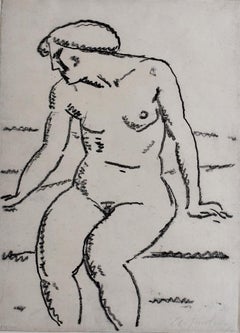
Painting With Face Profile For Sale on 1stDibs
Find the exact painting with face profile you’re shopping for in the variety available on 1stDibs. Find
modern versions now, or shop for
modern creations for a more modern example of these cherished works. If you’re looking for a painting with face profile from a specific time period, our collection is diverse and broad-ranging, and you’ll find at least one that dates back to the 18th Century while another version may have been produced as recently as the 21st Century. If you’re looking to add a painting with face profile to create new energy in an otherwise neutral space in your home, you can find a work on 1stDibs that features elements of
gray,
black,
brown,
white and more. Finding an appealing painting with face profile — no matter the origin — is easy, but
Karoline Kroiss,
Nathan Durfee,
Sunil Das,
Ned Martin and
Eric Ceccarini each produced popular versions that are worth a look. These artworks were handmade with extraordinary care, with artists most often working in
paint,
oil paint and
paper.
How Much is a Painting With Face Profile?
The price for a painting with face profile in our collection starts at $67 and tops out at $488,500 with the average selling for $2,419.
Alexej Jawlensky for sale on 1stDibs
Alexei Jawlensky (1864–1941) was a Russian-born Expressionist painter known for his vivid use of color and bold, abstracted portraits. Born in Torzhok, Russia, he later moved to Germany, where he became associated with the Der Blaue Reiter group alongside Wassily Kandinsky and other modernist artists. His work evolved from Fauvist-inspired landscapes to increasingly abstract and spiritual portraiture, particularly his Meditations series. Due to illness, he suffered from arthritis in later years but continued to paint. Jawlensky became a German citizen in 1934 and spent his final years in Wiesbaden, where he passed away in 1941.
A Close Look at Expressionist Art
While “expressionist” is used to describe any art that avoids naturalism and instead employs a bold use of flattened forms and intense brushwork, Expressionist art formally describes early-20th-century work from Europe that drew on Symbolism and confronted issues such as urbanization and capitalism. Expressionist artists experimented in paintings and prints with skewed perspectives, abstraction and unconventional, bright colors to portray how isolating and anxious the world felt rather than how it appeared.
Between 1905 and 1920, Austrian and German artists, in particular, were inspired by Postimpressionists such as Paul Gauguin and Vincent van Gogh in their efforts to strive for a new authenticity in their work. In its geometric patterns and decorative details, Expressionist art was also marked by eclectic sources like German and Russian folk art as well as tribal art from Africa and Oceania, which the movement’s practitioners witnessed at museums and world’s fairs.
Groups of artists came together to share and promote the themes now associated with Expressionism, such as Die Brücke (The Bridge) in Dresden, which included Erich Heckel, Ernst Ludwig Kirchner and Karl Schmidt-Rottluff and investigated alienation and the dissolution of society in vivid color. In Munich, Der Blaue Reiter (The Blue Rider), a group led by Wassily Kandinsky and Franz Marc, instilled Expressionism with a search for spiritual truths. In his iconic painting The Scream, prolific Norwegian painter Edvard Munch conveyed emotional turmoil through his depiction of environmental elements, such as the threatening sky.
Expressionism shifted around the outbreak of World War I, with artists using more elements of the grotesque in reaction to the escalation of unrest and violence. Printmaking was especially popular, as it allowed artists to widely disseminate works that grappled with social and political issues amid this time of upheaval. Although the art movement ended with the rise of Nazi Germany, where Expressionist creators were labeled “degenerate,” the radical ideas of these artists would influence Neo-Expressionism that emerged in the late 1970s with painters like Jean-Michel Basquiat and Francesco Clemente.
Find a collection of authentic Expressionist paintings, sculptures, prints and more art on 1stDibs.
Finding the Right Drawings-watercolor-paintings for You
Revitalize your interiors — introduce drawings and watercolor paintings to your home to evoke emotions, stir conversation and show off your personality and elevated taste.
Drawing is often considered one of the world’s oldest art forms, with historians pointing to cave art as evidence. In fact, a cave in South Africa, home to Stone Age–era artists, houses artwork that is believed to be around 73,000 years old. It has indeed been argued that cave walls were the canvases for early watercolorists as well as for landscape painters in general, who endeavor to depict and elevate natural scenery through their works of art. The supplies and methods used by artists and illustrators to create drawings and paintings have evolved over the years, and so too have the intentions. Artists can use their drawing and painting talents to observe and capture a moment, to explore or communicate ideas and convey or evoke emotion. No matter if an artist is working in charcoal or in watercolor and has chosen to portray the marvels of the pure human form, to create realistic depictions of animals in their natural habitats or perhaps to forge a new path that references the long history of abstract visual art, adding a drawing or watercolor painting to your living room or dining room that speaks to you will in turn speak to your guests and conjure stimulating energy in your space.
When you introduce a new piece of art into a common area of your home — a figurative painting by Italian watercolorist Mino Maccari or a colorful still life, such as a detailed botanical work by Deborah Eddy — you’re bringing in textures that can add visual weight to your interior design. You’ll also be creating a much-needed focal point that can instantly guide an eye toward a designated space, particularly in a room that sees a lot of foot traffic.
When you’re shopping for new visual art, whether it’s for your apartment or weekend house, remember to choose something that resonates. It doesn’t always need to make you happy, but you should at least enjoy its energy. On 1stDibs, browse a wide-ranging collection of drawings and watercolor paintings and find out how to arrange wall art when you’re ready to hang your new works.