Blue Rider Art

to
1
5
4
1
Overall Width
to
Overall Height
to
10
2
5
1
1
1
117,849
64,510
56,596
28,606
14,646
9,612
6,826
6,022
4,185
3,161
2,544
2,318
2,144
601
8
2
5
4
4
2
2
1
1
1
1
1
5
2
2
1
1
5
2
1
4
1
5
5
Style: Blue Rider
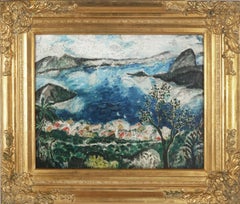
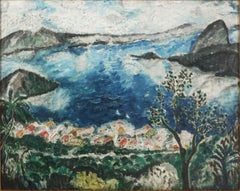
1940s Signed German Impressionist Oil of Rio de Janeiro in Style of Max Slevogt

1940s Signed German Impressionist Oil of Rio de Janeiro in Style of Max Slevogt

Located in Soquel, CA

German Impressionist Painting of Rio de Janeiro's Guanabara Bay and Sugarloaf Mountain in style of Max Slevogt This vivid landscape painting offers a panoramic view of Rio de Janeir...

Category

1940s Blue Rider Art

Materials

Oil, Board

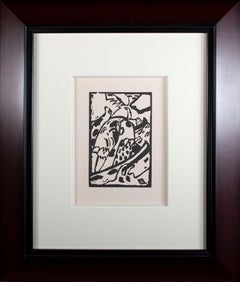
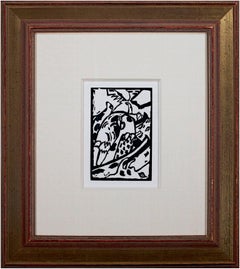
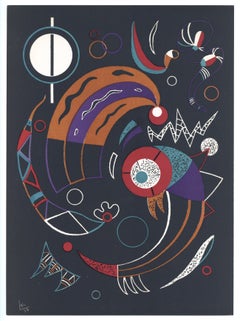
'Improvisation 7' original first ed. woodcut  from 'Klänge' by Wassily Kandinsky

'Improvisation 7' original first ed. woodcut from 'Klänge' by Wassily Kandinsky

By Wassily Kandinsky

Located in Milwaukee, WI

The present woodcut print comes from 'Klänge (Sounds),' a book of original graphics and poetry by Wassily Kandinsky. This first edition was released in an edition of 300, each book signed and numbered by the artist. The title of the album and this particular print, 'Improvisation,' demonstrated Kandinsky's interest in music and how abstract musical forms could be translated into images on a two-dimensional surface. This particular composition is difficult to read, but through the abstraction, one can make out various figures and a landscape beyond. 7.5 x 5 inches, image 22 x 19.5 inches, frame Woodcut in black ink on laid paper (watermark Van Gelder Zonen) Signed with encircled 'K' in the block, lower right Framed to conservation standards using 100 percent acid free archival materials including silk-lined matting with 1/4 inch bevel, museum glass, and a gold-gilded moulding Ref. Roethel 124 The Museum of Modern Art described 'Klänge (Sounds)' as follows: Vasily Kandinsky's self-described "musical album," Klänge (Sounds), consists of thirty-eight prose-poems he wrote between 1909 and 1911 and fifty-six woodcuts he began in 1907. In the woodcuts Kandinsky veiled his subject matter, creating increasingly indecipherable images (though the horse and rider, his symbol for overcoming objective representation, runs through as a leitmotif). This process proved crucial for the development of abstraction in his art. Kandinsky said his choice of media sprang from an "inner necessity" for expression: the woodcuts were not merely illustrative, nor were the poems purely verbal descriptions. Kandinsky sought a synthesis of the arts, in which meaning was created through the interaction of, and space between, text and image, sound and meaning, mark and blank space. The experimental typography shows his interest in the physical aspects of the book. Klänge is one of three major publications by Kandinsky that appeared shortly before World War I, alongside Über die Geistige in der Kunst (Concerning the Spiritual in Art) and the Blaue Reiter almanac...

Category

1910s Blue Rider Art

Materials

Woodcut

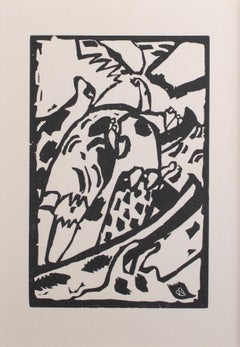
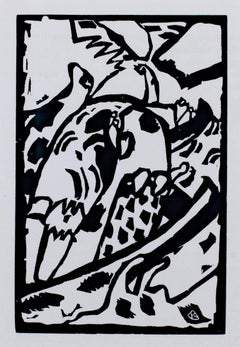
'Improvisation 7' second ed. woodcut from 'Klänge' by Wassily Kandinsky

'Improvisation 7' second ed. woodcut from 'Klänge' by Wassily Kandinsky

By Wassily Kandinsky

Located in Milwaukee, WI

'Improvisation 7' second ed. woodcut from 'Klänge' is a woodcut print created by Wassily Kandinsky. The present woodcut print comes from the second edition of 'Klänge (Sounds),' a book of original graphics and poetry by Wassily Kandinsky. The title of the album and of this print, 'Improvisation,' demonstrated Kandinsky's interest in music and how abstract musical forms could be translated into images on a two-dimensional surface. This particular composition is difficult to read, but through the abstraction, one can make out various figures and a landscape beyond. Originally carved and printed in 1911, this second edition print was done ca. 1938. It is a woodcut in black ink on woven paper. Signed with encircled 'K' in the block, lower right (from the book, signed in ink, ed. 117/300) Image Size: 7 1/2" x 5 inches Frame Size: 22 1/4" x 18 3/4" Ref. Roethel 124 Artist Bio: The Museum of Modern Art described 'Klänge (Sounds)' as follows: Vasily Kandinsky's self-described "musical album," Klänge (Sounds), consists of thirty-eight prose-poems he wrote between 1909 and 1911 and fifty-six woodcuts he began in 1907. In the woodcuts Kandinsky veiled his subject matter, creating increasingly indecipherable images (though the horse and rider, his symbol for overcoming objective representation, runs through as a leitmotif). This process proved crucial for the development of abstraction in his art. Kandinsky said his choice of media sprang from an "inner necessity" for expression: the woodcuts were not merely illustrative, nor were the poems purely verbal descriptions. Kandinsky sought a synthesis of the arts, in which meaning was created through the interaction of, and space between, text and image, sound and meaning, mark and blank space. The experimental typography shows his interest in the physical aspects of the book. Klänge is one of three major publications by Kandinsky that appeared shortly before World War I, alongside Über die Geistige in der Kunst (Concerning the Spiritual in Art) and the Blaue Reiter almanac...

Category

1910s Blue Rider Art

Materials

Woodcut, Laid Paper
Related Items
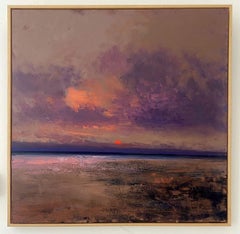
Shadow marshes. Richard K Blades. Painting of sea at sunset. Turner influence.

Shadow marshes. Richard K Blades. Painting of sea at sunset. Turner influence.

By Richard K Blades

Located in Coltishall, GB

A warm sunset over Norfolk's Cromer beach. Between Thoughts is a sublime oil painting that captures the mesmerizing tranquility of a sunset over thw North Sea. The horizon is ablaze...

Category

21st Century and Contemporary Blue Rider Art

Materials

Oil, Board

BLACK FACE
BLACK FACE

Karel AppelBLACK FACE, 1969

$750

H 22 in W 26 in

BLACK FACE

By Karel Appel

Located in Santa Monica, CA

KAREL APPEL (1921 - 2006) BLACK FACE, 1969 Lithograph in colors signed in pencil. Edition 26/75, Image: 19 3/4 x 25 1/4, sheet: 22 x 30 inches. Just hint of a mat line Appel was a member of the Cobra art movement

Category

1960s Blue Rider Art

Materials

Lithograph

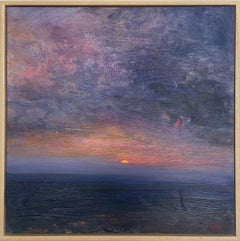
Low tide by Richard Blades. Oil painting. Sunset over the sea. Turner influence

Low tide by Richard Blades. Oil painting. Sunset over the sea. Turner influence

By Richard K Blades

Located in Coltishall, GB

Richard K Blades mesmerizing oil painting captures the ethereal beauty of a sunset over a tranquil sea. The sky, painted in vivid hues of orange and crimson, seamlessly blends with s...

Category

21st Century and Contemporary Blue Rider Art

Materials

Oil, Board

Marc Chagall, The Creation, from Drawings for the Bible, 1960

Marc Chagall, The Creation, from Drawings for the Bible, 1960

By Marc Chagall

Located in Southampton, NY

This exquisite lithograph by Marc Chagall (1887–1985), titled Creation (The Creation), from Marc Chagall, Dessins Pour La Bible (Drawings for the Bible), Verve: Revue Artistique et Litteraire, Vol. X, No. 37-38, originates from the July 29, 1960 issue published by Editions de la revue Verve, Paris, under the direction of Teriade, Editeur, Paris, and printed by Mourlot Freres, Paris, 1960. This visionary composition depicts the divine act of creation, evoking the genesis of light, life, and spirit through Chagall’s radiant imagination and poetic symbolism. The flowing forms and luminous harmonies reflect the unity between the divine and the natural world, a theme central to Chagall’s lifelong spiritual vision. Infused with movement and transcendence, the work transforms the biblical narrative into a lyrical meditation on the origin of existence and the creative essence of faith. The piece forms part of Chagall’s celebrated series of lithographs and drawings created for Dessins Pour La Bible, a monumental project uniting art, scripture, and mysticism in one of the artist’s most important achievements. Executed as a lithograph on velin du Marais paper, this work measures 14 x 10.5 inches (35.56 x 26.67 cm). Unsigned and unnumbered as issued. The edition exemplifies the superb craftsmanship of the Mourlot Freres atelier, renowned for its collaborations with the greatest modern masters of the 20th century. Artwork Details: Artist: Marc Chagall (1887–1985) Title: Creation (The Creation), from Marc Chagall, Dessins Pour La Bible (Drawings for the Bible), Verve: Revue Artistique et Litteraire, Vol. X, No. 37-38, July 29, 1960 Medium: Lithograph on velin du Marais paper Dimensions: 14 x 10.5 inches (35.56 x 26.67 cm) Inscription: Unsigned and unnumbered as issued Date: 1960 Publisher: Editions de la revue Verve, Paris, under the direction of Teriade, Editeur, Paris Printer: Mourlot Freres, Paris Catalogue raisonne references: Chagall, Marc, et al. Chagall Lithographe. Andre Sauret, 1960-1986, illustration 230-276. Cramer, Patrick, and Meret Meyer. Marc Chagall: Catalogue Raisonne des Livres Illustres. P. Cramer ed., 1995, illustration 42. Condition: Well preserved, consistent with age and medium Provenance: From Marc Chagall, Dessins Pour La Bible (Drawings for the Bible), Verve: Revue Artistique et Litteraire, Vol. X, No. 37-38, published by Editions de la revue Verve, Paris, 1960 Notes: Excerpted from the folio (translated from French), This double issue of Verve includes the drawings that Marc Chagall executed in 1958 and 1959 on biblical themes that he had not generally dealt with in his illustration for the Bible, engraved with etching and which were included in issue 33/34 of Verve. This album has 96 renderings in black and 24 color litbographies as well as the cover that were specially made for this album. It was completed printing on July 29, 1960 by Draeger Freres for black gravures and by Mourlot Freres for color lithography. About the Publication: Marc Chagall, Dessins Pour La Bible (Drawings for the Bible), published as Verve Vol. X, No. 37-38 on July 29, 1960, represents a significant continuation and expansion of Chagall’s profound engagement with biblical imagery and spiritual narrative. Conceived and directed by the visionary publisher Teriade, the publication builds upon the earlier Verve issue devoted to Chagall’s Bible illustrations by presenting a new body of work executed in 1958 and 1959, exploring themes and episodes that had not been fully addressed in the initial series. Printed in Paris by Draeger Freres for heliogravure and Mourlot Freres for lithography, the edition demonstrates an exceptional level of technical refinement and artistic collaboration. The publication includes an extensive suite of ninety six black reproductions and twenty four color lithographs, as well as specially created cover imagery, reflecting Chagall’s continued innovation in translating sacred themes into graphic form. As part of the broader tradition of Verve, one of the most important artistic and literary publications of the twentieth century, this issue exemplifies the fusion of text, image, and craftsmanship at the highest level. Today, Verve Vol. X, No. 37-38 stands as a major achievement within Chagall’s graphic oeuvre, reaffirming his role as one of the foremost interpreters of biblical narrative in modern art. About the Artist: Marc Chagall (1887–1985) was a Belarus-born French painter, printmaker, and designer whose visionary imagination, radiant color, and deeply poetic symbolism made him one of the most beloved and influential artists of the 20th century. Rooted in the imagery of his Jewish heritage and the memories of his childhood in Vitebsk, Chagall’s art wove together themes of faith, love, folklore, and fantasy with a dreamlike modern sensibility. His unique style merging elements of Cubism, Fauvism, Expressionism, and Surrealism defied categorization, transforming ordinary scenes into lyrical meditations on memory and emotion. Influenced by Russian icon painting, medieval religious art, and the modern innovations of artists such as Pablo Picasso, Henri Matisse, and Georges Braque, Chagall developed a profoundly personal visual language filled with floating figures, vibrant animals, musicians, and lovers that symbolized the transcendent power of imagination and love. During his early years in Paris, he became an integral part of the Ecole de Paris circle, forming friendships with Amedeo Modigliani, Fernand Leger, and Sonia Delaunay, and his creative spirit resonated with that of his peers and successors Alexander Calder, Alberto Giacometti, Salvador Dali, Joan Miro, Wassily Kandinsky, Marcel Duchamp, and Man Ray, artists who sought to push the boundaries of perception, emotion, and form. Over a prolific career that spanned painting, printmaking, stained glass, ceramics, and stage design, Chagall brought an unparalleled poetic sensibility to modern art, infusing even the most abstract subjects with human warmth and spiritual depth. His works are held in the most prestigious museums around the world, including the Museum of Modern Art, the Centre Pompidou, the Tate, and the Guggenheim, where they continue to inspire generations of artists and collectors. The highest price ever paid for a Marc Chagall artwork is approximately 28.5 million USD, achieved in 2017 at Sotheby’s New York for Les Amoureux (1928). Marc Chagall Creation...

Category

1960s Blue Rider Art

Materials

Lithograph

Marc Chagall, Couple Before the Tree, from Chagall Lithographer I, 1960

Marc Chagall, Couple Before the Tree, from Chagall Lithographer I, 1960

By Marc Chagall

Located in Southampton, NY

This exquisite lithograph by Marc Chagall (1887–1985), titled Couple devant l’arbre (Couple Before the Tree), from Chagall Lithographe I (Chagall Lithographer I), originates from the October 1960 issue published by Andre Sauret, Editeur, Monte-Carlo, and printed by Mourlot Freres, Paris, 1960. This visionary composition reflects Chagall’s mastery of the lithographic medium, embodying his poetic imagination through fluid line, expressive form, and a luminous sense of movement. The work conveys the artist’s unique ability to merge memory, symbolism, and emotion into a cohesive visual language, transforming even the simplest subject into a deeply evocative and dreamlike image. Infused with lyricism and spiritual resonance, the composition exemplifies Chagall’s enduring exploration of identity, mythology, and the transcendent power of art. The piece forms part of Chagall Lithographe I, a landmark publication that documents and celebrates the artist’s achievements in lithography, offering insight into one of the most significant aspects of his graphic oeuvre. Executed as a lithograph on velin paper, this work measures 12.5 x 9.625 inches (31.75 x 24.45 cm). Unsigned and unnumbered as issued. The edition exemplifies the superb craftsmanship of the Mourlot Freres atelier, renowned for its collaborations with the greatest modern masters of the 20th century. Artwork Details: Artist: Marc Chagall (1887–1985) Title: Couple devant l’arbre (Couple Before the Tree), from Chagall Lithographe I (Chagall Lithographer I), October 1960 Medium: Lithograph on velin paper Dimensions: 12.5 x 9.625 inches (31.75 x 24.45 cm) Inscription: Unsigned and unnumbered as issued Date: 1960 Publisher: Andre Sauret, Editeur, Monte-Carlo Printer: Mourlot Freres, Paris Catalogue raisonne references: Chagall, Marc, et al. Chagall Lithographe. Andre Sauret, 1960-1986, illustration 281-292. Cramer, Patrick, and Meret Meyer. Marc Chagall: Catalogue Raisonne des Livres Illustres. P. Cramer ed., 1995, illustration 43. Condition: Well preserved, consistent with age and medium Provenance: From Chagall Lithographe I (Chagall Lithographer I), published by Andre Sauret, Editeur, Monte-Carlo, 1960 Notes: Excerpted from the album (translated from French), This work, which was designed and compiled by Fernand Mourlot and Andre Sauret, was finished in October 1960. The reproductions were printed on the presses of Draeger Freres, and the original lithographs on the presses of Mourlot Freres. The Imprimerie Nationale de France is responsible for the typography. Of this work it was shot, apart, CL examples on Grand Velin d'Arches, numbered to the press from I to CL, signed by the artist and the publisher, including, in addition, two original lithographs specially made for this separate draw. About the Publication: Chagall Lithographe I (Chagall Lithographer I), published in October 1960 by Andre Sauret in Monte-Carlo and printed by Mourlot Freres, represents a foundational survey of Marc Chagall’s lithographic production. Conceived in close collaboration with master printer Fernand Mourlot, the publication serves as both a catalogue and a celebration of the artist’s exploration of lithography from the late 1940s through the 1950s. It documents the technical and artistic evolution of Chagall’s printmaking, highlighting the innovative approaches he developed in partnership with the Mourlot atelier, whose expertise allowed for the translation of his painterly vision into the lithographic medium with extraordinary fidelity. The publication includes numerous reproductions alongside original lithographs, offering a comprehensive overview of themes central to Chagall’s work, including biblical narratives, folklore, and personal symbolism. Widely regarded as an essential reference in the study of Chagall’s graphic oeuvre, Chagall Lithographe I stands as a testament to the enduring collaboration between artist and printer, and to the importance of lithography within the broader trajectory of 20th century modern art. About the Artist: Marc Chagall (1887–1985) was a Belarus-born French painter, printmaker, and designer whose visionary imagination, radiant color, and deeply poetic symbolism made him one of the most beloved and influential artists of the 20th century. Rooted in the imagery of his Jewish heritage and the memories of his childhood in Vitebsk, Chagall’s art wove together themes of faith, love, folklore, and fantasy with a dreamlike modern sensibility. His unique style—merging elements of Cubism, Fauvism, Expressionism, and Surrealism—defied categorization, transforming ordinary scenes into lyrical meditations on memory and emotion. Influenced by Russian icon painting, medieval religious art, and the modern innovations of artists such as Pablo Picasso, Henri Matisse, and Georges Braque, Chagall developed a profoundly personal visual language filled with floating figures, vibrant animals, musicians, and lovers that symbolized the transcendent power of imagination and love. During his early years in Paris, he became an integral part of the Ecole de Paris circle, forming friendships with Amedeo Modigliani, Fernand Leger, and Sonia Delaunay, and his creative spirit resonated with that of his peers and successors—Alexander Calder, Alberto Giacometti, Salvador Dali, Joan Miro, Wassily Kandinsky, Marcel Duchamp, and Man Ray—artists who, like Chagall, sought to push the boundaries of perception, emotion, and form. Over a prolific career that spanned painting, printmaking, stained glass, ceramics, and stage design, Chagall brought an unparalleled poetic sensibility to modern art, infusing even the most abstract subjects with human warmth and spiritual depth. His works are held in the most prestigious museums around the world, including the Museum of Modern Art, the Centre Pompidou, the Tate, and the Guggenheim, where they continue to inspire generations of artists and collectors. The highest price ever paid for a Marc Chagall artwork is approximately $28.5 million USD, achieved in 2017 at Sotheby’s New York for Les Amoureux (1928). Marc Chagall Couple...

Category

1960s Blue Rider Art

Materials

Lithograph

Marc Chagall, The Angel, from Chagall Lithographer I, 1960

Marc Chagall, The Angel, from Chagall Lithographer I, 1960

By Marc Chagall

Located in Southampton, NY

This exquisite lithograph by Marc Chagall (1887–1985), titled L'Ange (The Angel), from Chagall Lithographe I (Chagall Lithographer I), originates from the October 1960 issue publishe...

Category

1960s Blue Rider Art

Materials

Lithograph

Last by Richard K Blades. Moody seascape with setting sun. Turner influence

Last by Richard K Blades. Moody seascape with setting sun. Turner influence

By Richard K Blades

Located in Coltishall, GB

Sunset over the sea after a storm rolls by... portrays a mesmerizing seascape at dusk, where the horizon blurs in a harmonious blend of colors. Blades skillfully manipulates light a...

Category

21st Century and Contemporary Blue Rider Art

Materials

Oil, Board

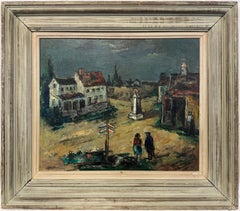
“Crossroads, c. 1940” WPA Polish-American Expressionist Modernist Oil Signed

“Crossroads, c. 1940” WPA Polish-American Expressionist Modernist Oil Signed

By Sol Wilson

Located in Yardley, PA

“Crossroads, c. 1940” by Sol Wilson (Polish-American, 1896-1974). This expressive painting by Wilson depicts a moody village crossroads rendered with his signature textured brushwor...

Category

1940s Blue Rider Art

Materials

Oil, Board

Previously Available Items
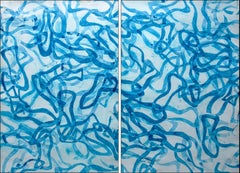
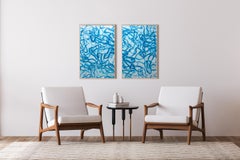
Blue of Blues, Abstract Fish Shapes Diptych, Overlapping Forms, Mediterranean

Blue of Blues, Abstract Fish Shapes Diptych, Overlapping Forms, Mediterranean

By Enric Servera

Located in Barcelona, ES

This series by Enric Servera explores the relationship of humans to salt and seawater. The intention of these works is to submerge us into the sea, a salty treasure that surrounds us and reminds us of its natural beauty and the importance of its preservation. Details: Title: Blue of Blues N12 Medium: Mixed Media on Paper Size: 90x 120 cm total (35.4 x 49.6 inches). Each panel measures 63 x 90 cm (24.8 x 35.4 inches). Year: 2023 * Frame is for illustrative purposes only. Artwork shipped carefully rolled and packaged in a tube. * Certificate of Authenticity provided. Enric Servera (Ciutadella de Menorca, 1970) lives and works between Barcelona and Menorca, Spain. His works explores the colors and forms of the ocean, inspired by the fauna and flora of the Mediterranean Sea. His work has shown in galleries across Spain, and is part of several public and private collections. Words that may describe this series of artworks are: Mediterranean-inspired art, abstract sea paintings...

Category

2010s Blue Rider Art

Materials

Acrylic, Watercolor, Paper

Felson,

Wassily KandinskyFelson,, 1909

Sold

H 6.05 in W 6.05 in

Felson,

By Wassily Kandinsky

Located in New York, NY

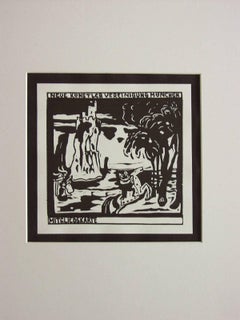
Black and White Woodcut. Published in 1909 in an edition of 100 to be used as a card member for the group of artists "Neu Kunstler-Vereingun Munchen". The impression is complete in ...

Category

1910s Blue Rider Art

Materials

Woodcut

Blue Rider art for sale on 1stDibs.

Find a wide variety of authentic Blue Rider art available for sale on 1stDibs. Works in this style were very popular during the 21st Century and Contemporary, but contemporary artists have continued to produce works inspired by this movement. Many Pop art paintings were created by popular artists on 1stDibs, including Wassily Kandinsky, Anastasia Kurakina, James Mannix, and (after) Wassily Kandinsky. Frequently made by artists working with Woodcut Print, and Paper and other materials, all of these pieces for sale are unique and have attracted attention over the years. Not every interior allows for large Blue Rider art, so small editions measuring 6.05 inches across are also available. Prices for art made by famous or emerging artists can differ depending on medium, time period and other attributes. On 1stDibs, the price for these items starts at $450 and tops out at $26,000, while the average work sells for $3,075.