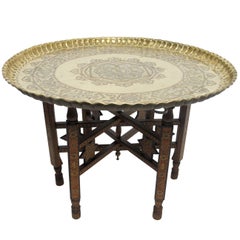
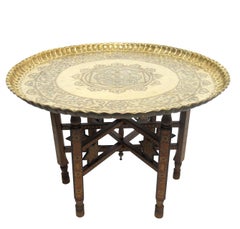
After the Muslim conquest of the Iberian Peninsula in the eighth century, Islamic Spain became a cultural mix of influences that shaped both private homes and religious spaces. Moorish design was the name given to this style, which evolved through the 15th century with vibrant tile work, horseshoe arches and lavish ornamentation, most visible at sites such as Granada’s Alhambra and the Mosque-Cathedral of Córdoba. Moorish furniture was often similarly ornate, and featured pieces inlaid with wood, ivory and bone.
When European designers began studying Moorish art and architecture in the early 19th century, it led to a Moorish Revival. Appropriating the style’s decorative flourishes and architectural elements, it promoted a romantic view of Islamic design. Travelers could bring home a memento of what they witnessed in the Middle East, a trend that aligned with a fad for themed interiors. Men’s smoking rooms arranged with ottomans, divans and settees and inlaid tables were especially popular, as were cafés where coffee was served amid bead curtains and colorful floor mats. (Handwoven rugs are a centerpiece of Moorish interiors.) Octagonal rooms with domed ceilings were created for wealthy homes, frequently with furnishings like pipe stands, filigree plasterwork and arched doorways. The horseshoe arch is an iconic attribute of Moorish architecture that, in addition to Spain, can be found in Sicily, Morocco and elsewhere.
Several late 19th to early 20th-century movements featured Moorish touches. The American and English Aesthetic Movement, for example, borrowed liberally from global decorating styles, as seen in furniture designed by Lockwood de Forest, a New York-born artist who mixed Eastern and Western forms. The visual vocabulary of Art Nouveau also references the elegant use of geometry in Moorish design, with Milanese Art Nouveau furniture designer Carlo Bugatti drawing inspiration from the style. The Arts and Crafts movement, which prized expressive yet simple design, incorporated Moorish influences; hand-painted furniture and tile work created by William De Morgan, a British designer and potter who made furnishings for the likes of Morris & Co., were informed by techniques from Moorish Spain.
Find a collection of Moorish lighting, decorative objects, folk art and more furniture on 1stDibs.
Whether burnished or lacquered, antique, new and vintage brass furniture can elevate a room.
From traditional spaces that use brass as an accent — by way of brass dining chairs or brass pendant lights — to contemporary rooms that embrace bold brass decor, there are many ways to incorporate the golden-hued metal.
“I find mixed metals to be a very updated approach, as opposed to the old days, when it was all shiny brass of dulled-out silver tones,” says interior designer Drew McGukin. “I especially love working with brass and blackened steel for added warmth and tonality. To me, aged brass is complementary across many design styles and can trend contemporary or traditional when pushed either way.”
He proves his point in a San Francisco entryway, where a Lindsey Adelman light fixture hangs above a limited-edition table and stools by Kelly Wearstler — also an enthusiast of juxtapositions — all providing bronze accents. The walls were hand-painted by artist Caroline Lizarraga and the ombré stair runner is by DMc.
West Coast designer Catherine Kwong chose a sleek brass and lacquered-parchment credenza by Scala Luxury to fit this San Francisco apartment. “The design of this sideboard is reminiscent of work by French modernist Jean Prouvé. The brass font imbues the space with warmth and the round ‘portholes’ provide an arresting geometric element.”
Find antique, new and vintage brass tables, case pieces and other furnishings now on 1stDibs.
As a practical focal point in your living area, antique and vintage coffee tables and cocktail tables are an invaluable addition to any interior.
Low tables that were initially used as tea tables or coffee tables have been around since at least the mid- to late-1800s. Early coffee tables surfaced in Victorian-era England, likely influenced by the use of tea tables in Japanese tea gardens. In the United States, furniture makers worked to introduce low, long tables into their offerings as the popularity of coffee and “coffee breaks” took hold during the late 19th century and early 20th century.
It didn’t take long for coffee tables and cocktail tables to become a design staple and for consumers to recognize their role in entertaining no matter what beverages were being served. Originally, these tables were as simple as they are practical — as high as your sofa and made primarily of wood. In recent years, however, metal, glass and plastics have become popular in coffee tables and cocktail tables, and design hasn’t been restricted to the conventional low profile, either.
Visionary craftspeople such as Paul Evans introduced bold, geometric designs that challenge the traditional idea of what a coffee table can be. The elongated rectangles and wide boxy forms of Evans’s desirable Cityscape coffee table, for example, will meet your needs but undoubtedly prove imposing in your living space.
If you’re shopping for an older coffee table to bring into your home — be it an antique Georgian-style coffee table made of mahogany or walnut with decorative inlays or a classic square mid-century modern piece comprised of rosewood designed by the likes of Ettore Sottsass — there are a few things you should keep in mind.
Both the table itself and what you put on it should align with the overall design of the room, not just by what you think looks fashionable in isolation. According to interior designer Tamara Eaton, the material of your vintage coffee table is something you need to consider. “With a glass coffee table, you also have to think about the surface underneath, like the rug or floor,” she says. “With wood and stone tables, you think about what’s on top.”
Find the perfect centerpiece for any room, no matter what your personal furniture style on 1stDibs — shop Art Deco coffee tables, travertine coffee tables and other antique and vintage coffee tables and cocktail tables today.