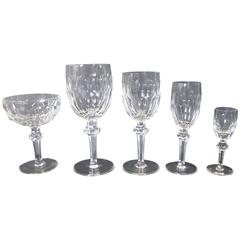
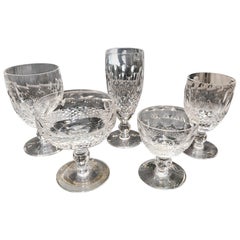
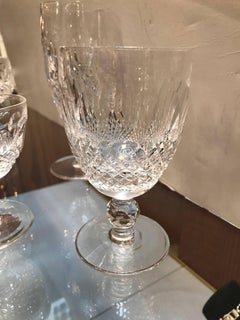
Among glassware aficionados, the name Waterford has earned a place of eminence — both for antique crystal vases, glasses, chandeliers and serveware made by the original Irish company in the 18th and 19th centuries, and for new versions of the firm’s classic patterns produced after its rebirth in the 1940s. With either iteration, Waterford is a byword for traditional elegance.
Waterford crystal was born of a tax loophole. In 1783, business-minded brothers George and William Penrose founded the Waterford Glass House in southeastern Ireland because Irish glass was exempt from steep British import duties. The two wanted to make fine-quality wares and hired artisans from England, including master glassmaker John Hill. The factory’s flint glass — a precursor to lead crystal — soon won a clientele among British and continental aristocrats.
One of Hill’s aesthetic innovations was to polish glassware after a pattern was cut, to buff off the resulting frosted surface. The look became a Waterford trademark. Through the fame of its wine goblets, claret jugs and decanters, the firm continued to win honors at the many industrial expositions of the early Victorian era. But over those years, higher and higher luxury excise taxes were placed on fine crystal. Waterford products became prohibitively expensive, and the company closed in 1851.
The brand’s renown was still intact when it was revived in 1947 by a Czech glass manufacturer named Charles Bacik, who moved to Ireland after the Communist takeover of his country. For centuries, the region now called the Czech Republic had been the great glassware center of Middle Europe — the source of crystal to legendary Viennese glass design firms such as Lobmeyr and Bakalowits. So Bacik brought with him the master glassblower and designer Miroslav Havel.
In Dublin, Havel studied the old Waterford style book archives kept in the National Museum. He used these classic patterns as the basis for new ones such as Lismore, with its crosshatching and flame-like vertical cuts, and Alana, with its heavily textured diamond cuts. Past and present are thus linked at Waterford.
Introduced in 1991, the Marquis by Waterford range of vases, bowls and other wares were priced for everyday use and were intended for use in modern homes. It was the first new brand debuted by the company in what was then its more than two-century history.
As you will see on 1stDibs, antique or recently made, Waterford crystal is the essence of refinement.
Find Waterford crystal vases, serveware and other collectibles for sale on 1stDibs.
While it isn’t always top of mind for some, antique and vintage tableware can enhance even the most informal meal. It has been an intimate part of how we’ve interacted with our food for millennia.
Tableware has played a basic but important role in everyday life. Ancient Egyptians used spoons (which are classified as flatware) made of ivory and wood, while Greeks and Romans, who gathered for banquets involving big meals and entertainment, ate with forks and knives. At the beginning of the 17th century, however, forks were still uncommon in American homes. Over time, tableware has thankfully evolved and today includes increasingly valuable implements.
Tableware refers to the tools people use to set the table, including serving pieces, dinner plates and more. It encompasses everything from the intricate and elaborate to the austere and functional, yet are all what industrial product designer Jasper Morrison might call “Super Normal” — anonymous objects that are too useful to be considered banal.
There are four general categories of tableware — serveware, dinnerware, drinkware and, lastly, flatware, which is commonly referred to as silverware or cutlery. Serveware includes serving bowls, platters, gravy boats, casserole pans and ladles. Most tableware is practical, but it can also be decorative. And decorative objects count as tableware too. Even though they don’t fit squarely into one of the four categories, vases, statues and floral arrangements are traditional centerpieces.
Drinkware appropriately refers to the vessels we use for our beverages — mugs, cups and glasses. There is a good deal of variety that falls under this broad term. For example, your cheerful home bar or mid-century modern bar cart might be outfitted with a full range of vintage barware, which might include pilsner glasses and tumblers. Specialty cocktails are often served in these custom glasses, but they’re still a type of drinkware.
Every meal should be special — even if you’re using earthenware or stoneware for a casual lunch — but perhaps you’re hosting a dinner party to mark a specific event. The right high-quality tableware can bring a touch of luxury to your cuisine. Young couples, for example, traditionally add “fine china,” or porcelain, to their wedding registry as a commemoration of their union and likely wouldn’t turn down exquisite silver made by Tiffany & Co. or Georg Jensen.
It’s important to remember, however, that when you’re setting the dining room table to have fun with it. Just as you might mix and match your dining chairs, don’t be afraid to mix new and old or high and low with your tableware. On 1stDibs, find an extraordinary range of vintage and antique tableware to help elevate your meal as well as the mood and atmosphere of your entire dining room.