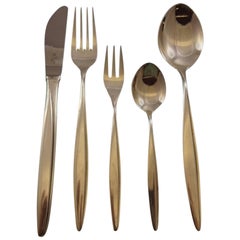
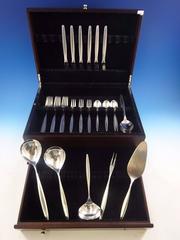
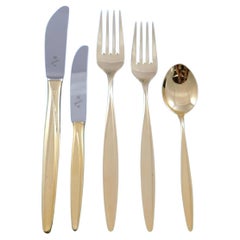
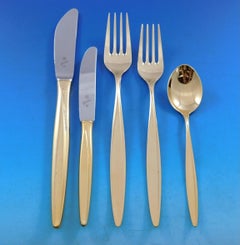
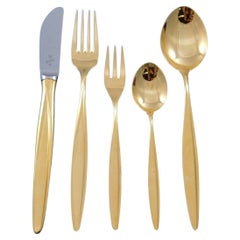
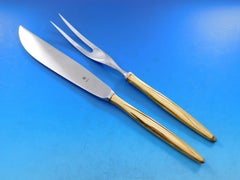
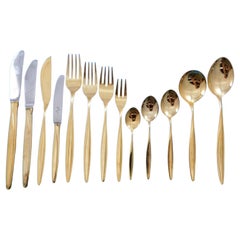
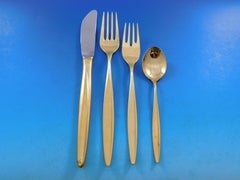
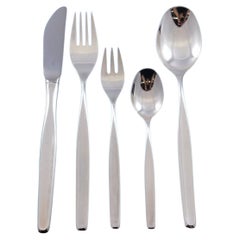
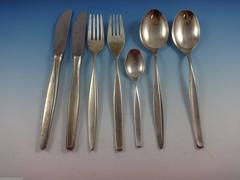
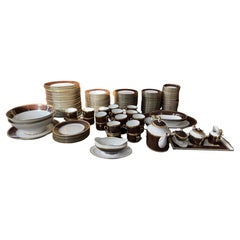
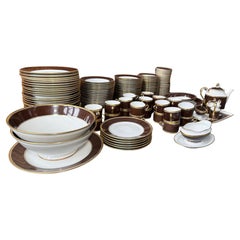
The fine brass, copper and silver metalware produced by distinguished manufacturer Württembergische Metallwarenfabrik (WMF) has adorned the tabletops of restaurants, hotels and homes around the world. WMF is especially prized by collectors for its Art Nouveau works of the late 19th century and Art Deco pieces manufactured throughout the early 20th century.
WMF traces its beginnings to 1880 when the merger of Straub & Sohn and Ritter & Co. formed the public limited company Württembergische Metallwarenfabrik. The company initially focused on tableware and decorative pieces, such as vases and planters. In 1892, WMF introduced its patented “perfect hard silver plating,” a technology that distributes twice as much silver to the sections of cutlery that experience the most wear, allowing the whole piece to hold its luster longer than other silver-plated products.
In 1905, WMF acquired a majority holding of Orivit AG, a company in Cologne that manufactured products from a tin alloy, further expanding its range of materials. By 1910, its main facility in Geislingen, Germany, employed 4,000 workers. It had branches in Vienna, Warsaw and London, and printed a catalog in 12 languages.
As a German business, WMF experienced extensive asset loss in the aftermath of the world wars. However, by 1950, its main facility once again had a workforce of more than 3,000 employees, and its high-quality products returned to popularity. There was an increase in demand for its Cromargan cutlery as well as work by WMF’s preeminent lighting designer, Wilhelm Wagenfeld.
By the 1960s, WMF’s main facility had 5,800 employees. More factories were opened to keep up with demand. WMF is now one of the largest manufacturers of metalware in the world and continues to produce pieces of superb quality. The company has over 200 branches in Germany, Austria and Switzerland, and owns branches in 40 other countries.
On 1stDibs, explore serveware, decorative objects, lighting and more from Württembergische Metallwarenfabrik (WMF).
While it isn’t always top of mind for some, antique and vintage tableware can enhance even the most informal meal. It has been an intimate part of how we’ve interacted with our food for millennia.
Tableware has played a basic but important role in everyday life. Ancient Egyptians used spoons (which are classified as flatware) made of ivory and wood, while Greeks and Romans, who gathered for banquets involving big meals and entertainment, ate with forks and knives. At the beginning of the 17th century, however, forks were still uncommon in American homes. Over time, tableware has thankfully evolved and today includes increasingly valuable implements.
Tableware refers to the tools people use to set the table, including serving pieces, dinner plates and more. It encompasses everything from the intricate and elaborate to the austere and functional, yet are all what industrial product designer Jasper Morrison might call “Super Normal” — anonymous objects that are too useful to be considered banal.
There are four general categories of tableware — serveware, dinnerware, drinkware and, lastly, flatware, which is commonly referred to as silverware or cutlery. Serveware includes serving bowls, platters, gravy boats, casserole pans and ladles. Most tableware is practical, but it can also be decorative. And decorative objects count as tableware too. Even though they don’t fit squarely into one of the four categories, vases, statues and floral arrangements are traditional centerpieces.
Drinkware appropriately refers to the vessels we use for our beverages — mugs, cups and glasses. There is a good deal of variety that falls under this broad term. For example, your cheerful home bar or mid-century modern bar cart might be outfitted with a full range of vintage barware, which might include pilsner glasses and tumblers. Specialty cocktails are often served in these custom glasses, but they’re still a type of drinkware.
Every meal should be special — even if you’re using earthenware or stoneware for a casual lunch — but perhaps you’re hosting a dinner party to mark a specific event. The right high-quality tableware can bring a touch of luxury to your cuisine. Young couples, for example, traditionally add “fine china,” or porcelain, to their wedding registry as a commemoration of their union and likely wouldn’t turn down exquisite silver made by Tiffany & Co. or Georg Jensen.
It’s important to remember, however, that when you’re setting the dining room table to have fun with it. Just as you might mix and match your dining chairs, don’t be afraid to mix new and old or high and low with your tableware. On 1stDibs, find an extraordinary range of vintage and antique tableware to help elevate your meal as well as the mood and atmosphere of your entire dining room.