Georges Braque Art

French, 1882-1963

Georges Braque was born in Argenteuil, France, in 1882. Braque lived much of his childhood and young adult life in Le Havre. He attended night classes at the art school from 1897–99 and then moved to Paris, where he obtained his license as a master decorator. From 1905–06, after studying at École des Beaux-Arts in Paris and having been influenced by the works of Henri Matisse, he began to paint in the way of Fauvism by using bright colors and taking advantage of the freedom of the composition. Paysage à L'Estaque (1906) was one of the prominent works of art made at this time.

The year 1907 was a significant time in Braque's development, wherein he visited the retrospective on Paul Cézanne and he came into contact with Picasso, who was very engrossed in the realization of Les Demoiselles d'Avignon at the time. At this point, Braque began nurturing a considerable interest in primitive art. After the First World War, Braque worked autonomously and developed a more personal style, which was characterized by vivid colors and textured surfaces. Braque painted still life, interior views, and ocean scenes. The Ateliers (1948–55) and Birds (1955–63) series were painted during this period. In 1948, he obtained his first award for painting at the XXIV Biennial in Venice.

to
82
92
52
35
14
Overall Width
to
Overall Height
to
1
192
1
3
7
79
86
7
1
1
116
27
3
2
1
1
142
48
1
47
32
27
23
19
14
13
12
11
10
9
9
8
6
6
6
5
5
5
5
142
35
14
13
6
198
10,222
2,785
2,504
1,384
42
41
112
78
Artist: Georges Braque
Migration - Modern, Colour Aquatint, Birds
By Georges Braque
Located in Köln, DE
Fascinated by an experience in the Camargue bird sanctuary in 1955, the bird became a symbol of freedom and harmony for Georges Braque. ‘I now only draw birds, after my still lifes h...
Category

1960s Modern Georges Braque Art

Materials

Aquatint, Etching

Bouquet: Fleurs bleues - Modern, Woodcut, Vase of Blue Flowers
By Georges Braque
Located in Köln, DE
"Bouquet: Fleurs bleues" by Georges Braque from Guillaume Apollinaire's "Si je mourais là-bas" (If I die there). It is the 14th panel of the suite. The present woodcut on japon nac...
Category

1960s Modern Georges Braque Art

Materials

Woodcut

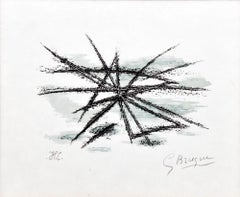
L'Etang from Lettera amorosa, 1963
By Georges Braque
Located in Palo Alto, CA
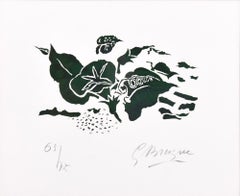
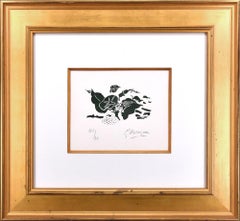
As black remnants of flora float on top of green patches of murky water, a sense of frenzied movement overtakes this small composition. Stark black lines crisscross as if done in cha...
Category

1960s Modern Georges Braque Art

Materials

Lithograph

Les Étoiles (Stars), 1959
By Georges Braque
Located in Palo Alto, CA
Georges Braque Les Étoiles (Stars), 1959 opens a cloud-like window into a dreamy black and navy sky peppered with playful stars above which a bird, its bod...
Category

1950s Modern Georges Braque Art

Materials

Lithograph

Les Marguerites (Daisies), c. 1950
By Georges Braque
Located in Palo Alto, CA
Created with a sensitive attention to color and value, this work is one of many floral motifs Braque depicted in his lifetime. Deeply saturated tones of ochre and brown express a subdued mood, while the hints of highlights convey to the viewer a sense of brightness and energy. A cluster of yellow daisies emerge from a simple ochre vase...
Category

1950s Modern Georges Braque Art

Materials

Etching, Aquatint

Untitled (Fleur Tombe), 1962
By Georges Braque
Located in Palo Alto, CA
The rich blue color bursts from the page in Georges Braque Untitled (Fleur Tombe), 1962, overtaking the black lettering and white background. Drawn onto the title page of the book “Braque Le goût de notre temps” by Albert Skira this hand applied watercolor is striking. In several strong stokes, a flower is presented with its blue petals seeming to float down the page until almost reaching the bottom.  The delicate blue touches the page which in turn lights up with brilliant flowers. The petals are slightly smudged, and you can see the brushstrokes that Braque applied to the page. PArt of what makes this unique watercolor so wonderful is that the viewer can so clearly see and feel the hand of the artist. Caught in between the flower and falling petals is the black hand...
Category

1960s Modern Georges Braque Art

Materials

Watercolor

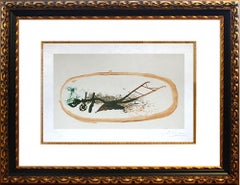
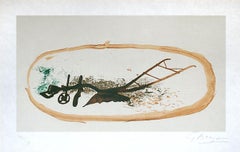
La Charrue (The Plough)
By Georges Braque
Located in Palo Alto, CA
Combining the organic with the technical, Braque (Argenteuil-sur-Seine, 1882- Paris, 1963) depicts a plough against a background of graphing squares. The plough appears as if in wate...
Category

1960s Modern Georges Braque Art

Materials

Lithograph

Le Feuille morte from Lettera amorosa, 1963
By Georges Braque
Located in Palo Alto, CA
A leaf rests on the sheet in Georges Braque Le Feuille Morte from Lettera Amorosa, 1963 as a testament to the beauty found in the cycle of nature. As gorgeous pink and brown tones wi...
Category

1960s Modern Georges Braque Art

Materials

Lithograph

Lithograph from Le tir à l'arc (The Archery)
By Georges Braque
Located in Palo Alto, CA
This abstract Georges Braque Le tir à l'arc (The Archery), 1960 toys with repetitive motifs that vary ever so slightly. Four white, rectangular figures arranged in a square formation...
Category

1960s Modern Georges Braque Art

Materials

Lithograph

Le Char III (The Chariot III), 1955
By Georges Braque
Located in Palo Alto, CA
This fascinating and lively piece instantly captures the viewer's attention. Considered an ancient symbol of power and glory, the chariot is delved wit...
Category

1950s Modern Georges Braque Art

Materials

Varnish, Lithograph

Page 63 from Si je mourais la-bas, 1962
By Georges Braque
Located in Palo Alto, CA
Georges Braque Page 63 from Si je mourais la-bas, 1962, captures the heart of many with its poignant and inspiring shade of cobalt blue. Rendered on cris...
Category

1960s Modern Georges Braque Art

Materials

Engraving

Le tir à l'arc (Archery)
By Georges Braque
Located in Palo Alto, CA
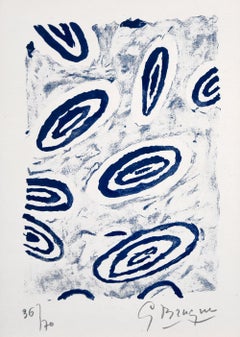
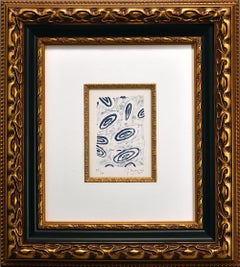
Comprised of a repetition of oval blue targets, Georges Braque Le tir à l'arc (Archery) exemplifies Braque's skill at evoking a sense of mood through abstraction. The soft, swirling ...
Category

1960s Modern Georges Braque Art

Materials

Lithograph

Georges Braque - Original Lithograph
By Georges Braque
Located in Collonge Bellerive, Geneve, CH
Georges Braque - Original Lithograph 1963 Dimensions: 32 x 24 cm Andre Sauret, Monte Carlo The father of Cubism Three Cubist that distinguishes art historian periods were initiated and developed by Georges Braque: The Cubist Cézanne (1907-1909), Executive (1909-1912) and synthetic (1912-1922). Post-Impressionist and fawn, Braque no longer adheres to the contingency of a decorative way or the other. Cézanne’s paintings exhibited at the Grand Palais during the retrospective of 1907 are a revelation: Cézanne sought and invented a pictorial language. In his footsteps, Braque went to the South with the reasons of the Master. He returned with Estaque landscapes and surprising Ciotat it keeps Cezanne geometric model and retains the “passages” continuity from one surface to another to create the sensation of “turning around” of the object represented. But he wants to go after the consequences of the vision of Cezanne. In his paintings Houses in L’Estaque (1908) it simplifies the volumes of houses, neglects detail by removing doors and windows: the plastic rhythm that builds the table. Large Nude , a masterpiece of the period, can be considered the first work of Cézanne cubism . Systematizing and deepening Braque discoveries open the door analytical cubism. In 1909, his painting became more cerebral than sensual. The pattern is recreated in the two-dimensionality of the canvas, leaving aside any illusionistic perspective. In Still Life with Violin, objects are analyzed facets according to their characteristic elements, each facet referring to a particular view of the object. There are so many facets of points selected view: Table reflects the knowledge of the object and the ubiquity of the eye. Moreover, Braque is looking for the essence of the objects in the world rather than their contingency, which explains the absence of light source and use of muted colors (gray, ocher), contingent aspects of the object . But formal logic has stepped facets, erased any anecdote to the object and ultimately led to his painting a hermetic more marked on the edge of abstraction (see the series of Castle Roche-Guyon ). Braque, anxious to keep the concrete and refusing at all costs that the logic of Cubism takes the paintings to abstract, reintroduced signs of reality in his paintings in 1912 marks the beginning of Synthetic Cubism. Historians speak of “signs of real” rather than reality because what interests Braque, this is not to put reality into a table, but to create a painting which, by its language, refers to the real. To do this, he invented two major techniques XX th century inclusions and contributions. The inclusions consist of painting objects that have no real depth, materials (wallpaper in Nature morte aux playing cards faux wood is a pictorial inclusion) or letters (calligraphic inclusion in Portuguese ), made first brush and a few months later stencil. Contributions are defined in contrast with the collage on canvas of foreign materials: glued or sand paper, sawdust, etc.. Regarding the collages, Braque used for the first time in September 1912 a piece of adhesive paper imitating faux wood Compote and Glass , then the packet envelope of tobacco Bock in 1912-1913, or an advertisement in Damier , 1913). Inputs and inclusions refer to an external object in the table, without “emulate” this object. Away from their appearances, objects are represented in closest essence of the objects in the real world sense. This is also the time of Synthetic Cubism that Braque invented paper sculpture. There are, unfortunately, and no one is living proof of a photograph makes it possible to realize: Paper and paperboard. Métamorphoses period(1961-1963). In 1961, Georges Braque worked on a Greek head for the Louvre, which obsesses him, and he wishes to free his mind. He tried several times to bring out the paint and the result was unsatisfactory. He thinks the ultimate metamorphosis its Greek head projected in three dimensions. He calls in his studio of Baron Heger Loewenfeld, master lapidary, and he communicates his enthusiasm during the “fateful encounter.” Nine months later, in honor of the eighty years of Georges Braque, Heger Loewenfeld offers the Master of the ring Circe: the famous Greek head finally exorcised, carved in an onyx. Braque Loewenfeld then asked to identify other issues that haunt him. From dated and signed by Georges Braque, Heger gouaches Loewenfeld shapes works in the fields of jewelery, lapidary art...
Category

1960s Modern Georges Braque Art

Materials

Lithograph

Georges Braque art for sale on 1stDibs.

Find a wide variety of authentic Georges Braque art available for sale on 1stDibs. If you’re browsing the collection of art to introduce a pop of color in a neutral corner of your living room or bedroom, you can find work that includes elements of orange, purple, yellow and other colors. You can also browse by medium to find art by Georges Braque in lithograph, etching, aquatint and more. Much of the original work by this artist or collective was created during the 20th century and is mostly associated with the modern style. Not every interior allows for large Georges Braque art, so small editions measuring 7 inches across are available. Customers who are interested in this artist might also find the work of Bernard Buffet, André Derain, and Raoul Dufy. Georges Braque art prices can differ depending upon medium, time period and other attributes. On 1stDibs, the price for these items starts at $110 and tops out at $49,928, while the average work can sell for $4,896.
Artists Similar to Georges Braque

Questions About Georges Braque Art
  • 1stDibs ExpertApril 5, 2022
    Georges Braque is known for being one of the leading artists in both the Fauve and Cubist art movements of the early 20th century. The French artist produced paintings, collages, prints and sculptures. On 1stDibs, find a variety of Georges Braque art.
  • 1stDibs ExpertAugust 29, 2024
    No, Georges Braque was not a Surrealist. Influenced by Henri Matisse, Braque's early works display the bright colors and emotional symbolism common to Fauvist art. Later in his career, the French artist worked primarily in Cubism alongside his contemporary Pablo Picasso. Shop a selection of Georges Braque art on 1stDibs.