
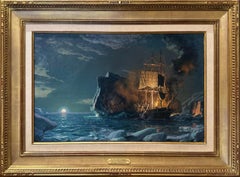
The Bark "Black Eagle" cutting in at Chesterfield Inlet
By John Stobart
Located in Naples, Florida
The Bark 'Black Eagle' cutting in at Chesterfield Inlet
Category
Early 20th Century John Stobart Art
Materials
Oil
The Bark "Black Eagle" cutting in at Chesterfield Inlet
By John Stobart
Located in Naples, Florida
The Bark 'Black Eagle' cutting in at Chesterfield Inlet
Oil
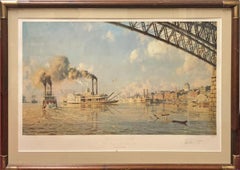
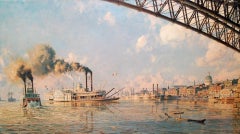
St. Louis, Gateway to the West
By John Stobart
Located in Missouri, MO
John Stobart "St. Louis, Gateway to the West" Color Lithograph 30 x 42 inches framed Signed in Pencil and Numbered 434/750
Lithograph
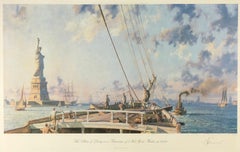
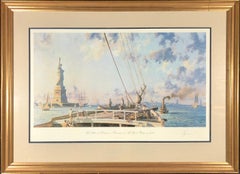
The Statue of Liberty in a Panorama of New York City in 1886
By John Stobart
Located in Missouri, MO
John Stobart "The Statue of Liberty in a Panorama of New York City in 1886" Color Lithograph approx 32 x 43 inches framed Signed in Pencil and Numbered 914/950 A marine painter of ...
Lithograph

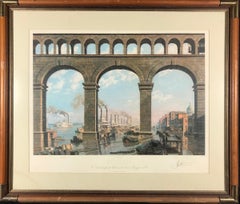
A View of St. Louis
By John Stobart
Located in Missouri, MO
John Stobart "St. Louis, A View Through the Arches of the Eads Bridge" 1979 Color Lithograph 32.5 x 37.5 inches framed Signed in Pencil and Numbered 221/75...
Lithograph
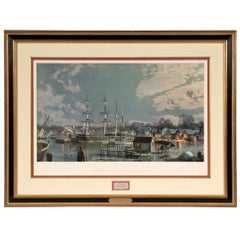
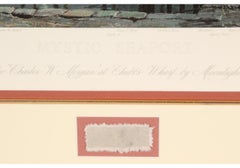
J. Stobart Lithograph "Mystic Seaport. "The Charles L. Morgan" at Chubb's Wharf
By John Stobart
Located in Bridgeport, CT
Marked mystic seaport Member's Edition #136/736 on the frame's plaque. Celebrating the 150th anniversary of the ship. Includes a framed swatch of the sh...
Wood
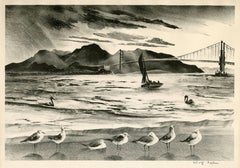
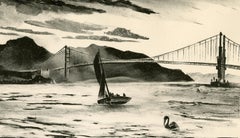
The Golden Gate
By Adolf Arthur Dehn
Located in Fairlawn, OH
The Golden Gate Lithograph on wove paper watermarked GC, 1940 Signed in pencil by the artist (see photo) Publisher: Associated American Artists Edition: 189, unnumbered The image depicts The Golden Gate Bridge which connects San Francisco and Marin County, California References And Exhibitions: Illustrated: Adams, The Sensuous Life of Adolf Dehn, Fig. 13.17, page 324 Reference: L & O 325 AAA Index 391 Adolf Dehn, American Watercolorist and Printmaker, 1895-1968 Adolf Dehn was an artist who achieved extraordinary artistic heights, but in a very particular artistic sphere—not so much in oil painting as in watercolor and lithography. Long recognized as a master by serious print collectors, he is gradually gaining recognition as a notable and influential figure in the overall history of American art. In the 19th century, with the invention of the rotary press, which made possible enormous print runs, and the development of the popular, mass-market magazines, newspaper and magazine illustration developed into an artistic realm of its own, often surprisingly divorced from the world of museums and art exhibitions, and today remains surprisingly overlooked by most art historians. Dehn in many regards was an outgrowth of this world, although in an unusual way, since as a young man he produced most of his illustrative work not for popular magazines, such as The Saturday Evening Post, but rather for radical journals, such as The Masses or The Liberator, or artistic “little magazines” such as The Dial. This background established the foundation of his outlook, and led later to his unique and distinctive contribution to American graphic art. If there’s a distinctive quality to his work, it was his skill in introducing unusual tonal and textural effects into his work, particularly in printmaking but also in watercolor. Jackson Pollock seems to have been one of many notable artists who were influenced by his techniques. Early Years, 1895-1922 For an artist largely remembered for scenes of Vienna and Paris, Adolf Dehn’s background was a surprising one. Born in Waterville, Minnesota, on November 22, 1895, Dehn was the descendent of farmers who had emigrated from Germany and homesteaded in the region, initially in a one-room log cabin with a dirt floor. Adolf’s father, Arthur Clark Dehn, was a hunter and trapper who took pride that he had no boss but himself, and who had little use for art. Indeed, during Adolf’s boyhood the walls of his bedroom and the space under his bed were filled with the pelts of mink, muskrats and skunks that his father had killed, skinned and stretched on drying boards. It was Adolf’s mother, Emilie Haas Dehn, a faithful member of the German Lutheran Evangelical Church, who encouraged his interest in art, which became apparent early in childhood. Both parents were ardent socialists, and supporters of Eugene Debs. In many ways Dehn’s later artistic achievement was clearly a reaction against the grinding rural poverty of his childhood. After graduating from high school in 1914 at the age of 19—an age not unusual in farming communities at the time, where school attendance was often irregular—Dehn attended the Minneapolis School of Art from 1914 to 1917, whose character followed strongly reflected that of its director, Munich-trained Robert Kohler, an artistic conservative but a social radical. There Dehn joined a group of students who went on to nationally significant careers, including Wanda Gag (later author of best-selling children’s books); John Flanagan (a sculptor notable for his use of direct carving) Harry Gottlieb (a notable social realist and member of the Woodstock Art Colony), Elizabeth Olds (a printmaker and administrator for the WPA), Arnold Blanch (landscape, still-life and figure painter, and member of the Woodstock group), Lucille Lunquist, later Lucille Blanch (also a gifted painter and founder of the Woodstock art colony), and Johan Egilrud (who stayed in Minneapolis and became a journalist and poet). Adolf became particularly close to Wanda Gag (1893-1946), with whom he established an intense but platonic relationship. Two years older than he, Gag was the daughter of a Bohemian artist and decorator, Anton Gag, who had died in 1908. After her husband died, Wanda’s mother, Lizzi Gag, became a helpless invalid, so Wanda was entrusted with the task of raising and financially supporting her six younger siblings. This endowed her with toughness and an independent streak, but nonetheless, when she met Dehn, Wanda was Victorian and conventional in her artistic taste and social values. Dehn was more socially radical, and introduced her to radical ideas about politics and free love, as well as to socialist publications such as The Masses and The Appeal to Reason. Never very interested in oil painting, in Minneapolis Dehn focused on caricature and illustration--often of a humorous or politically radical character. In 1917 both Dehn and Wanda won scholarships to attend the Art Students League, and consequently, in the fall of that year both moved to New York. Dehn’s art education, however, ended in the summer of 1918, shortly after the United States entered World War I, when he was drafted to serve in the U. S. Army. Unwilling to fight, he applied for status as a conscientious objector, but was first imprisoned, then segregated in semi-imprisonment with other Pacifists, until the war ended. The abuse he suffered at this time may well explain his later withdrawal from taking political stands or making art of an overtly political nature. After his release from the army, Dehn returned to New York where he fell under the spell of the radical cartoonist Boardman Robinson and produced his first lithographs. He also finally consummated his sexual relationship with Wanda Gag. The Years in Europe: 1922-1929 In September of 1921, however, he abruptly departed for Europe, arriving in Paris and then moving on to Vienna. There in the winter of 1922 he fell in love with a Russian dancer, Mura Zipperovitch, ending his seven-year relationship with Wanda Gag. He and Mura were married in 1926. It was also in Vienna that he produced his first notable artistic work. Influenced by European artists such as Jules Pascin and Georg Grosz, Dehn began producing drawings of people in cafes, streets, and parks, which while mostly executed in his studio, were based on spontaneous life studies and have an expressive, sometimes almost childishly wandering quality of line. The mixture of sophistication and naiveté in these drawings was new to American audiences, as was the raciness of their subject matter, which often featured pleasure-seekers, prostitutes or scenes of sexual dalliance, presented with a strong element of caricature. Some of these drawings contain an element of social criticism, reminiscent of that found in the work of George Grosz, although Dehn’s work tended to focus on humorous commentary rather than savagely attacking his subjects or making a partisan political statement. Many Americans, including some who had originally been supporters of Dehn such as Boardman Robinson, were shocked by these European drawings, although George Grocz (who became a friend of the artist in this period) admired them, and recognized that Dehn could also bring a new vision to America subject matter. As he told Dehn: “You will do things in America which haven’t been done, which need to be done, which only you can do—as far at least as I know America.” A key factor in Dehn’s artistic evolution at this time was his association with Scofield Thayer...
Lithograph
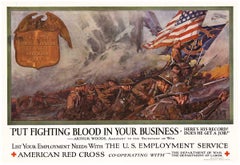
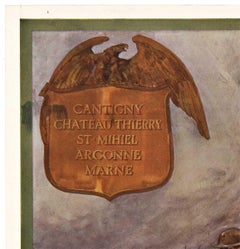
Put Fighting Blood in Your Business
Located in Spokane, WA
Original WW1 poster. Put Fighting Blood in Your Business. Here’s his record! Does he get a Job? Arthur Woods, Assistant to the Secretary of...
Lithograph
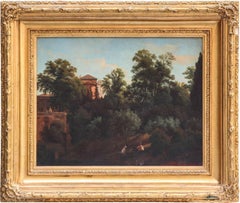
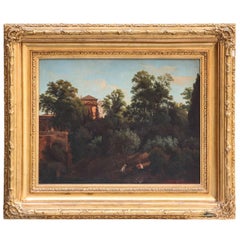
$5,353
H 25.6 in W 30.71 in D 1.97 in
19th Century Roman Landscape oil on canvas with Giltwood Frame
Located in Rome, IT
Amaizing 19' century Roman landscape depicting a part of Villa Borghese with Trinità dei Monti. With a finely carved gilt wood coeval frame. Measurements with frame cm 65 x78 wit...
Oil
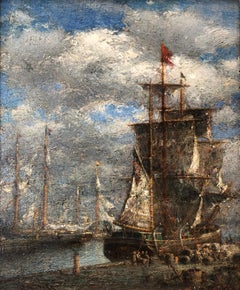
Home Safe
By James Gale Tyler
Located in Greenville, DE
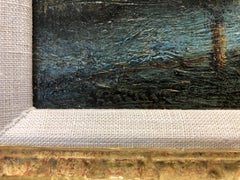
Very well executed seascape. Alternate title "In Point" inscribed on the rear. 17 x 15in in frame, including linen liner. ...
Oil, Board
$4,163
H 20.08 in W 28.75 in D 1.19 in
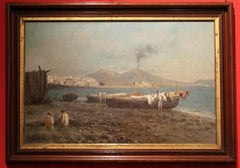
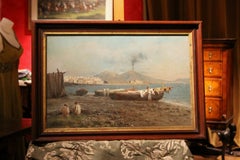
Italian Impressionist Oil on Board Marine Landscape Painting Naples Bay View
By Francesco Coppola Castaldo
Located in Firenze, IT
Everyday fishermen life is captured in this wonderful Italian impressionist late 19th century oil painting on thin board titled fishermen ashore. We love the neutral and natural colo...
Oil, Board
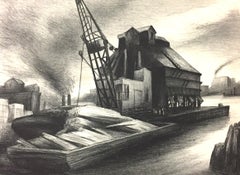
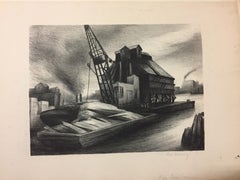
Ann Nooney, (Loading the Lumber Barge, NYC)
By Ann Nooney
Located in New York, NY
The dimensions are for the image. There are large margins. Signed in pencil. A native New Yorker, Ann Nooney (1900-1970), recorded the urban scene while on the Works Progress Admini...
Lithograph

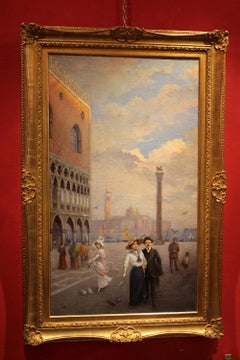
$8,475Sale Price|25% Off
H 51.19 in W 33.47 in D 1.19 in
Venice Landscape Italian Oil on Canvas Painting in Gilt Wood Frame, Belle Epoque
Located in Firenze, IT
This delightful turn of the century (early 20th century) oil on canvas painting represents an Italian landscape with one of the most famous squares in the world: Piazza San Marco in ...
Canvas, Oil
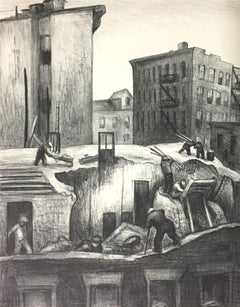
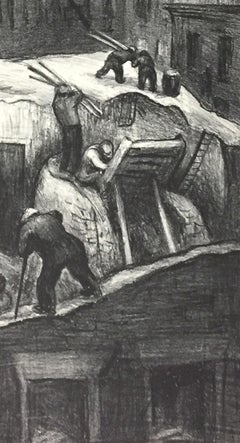
Ann Nooney, (Demolition with Windows, NYC)
By Ann Nooney
Located in New York, NY
The dimensions are for the image; there are large margins. This lithograph is signed in pencil. A native New Yorker, Ann Nooney (1900-1970) recorded the urban scene while on the Wo...
Lithograph
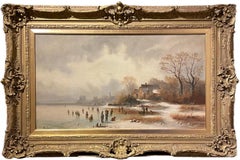
$3,381Sale Price|50% Off
H 32 in W 48 in D 6 in
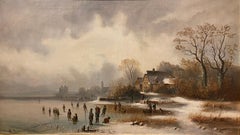
Oil Painting "Winter Skating Scene" by Anton Doll (1826-1877)
Located in Uppingham, GB
Oil Painting, Landscape "Winter Skating Scene" by Anton Doll (1826-1877) ...
Oil
$620Sale Price|20% Off
H 30 in W 20 in D 0.05 in
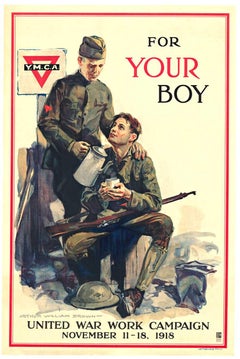
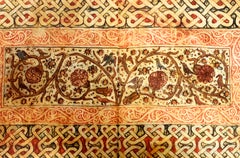
Original "For Your Boy, YMCA, vintage WW1 1918 poster
By Arthur William Brown
Located in Spokane, WA
Original. YMCA for Your Boy. Acid-free original vintage poster in excellent condition with archival linen backing, ready to frame. Certificate o...
Lithograph
$125
H 11 in W 8.75 in D 1 in
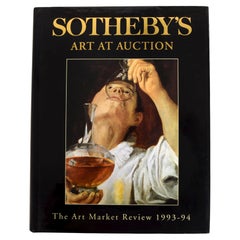
Sotheby's Art at Auction, the Art Market in Review 1993-94 by Sotheby's, 1st Ed
By Sotheby's
Located in valatie, NY
Sotheby's Art at Auction - The Art Market in Review 1993-1994 by Sotheby's. Hightlights: "The Property of a Lady" by Ian Fleming a James Bond short story (commissioned by Sotheby's in 1963), Klimt (Dame mit Facher), David Smith (Cubi V), Harry Winston diamond necklace...
Paper
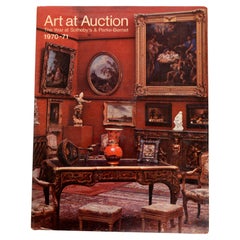
Art at Auction The Year at Sotheby's & Parke-Bernet 1970-71, 1st Ed
Located in valatie, NY
Art at Auction: The Year at Sotheby's & Parke-Bernet 1970-71. By Philip and Annamaria MacDonald. Viking Press, NY, 1970. Numerous color photos of important lots from all of Sotheby's...
Paper
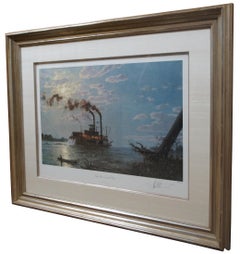
Sold
H 26 in W 1 in D 33 in
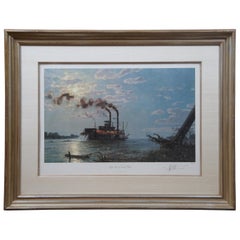
John Stobart Night Run to Friar’s Point Signed Lithograph River Boat Landscape
By John Stobart
Located in Dayton, OH
"1981 lithograph print of “Night Run to Friars Point” by John Stobart, pencil signed and numbered 465/750, published by Maritime Heritage Prints, Inc. “A marine painter of harbor sce...
Paper
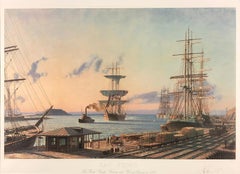
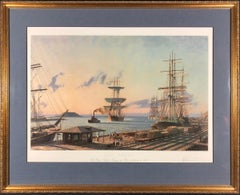
San Pedro, The Bark "Vidette" Towing into Port at Sunrise, 1890
By John Stobart
Located in Missouri, MO
John Stobart "San Pedro, The Bark 'Vidette' Towing into Port at Sunrise, 1890" Color Lithograph Approx. 33 x 41 Framed Signed in Pencil and Numbered 463/750 ...
Lithograph
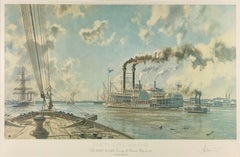
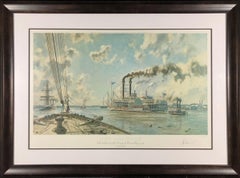
New Orleans - Robert E. Lee Leaving the Crescent City in 1880
By John Stobart
Located in Missouri, MO
John Stobart "New Orleans - Robert E. Lee Leaving the Crescent City in 1880" Color Lithograph 33 x 45 inches famed Signed in Pencil and Numbered 642/750 A marine painter of harbor ...
Lithograph
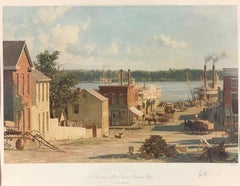

Hannibal - View from Mark Twain's Boyhood Home
By John Stobart
Located in Missouri, MO
John Stobart "Hannibal - A View from Mark Twain's Boyhood Home" Color Lithograph Signed in Pencil and Numbered 582/750 A marine painter of harbor scenes and ship portraits, John Sto...
Lithograph

Sold
H 25.5 in W 30 in D 1 in
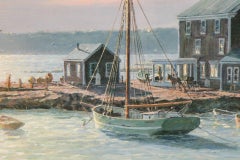
John Stobart Colored Lithograph "Sunset over the Westport River in 1862"
By John Stobart
Located in Bridgeport, CT
Signed and dated 1996, in plate lower left, pencil signed and numbered 169/500 lower right margin. Published by maritime heritage prints. Sight measurement: 18 by 24...
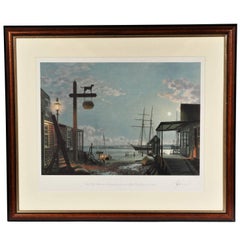
John Stobart Lithograph "Vineyard Haven, Black Dog Tavern, 1984"
By John Stobart
Located in Bridgeport, CT
John Stobart colored lithograph entitled 'Vineyard Haven. The Topsil Schooner Shenandoah from the black dog Tavern in 1984.' Signed and dated 1984 in plate lower right, pencil signe...