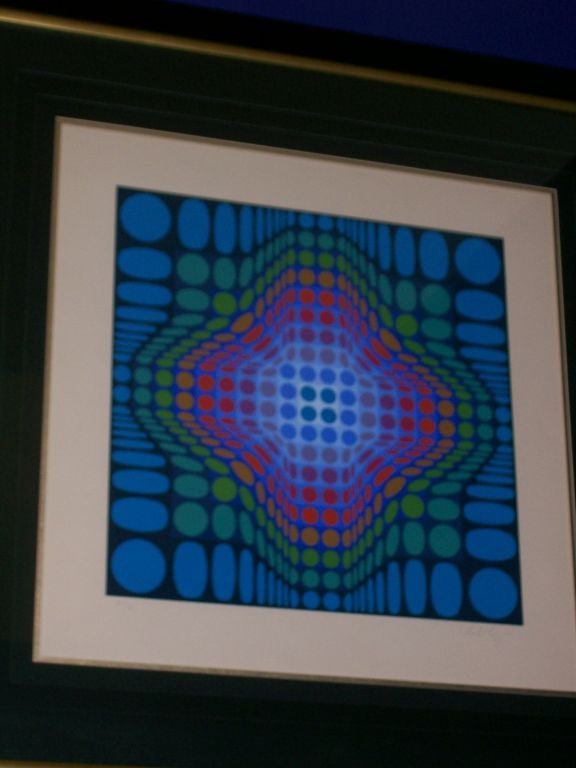
Victor Vasarely Furniture

French, Hungarian, 1906-1997

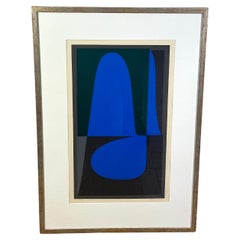
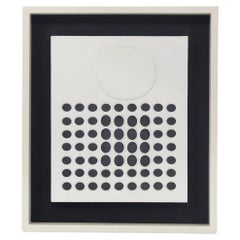
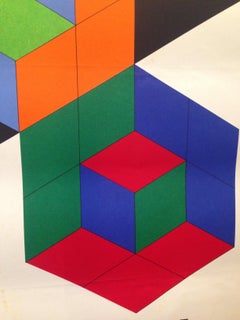
Widely considered the grandfather of Op art, the French-Hungarian painter Victor Vasarely (1906–97) created eye-popping geometric abstractions that play with the viewer’s perception of depth, perspective and motion. A classic example is the 1937 Zebra, which consists of undulating black and white stripes that suggest the form of the titular animal through optical trickery. The work is often credited as the earliest Op art painting.

Such illusions were more than pleasing tricks for Vasarely, who insisted that “pure form and pure color can signify the world.” He wanted to “democratize” art by producing works in large editions at reasonable prices that were understandable across national and cultural boundaries. In the 1960s, he developed an alphabet plastique, or fine art alphabet, consisting of elementary visual building blocks that could be used in endless combinations to create original compositions. By employing this universal visual vocabulary and stripping away topical references, he sought to create what he called a “Planetary Folklore.”

Embodying Vasarely’s singular belief that art should serve a social function, accessible to all, these innovations may perhaps be his greatest contribution to 20th-century art.

Find a collection of Victor Vasarely prints, paintings, sculptures and other art on 1stDibs.

to
8
43
27
71
28
12
1
1
70
23
45
2
12
32
8
47
14
11
10
6
52
36
10
10
4
71
71
71
244
13,046
3,894
2,679
2,252
Creator: Victor Vasarely
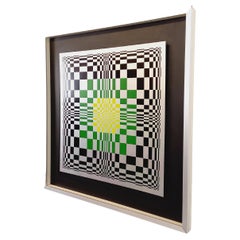
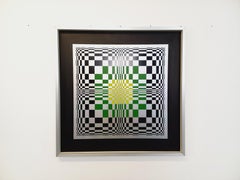
1970s VASARELY "Live and let live love and let love" Rosenthal Framed Plate

1970s VASARELY "Live and let live love and let love" Rosenthal Framed Plate

By Victor Vasarely, Rosenthal

Located in Moreno Valley, CA

1970s VICTOR VASARELY "Live and let live love and let love". Rosenthal collectible framed German plate. Victor Vasarely Rosenthal Studio Line Limited Edition Porcelain Plate. By Vasarely born 1936. "Leben und Leben lassen, Lieben und Lieben lassen" "Live and let live - love and let love". Limited edition, signed and numbered. Plate is in good condition, size is 12". Frame is not in good condition, white became yellowish shows wear. Victor Vasarely, born as Győző Vásárhelyi on April 9, 1906, in Pécs, Hungary, was a Hungarian-French artist widely regarded as the "father of Op Art" (Optical Art). He is known for his pioneering work in geometric abstraction and the use of optical illusions to create visually captivating and dynamic artworks. Vasarely's early career involved studying medicine in Budapest, but he later decided to pursue his passion for art and enrolled in the Műhely (Workshop) academy in Hungary. He initially experimented with various styles, including Impressionism and Post-Impressionism, but his interest in geometric abstraction grew stronger over time. In the 1930s, Vasarely moved to Paris, where he continued to explore geometric patterns, lines, and shapes in his art. He believed that art should not merely imitate nature but should create its own language of forms and colors to engage the viewer's perception actively. This philosophy led to the development of Op Art, a movement that emerged in the 1960s and focused on creating optical illusions and visual effects through precise geometric patterns and colors. Vasarely's artworks often featured meticulously arranged geometric shapes, giving the impression of movement and three-dimensionality. He employed various optical tricks, such as the juxtaposition of contrasting colors and the use of repetition, to create an illusion of depth and visual dynamism. His artworks can evoke a sense of visual vibration and often challenge the viewer's perception. Throughout his career, Vasarely's influence extended beyond the art world. He believed in the democratization of art and wanted to make art accessible to a wider audience. He embraced mass production techniques, creating what he called "multiple originals" or "serigraphs" (a form of screen printing). These serigraphs allowed him to produce multiple copies of his artworks at affordable prices, making them more accessible to art enthusiasts. Vasarely's artistic legacy continues to be celebrated around the world. His work has been exhibited in numerous galleries and museums, and he remains an influential figure in the fields of Op Art and abstract geometric art. He passed away on March 15, 1997, in Paris, leaving behind a vast body of work that continues to captivate audiences and inspire artists to this day. About Rosenthal: German porcelain manufactory Rosenthal was originally founded as a ceramics-painting studio by Philipp Rosenthal Sr. (1855-1937) in 1879 at Schloss Erkersreuth in Bavaria, near the Czech border. Its first highly popular product was an ashtray inscribed with the words “Resting place for lit cigars.” In 1890, the company moved to the neighboring hamlet of Selb and, a year later, began to manufacture its own porcelain, since white porcelain was, at that time, in short supply. Rosenthal’s first complete table service was called Empire; it was exhibited along with other lines at Paris’s Exposition Universelle in 1900. With the dawn of the 20th century, Rosenthal began producing porcelain tableware and services formed and decorated in the latest styles, like the Jugendstil Botticelli (1903), the Art Nouveau Darmstadt (1905), and the all-white Maria (1916) lines. Successes with this au courant approach led the company to launch an art pottery division in 1910, dedicated to luxury tableware, vases, and other decorative objects. By the 1930s, figurines were another important Rosenthal product, most notably the Disney-licensed Mickey Mouse pieces introduced in 1931. In 1934, Philipp Rosenthal was forced to leave his company and country when his Jewish ancestry came under persecution by the Nazi regime. Despite the loss of its founder, the Rosenthal company remained the premier supplier of high-quality porcelain tableware to the Third Reich. After the war, in 1950, Philip Rosenthal Jr. (1916-2001) joined his father's company as an advertising manager. By 1958, he had become its CEO, continuing his father’s vision to produce high-quality porcelain in line with progressive tastes. Through the rest of the 20th century, Rosenthal was the most commercially successful porcelain producer in Germany. In the postwar era, Rosenthal’s most famous tableware lines have included 2000 by Raymond Loewy and Richard Latham (1954), Magic Flute by Bjørn Wiinblad (1959), Suomi by Timo Sarpaneva (1976), and Moon by Jasper Morrison (1997). The company has enjoyed many popular and critically acclaimed collaborations with designers and brands, like Salvador Dalì, Tapio Wirkkala, Walter Gropius, Andy Warhol, Ron Arad, Enzo Mari, Konstantin Grcic, and Versace. Rosenthal's product lines have encompassed more than ceramics over the years. In 1972, the company began producing furniture, under the subsidiary Rosenthal Einrichtung, in Espelkamp, Germany. Standouts from this arm of Rosenthal include Gunter Ferdinand Ris and Herbert Selldorf’s futuristic Sunball Lounge Chair (1969), Verner Panton’s Relaxer Rocking Chair (1974), Burchard Vogtherr's Vario Pillo...

Category

Late 20th Century German Post-Modern Victor Vasarely Furniture

Materials

Porcelain

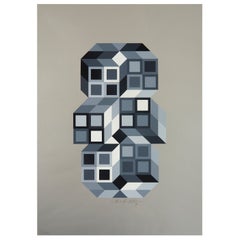
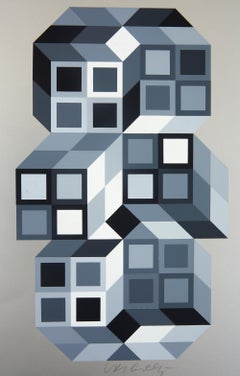
Victor Vasarely, Serigraph "Composition Silver", 1980

Victor Vasarely, Serigraph "Composition Silver", 1980

By Victor Vasarely

Located in Renens, CH

Artist: Victor Vasarely Title: Composition Silver Year: 1980 Edition: Edition of 100. Dimensions : 31,8 cm x 44.8 cm Signed and numbered 32/100 in pencil. Screenprint on paper...

Category

1980s French Modern Vintage Victor Vasarely Furniture

Materials

Paper

Victor Vasarely, Serigraph "Cosca II", 1982

Victor Vasarely, Serigraph "Cosca II", 1982

By Victor Vasarely

Located in Renens, CH

Victor Vasarely, serigraph "Cosca II", 1982 Title: Cosca II Year: 1982 Reference: Benavides/Vasarely (Online Catalogue Raisonné): 933 Dimensions : 61,3 cm x 68 cm Signed and num...

Category

1980s French Vintage Victor Vasarely Furniture

Materials

Paper

Victor Vasarely, Space age Op art metal tray, Limited ed. Metalgraf Italy 1970s

Victor Vasarely, Space age Op art metal tray, Limited ed. Metalgraf Italy 1970s

By Victor Vasarely

Located in Firenze, IT

Space age Op art metal tray Victor Vasarely, Metalgraf for Italsider Italy 1970s Limited edition Metal H 2 cm - 45 × 45 cm Conditions: very good consistent with age and use.

Category

1970s Italian Space Age Vintage Victor Vasarely Furniture

Materials

Metal

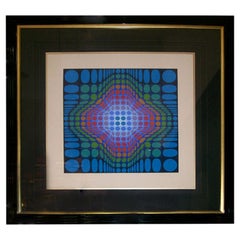
Victor Vasarely 1976 “Koskota” Silkscreen Screenprint Signed and Numbered

Victor Vasarely 1976 “Koskota” Silkscreen Screenprint Signed and Numbered

By Victor Vasarely

Located in Palm Springs, CA

A wonderful newly framed screenprint silkscreen by the Pop art master Victor Vasarely. This one is titled “Koskota” and dates from the 1976. It is pencil signed lower right and numbe...

Category

1970s American Vintage Victor Vasarely Furniture

Materials

Paper

Victor Vasarely "Hexa 5" Serigraph 160/200, Sonora Collage Collection

Victor Vasarely "Hexa 5" Serigraph 160/200, Sonora Collage Collection

By Victor Vasarely

Located in Toledo, OH

Victor Vasarely "Hexa 5" Serigraph 160/200, Sonora Collage Collection. Circa 1987. Victor Vasarely (French/Hungarian 1906-1997), Op Art Movement, Mixed Media Innovations in color and...

Category

Mid-20th Century Victor Vasarely Furniture

Materials

Paper

Victor Vasarely Framed Porcelain Wall Sculpture for Rosenthal 1964

Victor Vasarely Framed Porcelain Wall Sculpture for Rosenthal 1964

By Victor Vasarely

Located in Pawtucket, RI

Rarely seen Op Art wall sculpture by Victor Vasarely for Rosenthal. Porcelain relief panel in felt lined frame, limited number 7 of an edition of 50. Edition card attached on reverse...

Category

1960s German Mid-Century Modern Vintage Victor Vasarely Furniture

Materials

Porcelain

Victor Vasarely, screenprint "Granat", 1966. Portfolio Lapidaire

Victor Vasarely, screenprint "Granat", 1966. Portfolio Lapidaire

By Victor Vasarely, Denise René

Located in Renens, CH

Artist: Victor Vasarely Title: "Granat" Silksreen, 1966 Handsigned by the artist in pencil and numbered 79/150 Publisher : Denise Renè, Paris Printer : Ateliers Arcay A leading pione...

Category

1960s French Mid-Century Modern Vintage Victor Vasarely Furniture

Materials

Paper

Beryl négatif
Beryl négatif

Beryl négatif

By Victor Vasarely

Located in Paris, FR

Edition : 47/50 Publisher : Denise René, Paris Catalog : [Benavides Vol. II 1893] 36.00 cm. x 36.00 cm. 14.17 in. x 14.17 in. (image) Titled, annotated and signed on the back Sl...

Category

1960s French Kinetic Vintage Victor Vasarely Furniture

Materials

Wood

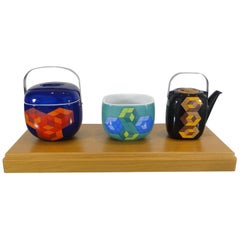
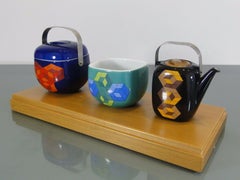
Vasarely Three-Part Miniature Crockery on a Wooden Tray, 1976

Vasarely Three-Part Miniature Crockery on a Wooden Tray, 1976

By Victor Vasarely

Located in Saint-Didier, Provence-Alpes-Côte d'Azur

Vasarely Three-part miniature crockery on a wooden tray Artists: Victor Vasarely, Timo Sarpaneva, 1976 Manufacturer: Rosenthal, Selb 25th Anniversary Special Edition White ename...

Category

1970s French Vintage Victor Vasarely Furniture

Materials

Wood

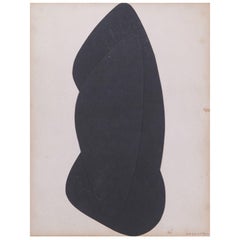
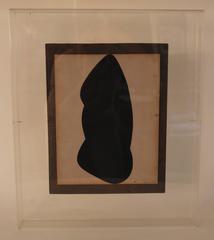
Victor Vasarely, Dolmen 1947-1950 Collage on Cardboard on Wood

Victor Vasarely, Dolmen 1947-1950 Collage on Cardboard on Wood

By Victor Vasarely

Located in Nice, Cote d' Azur

Victor Vasarely (1906-1997), Dolmen 1947-1950 collage on cardboard on wood, signed lower right, dated and titled on the reverse, photo certificate by Pierre Vasarely. Height: 35 cm, ...

Category

1940s French Mid-Century Modern Vintage Victor Vasarely Furniture

Materials

Wood, Paint

Victor Vasarely furniture for sale on 1stDibs.

Victor Vasarely furniture are available for sale on 1stDibs. These distinctive items are frequently made of paper and are designed with extraordinary care. There are many options to choose from in our collection of Victor Vasarely furniture, although gray editions of this piece are particularly popular. Many of the original furniture by Victor Vasarely were created in the mid-century modern style in europe during the 20th century. If you’re looking for additional options, many customers also consider furniture by Man Ray, Marcel Duchamp, and Bernard Buffet. Prices for Victor Vasarely furniture can differ depending upon size, time period and other attributes — on 1stDibs, these items begin at $349 and can go as high as $45,000, while a piece like these, on average, fetch $3,410.
Questions About Victor Vasarely Furniture
  • 1stDibs ExpertOctober 30, 2024
    What a serigraph is worth depends on its age, maker, style, image quality, availability and overall condition. Pieces produced by well-known artists, such as Andy Warhol, Sister Mary Corita Kent, Pablo Picasso, Peter Max, LeRoy Neiman, Igor Medvedev, Romero Britto and Itzchak Tarkay, may have significant value. For example, Warhol's “Marilyn” serigraphs have sold for between $3 and $5 million at auctions. If you'd like to get a professional opinion on the potential value of any serigraphs in your collection, a certified appraiser or knowledgeable art dealer can help you. On 1stDibs, explore a variety of serigraphs.
  • 1stDibs ExpertMarch 22, 2022
    Victor Vasarely was originally from Hungary. He was born in Pécs on April 9, 1906. His family moved to Piešťany, Slovakia, during his childhood, and he attended medical and art schools in Budapest, Hungary. In 1930, Vasarely relocated to Paris, France, and lived there until his death on March 15, 1997. On 1stDibs, find a variety of Victor Vasarely art.
  • 1stDibs ExpertMarch 22, 2022
    Victor Vasarely was a Hungarian-French artist best known for his Op art. By combining principles of geometry with artistic techniques, he produced two-dimensional works with incredible depth. Some even seem to move on the canvas. Vasarely also made sculptures, collages and decorative accents. On 1stDibs, shop a variety of Victor Vasarely art.
  • 1stDibs ExpertApril 5, 2022
    Victor Vasarely's famous painting Zebra is on display at the Pompidou Centre in Paris, France. He painted the piece in 1937. You can see elements of the Op art style that Vasarely would later become famous for taking shape in the painting. On 1stDibs, find a range of Victor Vasarely art.
  • 1stDibs ExpertMarch 22, 2022
    Many things inspired Victor Vasarely over the course of his life. The color theory of Josef Albers, and the Constructivist methods of Wassily Kandinsky greatly influenced his work. He also found inspiration in the geometry of the natural world, particularly in the landscapes of Breton Beach of Belle Isle in France. On 1stDibs, find a selection of Victor Vasarely art.
  • 1stDibs ExpertFebruary 13, 2024
    One key fact about Victor Vasarely is that he is considered the grandfather of Op art due to his eye-popping geometric abstractions that play with the viewer’s perception of depth, perspective and motion. He was born in Pécs, Austria-Hungary, on April 9, 1906, and began studying medicine at the Eötvös Loránd University in 1925 with the hope of one day becoming a doctor. Two years later, he shifted gears and enrolled in a painting course at the Podolini-Volkmann Academy. In the 1960s, he developed an alphabet plastique, or fine art alphabet, consisting of elementary visual building blocks that could be used in endless combinations to create original compositions. One final fact is that both Hungary and France have issued postage stamps featuring his artwork. On 1stDibs, explore a range of Victor Vasarely art.
  • 1stDibs ExpertMarch 22, 2022
    To pronounce Victor Vasarely, say "VIK-tr va-sr-EH-lee." His first name and surname are Hungarian. The artist, known as one of the pioneers of Op art, was born in Pécs, Hungary, on April 9, 1906. Find a variety of Victor Vasarely art on 1stDibs.
  • 1stDibs ExpertMarch 22, 2022
    Victor Vasarely was born in Pécs, Hungary, on April 9, 1906. Over the course of his life, he lived in Piešťany, Slovakia; Budapest, Hungary; and Paris, France. He died in Paris on March 15, 1997. On 1stDibs, find a selection of Victor Vasarely art.
  • 1stDibs ExpertFebruary 1, 2024
    Victor Vasarely is best known for producing sculptures and paintings with a grid-like appearance. The Hungarian-French artist first began to create these works in 1960, aiming to play with how viewers perceive depth and form. These works demonstrated that kinetic art could be two-dimensional and evoke a sense of movement despite remaining stationary. On 1stDibs, find a selection of Victor Vasarely art.
  • 1stDibs ExpertFebruary 21, 2024
    The name of one of the most well-known artworks by Victor Vasarely is Zebra. He produced the piece in 1937, and it depicts two zebras with bold black stripes that seem to undulate before the eye. Other acclaimed works by the Hungarian-French artist include Vega-Nor, Tekers MC, Keple-Gestalt, The Chess Board, Vonal-Stri, Vega 200 and Orion Gris. Explore a collection of Victor Vasarely art on 1stDibs.
  • 1stDibs ExpertMarch 22, 2022
    Victor Vasarely used a variety of materials to produce his art. He painted with both oils and acrylics and usually used canvas as the base of his works. Many of his sculptures feature lucite and glass. On 1stDibs, find a collection of Victor Vasarely art.
  • 1stDibs ExpertMarch 22, 2022
    Many historians identify Zebras as Victor Vasarely's most famous piece. He painted the work in 1937. Some of his most famous Op art compositions include Tridim, Vega-Nor, Denfert and Cheyt-M. On 1stDibs, find a range of Victor Vasarely art.
  • 1stDibs ExpertMarch 22, 2022
    Yes, Victor Vasarely was an abstract artist. Specifically, he was a part of the Op art movement, which focused on depicting two-dimensional abstract images that appear three-dimensional. His best known works include Zebras, Tridim, Vega-Nor, Denfert and Cheyt-M. Find a collection of Victor Vasarely art on 1stDibs.
  • 1stDibs ExpertApril 5, 2024
    How Victor Vasarely created his art varied. For his paintings, the Op artist typically used canvas as a base, painstakingly adding geometric forms in oil and acrylic paint. When producing sculptures, Vasarely often used lucite and glass to give his works a feeling of depth and luminosity. On 1stDibs, find a variety of Victor Vasarely art.
  • 1stDibs ExpertApril 5, 2022
    Victor Vasarely was an artist, working in painting, sculptures and collages. His vibrant, geometric pieces earned him the nickname of ‘grandfather’ of the Op Art movement. Shop a selection of Victor Vasarely’s pieces from some of the world’s top art dealers on 1stDibs.
  • 1stDibs ExpertApril 22, 2024
    Here are some facts about Victor Vasarely's art. First, his work contributed to the development of Op art and consisted largely of eye-popping geometric abstractions that play with the viewer's perception of depth, perspective and motion. A classic example is the 1937 Zebra, which consists of undulating black and white stripes that suggest the form of the titular animal through optical trickery. The work is often credited as the earliest Op art painting. Vasarely wasn't just attempting to fool the eye; he wanted to "democratize" art by producing work in large editions at reasonable prices and with themes that were understandable across national and cultural boundaries. Also, Vasarely developed an alphabet plastique, or fine art alphabet, consisting of elementary visual building blocks that could be used in endless combinations to create original compositions. By employing this universal visual vocabulary and stripping away topical references, he sought to create what he called a "Planetary Folklore." On 1stDibs, shop a selection of Victor Vasarely art.
  • 1stDibs ExpertMarch 22, 2022
    The exact number of artworks produced by Victor Vasarely is unknown. However, references include more than 1,000 pieces attributed to the Hungarian-French artist. Vasarely shaped the Op art movement with pieces like Tridim, Vega-Noir and Cheyt-M. On 1stDibs, shop a selection of Victor Vasarely art.
  • 1stDibs ExpertApril 5, 2022
    Victor Vasarely made 44 works of art in his lifetime. The artist’s paintings fell into the Op-Art movement and his work entitled Zebra is considered one of the earliest examples of Op-Art. His paintings often focus on bold colors, shading, shapes and optical illusions. Shop a selection of Vasarely pieces from some of the world’s top art dealers on 1stDibs.
  • 1stDibs ExpertMarch 22, 2022
    Victor Vasarely produced Op art by employing principles of physics and geometry. He painted his works by hand with oils and acrylics on canvas in a way that made the images seem three-dimensional and capable of movement. On 1stDibs, shop a selection of Victor Vasarely art.
  • 1stDibs ExpertMarch 22, 2022
    The exact number of paintings Victor Vasarely painted is unknown. However, historians know of more than 1,000 works produced by the artist over the course of his life. In addition to paintings, he produced sculptures, collages and decorative objects. On 1stDibs, shop a range of Victor Vasarely art.
  • 1stDibs ExpertMarch 13, 2024
    There are many examples of Op art by Victor Vasarely, who is widely considered the grandfather of this art movement. A classic example is 1937’s Zebra, which has undulating black and white stripes that suggest the form of the titular animal through optical trickery. The work is often credited as the earliest Op art painting. Other Op art works by Vasarely include Vega-Nor, The Chess Board, Vonal-Stri and Keple-Gestalt. Shop a range of Victor Vasarely art on 1stDibs.