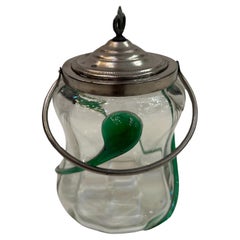
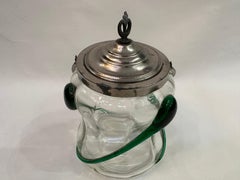
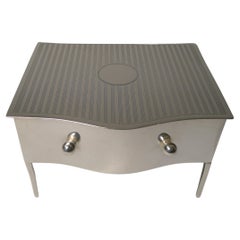
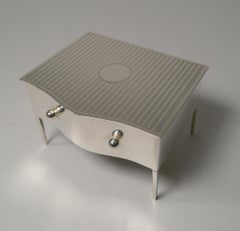
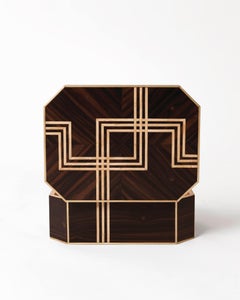
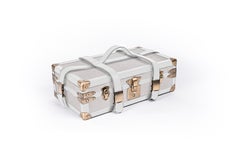
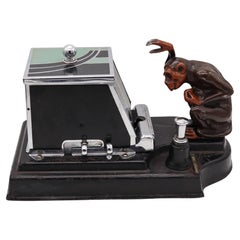
Desk cigar humidor designed by Erik Fleming (1894–1954) for Atelier Borgila.
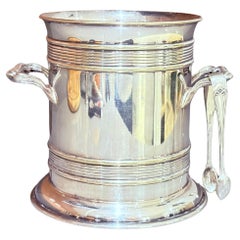
This is an extremely rare desk cigars humidor created in Stockholm Sweden by the Baron Erik Herman Fleming for the Atelier Borgila, back in 1941. The rare humidor has been masterfully hand crafted with faceted chamfered and art deco patterns in solid .925/.999 sterling silver with high polished finish. The elaborated lid depict the Swedish king's monogram of Gustav V, which implies that this piece was a kind of gift directly from the King of Sweden. It is fitted in the interior with a removable cigar holder and at the sides, with two hinged round handles. The interior's surfaces are completely lined up with cedarwood veneer. An exceptional museum quality piece with great Swedish craftmanship.
Erik Herman Fleming
He was a Swedish metalsmith, baron, teacher, and designer. He was one of the foremost Swedish silversmiths of his time, and worked as a Swedish court artisan. He was born on April 26, 1894, in Stockholm, to parents Sigrid Wilhelmina Amalia Söderhielm and Oscar Herman August Fleming. He attended the Althin's School of Painting in Stockholm from 1914 to 1915; and continued his studies in engineering at the Technische Universität Berlin from 1915 to 1917; and architecture at the University of Munich from 1917 to 1918. He learned silversmithing as a hobby initially, and enjoyed it enough to pursued further study under Anna Möcklin (who had worked for C. G. Hallberg and K. Andersson). In 1921, Fleming founded Atelier Borgila, a silver workshop and royal court supplier in Stockholm. C. F. Larsson was hired as the lead foreman for Atelier Borgila. Additionally Fleming taught metal arts at Konstfack in Stockholm, where he became head teacher of metal arts from 1947 until his death in 1954. He was the father of the silversmith Lars Fleming (1928–2025). Fleming's work is in the museum collection at the National-Museum in Stockholm, Sweden.
Atelier Borgila
This is a prestigious Swedish silversmithing workshop founded in Stockholm in the early 1920s by the baron and designer Erik Fleming (1894–1954). Considered the premier silver firm in Sweden during the mid-20th century, the workshop is renowned for its "Swedish Modern" style, characterized by simple elegance and minimalist decoration. Erik Fleming originally trained as an architect and engineer but became a silversmith almost by chance. He served as a purveyor to the Royal Court of Sweden. One of his most notable works was an 800-piece dinner service created in 1933—a wedding gift from the Swedish people to Prince Gustaf Adolf and his wife, Sibylla. In 1943, he organized the first exhibition of modern jewelry in Sweden, helping to launch the careers of many post-war artists. Following Erik's death in 1954, his son, Lars Peter Eriksson Fleming, continued the workshop's legacy. Over the decades, renowned designers and silversmiths worked for Atelier Borgila, including: Sigurd Persson: One of Sweden's most influential designers. Rey Urban, Birger Haglund, and Claes Giertta. Rikard Waterval: Known for avant-garde designs in the 1970s and 1990s.
Country: Stockholm, Sweden.
Period: Art-Deco, 1940-1941.
Designer: Erik Fleming (1894–1954) for Atelier Borgila.
Materials: Solid polished .925/.999 Sterling Silver and cedar wood veneers.
Weight: 1,106.65 Grams, (709.30 Dwt).
Measurements: H. 212.10 mm by L. 154.5 mm by 133.40 mm, (8.35 x 6.08 x 5.25 Inches).
Hallmarks: Stamped with Swedish royal marks; the maker's mark, the mark for the assay and warranty of the silver, the production date letter-code P8 for 1941 and signed in full as follows: "BORGILA S P8 STERLING".
Engraved: With a discrete dedication to the base that reads "Christer C. Skriver 2/17/1949 Fran Automobilindustrikommittkien.
Notes: Automobilindustrikommittkien refers to a Swedish committee, likely the Automotive Industry Committee, which commissioned a sterling silver Art Deco humidor...
Category
1940s Swedish Vintage Art Deco Decorative Objects
MaterialsSterling Silver, Silver