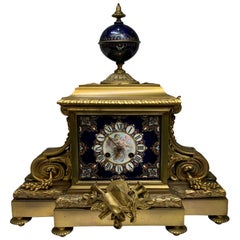
Empire mantel clock / French mantel clock, Flute player / Shepherd, Panpipes / Syrinx, Shepherd's crook, Tree stump, Musical instruments / Trophy, Mythology / Pastoral / Arcadia, Fire-gilt bronze / Ormolu, Patinated bronze, Two-tone / Ormolu and patinated bronze, Empire / Restauration (c. 1805–1820), France / Paris / French antique
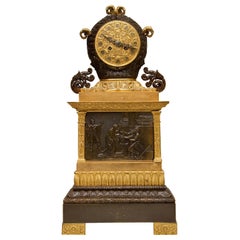
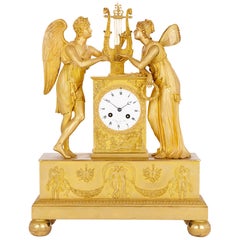
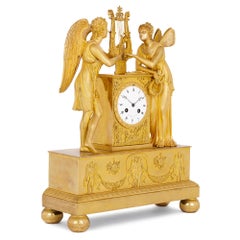
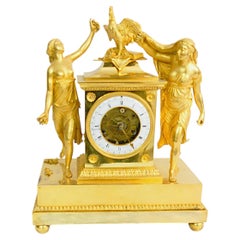
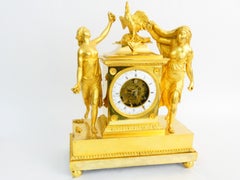
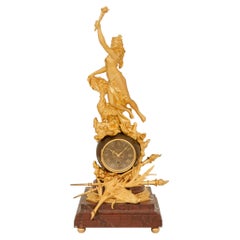
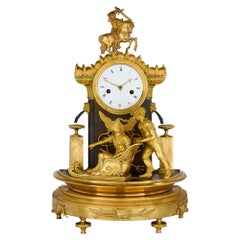
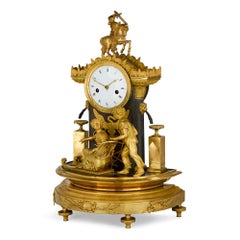
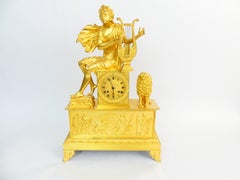
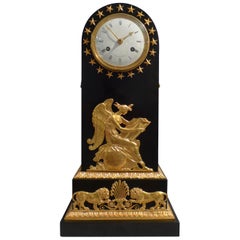
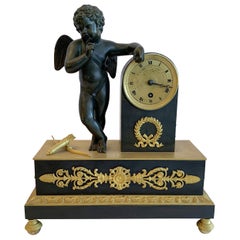
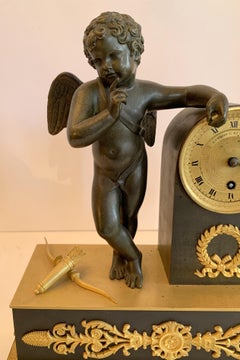
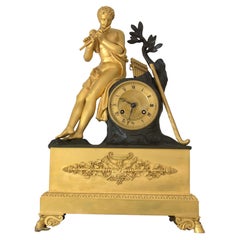
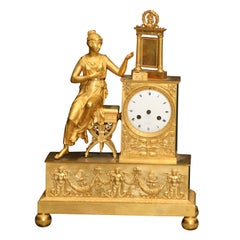
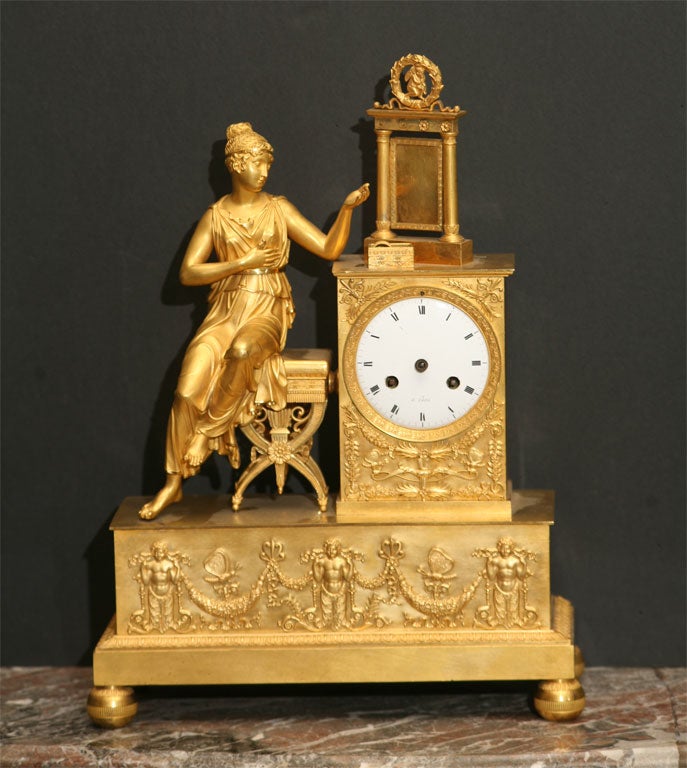
This French mantel clock (*pendule*) from the Empire period (c. 1805–1815) is distinguished by a classic bucolic-mythological motif.
Description & Stylistic Features
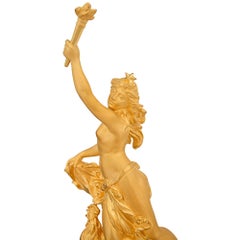
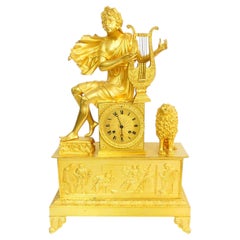
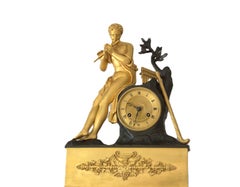
Motif: Depiction of a shepherd or youth playing the flute (possibly representing Daphnis, Pan, or Marsyas). He sits upon a dark-patinated tree stump into which the clock face is set.
Attributes: Beside the dial, a pan flute (syrinx) and a shepherd’s crook lean against a branch.
Materials & Technique: A combination of fire-gilded bronze (ormolu)—featuring the original matte and burnished gilding—and dark-patinated bronze for the tree trunk and branch.
Base: The rectangular gilded base features a fine appliqué depicting musical trophies, grapes, and cornucopiae. The base rests on sculptural feet shaped like goat hooves (faun legs).
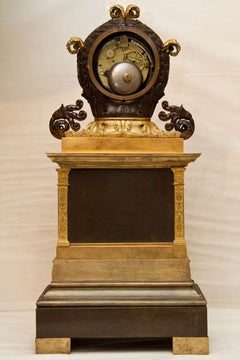
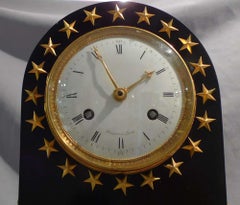
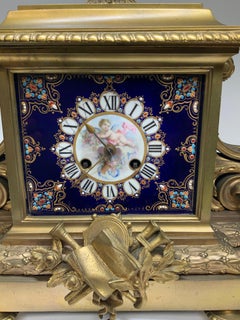
Dial & Movement: Gilded bronze dial with a guilloché center and Roman numerals. Two winding holes for the French pendulum movement, featuring silk-thread suspension and slide regulation.
Classification & Condition
Period: French Empire (reign of Napoleon I, c. 1805–1815).
Condition: Very fine historical gilding with slight signs of age/patina on the surface of the base. The contrast between the fire-gilded figure and the dark patina of the tree is characteristic of high-quality Parisian bronze work from this era.
This is an absolutely breathtaking piece! What you have before you is a classic French mantel clock from the Empire era (or the Restoration period), likely dating from the early to mid-19th century (approx. 1810–1830). These clocks are renowned for their first-class craftsmanship, combining precise timekeeping with exquisite, allegorical sculptures.The Figure: The gilded figure depicts a young man—presumably Apollo.
The Scene: He sits upon a dark, patinated bronze base shaped like a tree stump or a rock formation, into which the clock’s dial is set. The Details: To his left (to our right), a pan flute (Syrinx) can be discerned leaning against the tree, accompanied by a shepherd’s staff or walking stick. The Frieze: The gilded relief on the rectangular base features a beautiful composition of an antique-style urn, horns, ribbons, and grapevines, further underscoring the Bacchic or pastoral theme.
1. Clockmaker & Provenance (Movement & Signature)
Clockmaker: Havard
Location: Rouen (Normandy, France)
Classification: Havard was a clockmaker and goldsmith based in Rouen. During the Consulate and Empire periods (c. 1800–1815), renowned Parisian bronze foundries supplied fine cases to prominent clockmakers in the French provinces, who then completed the pieces with their own movements and signed dials.
2. Art Historical Classification (Style & Motif)
Period: French Empire / Reign of Napoleon I (c. 1805–1815).
Theme / Motif: Bucolic / pastoral-mythological depiction of a flute-playing shepherd (Daphnis or Attis/Pan theme).
Material/Execution: Fire-gilded bronze (ormolu) combined with brown/black patinated bronze (tree stump, foliage). Base featuring musical trophy appliqués and goat-hoof feet.
Standard literature and reference works for identifying French mantel clocks from this period:
Standard Reference Works
Elke Niehüser: *Die französische Bronzeuhr – Tabernakeluhr, Figuranduhr, Wanduhr, Cartel, Commode, Standuhr*. Callwey, Munich 1997. (The standard work on the typology and iconography of figurative Empire-style bronze clocks)
Hans Ottomeyer / Peter Pröschel: *Vergoldete Bronzen – Die Bronzen des Spätbarock und Klassizismus*. 2 volumes, Klinkhardt & Biermann, Munich 1986. (Reference work on Parisian bronze makers, fire gilding, the art of chasing, and casting models)
Jean-Dominique Augarde: *Les Ouvriers du Temps – La pendule française du Louis XIV à Napoléon Ier*. Antiquorum, Geneva 1996. (Comprehensive work on clockmakers, bronze casters, and manufacturing techniques)
Pierre Kjellberg: *Encyclopédie de la Pendule Française du Moyen Age au XIXe Siècle*. Éditions de l'Amateur, Paris 1997. (Chronological overview with numerous comparative illustrations)
Tardy (Henri-Léon Tardy): *Les Plus Belles Pendules Françaises*. Tardy, Paris. (Monumental standard work organized by period and motif)
Specialized Literature & Directories
Tardy: *Dictionnaire des Horlogers Français*. Tardy, Paris 1971–1972. (Reference work for identifying clockmaker signatures on dials or movements)
Gérard L'Épaux: *Pendules Empire...
Category
1810s French Antique Empire Decorative Objects