Located in San Francisco, CA
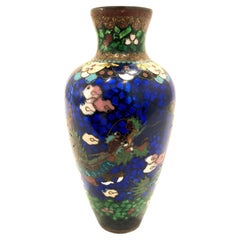
On offer is an antique Japanese cloisonné-on-brass cabinet vase, dating back to the late Meiji Period (circa 1870s–1890s) in Japanese decorative arts. It was likely made in early production centers such as Nagoya or Kyoto.
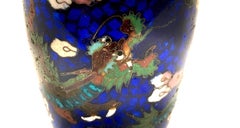
DESIGN: The central figure in this piece is a flying dragon. In Japanese mythology, the dragon is a benevolent, water-dwelling guardian associated with wisdom, good fortune, prosperity and rain. This dragon’s Japanese pedigree is confirmed by its three-clawed feet; traditional Chinese imperial dragons typically feature five claws.
COLORS: The dragon winds through stylized ruyi-shaped clouds and stylized floral blooms against a deep blue sky, representing its celestial flight. The deep cobalt blue evokes the night sky or the deep waters from which the dragon rules. Green and earth tones symbolize the natural, organic elements matching the grounding tree-bark motifs. Lastly, the white clouds emphasize purity and the spiritual realm.
TECHNIQUE: This piece is created using the traditional wire cloisonné technique on a solid brass base. The entire vessel was beaten or cast from a sheet of brass. The exposed, raw golden-brown metal on the flat underside of the base and the circular inner rim of the neck confirms its purely metallic construction.
An artisan then used fine brass ribbon wires (the “Cloisons”) meticulously shaping and soldering or gluing them directly to the outer brass walls to form distinct structural compartments. These partitioned brass cells were packed with layers of colored vitreous glass powder paste. The entire brass vessel was then repeatedly fired in a kiln at high temperatures, melting the paste into a glassy finish.
Next came the mosaic-like, fractured layout of the deep cobalt blue field, which mimics precious inlay work. This complex style was popularized by master Meiji enamellers like Gonda Hirosuke, who regularly produced specialized 6" x 3" dragon cabinet...
Category
Late 19th Century Japanese Meiji Antique Bay Area - Decorative Objects